
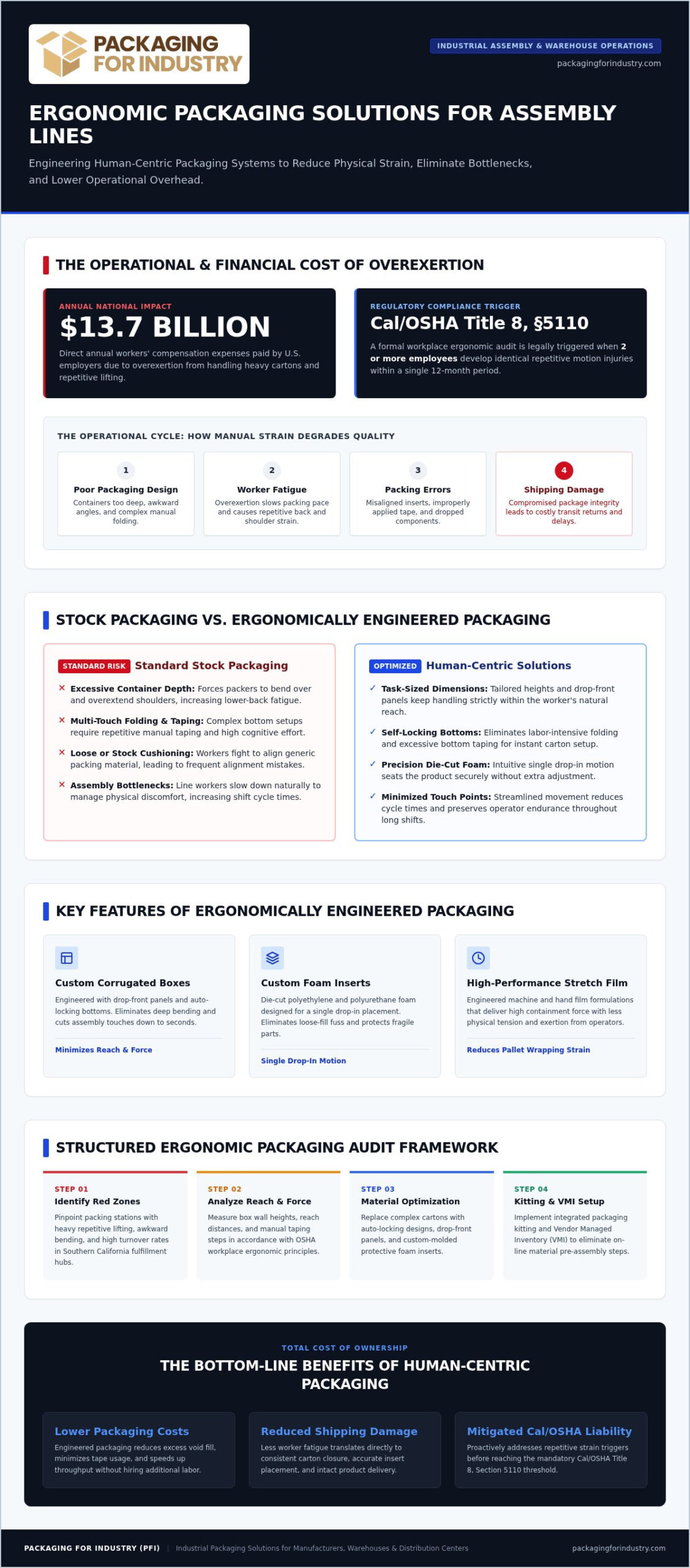
Did you know that overexertion from handling heavy cartons and repetitive lifting costs U.S. employers $13.7 billion annually in direct workers’ compensation expenses? For operations managers, these costs represent more than just financial loss; they signify skilled workers sidelined by repetitive motion injuries and assembly lines stalled by inefficient workflows. You’re likely already aware that a slow, awkward packing process is the primary bottleneck in your facility. Whether you’re sourcing packaging for manufacturers or specialized packaging for warehouses, implementing ergonomic packaging solutions for assembly lines is no longer just a safety initiative; it’s a critical strategy for maintaining operational flow and reliability.
We understand that your goal is to move product safely and quickly without skyrocketing labor costs. This guide will show you how engineered packaging design reduces worker strain, eliminates assembly bottlenecks, and lowers operational costs through smarter material usage. By choosing the right packaging for distribution centers and manufacturing floors, you can transform your packing stations into high-speed, low-risk environments. We’ll examine how custom corrugated boxes, precision protective foam, and high-performance stretch film protect both your people and your bottom line.
Key Takeaways
- Learn how reducing physical strain directly correlates to lower shipping damage rates and higher worker productivity across the manufacturing floor.
- Discover how custom corrugated boxes and die-cut foam inserts eliminate excessive reaching and simplify the packing process into a single drop-in motion.
- Understand the engineering behind choosing the right material grades and foam densities to balance heavy-duty protection with ease of handling for operators.
- Explore how implementing ergonomic packaging solutions for assembly lines through integrated kitting and VMI programs can significantly reduce labor-intensive assembly steps.
- Identify specific “red zones” in your facility with a structured ergonomic audit to target and eliminate the most fatiguing packing tasks.
The Impact of Ergonomic Packaging on Assembly Line Productivity
Implementing ergonomic packaging solutions for assembly lines is a deliberate strategy to reduce physical strain while optimizing the movements of your workforce. This approach ensures that the physical requirements of the packing process align with the natural capabilities of the human body. Simply put, ergonomic packaging is the intersection of material engineering and human kinesis. When a corrugated box supplier provides containers that are too deep or lack proper access points, workers are forced into awkward reaching and twisting postures. These manual material handling risk factors, such as those detailed in ergonomics for manual material handling, are often exacerbated by stock packaging that isn’t sized for the specific task at hand.
There is a direct correlation between worker fatigue and increased shipping damage rates. As a shift progresses, the physical exertion required to handle poorly designed packaging for warehouses leads to diminished precision. A tired worker is more likely to drop a component, misalign a custom foam insert, or fail to secure a closure properly. These errors don’t just slow down the line; they result in costly returns and compromised supply reliability. Facilities can lower packaging costs by addressing these inefficiencies at the source with engineered designs that support the operator’s natural range of motion.
The financial impact of Musculoskeletal Disorders (MSDs) on manufacturing overhead is substantial. In California, these risks carry significant regulatory weight. A formal ergonomic audit is legally triggered under Cal/OSHA Title 8, Section 5110 when two or more employees develop identical repetitive motion injuries within a 12-month period. By prioritizing ergonomic packaging solutions for assembly lines, businesses can proactively mitigate these liabilities while maintaining a steady production rhythm. When you compare packaging pricing, it’s vital to look beyond the per-unit cost and account for the potential savings in workers’ compensation and lost-time injuries.
The Hidden Costs of Non-Ergonomic Packaging
Repetitive strain injuries and worker downtime create significant assembly bottlenecks that standard financial reports often miss. When a packing station requires excessive force or awkward bending, throughput drops as workers naturally slow down to manage discomfort. This inefficiency contributes to high employee turnover rates, particularly in competitive Southern California warehouse hubs like Anaheim and Ontario. Replacing and training new staff further inflates operational costs and destabilizes lead times for critical packaging for manufacturers.
Improving Throughput with Human-Centric Design
Human-centric design focuses on reducing the number of “touches” required to pack a single unit. By using intuitive features like self-locking bottoms or drop-front panels, you eliminate the need for complex folding or excessive taping. This reduces the cognitive load on the line worker, allowing them to focus on speed and accuracy. Simplified assembly steps ensure that the packing process moves with the same efficiency as the rest of your production line, ultimately helping to reduce shipping damage and improve total cost of ownership.
Key Features of Ergonomically Engineered Packaging Solutions
While many facilities invest in adjustable workstations or lifting columns, the physical design of the packaging materials often remains a secondary thought. True ergonomic packaging solutions for assembly lines focus on the precise interaction between the worker and the container. By aligning with OSHA workplace ergonomics guidelines, these solutions prioritize engineering controls that minimize reach distance and force. Designing a box with the correct dimensions prevents the operator from overextending their lower back or shoulders, which are common sites for repetitive strain. When the package itself is engineered for the human body, the entire assembly process becomes more fluid and predictable.
Advanced Corrugated Box Designs
Custom corrugated boxes provide a significant advantage over stock sizes because they eliminate the need for excessive void fill and awkward reaching. For example, using a drop-front RSC or a shallow die-cut tray allows a packer to place components without leaning into a deep carton. While standard RSC boxes are functional, custom die-cut designs often include self-locking features that eliminate the need for repetitive taping. This reduces the “touches” per unit and prevents the wrist strain associated with manual tape dispensers. Heavy-duty double-wall boxes ensure the container remains stable on the conveyor, preventing the worker from having to steady a flimsy box while simultaneously loading product.
Custom Foam Inserts for Intuitive Assembly
Precision-engineered custom foam inserts transform the packing process into a simple, drop-in operation. Rather than prying apart generic foam sheets or wrapping items in bubble wrap, operators use pre-shaped cavities that guide the assembly. Multi-material assemblies can combine different foam densities to provide both structural support and soft cushioning in a single integrated piece. Including “easy-pull” tabs or finger relief notches allows for the safe removal of high-value components during kitting or quality checks. This design reduces repetitive pinching motions that contribute to carpal tunnel syndrome and ensures that even delicate electronics are handled with minimal physical force.
For heavier industrial kits, die-cut hand holes are a critical feature. These allow for a balanced, two-handed lift, which keeps the load within the body’s “power zone,” the area between the knuckles and chest. When packaging is designed for the natural grip of the human hand, the risk of drop-related damage and worker injury decreases simultaneously. If you’re looking to optimize your line’s safety and speed, you can request a packaging quote to see how custom-engineered designs can improve your facility’s specific workflow.
Comparing Material Choices for Worker Safety and Speed
Material selection is often viewed strictly through the lens of product protection or unit cost. However, the physical properties of your packaging materials are a primary driver of assembly line efficiency. Heavy, rigid materials increase the tare weight of every shipment, while overly complex assemblies force workers to use excessive grip strength. By selecting materials with a high strength-to-weight ratio, you can implement ergonomic packaging solutions for assembly lines that protect the product without fatiguing the operator. This approach aligns with NIOSH research on musculoskeletal disorder prevention, which emphasizes reducing the physical demands of manual tasks to prevent long-term injury.
Corrugated Grade vs. Worker Effort
Choosing between double-wall and triple-wall custom corrugated boxes requires a balance of durability and handleability. While triple-wall board offers superior stacking strength for heavy industrial equipment, it’s also significantly heavier and harder to fold manually. In many cases, an engineered double-wall box with high-performance liners provides the necessary protection while remaining light enough for a single worker to manipulate. For environments with high humidity, weather-resistant coatings can improve grip reliability. This ensures that the worker doesn’t have to use compensatory muscle force to maintain control of the container, effectively reducing the risk of slips and strains.
Protective Foam Density and Compression
Foam density selection is critical because it dictates how much effort a worker must exert during the “seating” process. Polyurethane (PU) foam is softer and more compliant, making it ideal for lighter components that require a gentle touch. In contrast, polyethylene (PE) is stiffer and more durable for heavy-duty applications. High-density foam inserts increase the amount of physical compression force an operator must apply to properly seat a component, potentially leading to repetitive wrist strain over a full shift. For electronics assembly, using ESD foam packaging ensures that components are protected from static while maintaining a density that allows for easy, low-force insertion.
The method used to secure these materials also impacts worker health. Moving from manual packaging tape dispensers to water-activated tape or automated case sealers removes the repetitive “pull and tear” motion that often leads to tendonitis. Additionally, integrating corner and edge protection can simplify the palletizing process. These rigid supports allow workers to stack boxes more securely with less dependence on high-tension stretch film, reducing the physical torque required to stabilize a load. By optimizing these material choices, you can lower packaging costs and improve throughput simultaneously.
How to Implement an Ergonomic Packaging Audit
Implementing ergonomic packaging solutions for assembly lines requires a systematic evaluation of your current packing process. A successful audit doesn’t just look for safety hazards; it identifies inefficiencies that slow down your throughput. By following a structured five-step approach, operations managers can transition from generic supplies to engineered solutions that optimize every motion on the line.
- Step 1: Identify Red Zones. Observe the packer’s range of motion. Any task requiring reaching above the shoulders or bending below the waist is a “red zone” that increases fatigue and injury risk.
- Step 2: Time the Assembly. Measure the seconds spent on box assembly and void fill application. If a worker spends 20 seconds folding a complex stock box, that’s a bottleneck that can be engineered out.
- Step 3: Analyze Repetitive Motions. Count the “touches” per unit. Identify repetitive taping or folding motions that contribute to wrist strain and look for ways to consolidate these steps.
- Step 4: Live Line Testing. Introduce prototypes to a live assembly line. Real-world feedback from operators is essential to ensure the design actually improves the workflow.
- Step 5: Calculate ROI. Compare the labor time saved per unit against the cost of custom materials. Lowering the cycle time per pack often results in a lower total cost of ownership, even if the individual box cost is slightly higher.
Request an industrial packaging audit
Mapping the Packer’s Workflow
Efficiency starts with the placement of your industrial packaging supplies. Analyzing reach distances ensures that high-volume items like custom corrugated boxes and packaging tape are located within the operator’s primary power zone. Establishing “point-of-use” packaging minimizes unnecessary walking and twisting. We also evaluate your stretch film usage, determining if moving from manual hand wrap to machine application could eliminate the most physically demanding part of your palletizing process.
The Value of Free Prototyping
We provide free prototyping for fit and function to ensure your new design works before a full rollout. This phase is critical for testing custom foam inserts to ensure they provide both protection and ease of removal. Using CAD/CAM support, our engineering team refines ergonomic features in custom crates and heavy-duty containers, focusing on balanced lift points and intuitive access. This iterative process allows you to lower packaging costs by getting the design right the first time, preventing expensive mid-production changes.
Custom Industrial Packaging Solutions from PFI
PFI provides Southern California manufacturers with a comprehensive approach to facility efficiency. We don’t just supply materials; we engineer integrated systems that streamline the entire packing process. By combining custom corrugated boxes, precision foam, and heavy-duty crates into a single kit, we eliminate the need for workers to source components from multiple warehouse locations. This integration is a core component of effective ergonomic packaging solutions for assembly lines, as it reduces the physical footprint of the packing station and minimizes repetitive retrieval motions.
Our Vendor Managed Inventory (VMI) programs further enhance these ergonomic benefits. By establishing point-of-use stocking, we keep assembly lines clean and organized. Workers don’t have to haul heavy bulk master cartons across the floor or reach into deep, cluttered bins to find supplies. Instead, the exact materials required are delivered directly to the station in the quantities needed. This proactive management ensures a steady, fatigue-free workflow and prevents the physical strain associated with managing excess inventory at the workstation.
Integrated Solutions for High-Tech Industries
Precision is non-negotiable for high-value sectors. We provide specialized aerospace packaging solutions designed for complex, high-tolerance components that require absolute stability. These designs often feature custom foam assemblies that secure medical devices or sensitive electronics with minimal force. By utilizing anti-static and ESD materials, we help manufacturers reduce shipping damage while maintaining an intuitive assembly process. Each solution is tailored to the specific geometry of the product, ensuring that heavy-duty protection doesn’t come at the expense of assembly speed or worker comfort.
Local Support and Reliable Supply
PFI serves as a steady partner for businesses across Southern California. We offer local next-day delivery in Anaheim, Irvine, and throughout Los Angeles County, providing a reliable alternative to large, impersonal catalog suppliers. This proximity allows us to support just-in-time manufacturing needs, preventing production stops caused by supply chain gaps. As a local corrugated box supplier, we possess the agility to refine designs quickly based on your line’s real-time performance.
Choosing PFI means gaining access to a resourceful team that understands the intersection of engineering and economics. We focus on lowering your total cost of ownership by optimizing material usage and reducing labor-intensive packing steps. You can request a packaging quote today to compare pricing on custom sizes and bulk industrial quantities tailored to your facility’s unique ergonomic requirements.
Optimizing Your Production Floor with Engineered Packaging
Transitioning to ergonomic packaging solutions for assembly lines is a strategic move that pays dividends in both worker safety and throughput. By engineering the package to fit the human operator, you eliminate the awkward reach zones and repetitive strains that drive up workers’ compensation claims. Whether you’re in the aerospace, medical, or electronics sectors, precision-engineered materials ensure that every touch on the line adds value rather than fatigue.
PFI supports your transition with free prototyping and CAD/CAM design to ensure every custom insert and corrugated box fits your workflow perfectly. Our local next-day delivery across Southern California ensures your supply remains reliable and your floor stays clear. We’re ready to help you lower packaging costs while protecting your most valuable asset: your workforce. Our specialists understand the unique requirements of high-tech manufacturing and are prepared to optimize your packing stations for maximum efficiency.
We look forward to helping you build a safer, more efficient packing operation that supports your long-term production goals and operational stability.
Frequently Asked Questions
What are the most common ergonomic issues on an assembly line?
The most frequent physical risks involve static loading, repetitive pinch grips, and high-force prying when using poorly fitted stock boxes. These motions lead to fatigue and increase the likelihood of assembly errors. Implementing ergonomic packaging solutions for assembly lines targets these specific micro-motions by optimizing how materials are presented to the worker. This proactive approach reduces the physical toll on the operator while maintaining a high production tempo throughout the shift.
How does custom packaging design reduce shipping damage and worker strain?
Custom designs use intuitive features like drop-front panels and self-locking bottoms to eliminate the need for complex folding and repetitive taping. These “one-touch” assemblies ensure that products are seated correctly without physical force. By reducing the number of touches per unit, you lower the cumulative strain on the worker’s hands and wrists. Simultaneously, a perfect fit eliminates internal movement, ensuring that even fragile components arrive at their destination without sustaining shipping damage.
Can custom-engineered packaging actually lower my total costs?
Custom packaging lowers the total cost of ownership by reducing labor hours and workers’ compensation liabilities. While stock boxes may have a lower unit price, they often require excessive void fill and complex assembly steps that slow down your throughput. By engineering out these bottlenecks, you reduce the labor cost per unit packed. PFI focuses on helping you lower packaging costs by optimizing material usage and improving overall line efficiency.
What industries benefit most from ergonomic packaging audits?
Industries handling complex or high-value components, such as automotive, industrial machinery, and aerospace, see the greatest benefit from ergonomic audits. These sectors often deal with heavy or awkwardly shaped parts that are difficult to pack using standard supplies. An audit identifies specific “red zones” in the workflow where custom-engineered containers or integrated foam kits can simplify the process. This ensures that protection is maximized while the physical demand on the operator is minimized.
Is it better to use hand stretch film or machine stretch film for ergonomics?
Automated machine stretch film is the superior choice for ergonomics because it removes the need for workers to walk backward or bend while securing pallets. If your volume requires manual wrapping, using a high-performance pre-stretched film is a safer alternative to standard hand wrap. This material requires significantly less tension and force to apply. You can request a stretch film quote to compare different gauges and application methods for your facility.
How does a Vendor Managed Inventory (VMI) program improve line ergonomics?
A VMI program improves ergonomics by establishing point-of-use stocking, which eliminates the need for workers to haul heavy bulk containers from distant warehouse racks. PFI manages the replenishment cycle, ensuring that the correct ergonomic packaging solutions for assembly lines are always within the operator’s primary reach zone. This organization reduces unnecessary walking and lifting, allowing your team to focus on production rather than material handling. It also prevents production stops caused by unexpected packaging shortages.
What is the process for getting a custom packaging quote from PFI?
The process begins with a technical review of your product and workstation layout. Our team provides a custom packaging quote that integrates design, prototyping, and production. Depending on your needs, we can provide a specific corrugated box quote for easy-setup containers or a foam packaging quote for precision inserts. For heavy-duty industrial applications, we also provide a mailing tube quote for high-strength cores and paper tubes tailored to your exact specifications.
Do you provide local packaging delivery in Southern California?
PFI provides local next-day delivery across Southern California, including Anaheim, Irvine, Orange County, and Los Angeles. As a local packaging supplier near me, we provide the agility needed for just-in-time manufacturing environments. This local support ensures that you have a reliable supply of custom and stock materials without the lead-time delays of nationwide catalog suppliers. We are committed to keeping Southern California assembly lines moving with dependable, locally managed packaging programs.