
What if a half-inch of excess cardboard was costing your operation an extra $28 per shipment? With the 2026 carrier cubic volume rules now in full effect, many Southern California manufacturers are discovering that standard catalog cartons are no longer a viable option for heavy industrial goods. Between the mandatory rounding rules from UPS and FedEx and the constant risk of LTL freight damage, your packaging choices now directly dictate your profit margins.
We understand that you’re likely balancing the need for structural integrity with the pressure to reduce shipping surcharges and reclaim expensive warehouse floor space. This guide provides the technical framework to select and source the heavy-duty corrugated boxes Los Angeles businesses use to protect high-value components while lowering total cost-per-unit. We’ll cover how to specify high-ECT double and triple-wall materials, optimize dimensions to bypass surcharge thresholds, and leverage local stocking programs for next-day reliability. By focusing on precision engineering and local logistics, you can transform your packaging from a simple container into a strategic advantage for your supply chain.
Key Takeaways
- Identify the specific ECT ratings and structural standards required to prevent product damage during LTL freight transit.
- Learn how custom-engineered heavy-duty corrugated boxes Los Angeles manufacturers rely on can eliminate expensive carrier dimensional weight surcharges.
- Lower operational overhead by implementing local Vendor Managed Inventory (VMI) programs that reclaim valuable warehouse floor space.
- Discover the strategic advantages of transitioning from national catalog suppliers to a local Anaheim-based partner for next-day delivery.
- Master the essential data points needed to specify industrial-grade double or triple-wall containers for an accurate wholesale packaging quote.
Technical Standards for Heavy-Duty Corrugated Boxes in Los Angeles
Standard catalog cardboard often fails in industrial LTL environments because it lacks the structural rigidity to survive multiple touchpoints. In 2026, logistics providers in Southern California have increased their reliance on automated sorting systems. These systems place higher mechanical stress on packaging than manual handling. Heavy-duty corrugated boxes Los Angeles manufacturers utilize must meet NMFC Rule 222 standards to ensure claims protection and structural integrity throughout the supply chain.
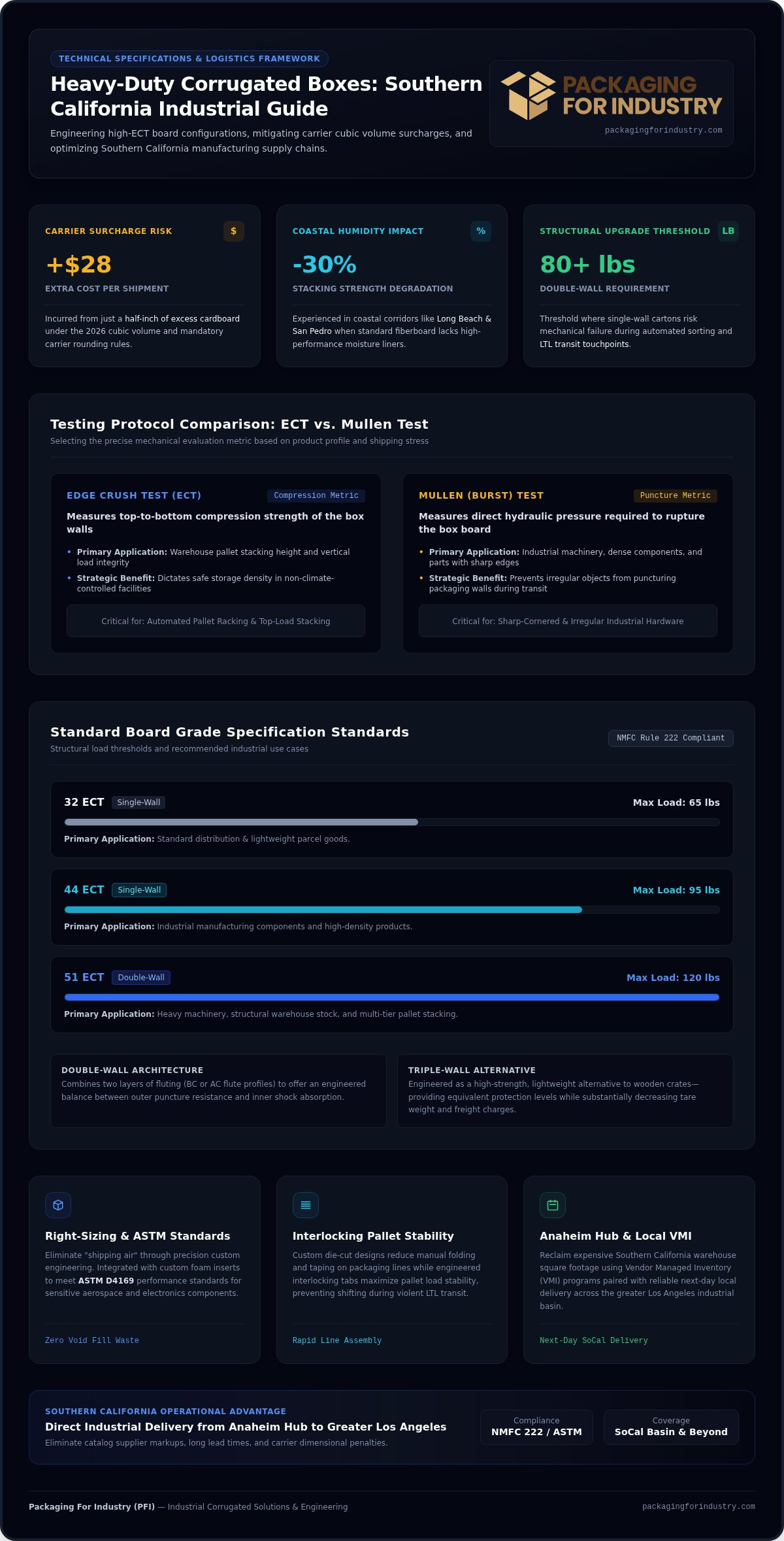
Environmental factors also play a critical role in board performance. While Southern California is generally dry, coastal humidity in areas like Long Beach or San Pedro can degrade the stacking strength of standard fiberboard by up to 30% during transit. High-performance liners and moisture-resistant adhesives help maintain the corrugated fiberboard construction and ratings required for long-term storage in non-climate-controlled warehouses. For aerospace and defense components, these standards aren’t suggestions; they’re mandatory specifications to prevent micro-fractures in sensitive equipment caused by box failure.
ECT vs. Mullen Test: Which Rating Matters for Your Load?
The Edge Crush Test (ECT) measures the top-to-bottom compression strength of the box. This is the primary metric for warehouse efficiency, as it dictates how high you can safely stack pallets. In contrast, the Mullen (Burst) test measures the force required to puncture the box wall. If you’re shipping heavy industrial parts with sharp edges or irregular shapes, Mullen ratings are often more relevant to your damage reduction goals. Aligning your corrugated box selection with the specific physical profile of your product is the first step in optimizing costs.
| Board Grade | Wall Style | Max Content Weight | Primary Application |
|---|---|---|---|
| 32 ECT | Single-Wall | 65 lbs | Standard shipping; lightweight goods |
| 44 ECT | Single-Wall | 95 lbs | Industrial components; high-density items |
| 51 ECT | Double-Wall | 120 lbs | Heavy machinery; stacked warehouse stock |
Double-Wall and Triple-Wall Configurations
Double-wall corrugated provides an essential structural upgrade for items exceeding 80 lbs. By combining two layers of fluting, these boxes offer superior cushioning and stacking strength. For extreme loads, triple-wall boxes serve as a lightweight, cost-effective alternative to wooden crates. They provide similar protection levels while significantly reducing tare weight, which lowers freight costs. Selecting the right flute combination, such as BC or AC, allows for a custom balance between outer puncture resistance and inner shock absorption for manufacturing applications.
Custom Engineering: Reducing Damage and Freight Costs
Industrial logistics in Southern California are increasingly expensive due to rising freight rates and warehouse costs. Manufacturers often overspend by using oversized catalog boxes that result in “shipping air,” which increases both material waste and transit costs. Custom engineering solves this by right-sizing the container to the specific product footprint. By integrating custom foam inserts, we create a unified protective system that meets ASTM D4169 shipping container performance standards. This ensures your high-value electronics or aerospace parts remain secure without the unnecessary bulk of traditional void fill.
High-volume manufacturing environments benefit significantly from custom die-cut designs. These solutions are not just about protection; they’re about assembly speed and material efficiency. Die-cut boxes reduce the need for excessive tape and manual folding, which streamlines your packing line operations. When using heavy-duty corrugated boxes Los Angeles suppliers provide, these custom designs can be engineered to interlock, increasing pallet stability and reducing the risk of transit shifting during LTL transport.
Solving the UPS and FedEx Surcharge Problem
Carriers now enforce strict cubic volume thresholds, with a significant surcharge trigger established at 10,368 cubic inches in early 2026. If your box exceeds these dimensions, you face Additional Handling Surcharges that often exceed $28 per package. Dimensional weight (DIM) pricing means you’re billed for the space your package occupies rather than its actual weight. A 1-inch reduction in box size can save thousands in annual freight. Designing custom boxes to stay just below these surcharge thresholds is one of the fastest ways to recover margin on your shipping spend.
Bulk Bins and Gaylord Boxes for Industrial Distribution
For large-scale logistics, standard boxes are often insufficient. High-capacity bulk bins, or Gaylords, are essential for managing chemicals, plastics, and textiles in Los Angeles distribution centers. These bins are engineered with triple-wall strength to support thousands of pounds while remaining stackable to maximize vertical warehouse space. Customizing these bins with collapsible designs or multi-use features allows for recurring production cycles, which lowers your long-term packaging spend. You can compare packaging pricing to see how custom-engineered bulk bins can optimize your current logistics costs.
Wholesale Procurement Strategies for Los Angeles Manufacturers
Procurement teams often overlook the hidden costs associated with national catalog suppliers. While these distributors offer convenience, they frequently charge a 20% to 30% premium on industrial quantities compared to direct manufacturing. Evaluating the total cost of ownership (TCO) requires looking beyond the unit price. You must account for transit damage, shipping surcharges, and the administrative burden of managing multiple vendors. Consolidating your spend on boxes, packaging tape, and stretch film with a single industrial partner simplifies your supply chain and provides more leverage for wholesale packaging pricing.
Catalog vs. Direct Manufacturer Pricing
National suppliers prioritize “stock-close-enough” sizes to maintain their massive inventory. This often forces you to pay for excess material you don’t need and results in higher shipping costs due to dimensional weight. Choosing a local corrugated box supplier allows for custom production runs tailored to your exact dimensions. We use ISTA transit testing protocols to validate that our board grades meet the specific rigors of your distribution cycle. This engineering-first approach ensures you aren’t over-specifying your material while still providing maximum protection for the heavy-duty corrugated boxes Los Angeles companies ship daily.
Bulk Ordering and Stocking Programs
Industrial real estate in Los Angeles reached an average of $1.30 to $1.41 per square foot in mid-2026. Devoting thousands of square feet to empty box storage is a poor use of capital that inflates your operational overhead. Our Vendor Managed Inventory (VMI) and Just-in-Time (JIT) programs allow you to lock in bulk packaging pricing without cluttering your facility. We stock your custom inventory in our Anaheim hub and deliver it exactly when your production schedule demands it. The ROI of local stocking programs is realized through the immediate reclamation of warehouse floor space and the elimination of production delays caused by stockouts. Transitioning to a local partner ensures the heavy-duty corrugated boxes Los Angeles operations require are always available for next-day delivery.
Local Logistics: Next-Day Delivery in Los Angeles and Beyond
The logistical geography of Southern California presents unique challenges for industrial supply chains. Traffic congestion and port delays can turn a standard delivery into a multi-day ordeal if your supplier is shipping from outside the region. Choosing an Anaheim packaging supplier provides a strategic buffer against these delays. For manufacturers requiring heavy-duty corrugated boxes Los Angeles proximity translates directly into reduced lead times and lower freight costs. We operate our own fleet to ensure that next-day delivery isn’t just a goal, but a standard operational procedure for our local clients.
This speed is particularly vital for the aerospace and aviation sectors. Mission-critical components often require immediate packaging for transport to testing facilities or assembly plants. A delay in receiving the correct double or triple-wall container can stall a multi-million dollar project. Our team understands these high-stakes environments and provides the rapid replenishment necessary to keep defense and aerospace suppliers on schedule. Whether you’re dealing with a sudden spike in orders or a shift in production, our local presence allows for emergency replenishment of heavy-duty corrugated boxes Los Angeles companies can’t get from national catalog distributors.
Vendor Managed Inventory (VMI) for Packaging
Our VMI program is designed to eliminate the stress of manual inventory tracking. We conduct regular on-site reviews of your stock levels at Los Angeles facilities to anticipate your needs before a shortage occurs. This proactive approach allows you to transition to a just-in-time packaging model, significantly reducing the amount of cash tied up in sitting inventory. By optimizing your stocking cycles, you can repurpose warehouse floor space for revenue-generating production equipment.
Southern California Service Area Highlights
We provide comprehensive coverage across the region’s primary industrial zones. Our next-day delivery routes include the manufacturing hubs of Santa Fe Springs, Carson, and Torrance. We also offer specialized support for the clusters in Irvine and Huntington Beach. This local network ensures your industrial packaging solutions arrive exactly when your production line is ready to pack.
Specifying Your Order: How to Request a Custom Box Quote
Requesting an accurate industrial quote requires more than just a rough size estimate. Providing specific technical data points upfront reduces lead times and ensures the final product meets your structural requirements without unnecessary material costs. The standard protocol for defining dimensions follows the “Golden Rule” of Length x Width x Depth (L x W x D). These measurements must always refer to the internal usable space of the container rather than the external footprint. This distinction is critical when using heavy duty corrugated boxes, as the thickness of double or triple-wall board can significantly reduce the actual volume available for your product.
We also evaluate the gross weight of your contents and the maximum stacking height in your facility. If you’re stacking pallets three-high in an Inland Empire distribution center, the bottom layer of heavy-duty corrugated boxes Los Angeles manufacturers rely on must support thousands of pounds of static load. Prototyping plays a vital role here. We use CAD/CAM technology to create physical samples, allowing you to test the fit and structural integrity before committing to a full production run.
Load and Transit Condition Assessment
Your transit method dictates the board grade and closure style required. If your product is shipped as individual parcels through UPS or FedEx, it requires higher puncture resistance to survive automated sorting systems. Palletized LTL freight focuses more on stacking strength and vertical compression. We also identify environmental factors such as coastal humidity or extreme heat that might degrade standard adhesives. For sensitive electronics or defense components, we can specify mil-spec packaging or integrated ESD foam to meet strict regulatory compliance.
Getting Started with Packaging For Industry
Our process begins with a comprehensive review of your current packaging spend and damage rates. We leverage our custom design packaging capabilities to engineer a solution that balances protection with freight efficiency. Once the design is finalized and tested, we can transition your account into a recurring VMI program to ensure you never face a stockout. This end-to-end oversight is why we are the preferred industrial packaging supplier near Anaheim. You can contact our engineering team today to request a custom packaging quote and receive a technical assessment of your current requirements.
Optimizing Your Southern California Supply Chain
Selecting the right industrial packaging is a strategic decision that impacts your bottom line, transit safety, and operational flow. By moving away from one-size-fits-all catalog options and adopting custom-engineered solutions, you eliminate unnecessary freight surcharges and reduce shipping damage. Implementing a local VMI program further optimizes your facility by reclaiming valuable floor space and ensuring you never face a production-stopping shortage.
Our team specializes in providing the heavy-duty corrugated boxes Los Angeles manufacturers need to protect high-value aerospace, medical, and industrial components. With our Anaheim-based hub, we offer reliable next-day delivery across Southern California and fast nationwide shipping for your broader distribution needs. We’re committed to helping you lower packaging costs through precision engineering and proactive supply management.
We look forward to partnering with your team to build a more resilient and cost-effective logistical operation.
Frequently Asked Questions
What is the difference between double-wall and triple-wall corrugated boxes?
Double-wall corrugated boxes use two layers of fluting to provide superior stacking strength for items weighing between 80 and 120 lbs. Triple-wall boxes add a third layer of fluting to handle extreme industrial loads or replace heavy wooden crates. This construction significantly increases puncture resistance and compression strength. While double-wall is common for standard manufacturing parts, triple-wall is the preferred choice for heavy machinery.
How do I choose between ECT and Mullen-rated boxes for heavy industrial parts?
Choose ECT ratings if your primary goal is maximizing warehouse stacking height and vertical compression. This test measures the board’s edge-wise strength. If you ship heavy industrial parts with sharp edges or irregular shapes, prioritize Mullen-rated boxes. Mullen testing measures bursting strength and puncture resistance. Selecting the right rating ensures your heavy-duty corrugated boxes Los Angeles shipments remain intact during rough LTL transit and multi-stop distribution cycles.
Does PFI offer next-day delivery for heavy-duty boxes in Los Angeles?
PFI provides local next-day delivery across the Greater Los Angeles area from our strategically located Anaheim hub. We operate a dedicated fleet to serve industrial hubs in Long Beach, Torrance, Santa Fe Springs, and the South Bay. This local proximity allows us to handle emergency replenishment and production line surges. Our goal is to ensure your shipping department never faces a shortage of the heavy-duty corrugated boxes Los Angeles operations rely on.
Can you manufacture custom-sized boxes to help us avoid UPS oversized surcharges?
We specialize in engineering custom-sized containers that stay below the expensive 10,368 cubic inch surcharge threshold implemented by parcel carriers in 2026. Many off-the-shelf catalog boxes trigger Additional Handling Surcharges because they’re slightly oversized for the product. Our CAD/CAM design process right-sizes your packaging to the exact product footprint. This precision engineering helps you avoid dimensional weight penalties and reduces the shipping air that inflates your annual freight spend.
What are Gaylord boxes, and are they available in Los Angeles?
Gaylord boxes are large, high-capacity bulk bins used to transport loose materials like plastics, chemicals, or textile rolls. These containers are typically constructed from triple-wall corrugated board to support weights exceeding 2,000 lbs. PFI supplies these bulk bins throughout Los Angeles and the Inland Empire. We offer custom sizes and collapsible designs that allow you to maximize vertical storage space and streamline your recurring industrial distribution cycles.
How does a Vendor Managed Inventory (VMI) program help reduce packaging costs?
A Vendor Managed Inventory (VMI) program reduces costs by reclaiming warehouse floor space and eliminating expensive emergency orders. We monitor your usage levels and replenish stock automatically based on agreed minimums and maximums. This prevents production downtime caused by stockouts while improving your cash flow. You only store what you need for immediate production, which is a major advantage given current industrial real estate rates in Southern California.
Do you provide custom foam inserts for heavy-duty corrugated shipping containers?
PFI provides fully integrated packaging solutions by combining heavy-duty boxes with custom-engineered foam inserts. We use polyethylene and polyurethane foam to create protective end caps, pads, and die-cut assemblies tailored to your product. These inserts absorb shock and vibration during transit. For electronics manufacturers, we offer anti-static and ESD foam options to prevent electrostatic discharge damage. This unified approach provides superior protection compared to loose-fill materials.
Can PFI handle mil-spec packaging requirements for aerospace contractors?
We maintain the technical expertise required to handle mil-spec packaging for aerospace and defense contractors across Southern California. Our team understands the rigorous structural and environmental requirements of military standards. We manufacture specialized containers that meet these exact specifications, including moisture barrier protection and high-performance cushioning. PFI acts as a reliable partner for companies near LAX and Burbank that require documented compliance and consistent supply for high-stakes projects.