
What if foam that addresses static risk still misses your cleanroom handling requirements? That distinction matters when high-value aerospace electronics must arrive protected from electrostatic discharge and shipping damage. Buyers searching for ESD foam packaging for aerospace electronics Southern California often need to solve both concerns, but ESD protection and cleanroom packaging aren’t interchangeable. ESD foam alone doesn’t establish that a package is suitable for cleanroom use.
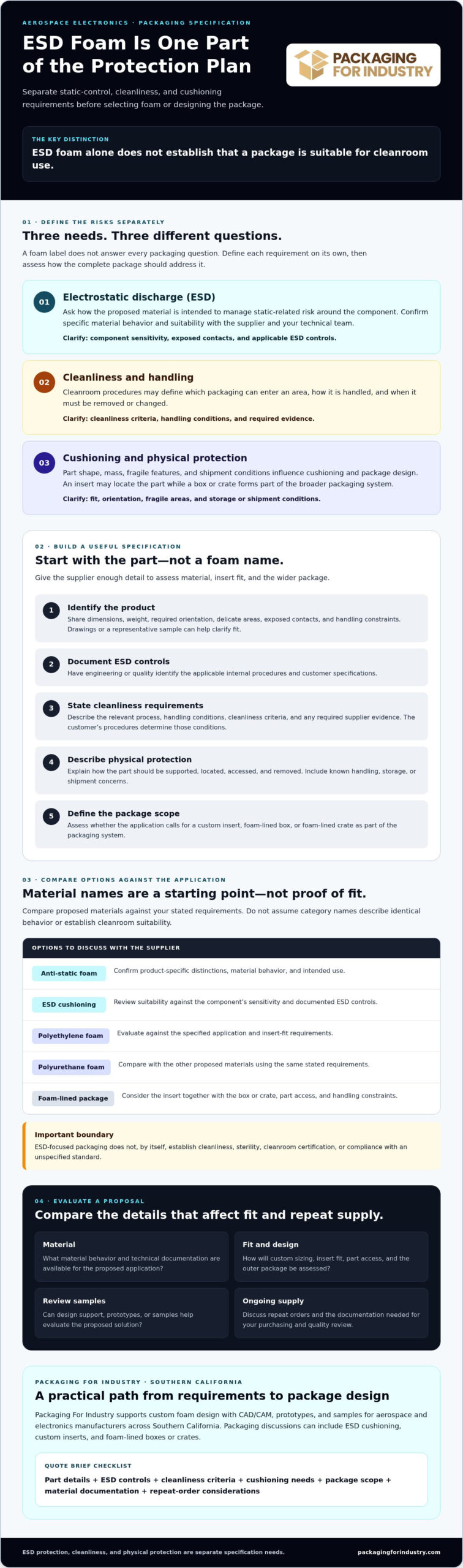
You’re right to look beyond a foam label: the component, handling environment, cushioning needs, and outer package all affect what to specify. This guide will help you separate static-control, cleanliness, and physical-protection requirements, then describe them clearly enough to compare proposals and request a packaging quote. We’ll cover the information a supplier needs to assess material, insert fit, and whether a foam-lined box or crate makes sense. Packaging For Industry supports custom foam design with CAD/CAM, prototypes, and samples, serving aerospace and electronics manufacturers across Southern California. The goal is a practical specification that reduces packaging mismatch and supports dependable repeat supply.
Key Takeaways
- Separate electrostatic discharge protection, cleanliness controls, and cushioning needs so each requirement is clear in your packaging specification.
- Use product dimensions, weight, fragility, exposed contacts, and handling constraints to give suppliers the information needed to assess fit.
- Compare anti-static foam, ESD cushioning, polyethylene foam, polyurethane foam, and foam-lined packaging against your stated application, not unsupported performance claims.
- When evaluating ESD foam packaging for aerospace electronics Southern California, ask suppliers about custom sizing, design support, samples, repeat orders, and material documentation.
- PFI can discuss ESD foam, custom inserts, foam-lined boxes or crates, and design support as part of an integrated packaging quote.
ESD Foam Packaging for Southern California Aerospace Electronics: Define the Protection Problem
Aerospace electronics need packaging that addresses the component’s handling requirements as well as the risks of storage and shipment. For buyers sourcing ESD foam packaging for aerospace electronics Southern California, the first step is to define the hazards separately. A material selected for static-control needs won’t automatically address cleanliness, shock, or vibration concerns.
What does ESD foam packaging do for sensitive electronics?
Electrostatic discharge (ESD) is the sudden transfer of electrical charge between objects. A discharge can damage or disrupt sensitive electronic components, sometimes without visible evidence. ESD foam packaging refers to cushioning selected to help manage static-related risks around the packaged item. The exact material properties and intended use should be confirmed with the packaging supplier and the buyer’s technical team.
Anti-static foam and ESD cushioning are packaging categories, but buyers shouldn’t assume the terms describe identical material behavior. Confirm the product-specific distinctions, technical documentation, and suitability with PFI before specifying a material. Start with the component’s sensitivity and exposed contacts, then ask engineering or quality teams to identify handling, storage, and packaging requirements. This gives suppliers a usable basis for a foam packaging quote rather than relying on a broad label.
Why aerospace and cleanroom applications need separate requirements
Static control, particulate management, and physical cushioning solve different problems. ESD-focused packaging addresses static-related concerns; it doesn’t establish that a material is acceptable for a cleanroom process or that it will prevent contamination. Cleanroom procedures may govern which packaging can enter an area, how it must be handled, and whether packaging must be removed or changed at a defined stage. The customer’s own procedures determine those conditions.
Static-control packaging addresses electrostatic risk; cleanliness controls determine whether packaging is acceptable for a specific cleanroom process. That distinction helps prevent a common specification gap: requesting “cleanroom ESD foam” without defining the required handling conditions, cleanliness criteria, or evidence the supplier must provide. Don’t imply that foam alone provides sterility, cleanroom certification, or compliance with an unspecified standard.
Physical protection also needs its own assessment. Component shape, mass, fragile features, and shipment conditions influence the cushioning and package design. A custom insert may need to locate the part securely, while a box or crate may be considered as part of the broader packaging system. PFI offers custom foam packaging, including ESD cushioning and foam-lined boxes or crates. Defining static, cleanliness, and impact requirements separately gives the supplier a clearer path to a practical design for aerospace electronics.
How to Specify ESD Foam, Cleanliness, and Cushioning for Aerospace Electronics
Start with the part, not a foam name. Give suppliers its dimensions, weight, orientation, fragile features, exposed contacts, and handling constraints. Drawings or a representative sample can help clarify fit. Then document the ESD, cleanliness, and physical-protection requirements separately so the proposed design can be reviewed against each need.
Use this sequence to prepare a custom packaging quote:
- 1. Identify the product. Share dimensions, weight, drawings or samples, required orientation, delicate areas, and any exposed contacts. Note how operators need to access and remove the part.
- 2. Document ESD controls. Ask engineering or quality to provide the applicable internal procedures and customer specifications. NASA’s ESD control program handbook can serve as a technical reference, but your organization must identify the requirements that apply to the item.
- 3. State cleanliness and handling rules. Describe cleanroom procedures, packaging entry restrictions, and any required handling or packaging transitions. Don’t assume an ESD material is automatically acceptable for a cleanroom process.
- 4. Define physical protection needs. Explain fragility and relevant shipment or handling conditions. Specify whether the design should include an insert, a box, a crate, or an integrated configuration, and identify concerns such as movement, impact, or difficult unpacking.
- 5. Describe the supply plan. Include shipping method and route, packaging configuration, order quantity, expected repeat-order pattern, and any reuse or disposal constraints. These details help suppliers scope a design and compare proposals on a consistent basis.
Supplier scoping checklist: Provide the part’s dimensions, weight, orientation, sensitivity, exposed contacts, ESD and cleanroom requirements, cushioning needs, shipment route, packaging configuration, order quantities, and repeat-order expectations.
Validate the proposed foam design before rollout
A drawing can help define the concept, but a prototype or sample lets product and quality teams assess the actual fit. Check that the part stays located as intended, remains accessible, and can be removed without creating handling problems. Review the complete package, not only the foam insert, because the outer box or crate contributes to the packaging configuration.
PFI offers custom design support, including CAD/CAM, prototypes, and samples. Ask the supplier to identify proposed materials and explain any performance claims, then compare those details with your customer documents. Mark unverified requirements for review rather than treating them as confirmed. Once the specification is ready, you can request a custom packaging quote with the information needed to evaluate fit and recurring supply needs for ESD foam packaging for aerospace electronics Southern California.
Compare ESD Foam Packaging Options for Cleanroom and Aerospace Use
Material names are a starting point, not a complete specification. For ESD foam packaging for aerospace electronics Southern California, compare each option against the customer’s documented static-control, cleanliness, fit, and shipping requirements. Ask the supplier to confirm product-specific properties and provide supporting documentation. Neither a foam label nor a material family alone establishes suitability for a particular application.
| Option | Potential role to discuss | Buyer’s check |
|---|---|---|
| Anti-static foam | A foam category offered for packaging where static-related concerns need consideration. | Confirm the exact product description and intended use. Don’t assume anti-static and ESD cushioning mean the same thing. |
| ESD cushioning | Cushioning selected with the stated ESD requirement in mind. | Provide the customer’s ESD documentation and ask the supplier to identify the material’s relevant properties for review. |
| Polyethylene foam | A foam material family to consider for a custom insert or other cushioning configuration. | Evaluate proposed fit and cushioning against the part and shipment needs; the material name alone doesn’t establish ESD or cleanroom suitability. |
| Polyurethane foam | Another foam material family that may be considered in a packaging design. | Request product-specific details and confirm the proposed use with engineering or quality. |
| Foam-lined packaging | Foam integrated with a box or crate to combine part positioning with an outer package. | Review the complete configuration, including loading, removal, handling, and shipment conditions. |
Match the foam configuration to the packaging workflow
An insert can locate a component within a package. Pads or end caps may be considered when the design calls for cushioning at selected contact points. A foam-lined box or crate integrates cushioning with the outer container. The choice depends on product geometry, handling steps, shipping needs, and how operators load and remove the electronics. Confirm design details with the supplier rather than assuming one configuration fits every part.
For a crate configuration, assess the foam and outer structure as one system. A custom insert may need to hold the product in position while allowing practical access, and the crate should be considered against the stated shipment requirements. PFI supplies ESD cushioning, custom foam inserts, and foam-lined boxes or crates. Its ESD and protective foam packaging information provides product context for a supplier discussion.
Keep the customer’s ESD and cleanroom requirements distinct from the physical-protection review. NASA’s requirements for an ESD control program offer a reference point, but buyers should identify the specific documents that govern their own program and product. Share those documents with the supplier, then confirm proposed materials and claims against them. This keeps the comparison focused on documented needs, not assumptions based on foam type.
Evaluate Southern California ESD Packaging Suppliers and Custom Quotes
A useful supplier proposal should show what’s included, what needs your approval, and what remains unconfirmed. For ESD foam packaging, compare suppliers on their ability to address documented requirements and support repeat orders, not just on the material label or quoted price. Clear proposals make it easier to compare packaging pricing on an equivalent basis and assess whether the design supports your goal to lower packaging costs without compromising protection.
What should a Southern California supplier quote include?
Provide the same information to each supplier so you can compare proposals consistently. Include product dimensions, weight, drawings or samples, quantities, delivery destination, and the intended configuration, such as a foam insert inside a box or crate. Review whether each proposal identifies:
- Proposed materials and packaging configuration, including documentation and claims for your team to verify.
- Custom sizing, engineering support, and whether prototypes or samples are available for evaluation.
- Design assumptions, exclusions, and customer specifications that still require confirmation.
- Initial quantities, expected repeat demand, and bulk packaging pricing for the quantities you actually anticipate.
Ask suppliers to flag open questions, particularly where customer approval is needed before rollout. Compare proposals only after confirming they cover the same configuration and requirements. This avoids evaluating one quote for a basic insert against another that includes a complete foam-lined package.
How can buyers reduce sourcing and supply friction?
If existing packaging contributes to damage, inconsistent fit, or process problems, share those details during a design review. Custom design support can help your team assess a revised configuration. PFI offers CAD/CAM support, prototypes, samples, and packaging reviews. Learn more about its custom packaging design services.
For recurring use, ask whether stocking or just-in-time inventory management fits your ordering pattern. Discuss expected consumption, replenishment needs, and how the approach would work for custom foam or related packaging. If local packaging delivery is part of your purchasing plan, confirm availability, timing, and applicability for the specific items and destination rather than assuming every custom order follows the same schedule.
Packaging For Industry is headquartered in Anaheim and serves Southern California, including Orange County, Los Angeles County, the Inland Empire, and San Diego County. Share your destination and supply needs to help clarify the scope of a proposal.
Build an Integrated ESD Foam Packaging Solution with PFI
Packaging For Industry (PFI) works with aerospace and defense, electronics and semiconductor, and medical device manufacturers. Its packaging offerings include anti-static foam, ESD cushioning, custom foam inserts, and foam-lined boxes or crates. Considering the foam and outer package together gives buyers a practical way to address component fit, handling, and shipment needs within one packaging design discussion.
When is custom ESD foam packaging worth evaluating?
Custom packaging may be worth reviewing when product geometry or handling needs don’t fit stock options, or when recurring damage, inconsistent fit, or production demand points to a design problem. PFI’s CAD/CAM support, custom packaging design, prototypes, and samples help teams assess a proposed configuration before wider use. That review can help identify packaging mismatches and evaluate cost-reduction opportunities, without assuming a specific outcome. Samples support evaluation, but they don’t guarantee compliance or shipment performance.
PFI’s combined foam, box, and crate capabilities can simplify coordination across packaging components. Its design support helps connect the buyer’s documented requirements to a proposed configuration, while review and prototyping give product and quality teams a chance to assess the design before rollout. Confirm proposed materials and customer requirements as part of that process. See PFI’s foam packaging options for relevant product information.
What to prepare before contacting PFI
Bring the information needed to scope the packaging and supply plan:
- Product dimensions, weight, sensitive areas, and available drawings or samples.
- Order quantities, shipment details, and whether demand is one-time or recurring.
- Customer-defined ESD, cleanroom, aerospace, or medical requirements for review.
- Southern California delivery location and any timing needs to confirm for the specific items.
PFI is headquartered in Anaheim and serves Southern California. Sharing these details gives its team a practical starting point for discussing a custom solution and helps your team evaluate fit, supply needs, and potential packaging improvements.
Put Your Packaging Requirements to Work
A dependable packaging specification separates ESD protection, cleanroom handling, and physical cushioning needs, then connects them in a package designed around the part and shipment. That gives your team a clearer basis to compare proposals, assess samples, and reduce the risk of packaging mismatch. For ESD foam packaging for aerospace electronics Southern California, documented customer requirements should guide material selection and supplier review.
Packaging For Industry, headquartered in Anaheim and serving Southern California, offers anti-static foam, ESD cushioning, custom foam inserts, and foam-lined boxes or crates. CAD/CAM support, prototypes, samples, and custom packaging design can help your team evaluate a proposed fit and configuration before wider use. Confirm product-specific properties and customer requirements as part of that review.
Bring your part details, shipment needs, order quantities, and applicable customer specifications to the supplier discussion. A well-scoped quote request is a practical first step toward packaging that fits your operation and supports repeat supply.
With clear requirements and a design your team can assess, you can move forward with greater confidence in your packaging decision.
Frequently Asked Questions
What is ESD foam packaging?
ESD foam packaging is cushioning selected for packaging applications with electrostatic-control requirements. The term alone doesn’t specify material properties, performance, or compliance with a customer requirement. Before requesting a quote, confirm the component’s sensitivity and handling needs with engineering or quality, then ask the supplier to document the proposed material and intended use. Include any applicable customer specifications so the proposed packaging can be reviewed against them.
Is ESD foam suitable for cleanroom packaging?
It may be considered if the application requires static control and the proposed packaging is compatible with customer-defined cleanroom procedures. ESD properties don’t automatically establish cleanliness, particle-control suitability, or cleanroom certification. Ask your quality team to identify packaging and handling requirements, including any restrictions on materials entering the cleanroom. Then request supplier documentation and review the proposed design against those requirements before approving it for use.
What is the difference between anti-static foam and ESD foam?
The terms may refer to different material properties, so don’t assume they’re interchangeable based on a product label. State the ESD requirement or customer specification, then ask the supplier for documentation describing the proposed material and its intended use. Have engineering or quality confirm that it fits the component and handling process. This helps your team compare options based on documented requirements rather than terminology alone.
How do I choose foam packaging for aerospace electronics?
Start with the component’s dimensions, weight, fragile areas, exposed contacts, and handling requirements. Add customer-defined ESD and cleanroom needs, shipment method, package configuration, and order quantity. Compare supplier proposals against those details, not just foam type or price. Prototypes or samples can help your product and quality teams assess fit, access, and removal before wider use, subject to your organization’s review and customer approval.
Can ESD foam alone meet cleanroom packaging requirements?
Don’t assume it can. ESD cushioning addresses static-control needs, which may be separate from cleanliness, particle, and handling controls for a cleanroom process. Ask your quality team to identify the applicable customer requirements, then request material documentation and any stated limitations from the supplier. Review the complete packaging configuration against the actual process and acceptance criteria. Foam alone doesn’t establish cleanroom suitability or certification.
What information should I provide for an ESD foam packaging quote?
Provide product dimensions, weight, drawings or samples, order quantities, shipment details, and the intended configuration if known. Include customer-defined ESD, cleanroom, aerospace, or medical requirements, along with recurring supply expectations and the delivery location. Ask the supplier to identify proposed materials, design assumptions, prototype options, and points requiring technical confirmation. These details help clarify the scope and make supplier proposals easier to compare.
Does PFI provide ESD foam packaging in Southern California?
PFI lists anti-static foam and ESD cushioning among its packaging offerings and serves Southern California from its Anaheim headquarters. Buyers searching “ESD foam packaging for aerospace electronics Southern California” should share the delivery location, specifications, required quantities, and intended use to confirm whether the requested solution fits. If delivery timing matters, verify it for the specific custom or stock items and destination when requesting a quote.