
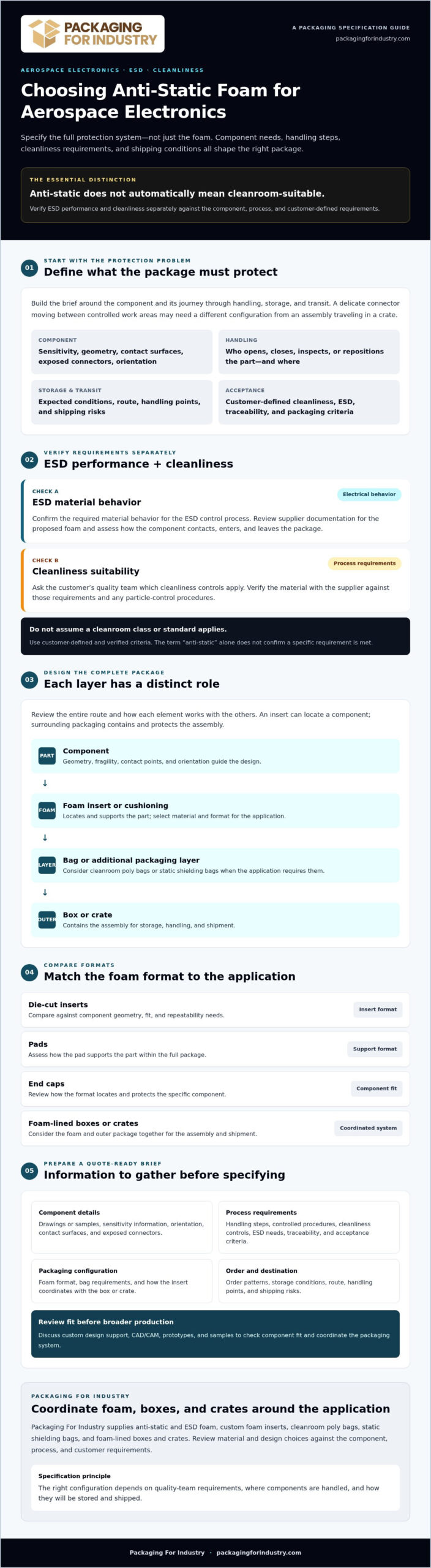
A foam insert can address electrostatic risk and still be unsuitable for a cleanroom. Choosing anti-static foam packaging for aerospace electronics means accounting for both requirements, as well as the risks components face during handling, storage, and transit. A material described as anti-static doesn’t, by itself, confirm cleanroom suitability or guarantee protection.
To turn component and process requirements into a packaging specification, assess the complete protection system, not just the foam. The right configuration depends on your quality team’s requirements, where components will be handled, and how they’ll be shipped. Documenting these details helps you compare options and request a quote based on the application.
This guide explains what to verify about ESD performance and cleanliness, how to compare foam inserts with surrounding packaging, and what information to provide when specifying a solution. Custom design, prototypes, and samples can help you check component fit before broader production. Packaging For Industry can discuss foam, boxes, and crates as a coordinated system for aerospace and electronics businesses in Southern California and beyond.
Key Takeaways
- Build the packaging brief around component sensitivity, handling steps, storage, transit, and customer-defined cleanliness requirements.
- Evaluate anti-static foam packaging for aerospace electronics as one part of a complete package, and verify material behavior and application requirements before selection.
- Compare die-cut inserts, pads, end caps, and foam-lined boxes or crates based on component geometry, repeatability, and how each format works with the outer package.
- Prepare drawings or samples, component orientation, order patterns, and destination conditions before requesting a packaging quote.
- Ask about custom design support, CAD/CAM, prototypes, and samples to review fit and coordinate foam with bags, boxes, or crates.
Anti-static foam packaging for aerospace electronics: define the protection problem
Before selecting foam, define what the package must protect: the component, the handling process, and the risks during storage and transit. A delicate connector moving between controlled work areas has different packaging needs from an assembly traveling in a crate. For anti-static foam packaging for aerospace electronics, choose materials for the actual application, not just the product label.
Anti-static or ESD foam is selected for its electrical behavior within an electrostatic discharge control process. Antistatic agents can change a material’s surface properties, including conductivity, as described in this overview of an antistatic agent. That general description doesn’t verify how a specific foam performs. Check the proposed foam’s properties in supplier documentation and review its suitability for the component and packaging process.
What anti-static foam does, and what it does not establish
ESD foam serves an ESD-related role around sensitive electronics. Select it based on the required material behavior and how the component will contact, enter, and leave the package. The term “anti-static” alone doesn’t establish that a foam meets a particular customer requirement.
Cleanroom suitability is a separate question. A foam may be considered for ESD control, but that doesn’t show that it meets a customer’s cleanliness requirements or particle-control procedures. Ask the customer’s quality team which cleanliness controls apply, then verify material suitability with the supplier before specifying it.
Why aerospace electronics need a packaging-system view
Assess the full route, not just the insert. Consider component geometry and fragility, along with the steps workers follow to place, remove, inspect, or reposition the part. Storage conditions, handling between work areas, and transit risks should also inform the design. An insert can locate a component; a bag may provide another packaging layer; a box or crate can contain the assembly for shipment. Each element has a distinct role, so review the complete configuration.
Foam choice cannot replace a complete packaging specification that accounts for the component, process, cleanliness requirements, and shipping conditions.
Packaging For Industry supplies anti-static and ESD foam, custom foam inserts, cleanroom poly bags, static shielding bags, and foam-lined boxes and crates. Its foam packaging options can be considered alongside the rest of the package, with material and design choices checked against the application and customer requirements.
How to assess cleanroom and ESD requirements before selecting foam
Before comparing foam options, gather the requirements that determine what the package must do. Engineering, quality, and the customer may each control part of the decision. Record their requirements separately so an ESD material choice isn’t mistaken for confirmation that the whole package suits a cleanroom or established handling process.
Questions to resolve with engineering and quality teams
Start with the part and the people who handle it. Confirm which surfaces may contact packaging, whether connectors remain exposed, and what handling or orientation restrictions apply. Ask the responsible teams to document requirements for cleanliness, ESD control, traceability, and packaging acceptance. Don’t assume a cleanroom class or standard applies; use only customer-defined and verified criteria. NASA’s reference on requirements for electrostatic discharge control can inform the discussion, but the buyer must confirm which requirements govern the specific application.
Use a checklist to capture the operating conditions:
- Component: sensitivity information, contact surfaces, exposed connectors, and orientation.
- Handling: who opens and closes the package, where that happens, and any controlled procedures.
- Storage and transit: expected storage conditions, route, handling points, and shipping risks.
- Acceptance: customer cleanliness, ESD, traceability, labeling, and inspection requirements.
Match each packaging component to a documented requirement
Specify the foam, bag, outer package, labels, and assembly process as distinct parts of the packaging system. Compare anti-static foam, ESD cushioning, and foam-lined packaging against documented requirements, then confirm proposed material properties with supplier documentation. If the package needs a bag, determine whether the customer calls for a static shielding bag, a cleanroom poly bag, or another specified option. Don’t assume a single bag or foam choice meets both needs.
Document how the packaging should be assembled and handled, too. The customer may have requirements for where a component is placed, how a bag is closed, or what information must accompany the package. These details affect usability and repeatability as well as material selection.
Packaging For Industry supports aerospace applications with packaging design and foam, bag, box, and crate options. Review its aerospace packaging solutions as you align the package with your application and customer requirements. Once engineering and quality have confirmed the brief, you can request a packaging quote with a clearer basis for comparing configurations.
Compare anti-static foam formats for aerospace electronics applications
The right format depends on the component’s shape, how it is placed and removed, and how it will be packed for shipment. A custom insert may locate a part precisely, while pads or end caps may suit a simpler support arrangement. Consider repeatability as well: packaging for recurring shipments should support consistent placement and handling. ESD-related damage can appear as outright, premature, or intermittent failure, as discussed by the Aviation Suppliers Association. A documented, application-specific design review is more useful than choosing by format name alone.
| Format | Component geometry | Repeatability and handling | Outer-package fit |
|---|---|---|---|
| Die-cut insert | Can be shaped around confirmed component dimensions and orientation. | Defined cavities can support consistent placement; confirm that removal is practical for the operator. | Designed to sit inside a selected box or crate. |
| Foam pads | May suit flatter parts or applications needing a simpler contact or cushioning layer. | Simple to position, but placement and quantity should be specified for repeat packing. | Can be used within an existing package when the configuration is validated. |
| End caps | May support the ends of a component with a suitable shape and contact area. | Can simplify loading, provided the part remains properly located during handling and transit. | Must be sized in relation to the package interior and other protective layers. |
| Foam-lined box or crate | Can combine component supports with protection integrated into the package interior. | Can establish a repeatable packout, subject to design review and process checks. | Considers the foam and the outer container together. |
Choose a format and material against the use case
Consider custom inserts when component geometry and orientation are confirmed and the package needs defined component locations. Pads or end caps may work for simpler support needs, but validate contact points, retention, and packing steps with the customer. A foam-lined box or crate may be appropriate when the outer package needs to be engineered alongside the cushioning. For larger assemblies, review a custom foam-lined crate as one coordinated configuration.
Polyethylene and polyurethane are candidate foam material families, not automatic recommendations. Anti-static or ESD options also need to match documented requirements. Ask the supplier for material data, then confirm properties and compatibility with the buyer’s quality and engineering teams before approval. Package design should follow product geometry and process needs, not a default foam format.
For anti-static foam packaging for aerospace electronics, Packaging For Industry can discuss custom inserts and foam-lined packaging alongside the surrounding box or crate. CAD/CAM support, prototypes, and samples may help the team review fit and packout before broader production. Confirm project-specific availability during the design discussion.
Build a quote-ready specification for aerospace electronics foam packaging
A clear brief helps a packaging supplier evaluate the application and prepare a quote for the complete package. For anti-static foam packaging for aerospace electronics, gather input from engineering, quality, and the teams that pack and ship the component. A detailed request also makes it easier to compare packaging pricing and assess options that may help lower costs without compromising documented requirements.
Information to include in a custom foam packaging quote
- Identify the part. Provide drawings or a sample, dimensions, quantity per package, orientation, and areas needing support or clearance. Ask whether custom sizes are available for the application.
- Describe the packout. Explain how the component is placed, removed, inspected, and handled. Note any contact or orientation restrictions.
- Share customer requirements. Include documented ESD, cleanliness, labeling, traceability, and packaging acceptance requirements. Flag details still under review.
- Define the complete package. Specify any bag, box, or crate requirements, along with relevant outer-package dimensions.
- Describe supply needs. Include destination conditions, shipping method, expected quantities, recurring volume, and order cadence. These details help a supplier assess whether bulk packaging pricing is relevant.
This brief gives your supplier a consistent basis for evaluating the configuration and identifying missing information before design or production planning.
Review assumptions and production readiness
Ask the supplier to identify design assumptions, whether a prototype or sample may be appropriate, and who will review and approve material properties and application suitability. PFI offers custom packaging design support, including CAD/CAM support, prototypes and samples, and packaging reviews. Confirm project-specific availability during the discussion.
If a prototype or sample is available for the project, have engineering, quality, and packaging staff review component fit, placement, and packing steps before broader production. Record requested changes and approvals so the final specification reflects the reviewed configuration.
A complete brief helps your team evaluate the proposed package and compare pricing against the actual application. It also gives the supplier a clearer basis for quoting foam packaging and any related bags or outer packaging.
Why work with PFI on aerospace electronics anti-static foam packaging
Choosing foam is only one part of specifying packaging for aerospace electronics. The insert, bag, and outer container need to fit the component and the customer’s documented handling and cleanliness requirements. Packaging For Industry can discuss these elements together, helping buyers evaluate a coordinated package rather than sourcing foam without considering how it will be used.
A coordinated approach to foam, bags, and outer packaging
PFI supplies anti-static and ESD foam, custom foam inserts, cleanroom poly bags, static shielding bags, corrugated boxes, and crates. Depending on the application, the discussion can cover how an insert fits the part, whether a bag is specified, and how the box or crate will contain the assembly. Each material and configuration remains subject to supplier documentation and review against customer requirements. No single foam choice establishes cleanroom suitability or guarantees component protection.
PFI’s aerospace packaging solutions bring packaging design support into that conversation. Sharing component details and packout requirements gives the team a basis to discuss options and identify what needs confirmation from engineering or quality.
From packaging review to recurring supply
Custom design support, including CAD/CAM, can help translate an approved application brief into a package for review. Where available for the project, prototypes or samples let stakeholders assess fit, component placement, and packing steps before broader production. Confirm project-specific capabilities and review responsibilities with the supplier, and have the appropriate customer teams verify material properties and requirements.
Supply planning matters, too. If the package will be reordered, share expected quantities and order cadence early. That allows the quote discussion to reflect the buyer’s purchasing pattern and opens a conversation about recurring supply. For Southern California aerospace and electronics businesses, PFI can discuss local service. Buyers elsewhere can raise broader distribution needs during project review.
Bring together the component information, customer requirements, and expected order pattern to discuss anti-static foam packaging for aerospace electronics with PFI. Share confirmed details and flag open questions so the packaging configuration can be evaluated against the application.
Specify the Package with Confidence
Choosing anti-static foam packaging for aerospace electronics starts with documenting the component, handling process, cleanliness requirements, and shipping conditions. ESD protection and cleanroom suitability are distinct considerations, so confirm each requirement with your quality team and verify proposed materials against supplier documentation.
Evaluate the complete package, not just the foam. Inserts, bags, boxes, and crates each play a role, and a clear specification helps your supplier assess fit, packout, and repeat-order needs. Packaging For Industry supports aerospace and electronics businesses with anti-static and ESD foam, cleanroom poly bags, static shielding bags, and custom design support. CAD/CAM, prototypes, and samples can support an application-specific design review. Local service is available in Southern California, with broader distribution needs also open for discussion.
Bring your drawings or samples, customer requirements, and expected order pattern to start a focused packaging review.
A well-defined brief gives your team and supplier a practical foundation for moving forward.
Frequently Asked Questions
Is anti-static foam suitable for aerospace electronics?
It can be suitable when the foam’s documented properties match the component’s ESD requirements and packaging process. The label “anti-static” alone doesn’t confirm performance or suitability for a specific application. Review the material information with your supplier and confirm customer-specific requirements with engineering or quality. For aerospace electronics, also consider how the foam works with the bag, outer package, handling steps, and shipping conditions.
What is the difference between anti-static foam and cleanroom packaging?
Anti-static foam is selected for its electrical behavior in an ESD control process. Cleanroom packaging addresses cleanliness requirements, including whether packaging materials are suitable for the customer’s controlled environment. These are separate considerations: an ESD-related foam designation doesn’t establish cleanroom suitability. Ask the customer’s quality team to specify both sets of requirements, then check the proposed foam and packaging components against supplier documentation.
Can anti-static foam be used in a cleanroom?
Possibly, but the foam’s anti-static designation doesn’t confirm that it meets a cleanroom’s cleanliness requirements. Suitability depends on customer-defined criteria and the material’s documented properties. Before bringing foam into a controlled environment, confirm the applicable requirements with the quality team and ask the supplier for relevant material information. Review the whole packout too, including bags, boxes, handling procedures, and how packaging is introduced into the work area.
How do I choose foam packaging for aerospace electronics?
Start with the component’s dimensions, orientation, contact surfaces, and handling restrictions. Then document ESD and cleanliness requirements, storage and transit conditions, and how the part will be packed and removed. Compare inserts, pads, end caps, or foam-lined packaging against those requirements, rather than selecting by format alone. Anti-static foam packaging for aerospace electronics should be reviewed as part of the complete package, with material properties confirmed by supplier documentation.
Does anti-static foam protect electronics from shock and vibration?
Not by virtue of its anti-static designation alone. ESD-related properties and physical cushioning are different considerations, so ask the supplier to explain the proposed foam’s documented characteristics for the application. The component, insert geometry, outer box or crate, and shipping conditions all affect the package design. Review the complete configuration against customer requirements, and don’t assume the foam will address shock or vibration without application-specific evaluation.
What information should I provide for a custom foam packaging quote?
Share component drawings or a sample, dimensions, quantity, orientation, and areas needing support or clearance. Include customer-defined ESD, cleanliness, labeling, and acceptance requirements, plus handling steps and any restrictions on component contact. Describe the outer box or crate, shipping destination and conditions, expected order quantities, and order cadence. If a requirement is still under review, flag it so the supplier can identify assumptions before quoting.
Can one supplier provide foam inserts and the outer packaging?
Yes. Packaging For Industry supplies anti-static and ESD foam, custom foam inserts, cleanroom poly bags, static shielding bags, corrugated boxes, and crates, allowing buyers to discuss these elements as a coordinated package. PFI serves aerospace and electronics businesses from Southern California. Ask the supplier to review the component, packout, and customer requirements together, and confirm material suitability and project-specific capabilities before approving the design.