
A broad catalog can make standard packaging easy to order, but it may not solve a poor fit, recurring damage, or rising shipping charges. If your current packaging isn’t meeting operational needs, compare suppliers by how they assess your product, shipping method, and replenishment requirements, not just by the range of items they list.
Packaging dimensions can affect billable shipping weight, while inadequate cushioning can leave products exposed to damage. Custom sizing and coordinated materials may help address both concerns. A capable supplier should ask about your product and handling risks before recommending a practical packaging approach.
This guide provides a framework for comparing packaging performance and supplier service. You’ll learn what to ask about custom design, prototypes, coordinated corrugated boxes, foam, and crates, along with inventory programs for repeat orders. Use these criteria to identify a supplier that can help reduce damage, limit supply interruptions, and make packaging costs more manageable.
Key Takeaways
- To find a packaging supplier with stronger engineering support, compare documented capabilities against your operation’s needs rather than assuming one supplier is the right fit for every buyer.
- Prepare product dimensions, weight, fragility, shipping method, and damage history so suppliers can make a useful recommendation.
- Evaluate catalog selection, custom design, prototype access, material coordination, and replenishment as separate criteria.
- Consider how packaging needs differ across manufacturing, warehouse, aerospace, electronics, and medical-device operations.
- Include current packaging, order quantities, and replenishment needs when requesting a custom quote from PFI.
Looking for a Packaging Supplier with Better Engineering?
Repeated product damage, parcel surcharges, a product that won’t fit standard boxes, or frequent rush orders can all signal that your packaging needs a closer review. The right supplier depends on the problem you need to solve. Compare catalog purchasing with engineering support based on your product, shipping method, purchasing workload, and replenishment needs.
Catalog ordering can be efficient when packaging needs are stable and standardized. If the same stock box protects your product, fits the shipment, and can be reordered in suitable quantities, a custom design may not be necessary. Buyers should still compare specifications, order quantities, and delivery suitability against their operating requirements.
When a catalog order may be enough
Standard packaging can work well for repeatable shipments with familiar dimensions and handling needs. Confirm that the selected packaging suits the product and shipping method, and check whether the order quantity and delivery schedule fit your storage capacity and purchasing plan. Catalog availability is one factor in supplier fit, not a substitute for checking those details.
When custom packaging engineering deserves a closer look
Recurring damage, unusual product dimensions, or fragile and high-value components may justify an engineering review. Assess how fit, cushioning, handling, and repeatability work together. For example, an industrial component shipped by parcel may need a closer-fitting corrugated box and protective foam, while a larger shipment may require a different packaging approach.
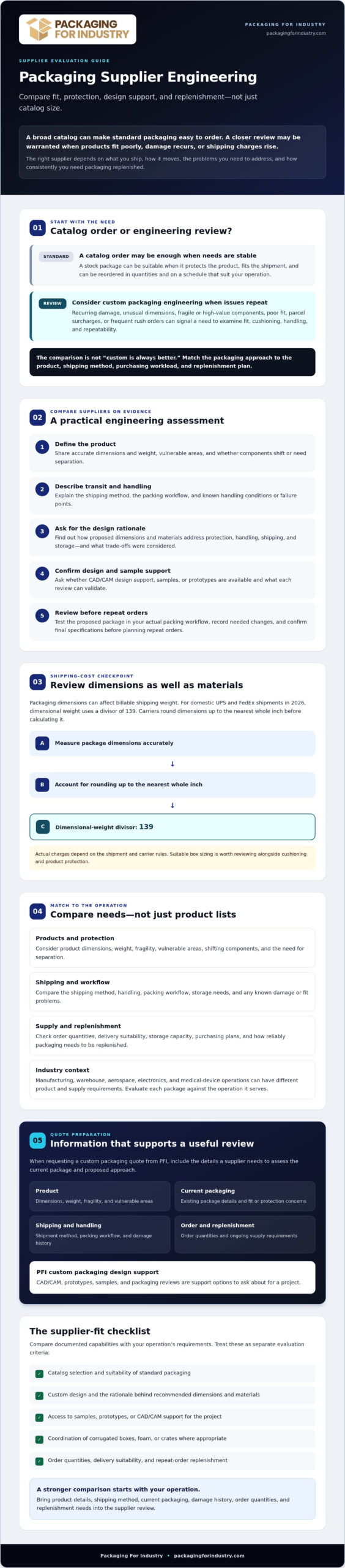
Package dimensions can also affect shipping charges and freight planning. For domestic UPS and FedEx shipments in 2026, dimensional weight uses a divisor of 139, and carriers round dimensions up to the nearest whole inch before calculating it. Accurate measurements and suitable box sizing are therefore worth reviewing. Actual charges depend on the shipment and carrier rules.
Packaging engineering brings design and technical considerations together to address practical packaging needs. Packaging For Industry offers custom packaging design support, including CAD/CAM, prototypes, samples, and packaging reviews. Buyers can learn more about its custom packaging design services.
Compare suppliers by how they assess your requirements and support repeat orders, not just by catalog breadth. A useful assessment starts with what you ship, how it moves, what problems you’re seeing, and how consistently you need packaging replenished.
How to Evaluate a Packaging Supplier’s Engineering Capability
A useful supplier assessment starts with your shipping operation, not a preferred box style. Share product dimensions and weight, fragility, how the shipment moves, and any current damage concerns. Include how products are handled during packing and what happens between dispatch and receipt. These details give a packaging supplier a basis for evaluating fit, cushioning, materials, and the risks your current setup may not address.
Use this process to compare engineering support:
- 1. Define the product. Provide accurate dimensions and weight, identify vulnerable areas, and explain whether the product has components that shift or require separation.
- 2. Describe transit and handling. Explain the shipment method, how the package moves through production or fulfillment, and any known handling conditions or failure points.
- 3. Ask for a design rationale. Find out how the proposed dimensions and materials address protection, handling, shipping, and storage needs. Ask what trade-offs the supplier considered.
- 4. Confirm design and sample support. Ask whether CAD/CAM design support, samples, or prototypes are available for your project, and what each review can help you validate.
- 5. Review before rollout. Test the proposed package in your actual packing workflow, record needed changes, and confirm the final specifications before planning repeat orders.
These questions help distinguish a product recommendation from a project-specific assessment. The Institute of Packaging Professionals (IoPP) is a resource for packaging professionals; buyers can use it to explore the broader field while evaluating the practical design support a supplier proposes.
Questions to ask before requesting a packaging quote
Ask how the supplier will assess product fit, handling, transit, and the damage concerns you report. Confirm whether design support, samples, or prototypes are available and what information the team needs to develop them. Also ask how proposed package dimensions and materials relate to your shipping method, storage limits, and packing process. Clear answers make it easier to compare recommendations on more than unit price.
PFI offers CAD/CAM support, prototypes and samples, and packaging reviews as part of its custom packaging design services. Availability and project scope should be confirmed for your specific requirements.
What to review in a prototype or sample
Check that the product stays restrained and protected without making packing unnecessarily difficult. Have the team that handles fulfillment or production pack and unpack the sample, then observe whether it closes securely and moves through the workflow as intended. Record fit issues, handling concerns, and requested adjustments. If you want to find a packaging supplier with better engineering than Uline, this hands-on review can help you compare design quality against your operation’s needs.
Once you’ve gathered product, shipment, and workflow details, you can request a packaging quote that gives the supplier a clear starting point for an actionable recommendation.
Catalog Supplier vs. Engineering Partner: Compare the Right Factors
A supplier comparison is more useful when it measures operating fit, not brand reputation or box price alone. Record what each supplier confirms, what is unavailable, and what still needs verification. Then weigh packaging performance alongside storage needs, purchasing effort, and replenishment reliability.
Use a supplier comparison matrix
Use a simple status for each response: Confirmed, Unavailable, or Requires verification. Apply the same questions to every supplier, including Uline, and base your assessment on documented project-specific answers.
| Factor | What to establish | PFI information | Other supplier |
|---|---|---|---|
| Design input | Will the supplier assess product fit, handling, and shipping needs? | Confirmed: custom packaging design support, including CAD/CAM. | Requires verification. |
| Custom sizes | Can packaging be adapted to the product and shipping method? | Custom and stock corrugated packaging are offered. | Requires verification. |
| Samples or prototypes | Can your team review a design before rollout? | Prototypes and samples are available; confirm project scope. | Requires verification. |
| Material coordination | Can the supplier coordinate corrugated, foam, and crates where needed? | Confirmed: PFI can combine boxes, foam, crates, and other materials. | Requires verification. |
| Repeat orders | Can replenishment planning support your quantities and purchasing process? | VMI and just-in-time inventory programs are offered. | Requires verification. |
| Regional or nationwide support | Can the supplier serve your locations and specific order requirements? | Southern California service and nationwide support are available; confirm project coverage. | Requires verification. |
Also assess how much time your team spends sourcing, ordering, and tracking packaging. A low unit price may not reflect the full operational fit if the packaging contributes to damage, takes excessive storage space, or creates extra purchasing work. Compare packaging pricing using the same specifications and project details, and avoid treating any savings as guaranteed.
Compare the packaging system, not just the box
A carton, cushioning, foam, and crate may need to work together to protect a product through handling and transit. Consider whether the product needs a closer fit, internal restraint, or a more coordinated combination of materials. Review PFI’s corrugated box options for stock or custom cartons. Score each supplier against the same requirements, not assumptions about catalog breadth or engineering capability.
To compare a proposed system with your current setup, request a project-specific packaging quote with your packaging specifications, usage, and replenishment needs.
Match Packaging Engineering to Your Industry and Supply Requirements
Packaging must fit both the product and the process that handles it. A manufacturer may need a repeatable pack-out for production, while a warehouse may prioritize storage space and predictable replenishment. Aerospace, electronics, and medical-device operations should give suppliers their specific product, handling, and packaging requirements so recommendations can be assessed against the actual application.
Packaging requirements vary by product and process
For electronics, verify whether ESD or anti-static packaging is required and share the relevant specifications. Fragile or high-value components may need protective foam and a box designed to limit movement. For machinery or heavy components, review cushioning, crate design, handling, and shipment method together. The right solution depends on the item and its route through production, storage, and transit.
Repeat production also requires consistent specifications. Ask how approved designs and later changes will be documented so purchasing and production teams use the correct packaging. For export-crate projects, provide the destination, shipment method, product details, and handling requirements. Confirm which design support and materials the supplier can provide for the specific shipment.
Include supply continuity in the engineering decision
A packaging design must also be practical to replenish. Identify materials with long lead times or a history of emergency orders, then compare replenishment needs with warehouse capacity and production schedules. Recurring items such as corrugated boxes or stretch film may need a different purchasing plan from a crate ordered for a specific shipment.
PFI offers vendor-managed inventory and just-in-time inventory management for packaging. Discuss usage, lead times, storage, and production schedules when assessing a replenishment program. Southern California buyers should confirm local service needs and delivery coverage. Businesses with multiple locations should verify support for each location, product, and order quantity.
Include supply continuity in your supplier comparison alongside design capability. A supplier that considers packaging performance and recurring needs together can help your team plan purchasing more deliberately. Share your product and replenishment requirements to explore a practical next step.
Request a packaging quote for your product and replenishment requirements
Request a Custom Packaging Quote from PFI
A useful quote starts with a clear project brief. Packaging For Industry (PFI) serves industrial buyers looking for custom or stock packaging, including corrugated boxes, protective foam, stretch film, pallets, and crates. Its design support includes CAD/CAM, packaging reviews, prototypes, and samples. For recurring needs, PFI also offers vendor-managed inventory and just-in-time inventory management programs.
Prepare a project brief that supports an accurate quote
Share enough detail for the supplier to assess the packaging and supply requirements together. Include product dimensions, weight, fragility, and any handling or storage constraints. Describe the current package, what needs to change, and any known damage or shipping-charge concerns.
- Shipment details: Note destinations and whether you ship by parcel or freight.
- Current packaging: Include materials, dimensions, and any recurring fit or protection issues.
- Order requirements: Estimate quantities, order frequency, current lead times, and which items need repeat replenishment.
- Operational needs: Explain production schedules, warehouse space limits, and any packing or assembly considerations.
Specific information helps the supplier determine what can be quoted, which design questions need review, and whether samples or prototypes are appropriate. If exact figures aren’t available, provide your best planning estimates and identify them as estimates.
What to expect when assessing PFI
PFI is an industrial packaging supplier headquartered in Anaheim, serving Southern California and supporting nationwide needs through distribution and manufacturing partners. Confirm service coverage, product scope, and order requirements for your locations and quantities. Quote recommendations depend on the project details and capabilities confirmed for that request; an initial inquiry is a starting point for assessing fit, not a promise of a particular design or result.
Buyers comparing suppliers can use the same brief to compare packaging pricing and evaluate the proposed solution against protection, shipping, storage, and replenishment needs. If your goal is to find a packaging supplier with better engineering than Uline, make the comparison specific to your operation rather than relying on broad claims about either supplier. Clear requirements help you assess whether custom design support or stock packaging is the more practical route.
Share your project details with PFI to start the review.
Put Your Packaging Requirements to Work
The right supplier is the one whose confirmed capabilities fit your products, shipping methods, and replenishment needs. To find a packaging supplier with better engineering than Uline, compare specific project responses rather than relying on assumptions about either company. Look beyond the box: assess how protective materials work together, whether the design can be reviewed before rollout, and how recurring orders will be managed.
Packaging For Industry supports industrial buyers with CAD/CAM design, prototypes and samples, packaging reviews, and cost-reduction analysis. PFI can coordinate corrugated boxes, foam, crates, and other industrial packaging, then discuss vendor-managed inventory or just-in-time programs for repeat needs. Share your product details, current packaging, damage concerns, quantities, and schedule to help shape a useful recommendation.
A clear project brief is a practical first step toward packaging that supports product protection and a more dependable supply process.
Frequently Asked Questions
How do I find a packaging supplier with better engineering than Uline?
Start with the shipping problem, then compare each supplier’s confirmed project capabilities. Share product dimensions, weight, handling requirements, shipment method, and any damage or surcharge concerns. Ask how the supplier assesses package fit, design options, samples, and repeat orders. If you want to find a packaging supplier with better engineering than Uline, base the comparison on documented responses and project-specific recommendations, not assumptions about either supplier.
Does Uline provide custom packaging engineering?
The available Uline page information emphasizes catalog products and shipping supplies, but it doesn’t establish the full scope of Uline’s engineering services. Ask Uline directly whether it can support your specific design, sample, and project-review needs. Then ask any alternative supplier the same questions. Compare confirmed answers, including what design support is available, what information is needed, and whether the supplier can address your recurring packaging requirements.
What should I send a packaging supplier to get a custom quote?
Provide product dimensions, weight, fragility, and any handling or storage requirements. Include the shipping method, destinations, current packaging, damage history, and any known dimensional surcharge concerns. For repeat orders, share estimated quantities, order frequency, current lead times, and storage constraints. This project brief helps the supplier assess whether custom corrugated boxes, foam, crates, or a combination of materials may suit the product and shipment.
Can custom packaging reduce shipping damage and freight costs?
Custom packaging may help address product damage or avoidable package dimensions, but results depend on the product, design, carrier requirements, and shipping profile. Ask the supplier to review current package dimensions, damage information, and transit methods before recommending a change. Compare the proposed design with your existing packaging, and review samples or prototypes where available. Use your own shipping and damage data to assess the result rather than assuming savings.
Is a packaging engineering supplier better than a catalog supplier for manufacturers?
Neither supplier model is automatically better for every purchase. Catalog purchasing may suit standardized, repeatable packaging, while engineering support may be worth evaluating for products requiring custom sizes, protective foam, crates, or packaging reviews. Manufacturers with recurring demand should also compare replenishment programs, lead times, and storage requirements. Choose based on documented production and shipping needs, then verify each supplier’s capabilities against those requirements.
Can one supplier provide boxes, foam, and crates together?
Some industrial suppliers offer multiple packaging categories, but confirm the specific products, design support, and supply scope for your project. Ask whether corrugated boxes, protective foam, and crates can be considered as an integrated system, and whether samples or prototypes are available. Packaging For Industry offers corrugated boxes, foam packaging, crates, and custom packaging design support. The appropriate combination depends on your product, shipping method, and purchasing requirements.
Does PFI serve packaging buyers outside Southern California?
Packaging For Industry is headquartered in Anaheim and serves industrial buyers in Southern California. The company also supports nationwide needs through distribution and manufacturing partners for applicable products and orders. Coverage can depend on the items, quantities, and locations involved, so confirm details before planning a rollout. Include every ship-to location and the packaging products required when requesting a quote to help verify service scope and availability.