
The right foam-in-place packaging setup is not the one that uses the most foam. It is the one matched to the product, materials, and shipping conditions. Two-component foam expands around an item to create a custom cushion, but protection depends on choosing suitable materials and achieving a consistent fit.
Manufacturers comparing packaging options need to look beyond the equipment. Product shape and fragility, production needs, and the carton all affect how the system performs and what the complete packaging approach requires.
This guide explains how foam-in-place equipment and materials work, when this method fits, and when another cushioning option may be more suitable. It also covers product fit, testing, shock protection, damage reduction, and packaging costs. Manufacturers in Orange County, Los Angeles, and San Diego can use these factors to assess packaging across their operations.
Key Takeaways
- Match the foam material and dispensing approach to the product’s shape, fragility, and packing requirements rather than choosing equipment first.
- Identify where conforming foam cushioning can protect irregular or delicate items, and where simpler cushioning may suit the shipment better.
- Assess shock protection alongside carton strength and structural support; cushioning alone does not replace bracing when a shipment needs it.
- Review how product fit, repeatable packing methods, and shipment testing can support consistent protection and help reduce damage.
- Understand how packaging requirements and inventory needs shape costs, and where PFI’s foam packaging, VMI, or JIT inventory management may support your operation.
Foam-in-Place Packaging Products and Materials
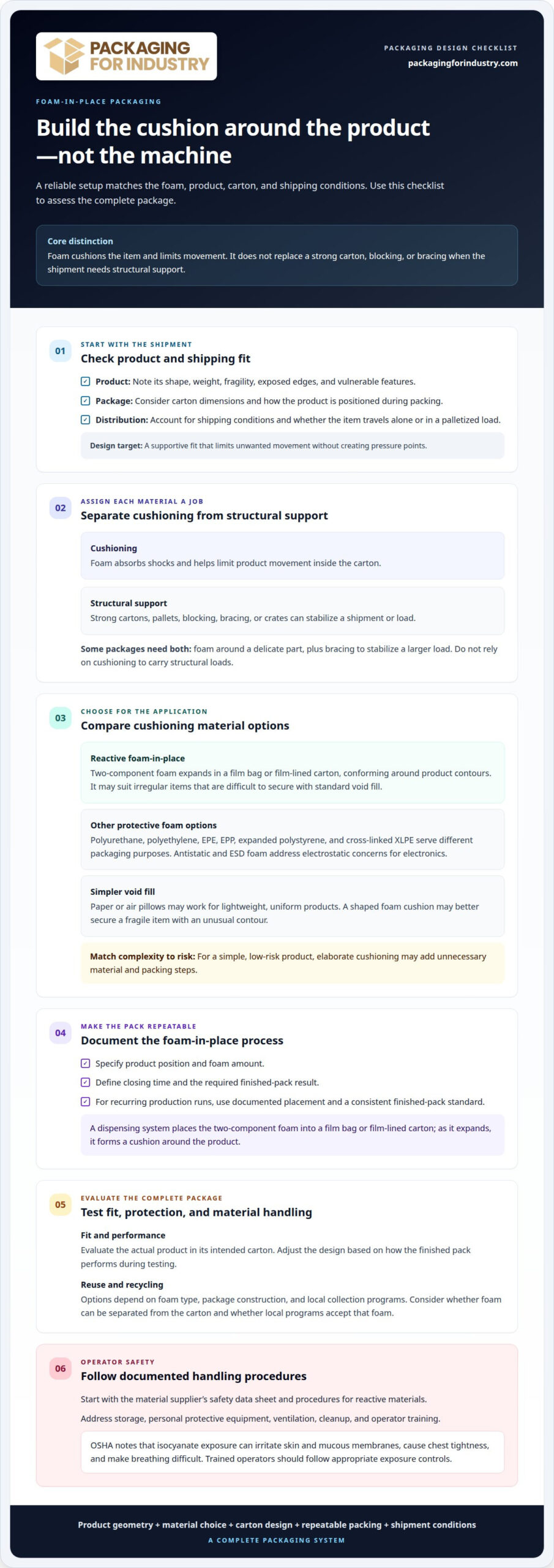
Foam-in-place packaging uses expanding foam to create cushioning around a product inside a carton or film bag. Material compatibility, product geometry, and production volume all shape the design. For a fragile component with exposed edges, the cushion should support those areas without treating foam as a substitute for carton strength or shipment bracing.
High-Volume Cushioning and Blocking
For recurring production runs, a repeatable process can create cushioning and blocking around products as they are packed. The design should reflect the item’s shape, the carton, and the packing sequence. High-volume operations benefit from documented placement and a consistent finished-pack standard. This helps operators pack products consistently while keeping cushioning separate from load-support requirements.
Cushioning Versus Structural Bracing
Cushioning absorbs shocks and limits product movement inside a carton. Structural support stabilizes the shipment or load with elements such as pallets, blocking, bracing, strong cartons, or crates. A package may need both: foam around a delicate part and bracing to stabilize a larger load. The design should account for each function rather than expecting cushioning to carry structural loads.
Foam-in-Place Process and Custom Fit
A dispensing system places two-component foam into a film bag or film-lined carton. As it expands, the material conforms to the product and forms a cushion around its contours. This can protect irregular items that are difficult to secure with standard void fill. Work instructions can specify product position, foam amount, closing time, and the required finished-pack result.
Foam Density and Package Design
A packaging provider selects density and package design by considering product weight, fragility, shape, carton dimensions, and distribution conditions. The goal is a supportive fit that limits unwanted movement without creating pressure points. The provider can evaluate the actual product in its intended carton and adjust the design based on how the finished pack performs during testing.
Suitable materials depend on the application. Polyurethane foam is used in reactive foam systems; polyethylene, EPE, EPP, expanded polystyrene, and cross-linked XLPE are other protective packaging options. Antistatic and ESD foam address electrostatic concerns for electronics. Each material serves a different purpose, so selection should follow the product’s protection requirements rather than assume one foam suits every item.
Paper and air pillows can work well as void fill for lightweight, uniform products. A shaped foam cushion may be better for a fragile item with an unusual contour. Compare how each material holds the product in place, the carton design, and the packing process. For a simple, low-risk product, elaborate cushioning may add unnecessary material and steps.
Environmental impacts and recycling options depend on foam type, package construction, and local collection programs. Separating foam from a carton can affect how each material is handled. Reuse may be practical in some operations, while recycling depends on whether local programs accept that particular foam. Assess foam-in-place packaging as part of the complete packaging system, including material separation after unpacking.
Safe handling starts with the material supplier’s safety data sheet and documented procedures. Packaging teams should address storage, personal protective equipment, ventilation, cleanup, and operator training for reactive materials. The Occupational Safety and Health Administration notes that isocyanate exposure can irritate skin and mucous membranes, cause chest tightness, and make breathing difficult. Trained operators should follow appropriate exposure controls when producing foam-in-place packaging.
Industries and Applications Served
Foam-in-place packaging can suit fragile, high-value, irregularly shaped products that standard cushioning may not secure. Aerospace, electronics, medical equipment, and industrial manufacturers can assess it for products with exposed components or unusual contours.
Application Fit by Product
Product shape and shipping risk matter more than industry labels. An irregular machine component, delicate electronic assembly, or instrument with protruding features may benefit from cushioning shaped around its contours. Uniform, lightweight products with low damage risk may need only paper, air pillows, or simple corrugated inserts.
The package also needs to suit the shipping task. A fragile unit moving through parcel distribution has different needs from a part secured inside a palletized load. Foam can limit movement around the item, but it does not replace a strong carton or the blocking and bracing needed to support a shipment.
Industry Use Cases
Aerospace, electronics, medical, and industrial businesses can assess foam for components that are fragile, valuable, or difficult to secure with standard void fill. Examples include an irregular aerospace part, an electronic assembly with vulnerable edges, or a precision instrument that needs a shaped cushion. The application depends on the item and its distribution conditions, not simply its industry.
Packaging teams can assess each product family separately. A facility shipping several shapes may use custom cushioning for vulnerable items and simpler materials for uniform goods. This matches protection to the shipment instead of applying one package design to every product.
- Aerospace: Consider irregular components that need a close-fitting cushion during shipment.
- Electronics: Assess assemblies with delicate features and include electrostatic protection needs in the package design.
- Medical: Review instruments or equipment whose shape makes standard void fill difficult to position.
- Industrial manufacturing: Evaluate heavy or unusual parts, while planning separate structural support when loads require it.
Foam may be unnecessary for lightweight, low-risk, uniform products. For example, a consistent item that stays secure with a corrugated insert may not need expanding cushioning. Paper or air pillows can also work when the main task is filling open space, rather than controlling movement around a fragile shape.
Production volume also affects the method. A foam-in-place machine may not be necessary for occasional packing or small batches; expandable foam bags may suit those applications. High-volume lines need a repeatable process that fits the packing workflow and produces a consistent finished pack.
To assess fit, review the product’s fragility, shape, weight, and carton, then consider how it will ship. Testing the actual product in its intended carton can reveal movement or pressure points before a method becomes standard. If the shipment needs pallet support, bracing, or a crate, those structural elements remain part of the design.
Benefits of Foam-in-Place Packaging
Protection must hold through handling, transport, and delivery. Evaluate cushioning performance, packing consistency, and material use together to understand the method’s operational value.
Impact and Vibration Cushioning
Foam cushions a product by absorbing shocks and vibrations during transportation. A shaped cushion can limit movement around a vulnerable item, reducing the chance that it strikes the carton during handling. The package must still suit the route and shipping conditions. For example, a delicate assembly sent through parcel distribution may need a different validated design from a secured pallet load.
Shipment Protection Requirements
For U.S. shipments, packaging requirements depend on the product, destination, carrier instructions, and customer specifications. The design should address planned distribution conditions and product-specific handling needs. Packaging teams can use International Safe Transit Association (ISTA) test procedures to select distribution testing that fits the shipment and validation goal.
Testing helps show whether a pack protects the item as intended. Evaluate the design using the actual product, carton, and shipping conditions. Testing can expose movement, pressure points, or carton damage that a packing-line review may miss. Use the results to adjust cushion placement or carton selection before making the method standard.
Barcode-supported work instructions can help operators repeat a validated pack. A product or carton barcode can identify the relevant procedure, including product position, foam amount, closing time, and acceptable finished-pack result. For example, scanning a product identifier before packing can distinguish similar components with different support needs. A barcode organizes the process; it does not replace training or pack checks.
Packaging costs involve more than the cushioning material. Product damage, replacement or rework, packing time, material use, and carton requirements all affect the total cost of shipping. Foam may be useful when a custom fit protects a fragile product, while simple paper or air cushioning may suit uniform, low-risk items. Compare protection needs with packing and material demands.
Reducing damage can lower costs when a better-fitted pack prevents avoidable product movement. Still, base the decision on shipment performance, not assumptions about the material alone. Compare test results and damage patterns across product types, then refine the design where evidence reveals a weakness. A heavy product that shifts inside its carton, for example, may need a different restraint strategy from a light, stable item.
For consistent operations, document the chosen pack and keep the work sequence clear at the packing station. Include the product identifier, carton choice, foam placement, and criteria for an acceptable finished pack. Review the process when the product, carton, or shipping route changes. This helps teams maintain validated protection while managing material use and repeatable packing.
Why Choose Packaging For Industry (PFI) for Foam Packaging
Packaging For Industry (PFI) helps manufacturers coordinate product protection with packaging supply. Manufacturers can turn to PFI for foam packaging when fragile or irregular products need a protective fit, or when existing packaging does not control movement during shipment. The design should account for the product, carton, packing process, and how materials reach the production floor.
For a new or changing product, PFI’s foam packaging supports a plan built around actual shipping needs. A product change, recurring damage pattern, or inconsistent packing method can signal that the current approach needs review. Teams can share product details, carton information, and shipping requirements to align cushioning with the operation rather than select materials in isolation.
Connect Protection With Packaging Supply
Packaging needs often extend beyond the item inside the carton. PFI also offers stretch film to secure packaged goods or pallet loads for storage and transport. Foam cushions a product, while stretch film helps unitize loads. Using the appropriate material at each stage helps warehouse and shipping teams manage packaging consistently.
Supply planning matters, too. A production line can lose efficiency when packaging materials aren’t available at the point of use. PFI’s Vendor Managed Inventory for packaging can support businesses seeking a managed approach to packaging supply. It may suit operations that want to coordinate material availability with ongoing consumption instead of handling every replenishment independently.
Choose an Inventory Approach That Fits Operations
Just-In-Time inventory management for packaging is another option for businesses coordinating supply with production demand. It can suit operations with limited storage or planned packaging workflows. The right approach depends on usage patterns, ordering processes, available storage, and the need to keep materials accessible without disrupting production.
PFI’s foam packaging, stretch film, VMI, and JIT offerings address different operational needs. A manufacturer focused on product damage may start with cushion and package design. A warehouse securing pallet loads may assess stretch film. A purchasing team managing recurring replenishment may consider inventory management. These decisions can be connected, but they solve distinct problems.
Before changing a packaging program, operations and purchasing teams can define the issue they want to solve. Useful inputs include the product or product family, current carton, damage concerns, packaging usage, and where materials are needed. Clear information keeps the discussion focused on the relevant product or inventory service instead of treating every packaging challenge as the same problem.
For manufacturers in Orange County, Los Angeles, and San Diego, reliable packaging supply supports shipping and day-to-day production. As an Orange County packaging supplier and industrial packaging supplier near Los Angeles, PFI can align foam packaging, stretch film, or packaging inventory management with the workflow the business needs to support, including packaging delivery in San Diego.
Contact Packaging For Industry (PFI) to request a foam packaging quote or custom packaging quote.
Frequently Asked Questions
What Is Foam Packaging?
Foam packaging includes protective materials and package formats that support products during storage and shipping. Purchasing teams can compare inserts, end caps, pads, and assembled foam components according to how each product is handled and packed. For a mixed product line, organizing requirements by product family can reveal where a shared format works and where a distinct protective design is needed.
How Does an Expanding Foam Cushion Support a Shipment?
A packaging team starts by reviewing the product, carton, packing sequence, and distribution needs. It then develops and evaluates a pack design, refining it if the finished package shows unwanted movement or pressure points. Once the design meets the shipment’s protection needs, written work instructions help operators repeat the method. This connects package design to the production line rather than treating equipment as a standalone purchase.
Which Materials Can Be Used for Foam Cushioning?
Options include polyurethane, polyethylene, EPE, EPP, EPS, and cross-linked XLPE, as well as antistatic or ESD foam. Choose based on product protection needs and the packaging system, not simply the material name. For electronics, the specification should account for static-control needs. Procurement teams can organize requirements by product family and identify where material compatibility or handling procedures differ.
How Much Does a Custom Foam Pack Cost per Package?
Pricing depends on the project and is provided after a quote request. Cost factors include product dimensions, foam type and amount, carton design, packing process, and order volume. A consistent repeat shipment may need a different design from a product with changing dimensions or special protection requirements. Comparing price with material use and packing needs gives purchasing teams a clearer basis for evaluating the complete approach.
How Does Expanding Foam Compare With Molded Foam, Bubble Wrap, and Paper?
Each option suits different production and shipping conditions. A preformed molded component may fit a stable product design and recurring pack, while bubble wrap or paper can serve products that need flexible wrapping or void fill. Expanding cushioning may suit products that are difficult to secure with standard materials. Compare product variation, packing-line consistency, storage needs, and required protection.
What Equipment and Process Does a Packaging Provider Use?
A packaging team may choose automated equipment, handheld dispensing, or expandable foam bags based on the product range and production needs. Selection also depends on packing frequency, operator workflow, and the consistency required across finished packages. A professional process establishes a repeatable packing method and trains operators to follow it. For occasional packing or small batches, a dedicated machine may not be necessary.
What U.S. regulations and shipping requirements apply to foam-in-place packaging?
For U.S. shipments, packaging requirements depend on the product, destination, carrier instructions, and customer specifications. Foam cushioning does not replace required carton strength, pallets, blocking, bracing, or crates.