
Your current packaging might be protecting your product, but it’s probably killing your margins through excessive dimensional weight surcharges. If you’re managing a high-volume warehouse or distribution center, you’ve likely dealt with the frustration of generic foam interior packaging that’s either too bulky or fails to prevent transit damage. Waiting weeks for custom inserts only adds to the operational stress. We know you need a solution that balances technical precision with fiscal responsibility to keep your supply chain moving efficiently.
In this article, you’ll learn how custom-engineered foam solutions reduce shipping damage and streamline your industrial logistics. We’ll explore the differences between polyethylene and polyurethane materials, the advantages of free CAD/CAM prototyping, and how PFI’s local next-day delivery in Southern California, including Los Angeles, Anaheim, and San Diego, helps you maintain a lean inventory. By the end, you’ll see how to lower your total packaging costs while ensuring every shipment arrives in perfect condition.
Key Takeaways
- Learn how custom-engineered foam interior packaging acts as a precision component to block and brace high-value items, helping your facility reduce shipping damage.
- Understand the technical performance of Polyethylene and Polyurethane materials to ensure your cushioning matches the weight and fragility of your specific product.
- Discover how custom die-cut inserts improve labor efficiency in fulfillment centers by replacing manual wrapping with streamlined, pre-shaped kitting solutions.
- Utilize free CAD prototyping and local next-day delivery across Southern California to reduce lead times and minimize warehouse inventory overhead.
- Learn how Vendor Managed Inventory (VMI) and bulk pricing programs can help your operation lower packaging costs while maintaining a reliable supply.
What is Foam Interior Packaging and Why Does It Matter for Industry?
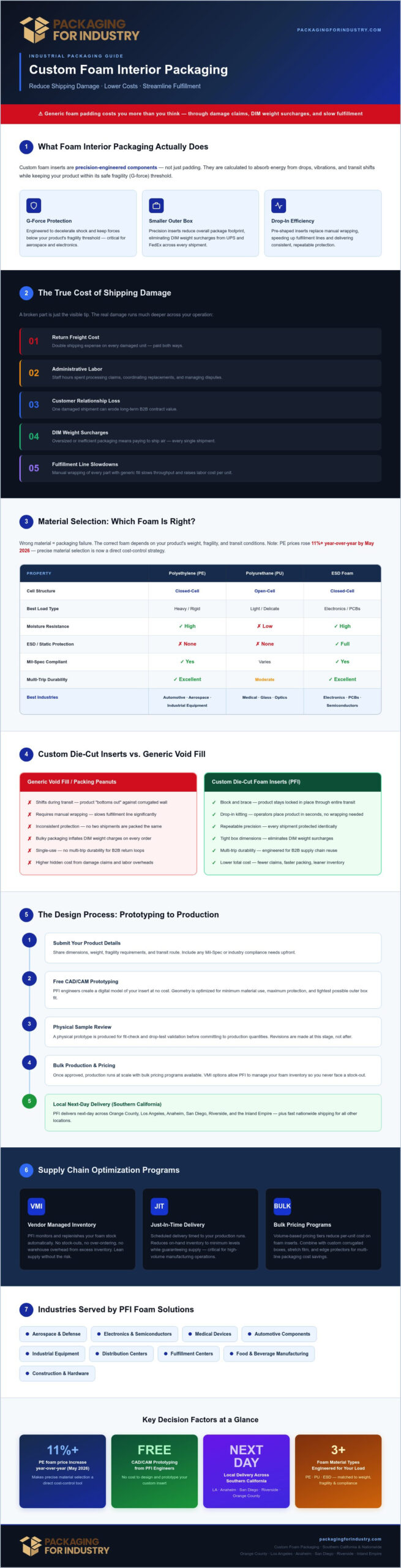
In the world of industrial logistics, foam interior packaging isn’t just “padding” or “bubble wrap.” It is a precision-engineered component designed to block and brace high-value products within a shipping container. Unlike generic void fill, these solutions are calculated to absorb energy during drops, vibrations, and shifts during transit. For manufacturers of fragile electronics or aerospace components, this level of protection is non-negotiable. It ensures that sensitive equipment remains secure and functional upon arrival, regardless of how rough the handling becomes.
Modern engineering allows us to address “fragility packaging” by calculating specific G-force protection. Every product has a fragility level, or the maximum amount of shock it can withstand before failing. We use foam interior packaging to manage that deceleration, ensuring the forces acting on your product stay well below its breaking point. This technical approach does more than protect the item; it helps companies lower packaging costs by allowing for smaller, more efficient outer boxes. When you reduce the size of your footprint, you’re not just saving on material; you’re cutting freight expenses across your entire supply chain.
The Economic Impact of Proper Interior Cushioning
Shipping damage creates a massive drain on operational efficiency. The true cost isn’t just the broken part; it’s the cost of the return freight, the administrative labor to process the claim, and the potential loss of a long-term customer. By investing in optimized foam density, you can significantly reduce these hidden expenses. Well-designed inserts also help you avoid the increasing dimensional (DIM) weight surcharges from carriers like UPS and FedEx. If your packaging is bulkier than it needs to be, you’re paying to ship air. Precise foam engineering allows for the tightest possible box dimensions without sacrificing safety.
Industrial vs. Consumer Foam Solutions
Generic solutions like packing peanuts or thin bubble wrap often fail in heavy-duty industrial environments. They shift during transit, leaving your product vulnerable to “bottoming out” against the corrugated wall. Industrial-grade foam, specifically custom-designed inserts, provides repeatable protection for high-volume manufacturing lines. We focus on material recovery and multi-trip durability, which is essential for B2B logistics. While off-the-shelf void fill might seem cheaper upfront, the labor required to manually wrap every part quickly eats into your margins. Custom-engineered inserts allow for a “drop-in” packing process that speeds up your fulfillment line and ensures consistent protection every time.
Material Selection: Polyethylene, Polyurethane, and ESD Foam
Selecting the correct material for your foam interior packaging is a technical decision that directly impacts your bottom line. The performance of your cushioning depends on density, cell structure, and the specific hazards of your transit route. If you select a material that’s too soft for a heavy load, it will bottom out and fail. If it’s too rigid for a delicate instrument, the shock transfers directly to the product. Finding that balance is where engineering meets logistics. Current market data shows polyethylene prices rose over 11% year-over-year by May 2026, which makes material yield and precision selection even more vital for cost control.
Polyethylene (PE) Foam for Heavy-Duty Protection
Polyethylene is a closed-cell foam known for its durability and high-load support. It doesn’t absorb moisture and resists chemicals, making it the industry standard for heavy machinery parts, automotive components, and industrial equipment. Because it’s rigid, it’s the ideal choice for blocking and bracing applications. If you’re shipping under Mil-Spec requirements, PE is often the mandatory material. We provide custom plank and die-cut options that offer the structural integrity needed for multi-trip durability in B2B supply chains.
Polyurethane (PU) Foam for Sensitive Equipment
Polyurethane is an open-cell material that provides superior soft cushioning for lightweight items. It’s the preferred choice for delicate electronics, glass components, and medical tools. PU foam is highly effective at vibration dampening during long-haul transit, which is a critical feature of high-performance foam interior packaging. You’ll frequently see it used in convoluted, or “egg-crate,” foam inserts because it easily conforms to irregular shapes. While it lacks the load-bearing strength of PE, its ability to cradle fragile items without abrasion is unmatched.
Specialized ESD and Anti-Static Foam
For semiconductor and medical device manufacturers, static discharge is a silent killer. Standard foam can generate friction-based static that destroys circuit boards. Specialized ESD and anti-static foam prevent this by dissipating or shielding against electrical charges. You can identify these materials by their industry-standard colors: pink for anti-static and black for conductive or dissipative grades. Meeting compliance for aerospace packaging requires these specific grades. The ANSI/ESD S541-2026 standard provides the current framework for these materials, ensuring sensitive electronics remain protected throughout production and transport.
If you’re ready to optimize your material usage, you can request a packaging quote to compare densities and pricing for your specific application.
Custom Die-Cut Foam Inserts vs. Standard Void Fill
Standard void fill like bubble wrap or air pillows might seem cost-effective on a per-unit basis, but these materials fail to provide the precision required for complex industrial assemblies. Custom die-cut foam is the gold standard for “kitting,” where multiple components must be organized and protected within a single container. Unlike loose fill, custom foam interior packaging eliminates “product migration,” which is the dangerous shifting of parts during transit that often leads to surface abrasion or structural damage. When a part moves inside the box, it effectively becomes a hammer, damaging both itself and the outer container.
For high-end Original Equipment Manufacturers (OEMs), the presentation value of a custom foam-lined box reflects the engineering quality of the product inside. It transforms a standard shipping container into a professional, organized delivery. This organized layout also serves as a visual checklist for the end-user, ensuring all components are present and accounted for upon arrival. From a logistics perspective, this isn’t just about aesthetics; it’s about operational speed and reducing the risk of customer claims due to missing or damaged parts.
Precision Engineering with Die-Cut Technology
We use CAD/CAM technology to engineer exact-fit cavities for even the most complex geometries. This ensures total repeatability across every shipment, providing a consistent protection profile that manual wrapping simply can’t match. By switching to “drop-in” foam solutions, you significantly reduce labor costs at the pack station. Your team spends seconds placing a part into a pre-shaped cavity rather than minutes struggling with tape and bubble wrap. In a high-volume fulfillment center, saving two minutes per box can equate to hundreds of labor hours saved per month, directly improving your facility’s throughput.
Integrated Solutions: Foam-Lined Boxes and Crates
Effective protection often requires combining materials into a single integrated unit. We can bond permanent foam liners to custom corrugated boxes, creating a reusable shipping solution that stays with the container. For heavy equipment, foam end caps offer a cost-saving alternative by protecting the most vulnerable corners without the expense of full-foam coverage. In international export scenarios, we often design hybrid packaging, such as heavy-duty wood crates with internal foam suspension, to handle the extreme vibrations of ocean or air freight. This integrated approach ensures that the foam interior packaging works in tandem with the outer shell for maximum reliability.
The Design Process: From Prototyping to Production
Moving from a concept to a finished protection solution requires a methodical approach that prioritizes both engineering precision and cost-efficiency. Our process begins with a detailed consultation to identify your product’s specific fragility and the environmental hazards it will face during transit. We then move into the engineering phase, where we create a CAD design for the foam interior packaging that accounts for material density and shock absorption. This technical foundation prevents the guesswork often associated with generic packaging and ensures your high-value gear remains secure through the most rigorous shipping cycles.
- Step 1: Initial consultation to assess product fragility and shipping hazards.
- Step 2: Engineering and CAD design of the custom foam inserts.
- Step 3: Free prototyping to test fit and function before mass production.
- Step 4: Material testing and drop-test simulations for high-value gear.
- Step 5: Final production and local Southern California delivery.
Free Prototyping and CAD Support
We provide free prototyping and CAD/CAM support because we believe every industrial client deserves a “perfect fit” before placing a bulk order. This phase allows your operations team to physically test how the foam interacts with your product and outer corrugated box. It’s during this stage that we refine foam-to-part tolerances, ensuring the material provides enough “give” to absorb shock without being so loose that it allows for product migration. By utilizing advanced CAD design, we significantly reduce the lead time for custom projects, moving your facility from design to delivery faster than traditional suppliers.
Custom Packaging for Manufacturers in Southern California
While many providers focus on global logistics, we leverage our local expertise to provide specialized support for companies requiring custom boxes in Anaheim, Los Angeles, and the surrounding Inland Empire. On-site reviews and packaging audits allow our team to identify specific damage risks within your unique warehouse environment. For businesses with multi-state distribution centers, we also provide nationwide shipping capabilities to maintain supply chain consistency. Our local presence allows us to offer next-day delivery across Orange County and San Diego, which is essential for maintaining lean inventory levels and avoiding the high costs of stockouts.
Optimizing Your Supply Chain with PFI Foam Solutions
Engineering the perfect foam interior packaging is only half the battle; the other half is ensuring your production line never stops due to a stockout. For high-volume manufacturers and fulfillment centers, packaging inventory is a constant balancing act. Storing bulky foam inserts takes up valuable floor space that could be used for revenue-generating production. We solve this by integrating your packaging requirements directly into your operational flow through strategic inventory management and localized logistics.
VMI and Just-In-Time Delivery
Our Vendor Managed Inventory (VMI) program is designed to eliminate warehouse clutter and improve your facility’s cash flow. Instead of tying up capital in months of safety stock, we store your custom foam inserts at our facilities and deliver them exactly when you need them. We perform regular inventory reviews to match your production schedules, ensuring you only pay for the materials you use. This just-in-time approach reduces the administrative burden on your purchasing department and ensures your foam interior packaging is always available for the next production run.
Why Choose Packaging For Industry (PFI)?
Many businesses rely on large national catalog suppliers for their standard needs, but these providers often lack the technical expertise required for complex industrial protection. PFI serves as a cost-saving alternative by providing direct engineering support and custom-tailored solutions that generic distributors don’t offer. We specialize in high-stakes industries, providing specialized packaging for warehouses, aerospace contractors, and medical device manufacturers who cannot afford the risk of transit damage.
Our local presence is a significant advantage for businesses in Southern California. We provide local next-day delivery across Orange County, Los Angeles, Anaheim, San Diego, Riverside, and the Inland Empire. This proximity allows us to respond faster than out-of-state suppliers, providing on-site support and rapid replenishment that keeps your supply chain resilient. Whether you need a single integrated solution combining foam with heavy-duty corrugated boxes or recurring shipments of ESD-safe inserts, our team is positioned to act as your proactive logistics partner.
If you’re looking to lower your total landed costs and improve shipping reliability, it’s time to move beyond generic supplies. We invite you to request a packaging quote today. Compare our technical capabilities and bulk pricing against your current supplier to see how a custom-engineered approach can protect your products and your bottom line.
Secure Your Supply Chain with Engineered Protection
Transitioning from generic void fill to precision foam interior packaging is a critical step for any high-volume industrial operation. You’ve seen how the right material selection, whether it’s durable polyethylene or vibration-dampening polyurethane, prevents bottoming out and product migration. Custom die-cut inserts don’t just protect your goods; they remove the hidden costs of shipping damage and excessive packing labor from your bottom line.
PFI provides the technical expertise and localized support that large catalog suppliers can’t match. With free prototyping and CAD design services, we ensure your components have a perfect fit before mass production begins. Our specialization in Aerospace and Mil-Spec standards, combined with local next-day delivery across Southern California, makes us a steady partner for your most demanding logistics challenges.
Let’s work together to eliminate professional stress and optimize your warehouse throughput. We’re ready to start your project and deliver the reliability your business deserves.
Frequently Asked Questions
How do I choose between Polyethylene and Polyurethane foam for my inserts?
Selection depends on the weight and fragility of your product. Polyethylene (PE) is a closed-cell, durable material ideal for heavy machinery and blocking applications because it resists moisture and chemicals. Polyurethane (PU) is an open-cell, soft foam that provides superior cushioning for delicate instruments and lightweight electronics. We help you evaluate these material properties during the design phase to ensure your foam interior packaging provides the correct G-force protection for your specific transit hazards.
Can I get a custom foam packaging quote for low-volume orders?
We specialize in bulk quantities and recurring orders for manufacturers and distribution centers. While we don’t focus on one-time residential needs, we provide a custom packaging quote for industrial clients looking to establish a reliable supply chain. Our model is built for businesses that require consistent, high-quality protection for their production lines. By focusing on industrial volumes, we offer a cost-saving alternative to large national catalog suppliers who often lack specialized engineering support.
Do you provide free prototypes for custom foam interior packaging?
Yes, we provide free prototyping and CAD/CAM support for our industrial partners. It’s essential to test the foam-to-part tolerances before starting a full production run to avoid costly errors. This phase allows your operations team to physically verify the fit and function of the inserts within your corrugated boxes. Our engineering team works closely with you to refine the design, ensuring the final product meets your protection and labor efficiency goals.
What is the lead time for custom die-cut foam inserts in Southern California?
Lead times for custom projects vary based on design complexity, but our local presence in Anaheim allows for faster turnaround than out-of-state competitors. For established VMI programs, we offer local next-day delivery across Southern California, including Los Angeles, Orange County, and the Inland Empire. Our goal is to keep your production moving without the delays associated with long-distance freight. Contact our team to discuss your specific timeline and production requirements.
How does custom foam help reduce UPS and FedEx shipping surcharges?
Custom-engineered foam reduces shipping costs by optimizing the dimensional (DIM) weight of your parcels. Carriers charge based on box size as much as weight, so using oversized boxes with generic void fill leads to unnecessary surcharges. By designing precise foam interior packaging, we allow you to use the smallest possible outer box. This reduction in footprint directly lowers your freight expenses while maintaining superior protection for your high-value components.
Do you offer anti-static or ESD foam for electronic components?
We provide specialized anti-static and ESD foam specifically for electronics and semiconductor manufacturers. These materials prevent static discharge from damaging sensitive circuit boards during handling and transit. Our inventory includes both polyethylene and polyurethane ESD grades, typically identified by their pink or black coloring. We ensure your packaging complies with necessary industry standards, including aerospace and Mil-Spec requirements, to protect your high-value electronic components from silent electrical damage.
Can you design a foam-lined box that combines corrugated and protective foam?
Integrated solutions are one of our core strengths at PFI. We can design and manufacture custom corrugated boxes that feature permanent or removable foam liners tailored to your product’s geometry. This approach simplifies your assembly process and ensures that the outer container and internal cushioning work as a single, high-performance system. Whether you need foam end caps or full-cavity inserts, we combine materials to provide total protection while streamlining your warehouse operations.
What industries do you serve with custom foam packaging solutions?
We provide custom protection for a wide range of high-stakes sectors. Our primary clients include aerospace and defense contractors, medical device manufacturers, and electronics companies. We also serve the automotive industry, industrial equipment manufacturers, and large-scale distribution centers. Our expertise in Mil-Spec packaging and complex industrial kits allows us to support any business that requires high-load support, moisture resistance, or precision vibration dampening for their high-value or fragile products.