
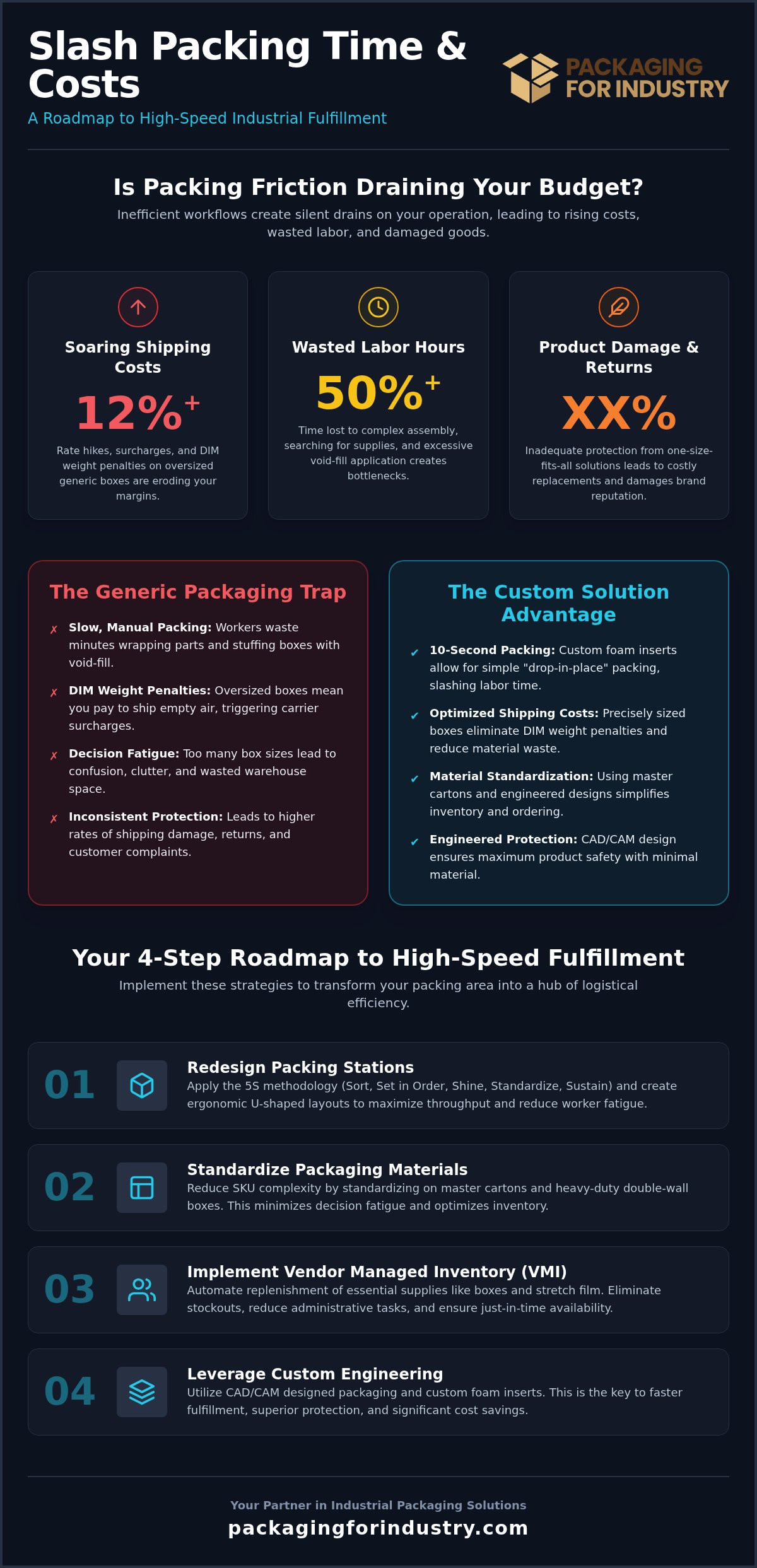
Why is your shipping department falling behind even as you add more labor to the packing floor? It’s a common frustration for warehouse managers who deal with labor-intensive processes for complex industrial parts and the constant threat of shipping damage. If you’re seeing shipping costs rise by as much as 12% due to 2026 surcharge triggers and dimensional weight changes, it’s time to rethink your strategy. Implementing custom packaging for faster order fulfillment is the most effective way to eliminate the friction that slows down your team and drains your budget.
We understand that warehouse clutter and lead-time surprises create professional stress you don’t need. This guide will show you how to streamline your industrial warehouse operations, optimize material usage, and implement supply chain strategies that slash packing times and lower overall costs. You’ll learn how engineered protection and better material selection can increase throughput at your packing stations while eliminating the stockouts that halt your production lines. By the end of this guide, you’ll have a clear roadmap to transform your packing area into a high-speed hub of logistical efficiency.
Key Takeaways
- Identify and eliminate packing friction by addressing the manual labor and material waste that create bottlenecks for your entire manufacturing line.
- Redesign your packing stations using the 5S methodology and strategic placement of high-volume items to maximize throughput.
- Reduce decision fatigue by standardizing on master cartons and heavy-duty double-wall boxes for industrial components.
- Implement Vendor Managed Inventory (VMI) to automate box and stretch film replenishment while cutting down on administrative tasks.
- Leverage custom packaging for faster order fulfillment through CAD/CAM design and custom foam inserts that allow for 10-second packing.
The Hidden Costs of Inefficient Industrial Packing Workflows
Packing friction represents the silent drain on your industrial operation. It’s the cumulative effect of excessive manual labor, material waste, and the logistical delays that occur when your shipping department can’t keep pace with your manufacturing line. When packing stations become congested, they create a reverse bottleneck. Finished goods sit on the floor instead of moving to the customer, which ties up capital and physical space. This inefficiency often manifests as cluttered workstations and ballooning overtime costs as teams struggle to clear the daily backlog.
The financial impact extends far beyond labor. Frequent shipping damage due to inadequate protection erodes your brand reputation and forces expensive returns. By applying principles of Packaging science and technology, you can identify where these friction points originate and how to resolve them. Utilizing custom packaging for faster order fulfillment ensures that every component is protected by design rather than by chance. If your team is constantly “making it work” with generic supplies, you aren’t just wasting time; you’re risking your bottom line.
Calculating the Real Cost of Packing Time
Measuring efficiency requires looking at the total fulfillment cost per order, not just the unit price of a corrugated box. High labor hours per package often stem from complex assembly requirements or excessive void-fill application. Additionally, emergency orders for packaging supplies carry hidden premiums. When you run out of boxes unexpectedly, you face expedited shipping fees and potential production downtime. Inefficient storage of obsolete or generic packaging stock also wastes valuable warehouse square footage. These secondary costs aggregate quickly, making a strong case for moving toward a more structured, engineered approach to your supply chain.
Why Generic Catalog Solutions Often Slow You Down
Generic catalog suppliers offer one-size-fits-all solutions that rarely fit industrial parts perfectly. This leads to the void-fill trap, where workers spend valuable minutes wrapping parts in bubble wrap or stuffing boxes with paper. Oversized packaging also triggers significant financial penalties. In 2026, FedEx and UPS utilize a dimensional (DIM) weight divisor of 139, meaning you’re billed for the size of the box rather than its actual weight. If you use a box that’s larger than necessary, you’re paying for air.
Switching to custom packaging for faster order fulfillment eliminates these surcharges. Instead of manual wrapping, custom-engineered foam packaging allows workers to drop parts into place, securing them in seconds. This precision reduces the pack-time per unit and ensures every shipment meets the strictest DIM weight requirements, shielding your business from the 7% to 12% rate hikes many shippers are seeing this year.
Redesigning Your Packing Station for Maximum Throughput
Workspace organization is just as critical as the materials you use. Adopting the ‘5S’ methodology: Sort, Set in order, Shine, Standardize, and Sustain, provides a framework for a high-performance packing environment. By eliminating unnecessary clutter, you remove the seconds wasted searching for a tape gun or a specific box size. Position your fast-movers, the high-volume items that account for the bulk of your orders, closest to the packing area to reduce travel time. Utilizing gravity-fed racks for corrugated boxes keeps supplies at eye level and ensures that the right size is always within reach. These structural changes are essential when implementing custom packaging for faster order fulfillment, as they ensure the physical environment doesn’t hinder your engineered solutions.
Integrating industrial-grade tools further accelerates the process. Automatic tape dispensers and machine stretch film wrappers replace slow, manual tasks with consistent, high-speed alternatives. These tools don’t just save time; they improve the structural integrity of your shipments by applying materials with a precision that manual application cannot replicate. When your station is optimized, your team can focus on the flow of goods rather than managing disorganized supplies.
Ergonomic Layouts for Industrial Operations
Designing a U-shaped or straight-line flow prevents the cross-traffic that causes warehouse congestion and safety hazards. Height-adjustable tables are another critical investment; they reduce worker fatigue and the packing errors that inevitably occur when staff are physically strained. Point-of-use storage is a key to 2026 warehouse efficiency as it places all necessary supplies within the operator’s immediate reach. This layout ensures that the movement of goods remains fluid and uninterrupted from the manufacturing line to the shipping dock.
Automating Repetitive Tasks with Industrial Supplies
Transitioning from hand stretch film to machine stretch film is a logical step for any operation scaling its pallet shipments. Machine wrappers provide superior load containment and use less material per pallet, which helps lower your per-unit shipping costs. Integrating digital scales and thermal label printers at the station removes the need for workers to walk to a central desk, further trimming the fulfillment cycle. For operations handling complex parts, packaging kitting pre-assembles protective components so the final packer can focus solely on the product. To see how these layout changes can impact your bottom line, you can request a packaging quote for a customized station setup.
Material Standardization: Reducing Decision Fatigue in the Warehouse
Decision fatigue occurs when warehouse staff must choose between dozens of similar box sizes or various types of void fill for every order. This hesitation slows down the packing line and leads to inconsistent quality across shipments. By standardizing on a limited set of “Master Cartons,” you simplify the decision-making process for your team. For heavy industrial components, utilizing double-wall or triple-wall boxes ensures that the container itself provides the necessary structural integrity without requiring extra layers of internal padding.
Stabilizing pallet loads also benefits from a standardized material approach. Incorporating corner and edge protection allows you to secure heavy items with fewer rotations of stretch film. This strategy is a cornerstone of custom packaging for faster order fulfillment because it replaces manual effort with engineered stability. Transitioning from loose-fill peanuts to custom-cut foam packaging further accelerates the process. Peanuts are messy, difficult to store, and slow to apply; custom foam inserts simply drop into place, providing superior protection in a fraction of the time.
Right-Sizing Your Industrial Inventory
Right-sizing is a technical approach that matches box dimensions precisely to the product’s physical profile. This reduces the need for void fill and directly addresses the 2026 shipping surcharge triggers mentioned in previous sections. When you eliminate empty space, you lower your DIM weight and per-unit shipping costs. Consulting with an experienced packaging manufacturer to audit your current SKU list can reveal opportunities to consolidate your inventory into fewer, more efficient sizes that serve multiple product lines.
Standardizing Protection with Custom Foam
Die-cut foam inserts are significantly faster to pack than manual alternatives like bubble wrap or air pillows. For specialized industries, using anti-static and ESD foam for sensitive electronics or aerospace components provides necessary protection while standardizing the packing workflow. Pre-designed protective assemblies eliminate guesswork for warehouse staff. Every worker follows the same high-speed process, which ensures that custom packaging for faster order fulfillment becomes a repeatable standard across your entire operation. This consistency reduces errors and ensures that your shipping department remains a reliable, high-throughput link in your supply chain.
Streamlining Logistics through VMI and Kitting Strategies
Logistical efficiency isn’t just about what happens at the packing table; it’s about what happens in the procurement office. Manual replenishment cycles often lead to administrative bottlenecks and unexpected shortages. By implementing Vendor Managed Inventory (VMI), you automate the replenishment of corrugated boxes and stretch film. This shift significantly reduces the time spent on repetitive purchase orders and administrative tasks. It allows your operations team to focus on production throughput rather than monitoring tape and pallet stock levels.
Leveraging kitting services provides another layer of operational speed. Instead of workers pulling individual corner protectors, custom foam inserts, and boxes from different aisles, they receive “ready-to-use” packaging sets. This is a primary driver of custom packaging for faster order fulfillment. It eliminates the search-and-gather time that often plagues industrial warehouses, ensuring that every component needed for a shipment is available in a single, organized kit. When your materials are pre-staged, the packing process moves with the purposeful speed of a well-oiled supply chain.
The Role of VMI in Eliminating Shortages
A VMI partner conducts regular usage reviews to prevent stockouts of critical shipping supplies. This proactive approach eliminates the “panic orders” that occur when a production spike catches a procurement team off guard. You also free up significant warehouse floor space by storing bulk inventory at PFI’s Anaheim facility. Storing supplies off-site until they’re needed improves your facility’s logistical flow and reduces clutter. Financially, VMI improves cash flow because you only pay for the materials you consume, rather than tying up capital in months of sitting stock.
Just-In-Time Delivery for Southern California Manufacturers
Proximity is a strategic advantage for aerospace and medical device suppliers in Orange County and Los Angeles. Utilizing local next-day delivery ensures that your packing line never stalls due to a late shipment of supplies. Just-In-Time (JIT) delivery models reduce the “panic time” associated with sudden shifts in demand or lead-time surprises from distant catalog suppliers. PFI’s local distribution network provides a logistical foundation for fast nationwide shipping. It ensures your products leave Southern California as quickly as they’re manufactured, maintaining your reputation for reliability. Using custom packaging for faster order fulfillment combined with JIT delivery creates a lean, responsive operation that can handle any production volume.
Custom Engineering: How Better Design Cuts Pack Times in Half
Engineering is the final piece of the efficiency puzzle. When you utilize CAD/CAM support, you aren’t just buying a container; you’re investing in a precision tool designed to fit your product like a glove. This level of accuracy eliminates the trial-and-error approach that often plagues shipping docks. The result is “Drop-In” speed. Custom foam inserts allow for 10-second packing of even the most fragile parts, effectively removing the manual labor bottleneck. For heavy machinery, designing custom wood crates that require zero additional void fill ensures that your largest shipments move as quickly as your smallest parcels. To begin a comprehensive damage-reduction audit, you can request a custom packaging quote today.
True efficiency is achieved when the packaging is designed alongside the product. This proactive strategy ensures that custom packaging for faster order fulfillment isn’t an afterthought but a core part of your logistical success. It removes the need for workers to improvise with generic supplies, which is where most time is lost in a traditional warehouse setting.
Prototyping for Faster Operational Rollouts
Free prototyping is essential for faster operational rollouts. It allows your team to test the fit and protection levels before committing to full-scale production. Custom inserts eliminate the need for complex, multi-material manual wrapping that slows down your staff and increases the risk of error. Custom-engineered solutions reduce both labor and material waste by providing exactly the protection needed without the excess. This streamlined approach ensures that once a design is approved, it can be integrated into your workflow with zero friction.
Solving Complex Industrial Challenges
Aerospace and medical device manufacturers face unique hurdles, such as mil-spec packaging requirements for high-value components. PFI specializes in integrating multiple materials, like heavy-duty corrugated, custom foam, and wood crates, into a single cohesive unit. This holistic design approach helps industrial clients lower packaging costs through technical utility rather than just cheap materials. By using custom packaging for faster order fulfillment, you ensure that your most complex parts are ready for transport with minimal handling. This engineering-first mindset is what separates a high-throughput operation from one that is constantly playing catch-up with its shipping backlog.
Optimizing Your Industrial Supply Chain for Long-Term Growth
True operational efficiency is achieved when your shipping department stops reacting to bottlenecks and starts preventing them. By redesigning your packing stations and standardizing your material inventory, you eliminate the decision fatigue that slows down your team. Transitioning to custom packaging for faster order fulfillment ensures that every part is protected by design while reducing the labor-intensive manual wrapping that drains your bottom line. Integrating VMI and kitting programs further stabilizes your supply chain; this allows you to focus on production rather than monitoring stock levels.
Packaging For Industry (PFI) acts as your expert partner in this transformation. We provide the CAD/CAM design support and free prototyping needed to solve complex industrial challenges. Our expertise in aerospace, medical, and manufacturing ensures your products reach their destination without damage. We offer fast nationwide shipping and local next-day delivery across Orange County, Los Angeles, and the Inland Empire to help you maintain a lean inventory without the risk of stockouts.
It’s time to transform your warehouse into a high-throughput engine that supports your business goals. We’re ready to help you lower costs and improve reliability starting today.
Frequently Asked Questions
What is the fastest way to reduce packing time for heavy industrial parts?
The fastest method is implementing custom-engineered crates and foam inserts that allow for “drop-in” packing. Instead of manual wrapping or constructing complex internal structures, workers place the part into a pre-shaped cavity. This approach eliminates the trial-and-error phase often found in shipping departments. Utilizing custom packaging for faster order fulfillment ensures that even heavy machinery or aerospace components are secured in seconds, which significantly increases your daily throughput.
How does right-sizing my boxes help reduce shipping costs?
Right-sizing reduces shipping costs by matching box dimensions precisely to your product’s size, which eliminates unnecessary empty space. This strategy directly addresses the 2026 dimensional weight (DIM) rules where carriers bill based on volume rather than actual weight. By removing the need for excessive void fill, you lower material expenses and avoid the cubic volume surcharges implemented by major carriers like UPS and FedEx earlier this year.
Can a VMI program really save my procurement team time?
Yes, a Vendor Managed Inventory (VMI) program automates the replenishment of your shipping supplies, which removes the burden of manual inventory tracking from your purchasing staff. PFI performs scheduled usage reviews and manages stocking levels for your corrugated boxes and stretch film. This process eliminates the need for repetitive purchase orders and prevents the “panic time” associated with unexpected packaging shortages or lead-time surprises.
What are the benefits of using custom foam inserts over bubble wrap?
Custom foam inserts provide superior protection and are significantly faster to apply than manual bubble wrapping. Unlike loose-fill or wrap, die-cut foam is engineered to the specific geometry of your product, ensuring consistent safety for high-value electronics or medical devices. This standardization removes the guesswork for your warehouse team, allowing them to pack fragile parts with a repeatable, high-speed process that reduces both labor hours and product damage.
How do I avoid UPS and FedEx dimensional weight surcharges?
You avoid these surcharges by using custom-engineered boxes that stay under the cubic volume triggers implemented in January 2026. Carriers apply “Additional Handling” fees to packages exceeding 10,368 cubic inches. By working with a packaging supplier to right-size your containers, you ensure that you aren’t paying for air. Custom packaging for faster order fulfillment allows you to maintain the smallest possible footprint while providing the necessary structural protection for industrial goods.
Why should I choose a local Southern California packaging supplier instead of a national catalog?
Local suppliers like PFI offer logistical advantages that national catalogs can’t match, such as next-day delivery across Orange County and Los Angeles. Proximity is vital for maintaining a lean inventory and responding to sudden production spikes. Unlike generic catalog providers, a local partner provides on-site packaging reviews and free prototyping. This hands-on approach ensures your custom crates and foam inserts are engineered correctly the first time, which reduces shipping delays.
Does custom packaging design take a long time to implement?
Implementation is surprisingly efficient when you utilize CAD/CAM design and free prototyping. PFI streamlines the process by creating samples that you can test for fit and protection before full-scale production begins. This engineering-first approach prevents the delays caused by improvised solutions using generic supplies. Once the design is finalized, our local distribution network ensures your custom boxes and inserts are delivered with the speed required by modern manufacturing schedules.
What is packaging kitting and how does it improve warehouse efficiency?
Packaging kitting is the process of pre-assembling all necessary shipping components, such as boxes, foam inserts, and labels, into a single, ready-to-use set. This strategy improves warehouse efficiency by eliminating the time workers spend gathering materials from different aisles. When a packer receives a kit, they can focus entirely on the product, which slashes the fulfillment cycle and ensures that every shipment meets the same high standard of protection and accuracy.