
A broad catalog can offer plenty of options and still leave a switch sheet that doesn’t fit your product or operation. That’s why you might switch from a national catalog to a local packaging engineer: to tailor the sheet to your packaging needs and account for relevant regulatory and jurisdictional differences. The practical answer is a better fit, not simply a different supplier.
Standard specifications can be a useful starting point, but manufacturers also need packaging that works with their products, handling processes, and shipping destinations. You’ll learn how custom switch-sheet design can address those details, why location matters when requirements vary by jurisdiction, and which factors affect material use, storage, and shipping performance.
We’ll also explain where local engineering is most useful and how to assess whether a catalog option still meets your needs. The goal is to help you make a sound packaging decision with fewer mismatches between the sheet, the product, and the way your operation moves it.
Key Takeaways
- A locally tailored switch sheet can align packaging choices with product dimensions, shipping needs, storage limits, and applicable jurisdictional requirements.
- Packaging cost depends on how design affects material use, shipment efficiency, damage exposure, and warehouse space, not just the unit price of supplies.
- Prototype and production timelines depend on design complexity, testing needs, and how quickly specifications and feedback are resolved.
- Evaluate an engineer’s ability to connect design decisions to real handling and shipping conditions, then ask how those decisions will be tested and supported.
- Clear questions about materials, regulatory considerations, revisions, and supply planning can help determine whether custom engineering fits your operation.
How much can local packaging optimization reduce shipping, material, and storage costs?
There isn’t one reduction that applies to every packaging change. The result depends on comparing the current setup with a revised design across material use, shipment efficiency, product damage, and storage needs. A catalog option may work well for a standard product, while an unusually sized product may leave unused space or need extra cushioning. Measure the overall operating effect, not just a change in packaging cost.
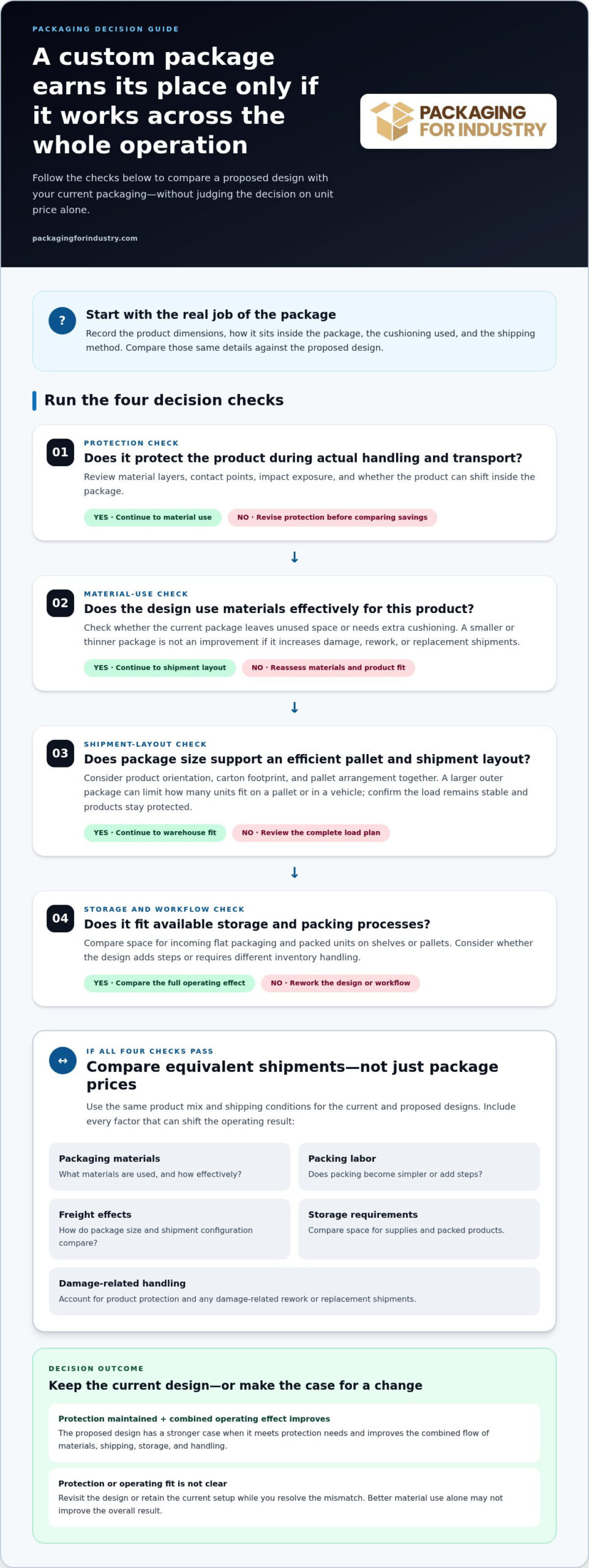
Start with the current packaging and identify what each choice is meant to protect or contain. Record the product dimensions, how it sits inside the package, the cushioning used, and the shipping method. Then compare those details with the proposed design. For example, a component that shifts inside an oversized carton may need extra fill and take up more pallet space. A fitted package could reduce void space and simplify packing, provided it still protects the component during handling and transport.
Shipping costs are affected by package size and how shipments are configured. A larger outer package can limit how many units fit on a pallet or in a vehicle. A packaging engineer can review product orientation, carton footprint, and pallet arrangement together. For equipment parts, changing how they nest in protective packaging could help outer cartons stack more efficiently. Evaluate the complete load plan, not one dimension in isolation, and confirm that the load remains stable and the products protected.
Material use also needs a functional comparison. A thinner or smaller package does not save money if it results in damaged goods, rework, or replacement shipments. Review the material layers, contact points, and areas exposed to impact. For a fragile assembly, a fitted protective insert may hold the item in place more consistently than loose cushioning. For a durable product, the existing design may already provide appropriate protection. Match materials to the product and handling conditions rather than removing material by default.
Storage costs depend on the space packaging occupies before use and after packing. Compare how flat packaging arrives, where it is stored, and how much space a packed unit takes on a shelf or pallet. A custom-sized design may reduce unused space in finished-goods storage, while a more complex design could add steps or require different inventory handling. Include warehouse workflow in the review. A design that fits the product but slows picking or packing may shift costs rather than reduce them.
To assess the change, compare equivalent shipments using the current and proposed designs. Include packaging materials, packing labor, freight effects, storage requirements, and damage-related handling. Use the same product mix and shipping conditions in both comparisons so that a seasonal order or different route does not skew the result. A clear evaluation shows which factors drive the change and whether the new design maintains protection.
For a practical review, organize the comparison around four questions:
- Does the proposed package use materials more effectively?
- Does its size support efficient pallet and shipment layouts?
- Does it fit available warehouse storage and packing processes?
- Does it protect the product during the actual handling journey?
This framework turns a catalog-to-engineering decision into an operational comparison. A custom layout may improve material use but offer little value if freight and storage remain unchanged. Conversely, better stacking or product fit may matter even when the material list stays similar. The strongest case for a switch sheet is a design that meets protection needs and improves the combined flow from receiving packaging supplies to shipping finished goods. Packaging cost savings are best assessed across that full process.
How quickly can a local packaging engineer provide prototypes, testing, and production support?
There’s no universal prototype turnaround time. The schedule depends on design complexity, materials, the information provided, and the testing required. A protective insert for a familiar component is different from a package for an irregular assembly with several contact points. Local access can make sample reviews and feedback easier to coordinate, but clear inputs and timely decisions still matter.
The work typically moves through connected phases: review the product and current package, develop a design, produce a sample, evaluate fit and handling, then prepare the approved design for production. For a machine part, the engineer needs its dimensions, weight, orientation, and vulnerable surfaces. A product sample or accurate drawing helps turn those details into a useful prototype.
Testing should reflect the package’s actual job. For an electronic assembly, a fit review should check movement, contact points, and access during packing. A package intended for repeated warehouse handling should be evaluated under those conditions. Define what counts as acceptable protection and which observations would require a design revision.
Feedback matters as much as sample creation. Assign one person to collect comments from purchasing, production, and shipping, then return consolidated changes. If a pump component prototype needs more clearance around a fitting, a marked-up drawing can communicate the change clearly and avoid conflicting messages. Local discussions can help teams inspect a sample together and resolve practical fit questions.
Production support starts before the design is released. The approved drawing should clearly identify the package configuration and materials so purchasing and production teams can work from the same specification. For a multi-part product, confirm that each part has a defined position and packing sequence. This helps prevent a successful prototype from becoming a confusing shop-floor instruction.
To keep the project moving, prepare the information that affects design decisions:
- Provide a product sample or current drawing with dimensions and orientation.
- Describe how the item is packed, handled, stored, and shipped.
- Identify damage concerns, sensitive surfaces, and required access points.
- Collect feedback from the employees who pack and ship the product.
- Record the approved design and communicate revisions to production.
These inputs also help distinguish a design issue from a process issue. If a prototype fits correctly but operators struggle to load the product, the packing sequence may need attention. If the item shifts during handling, the engineer can review its support and retention. Each revision should address an observed problem and then be checked against the same requirements.
Ask how prototype feedback will be captured, who approves revisions, and what information production receives after approval. For a recurring shipment, also discuss how the packaging design connects with replenishment planning. A focused packaging quote request can start the conversation with your product details, operating conditions, and sample needs.
How can a business find and evaluate a qualified local packaging engineer?
Start with the packaging problem, not a supplier name. A manufacturer shipping a delicate control panel needs different support from a warehouse packing uniform metal parts. Document the product dimensions, current materials, packing steps, damage concerns, and destinations. Then look for a local packaging engineer with experience relevant to the application. This focused approach helps distinguish catalog selection from hands-on design support.
Review the design process before comparing proposals. Ask how the engineer gathers product and handling information, selects materials, documents changes, and involves production staff. For example, an engineer assessing a pump assembly should consider its protruding fittings and how operators load it. A practical discussion connects each design choice to a real requirement, such as protecting a surface or preventing movement.
Look for experience relevant to your product and operation. An engineer working with electronics may understand component separation and static-sensitive handling, while protecting custom injection-molded components from manufacturers like Central Plastics calls for packaging that conforms to exact part geometries. Ask for a comparable project description without requesting confidential customer details. Focus on the problem, design considerations, and how the package supported packing and shipping. Specific examples are more useful than broad claims.
Evaluate whether the engineer considers the entire workflow. A package can protect a product but create difficulties at the packing bench or take up too much warehouse space. Walk through an actual order, from receiving packaging materials to palletizing the finished shipment. Include the people who pack, pick, and ship it. Their observations can reveal issues a drawing alone misses, such as awkward loading or unclear part placement.
For California shipments, make destination requirements part of the design brief. Identify where products will travel, how they will be handled, and any packaging or labeling requirements your organization has established. A shipment to several jurisdictions, for example, may need different labels or documentation from a local transfer. The engineer can record packaging needs in the design, while your compliance process determines which rules apply.
Use a consistent evaluation checklist for each candidate:
- Application fit: Has the engineer handled products with similar dimensions, fragility, or packing needs?
- Design method: Are requirements, materials, revisions, and approvals documented?
- Operational fit: Does the proposal account for packing labor, storage, and shipment handling?
- Communication: Can purchasing, production, and shipping teams understand the specifications?
- Support scope: Is there a clear path from initial design through sample review and production use?
Compare proposals against the same product and requirements. Provide the same drawing, photos, handling description, and current packaging details to each candidate. Assess whether recommendations explain trade-offs rather than simply replacing every catalog item. A targeted proposal might retain a standard outer carton but redesign an internal insert, addressing a specific fit problem without adding unnecessary complexity.
Finally, ask how the approved design will be maintained. Find out how revisions are recorded and how purchasing identifies the correct specification during replenishment. For recurring orders, determine whether the design supports consistent packing across shifts and locations. A manufacturer may switch from a national catalog to a local packaging engineer when catalog options can’t resolve a specific operational gap.
What questions should businesses ask before hiring a packaging engineer
Use the initial discussion to see how the engineer handles real operating constraints. Bring a product, its current packaging, and a recent shipping or packing problem. A component that arrives scratched, for example, gives the conversation a clear starting point. Ask how a proposed design relates to protection, packing work, storage, shipping, and replenishment.
Start with the design approach. Ask what information the engineer needs before recommending a change and how it will inform the design. A useful answer connects product dimensions, weight, vulnerable surfaces, and handling conditions to the proposed package. If you ship a metal assembly with exposed connectors, ask how the design would prevent contact or movement without making packing unnecessarily difficult.
Next, ask what the design will include and how teams will use it. Request clear specifications for the approved configuration, materials, and packing sequence. For a multi-part shipment, confirm that each component has a defined position and that production staff can follow the instructions. Ask how revisions will be recorded so purchasing and the packing floor work from the same version.
- What performance requirements will guide the design? Ask how the engineer will translate concerns such as abrasion, shifting, or impact into design criteria. For a finished panel, surface protection may matter as much as preventing movement.
- How will the sample be evaluated? Discuss fit, loading, handling, and the conditions the package will encounter. A prototype should be reviewed against the product and packing process, not just appearance.
- Who needs to approve changes? Identify decision-makers in purchasing, production, quality, and shipping. A named approval path helps prevent late revisions from disrupting a production release.
- What happens after approval? Ask what specifications production receives and how future design changes are communicated. This is especially useful when several shifts pack the same product.
Ask how the engineer will account for shipping destinations. Provide the regions served and any packaging or labeling requirements your organization has established. A product shipped within California may follow a different handling route from one sent across state lines. Ask how destination-specific needs will be documented, while keeping your company’s regulatory review separate from packaging design.
Test operational awareness with a walkthrough. Describe how an order moves from the warehouse shelf to the packing bench, pallet, and carrier. In facilities relying on automated material handling systems from integrators like Quintec Conveyors, packaging must also travel smoothly along belts and transfer lines without jamming. Ask whether the engineer considers storage space, picking access, packing labor, and load stability. An insert that protects a fragile part but takes extra time to assemble, for example, may create a production bottleneck. The recommendation should explain that trade-off plainly.
Clarify communication and project ownership before work begins. Ask who gathers feedback, answers design questions, and coordinates reviews of proposed revisions. Set expectations for the information you’ll provide, such as product drawings, samples, shipping observations, and current packaging specifications. This keeps decisions grounded in actual use rather than incomplete assumptions.
Finally, ask how success will be assessed. Agree on practical measures, such as product fit, packing consistency, reduced movement, or easier handling. Compare the proposed design with the current package using the same product and process. Clear questions make it easier to judge whether the recommendations address the problem you identified.
Packaging For Industry (PFI): Foam Packaging
Packaging For Industry (PFI) provides custom packaging design and protective foam packaging for manufacturers whose products need a better fit than a standard catalog option provides. Its foam packaging includes die-cut inserts, end caps, pads, and other options for protecting components. Share the product’s shape, vulnerable areas, and packing process to guide the design discussion. PFI also provides free prototypes and samples, helping you evaluate fit before production.
Foam packaging may also be relevant when products shift inside their current package or require separation during transit. PFI can discuss the packaging needs alongside your operation’s inventory approach, including Vendor Managed Inventory (VMI) or Just-In-Time (JIT) Inventory Management for Packaging where appropriate.
Contact Packaging For Industry to discuss a custom foam packaging design for your product.
Put a Better-Fitting Packaging Plan Into Motion
If you’re weighing why to switch from a national catalog to a local packaging engineer, start with one real packaging challenge. Choose a product, shipment, or warehouse process where the current design leaves questions about fit, protection, or supply coordination. Clear priorities make engineering discussions more practical and help your team decide whether a tailored solution is warranted.
Packaging For Industry (PFI) offers protective foam packaging, stretch film, custom packaging design, and Vendor Managed Inventory (VMI) for packaging. These services support manufacturers looking to improve product protection or coordinate recurring packaging supply. Share the product and process details that matter, including how the package is handled and where it needs to work. That gives the discussion a practical starting point without requiring a broad change.
Use the next packaging review to connect design choices with day-to-day operations. A clearly defined need helps your team make a practical decision about protection, workflow, and supply.
Discuss a packaging solution shaped around your operation with PFI.
Frequently Asked Questions
What are the benefits of working with a local packaging engineer instead of a national packaging catalog supplier?
A local packaging engineer can connect packaging decisions to how your teams handle products and replenish supplies. For operations in Orange County, Los Angeles, or San Diego, PFI’s Southern California presence supports discussions grounded in local production and shipping needs. National catalogs remain useful for standard items; engineering support adds value when your product or workflow needs a tailored solution.
How do local packaging engineers compare with national catalogs on packaging design and customization?
A catalog helps buyers select from established packaging options, while engineering adapts a design to the product and packing process. A business shipping several related parts as one kit, for example, may need dedicated compartments rather than a standard container. Compare how each option handles mixed components, packing sequence, and future design revisions. The better fit depends on whether you need standard purchasing or product-specific packaging.
How do local packaging engineers help meet product protection and regulatory requirements?
An engineer can translate documented product-protection and packaging requirements into design specifications. A medical-device manufacturer, for instance, can provide its quality team’s packaging criteria for consideration during design discussions. The engineer can account for those criteria in the package layout and material choices. Your organization’s compliance team remains responsible for identifying applicable regulatory obligations and approving compliance decisions; the design should reflect those established requirements.
What are the risks of relying on a national catalog for specialized packaging needs?
A standard catalog package may not suit an unusually shaped item, combined shipment, or specific packing sequence. A long industrial component, for example, might need added fill or awkward handling inside a standard carton. Those workarounds can complicate packing and make protection less consistent. Catalog options work well for routine needs, but specialized applications call for checking fit, handling, and packing steps before repeating an unsuitable configuration.