
The supplier with the bigger catalog isn’t automatically the right choice for a shipment that needs a purpose-built crate. In the Grainger vs local specialist for custom crating in Los Angeles decision, focus on whether the quoted scope fits your product, handling needs, and shipping route. A familiar purchasing channel may make sourcing straightforward, but a heavy, fragile, or high-value item may need design input and coordinated protection beyond a standard option. Confirm Grainger’s current custom-crating services and quote details directly rather than assuming what its catalog can or can’t cover.
This comparison helps you choose based on documented requirements, not supplier size or assumptions. We’ll look at crate design, protective materials, prototypes, export requirements to verify, lead times, repeat-order consistency, and how to compare quotes with equivalent scopes. For Los Angeles County businesses, an industrial packaging supplier such as Packaging For Industry can provide custom crate design, CAD/CAM support, prototypes or samples, and coordinated crate-and-foam solutions, depending on project scope and availability. The goal is a clearly defined quote that supports product protection, reliable procurement, and fewer avoidable shipping problems.
Key Takeaways
- Compare confirmed project fit, not assumptions about either supplier’s capabilities.
- Ask each supplier to document design support, crate materials, foam integration, prototype options, and how design revisions are handled.
- Prepare one consistent request for quote so you can compare design, protective components, quantities, and delivery assumptions on equal terms.
- Check how each supplier manages repeat orders, lead times, and supply consistency for your shipment and location.
- Consider PFI’s custom crate design, CAD/CAM support, prototypes, and coordinated packaging options, then confirm project scope and availability when requesting a quote.
Custom Crating in Los Angeles: What the Supplier Must Solve
Start with the shipment, not the supplier’s catalog. A catalog purchase may suit a straightforward, repeatable need. A custom-engineered crate may be a better fit when the product, handling needs, or route calls for a tailored design. Some projects need both: a designed crate with complementary packaging materials.
A custom crate is designed around the product it holds, how it will be handled, and the shipment context. A crate is a rigid shipping container, but choosing the right design takes more than measuring its outside dimensions. Buyers making the Grainger vs local specialist for custom crating in Los Angeles comparison should check whether each supplier can address the product’s fit and protection needs, explain its design support, define the quote, coordinate supply, and support repeat orders. Confirm Grainger’s current custom-crating scope, design assistance, lead times, and quote terms directly.
When a custom crate deserves a supplier comparison
An oversized industrial component may not fit a standard container. A heavy machine part may need secure support during handling, while a fragile or high-value assembly may need a closer review of how it is restrained and protected. Prior damage, unusual dimensions, or a specialized shipping method are practical reasons to review the packaging design before ordering.
Consider order frequency, too. A one-time shipment may need a single project-specific solution. Recurring production or shipping needs raise additional questions: Can the supplier reproduce the approved design? How will future orders be managed? Those requirements affect the value of design collaboration and the purchasing process.
What Los Angeles buyers should establish first
Prepare shipment details before requesting a quote. Record the product’s dimensions and weight, identify fragile areas and handling points, and provide the destination and relevant shipping details. Note whether the product may need foam lining, blocking, or other cushioning, and describe any damage history or handling concerns. For repeat orders, include your expected order pattern so suppliers can assess the supply requirement.
Ask each supplier to confirm what its quote includes: design work, crate construction, protective components, quantities, and delivery assumptions. This helps prevent a low-looking quote from being compared with a more complete proposal. PFI offers custom packaging design services, including CAD/CAM support and prototypes or samples. Confirm project scope and availability for your Los Angeles County location. Learn more about custom packaging design services.
Clear shipment requirements make supplier comparisons more useful: each quote can address the same product, protection needs, quantities, and delivery expectations.
Custom Crate Design and Protection: Compare the Work Behind the Quote
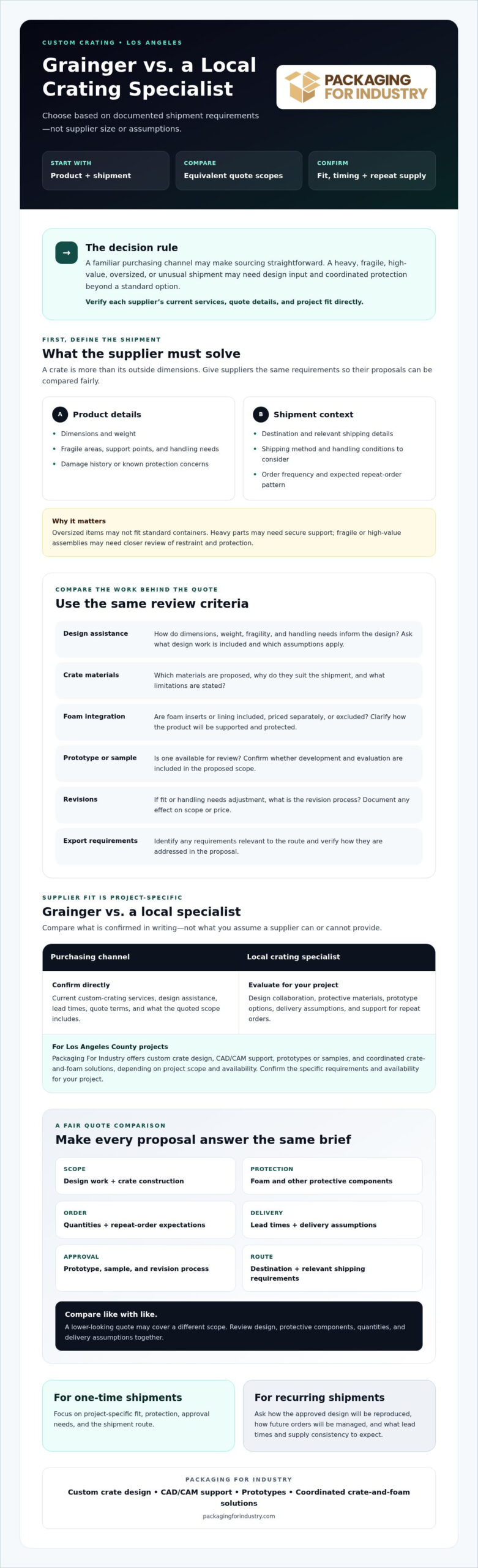
A custom crate quote should describe more than the finished container. It should explain how the supplier translated your product and handling requirements into a design, which protective materials are included, and what falls outside the quoted scope. For the Grainger vs local specialist for custom crating in Los Angeles comparison, request written answers from both suppliers instead of assuming either provides a particular design service or material.
Comparison criteria
- Design assistance: How will product dimensions, weight, fragility, and handling requirements inform the design? Document the included design work and any assumptions.
- Materials: Which crate materials are proposed, and why do they suit the shipment? Record the material choices and any stated limitations.
- Foam integration: Are foam inserts or lining included, priced separately, or excluded? Clarify how the product will be supported and protected.
- Prototype or sample: Is a prototype or sample available for review? Note whether development and evaluation are included in the quote.
- Revisions: What happens if the fit or handling approach needs adjustment? Document the revision process and whether changes affect the scope or price.
Assess design and protective fit
Ask each supplier to explain how the crate accommodates the product’s shape, support points, and handling needs. A component with delicate surfaces, for example, may need protective separation, while an irregular assembly may need specific internal support. Don’t treat foam as included unless the quote says so. Ask suppliers to list foam lining, inserts, blocking, and other protective components separately when their inclusion or price is unclear.
For international shipments, identify the destination and ask which wood-packaging requirements apply. The USDA provides guidance on international standards for wood packaging. Confirm the shipment’s requirements and the supplier’s proposed scope against current documentation.
Use prototypes to check fit before rollout
A prototype or sample can help your team check product fit, placement, access, and handling before approving a design for broader use. Ask whether the proposal covers prototype development, evaluation, and any resulting design changes. PFI provides custom packaging design services, including CAD/CAM support and prototypes or samples. Confirm availability and project scope when requesting a quote.
A packaging prototype lets buyers evaluate fit and handling before committing to a wider packaging rollout. To discuss a specific crate and protection requirement, you can request a custom packaging quote with the shipment details and desired review process.
Grainger vs. a Local Crating Specialist: Compare Service and Supply Fit
Neither supplier type is automatically the better choice. A large catalog supplier may fit established purchasing and account processes. A local specialist may be worth considering when a project needs design collaboration or coordinated protective packaging. The practical question in the Grainger vs local specialist for custom crating in Los Angeles comparison is what each supplier can confirm for your shipment, location, and ordering pattern.
Assess catalog sourcing on confirmed scope
If your team values established purchasing workflows or an existing account relationship, check whether those advantages apply to the crate order itself. Ask Grainger to confirm the specific crate’s availability, whether design assistance is included, how the quote defines materials and protection, and what order terms and lead-time estimates apply. Verify coverage for the delivery location directly. A broad catalog or existing relationship alone doesn’t establish that a particular custom crate can be supplied on the terms you need.
Evaluate what local coordination adds
A local specialist may be worth assessing when you need to coordinate a wood crate with foam packaging or other protective materials. This can be useful for an industrial shipment when standard packaging may not fit the product or protection requirements. PFI serves manufacturers and businesses in industries including aerospace, electronics, medical devices, automotive, and industrial equipment.
Packaging For Industry is an Anaheim-based industrial packaging supplier serving Los Angeles County and Southern California. Its custom crate design, CAD/CAM support, and prototype or sample capabilities can help teams evaluate a project’s fit and protection needs. Confirm the scope and availability for your shipment. Review PFI’s custom wooden crate options as part of your supplier assessment.
Compare both suppliers using the same request and record their answers side by side. Check:
- Crate availability: Can the proposed design be supplied for the product and order quantity?
- Engineering contact: Who can clarify design decisions and protection assumptions?
- Quote detail: Which design work, materials, foam, quantities, and delivery assumptions are included or excluded?
- Local coordination: What delivery arrangements can be confirmed for the shipment location?
- Repeat orders: How will the approved design and future orders be managed?
Clear answers help you assess protection, purchasing effort, and supply consistency alongside price. A framework for evaluating suppliers can help organize criteria such as quality, cost, and delivery performance.
Supplier fit depends on the confirmed project scope, not supplier size alone. Choose the provider whose products, service, and supply terms match your shipment and business needs.
How to Compare Custom Crating Quotes and Reduce Procurement Risk
A crate quote is easier to assess when each supplier is pricing the same shipment and protection scope. Before comparing prices, check whether proposals include equivalent design work, materials, protective components, quantities, and delivery assumptions. This gives manufacturers and warehouses a clearer basis for balancing quote details with damage exposure and supply needs.
Prepare one comparable custom crating request
Send each supplier the same information: product dimensions, weight, fragility, required quantity, destination, and expected order frequency. Include available drawings or photos, known handling challenges, prior shipping damage, and timing requirements. Ask suppliers to identify assumptions, exclusions, and any information they still need to prepare an accurate quote.
Review the quote before choosing
Use a side-by-side review. Check whether each response clearly states:
- Design scope: What design work is included, and what information or approvals are required?
- Materials and protection: Which crate materials and protective components are specified? Is foam included or quoted separately?
- Prototype expectations: Is a prototype part of the proposal, and how are evaluation and requested changes handled?
- Quantity and delivery: What quantity is priced, what delivery assumptions apply, and what lead-time estimate is provided?
- Changes and repeat orders: How will revisions, future orders, and communication be managed?
Confirm service coverage and delivery details for the exact Los Angeles-area ship-to location. Then consider the broader purchasing picture: a well-defined crate scope can help reduce shipping damage and avoid paying for protection or services the shipment doesn’t need. Ask suppliers to explain any rush-order assumptions, since timing can affect feasibility and quote terms. For recurring demand, clarify how the approved design will be identified and reordered to support consistent supply and help manage packaging costs over time.
For the Grainger vs local specialist for custom crating in Los Angeles decision, rely on documented scope rather than headline price alone. Resolve exclusions, compare equivalent proposals, and select the supplier whose confirmed capabilities and supply terms meet the shipment’s needs.
Choose a Los Angeles Custom Crating Partner and Request a Quote
Choose the supplier whose confirmed crate design, protective materials, quote scope, and supply terms match your shipment. In the Grainger vs local specialist for custom crating in Los Angeles comparison, neither a broad catalog nor a local presence is enough on its own. Verify the specific capabilities, delivery arrangements, and order terms you need before selecting a partner.
When PFI may be a practical local option
Packaging For Industry is an Anaheim-based industrial packaging supplier serving Los Angeles County and Southern California. For a project requiring custom crate design, ask about CAD/CAM support, prototypes or samples, foam-lined crates, and coordinating crates with foam or other packaging materials. Scope and availability depend on the project, so confirm what applies to your product and destination.
If shipping damage or packaging performance is a concern, ask whether a packaging review could help assess the current approach and identify design considerations. PFI offers packaging reviews focused on damage reduction and cost-reduction analysis. The supplier should explain how proposed protection addresses your product’s handling needs and which elements are included in the quote.
What to send with a quote request
Give the supplier enough detail to evaluate the job. Include:
- Product dimensions and weight, plus photos or available drawings.
- Shipment destination and required crate quantity.
- Known damage concerns, handling requirements, and limitations of the current packaging.
- Expected repeat-order needs and any relevant timing requirements.
These details help the supplier clarify design assumptions, protection options, quote scope, and delivery feasibility for the exact Los Angeles-area location. They also provide a starting point for discussing whether a prototype or combined crate-and-foam approach is appropriate. Confirm delivery timing and project scope directly before planning around an estimate.
Share your shipment requirements with PFI to discuss a project-specific packaging solution.
Make Your Crating Decision With Confidence
The right choice in the Grainger vs local specialist for custom crating in Los Angeles comparison is the supplier that confirms a suitable design, protection plan, quote scope, and supply process for your shipment. Compare written responses against the same requirements, including what’s included, what’s excluded, and how future orders will be handled.
Packaging For Industry is an Anaheim-based industrial packaging supplier serving Los Angeles County and Southern California. Its capabilities include custom crate design, CAD/CAM support, prototypes and samples, and coordinating crates with foam and other packaging materials. These options depend on project scope and availability, so share your shipment details and confirm what fits your application.
Clear requirements and comparable quotes support a practical decision about product protection and procurement. Send PFI your project details to discuss a custom crating quote.
Frequently Asked Questions
Is Grainger or a local specialist better for custom crating in Los Angeles?
Neither option is automatically better. Choose the supplier whose confirmed design, protection, quote scope, and supply terms fit your shipment. Compare both providers using the same product details and questions. Check crate availability, design assistance, foam options, delivery arrangements, and repeat-order support. Verify current capabilities and terms directly with each supplier before making a purchasing decision.
Does Grainger offer custom crating?
Confirm Grainger’s current custom-crating offering directly, since availability, design support, service coverage, lead times, and quote terms may depend on the project. Provide the product dimensions, weight, destination, quantity, and protection needs, then ask what the quote includes and excludes. Clarify whether crate design, foam or other protective components, prototypes, and delivery are included, separately quoted, or outside the available scope.
What information should I provide for a custom crate quote?
Provide the product’s dimensions and weight, required quantity, destination, and expected order frequency. Include photos or drawings if available, and describe fragile areas, handling points, known shipping damage, and limitations of the current packaging. Identify whether foam lining, blocking, or other cushioning may be needed. Clear details help suppliers assess the same requirements, identify missing information, and define design, material, and delivery assumptions in the quote.
When should a business choose a custom wood crate instead of a standard shipping container?
Consider a custom wood crate when a product’s size, shape, weight, fragility, or handling requirements aren’t adequately addressed by a standard container. Industrial equipment, an irregular component, or a product with a history of transit damage may warrant a packaging design review. The right choice depends on the item and shipment, so document support and protection needs and ask a supplier to explain the proposed design and scope.
Can a local crating specialist include foam protection in a crate?
Some specialists can coordinate foam protection with a crate, but confirm the materials and design scope for your project. Packaging For Industry offers custom wood crates, foam-lined crates, and foam packaging, and can assess whether crate and foam components can be combined for the shipment. Ask whether foam is included in the quote or priced separately, how the product will be supported, and whether a prototype or sample is available.
How do I compare custom crating quotes without choosing on price alone?
Compare what each quote covers: design work, crate materials, foam or other protective components, quantity, prototype expectations, delivery assumptions, and revision terms. Check exclusions and confirm lead-time estimates and service coverage for your exact Los Angeles-area location. For recurring orders, ask how suppliers will manage the approved design and future replenishment. A clear scope helps you weigh protection and supply reliability alongside the quoted price.