
What if reducing LTL damage starts with changing where protection is applied, not simply adding more packaging? Shared-freight handling can expose products to impacts, compression, vibration, and load movement. A box that works in storage may not be enough for the journey.
Damage claims and replacement work disrupt operations, while packaging changes can add material, labor, or freight costs. To learn how to reduce product damage in LTL shipments, start with evidence. Inspect damaged goods, review photos and claim notes, and look for recurring patterns such as crushed corners, punctures, or shifted loads. This helps identify the risk before you choose a fix.
This guide explains how to assess damage causes, select corrugated boxes and cushioning suited to the product, and stabilize pallets with appropriate stretch film and edge protection. It also covers how to test packaging changes and track damage alongside total shipping impact, so added protection earns its place. When standard packaging doesn’t fit the product or shipping method, custom packaging design and prototypes can help refine the solution. The goal is practical protection that supports reliable shipping without adding unnecessary cost.
Key Takeaways
- Use shipment records, package condition, and load configuration to identify recurring damage patterns before changing materials.
- To understand how to reduce product damage in LTL shipments, match box construction, cushioning, partitions, or foam to the product and observed failure mode.
- Follow a consistent packing and palletizing sequence, then check that products and unit loads are stable before dispatch.
- Test one targeted packaging change at a time where practical, and document damage, packaging use, and freight impacts.
- When standard packaging doesn’t fit, custom packaging design and prototypes can help evaluate a better-fitting solution without assuming added protection guarantees damage-free delivery.
Why product damage happens in LTL shipments, and where to look first
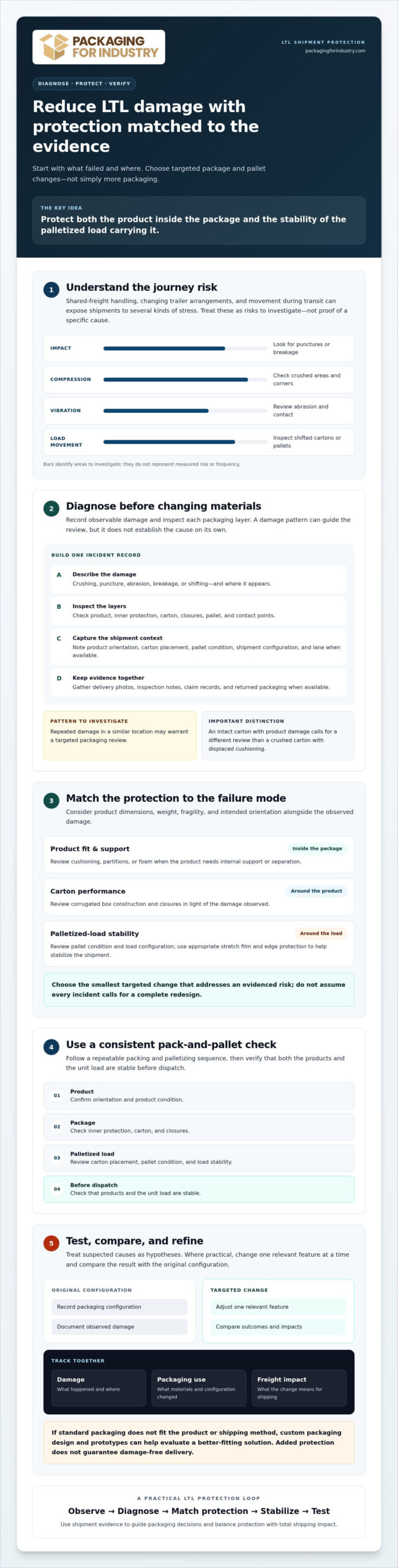
LTL freight shares transportation and handling resources with other shipments. The route, trailer arrangement, and handling sequence can vary, and freight may be moved or repositioned during transit. As the overview of Less-than-truckload shipping explains, LTL shipments can face handling, vibration, and compression risks. Load movement, impacts, poor package fit, or an unstable palletized load may also contribute to damage. These are possibilities to investigate, not proof of what happened in a specific shipment.
Start by reviewing four areas: product fragility, packaging performance, pallet stability, and shipment-handling evidence. A fragile product may need more internal support; a damaged carton may point to a different concern than a shifted pallet. The location and pattern of damage can guide the investigation, but they don’t establish the cause on their own.
Quotable takeaway: “LTL protection must account for both the package around the product and the stability of the palletized load carrying it.”
Which LTL damage patterns should a shipper investigate?
Describe what you can observe before assigning a cause: crushing, puncture, abrasion, breakage, or shifting. Note where the damage appears. A crushed carton corner could be consistent with compression or impact; scuffing may suggest contact or movement. Neither observation alone confirms how the damage occurred.
Record whether the product, inner protection, carton, pallet, or several layers show damage. For example, an intact carton with a damaged product calls for a different review from a carton with a crushed corner and displaced cushioning. These observations help distinguish product vulnerability from a packaging or unit-load issue and give the team a clearer basis for the next review.
What shipment evidence helps narrow down the cause?
Gather delivery photos, inspection notes, claim records, and returned packaging when available. Capture the product’s orientation, carton condition, pallet condition, and any visible movement in a consistent way. Photos of multiple sides and packaging layers make comparisons more useful.
Then compare reports by product, packaging configuration, and shipment lane where records allow. Repeated damage in a similar location may warrant a targeted packaging review; a single incident may not show a recurring pattern. Keep observations separate from conclusions so the next packaging change addresses an evidenced risk.
How to diagnose LTL shipping damage before changing packaging
Before ordering stronger cartons or adding cushioning, establish what failed and where. A structured review helps teams learn how to reduce product damage in LTL shipments without treating every incident as proof that the packaging needs a complete redesign.
Work through the issue in sequence:
- Define the damage: Record what happened to the product and where the damage appears.
- Inspect the package: Check the inner protection, carton, closures, and contact points for visible changes.
- Map the load: Note product orientation, carton placement, pallet condition, and shipment configuration.
- Test a targeted change: Adjust one relevant feature where practical, then compare the outcome with the original configuration.
Include product dimensions, weight, fragility, and intended orientation in the review. A compact, heavy component and a fragile item with a broad footprint may need different protection, even if both arrive with damaged cartons. Also record the shipment lane and pallet configuration when available. NMFTA’s guidance on packaging best practices for LTL can provide additional context as teams review their own loads.
Packaging changes should address an observed failure mode, not guesswork. Separate recurring patterns from isolated incidents, and treat each suspected cause as a hypothesis until the evidence supports it.
How should teams document damaged LTL shipments?
Use one incident record format across shifts and locations. Capture product condition, inner packaging, carton, pallet, and shipment identifiers where available. Add photos that show the damage in context, including the package exterior and affected contents, and follow your company’s documentation process. Track repeat incidents by product and packaging configuration. This makes comparisons more useful without mistaking a small sample for an industry benchmark.
How can teams distinguish packaging failure from load problems?
Inspect cushioning for displacement, check for internal movement, and note carton deformation, closure condition, and contact marks. Then assess the palletized load: did cartons shift, lean, or lose containment? A displaced insert and a leaning load point to different questions, but neither proves a cause alone. Record the findings, compare them with shipment evidence, and test the most relevant change before assigning blame.
If the review points to a fit or protection issue, a custom packaging quote can help evaluate options against the product and shipment configuration.
How to compare packaging options for reducing LTL product damage
Choose packaging by matching the observed failure mode to the product and shipment configuration. A useful comparison considers product weight, fragility, dimensions, orientation, pallet arrangement, and whether the damage affected the product, package, or load. Then weigh protection and fit against assembly effort, material use, and possible effects on shipment size. The goal is a suitable configuration, not simply more material.
Corrugated box construction: Compare the existing box with a suitable stock or custom corrugated option if the carton deforms, fits poorly, or doesn’t suit the product’s weight and dimensions.
Internal cushioning and foam: Consider cushioning when the product moves inside the carton or needs protection at specific contact points. Foam may be useful when shaped support or a more controlled fit is needed.
Partitions and dividers: Evaluate these when multiple items contact each other or shift within a shared carton. Their purpose is to separate and position contents, not automatically replace cushioning.
Pallet and load protection: Review pallet suitability and arrangement when the load leans or shifts. Stretch film and corner or edge protection can help contain and protect the unit load, but they don’t replace cushioning around the product.
Compare each option using the same criteria. Note expected fit, protection for the observed failure mode, assembly steps, material use, and any change to the packed shipment’s dimensions or configuration. Confirm carrier-specific requirements separately rather than assuming one packaging setup applies to every lane.
When should a shipper consider custom corrugated boxes or foam?
Consider custom sizing when incident evidence shows excess space, poor fit, or recurring product movement. Evaluate foam inserts, end caps, or partitions against product geometry and the contact points identified during inspection. PFI offers corrugated box options alongside foam packaging. A packaging review can help assess how those components work together before changing a recurring configuration.
When do pallet and edge-protection changes matter?
Focus on the unit load when cartons lean, shift, or show damage along exposed edges. Check whether the pallet supports the arrangement and whether stretch film and corner or edge protection suit the load’s shape. These components help stabilize or shield the palletized freight; product-level cushioning still needs to address movement and contact inside each package.
A practical way to assess how to reduce product damage in LTL shipments is to compare the current configuration with one targeted adjustment, then document both protection and operational impact. Avoid assuming that a heavier box or more wrap will solve a problem if the evidence points to fit, cushioning, or pallet stability instead.
How to prepare and stabilize an LTL shipment step by step
A repeatable packing sequence keeps product protection and pallet stability in view from the start. Use this checklist for packaging for manufacturers, warehouses, and distribution centers, then confirm any carrier-specific packaging, marking, or documentation instructions before release. Requirements can vary, so don’t assume one set of directions applies to every shipment.
- Inspect the product. Confirm its condition, dimensions, weight, fragile areas, and intended shipping orientation before packing.
- Select the package. Choose a carton that fits the product and shipment needs. Check that the selected cushioning, inserts, or dividers support the product and limit internal movement.
- Pack and close the carton. Position the product as intended, protect exposed edges and contact points, and check for movement before closing. Use closure materials and methods suited to the carton and shipment configuration.
- Prepare the palletized load. Arrange cartons to support a stable load. Where the configuration allows, avoid unsupported overhang and keep the load aligned on the pallet.
- Contain and inspect. Use suitable stretch film and corner protection to help contain and protect the unit load. Check carton closures, alignment, containment, and visible damage before dispatch.
- Confirm shipment details. Verify markings and documents against the shipper’s process and the carrier’s current instructions.
How should a product be packed inside its carton?
Fit cushioning and inserts to the product so they maintain its intended orientation and separation in transit. Before closing the carton, check for movement, product-to-carton contact, and exposed edges that lack protection. Dividers can separate multiple items; cushioning or inserts can help limit movement around an individual product. Select the closure method for the carton and shipment, then inspect the closed package for visible gaps or damage.
How should cartons be arranged and secured on a pallet?
Build the load with cartons arranged to support stability, and avoid unsupported overhang where the configuration permits. Apply suitable stretch film and corner protection to help contain the cartons and shield exposed edges. Neither replaces cushioning inside each package. Before release, check that the load remains aligned and contained, then confirm shipment markings and documentation follow verified shipper and carrier instructions.
For a review of box, cushioning, and load-stabilization options for your shipment, request a packaging quote.
How to test packaging improvements and build a reliable LTL solution
Before changing a packaging configuration, establish a baseline using available damage reports, packaging usage, and relevant freight impacts. Record the product, packaging setup, shipment lane, and load configuration so you can compare similar shipments. This gives your team a practical way to assess how to reduce product damage in LTL shipments while keeping operational impact in view.
Where practical, test one targeted change at a time. If the evidence points to product movement inside the carton, adjust the internal protection before revising the pallet setup. Track product condition, packaging materials, assembly effort, and freight effects together. A change may help address a recurring issue, but document results rather than assuming or guaranteeing them.
What should teams measure after a packaging change?
Use a consistent method to record damage incidents and product condition across comparable shipments. Note the packaging configuration, materials used, packing effort, and relevant freight effects, such as changes to the shipment’s dimensions or load arrangement. Compare results with the baseline and keep monitoring before extending the change to other products or shipment lanes. This helps teams understand whether a benefit persists without making broad claims from limited evidence.
When can a packaging supplier help solve repeat LTL damage?
Design input can help when standard packaging doesn’t fit product dimensions or recurring shipping conditions. Packaging For Industry offers custom and stock corrugated boxes, foam, stretch film, pallets, and protective materials, with design, prototypes, and packaging reviews focused on damage reduction. Coordinating these components can help manufacturers, aerospace and electronics companies, medical device producers, and warehouse teams evaluate protection alongside material use and packing effort.
Packaging For Industry supports industrial businesses nationwide and offers local next-day delivery across Southern California. Its packaging reviews and cost-reduction analysis provide practical support for evaluating repeat issues and improving supply reliability, without promising damage-free shipments or specific savings.
Turn LTL damage findings into a repeatable packaging process
Reducing damage starts with evidence. Document where products and packaging fail, compare incidents by product and shipment configuration, then select protection that addresses the observed risk. Corrugated boxes and internal cushioning protect the product, while pallets, stretch film, and protective materials help stabilize the unit load.
To improve how to reduce product damage in LTL shipments, test targeted changes and track product condition alongside material use, assembly work, and freight effects. Review the results before adopting a change more broadly. This practical process helps teams improve protection while keeping operational impact in view.
Packaging For Industry offers custom and stock corrugated boxes, foam, stretch film, pallets, and protective materials, along with packaging design, prototypes, and reviews focused on damage reduction. PFI supports businesses nationwide and offers local next-day delivery across Southern California. Confirm delivery details for your order.
With a measured approach and packaging suited to the shipment, your team can make informed improvements and build greater confidence in each LTL load.
Frequently Asked Questions
How can I reduce product damage in LTL shipments?
Start by identifying the damage pattern, then inspect the product, packaging, and palletized load before changing materials. Match the carton, cushioning, and load stabilization to the product’s dimensions, weight, fragility, and shipment configuration. Check for internal movement, carton deformation, and shifting on the pallet. Track results across comparable shipments, including packaging use and freight effects, so changes respond to evidence rather than assumptions.
Is a double-wall corrugated box enough for an LTL shipment?
Not necessarily. A double-wall box may be appropriate for some products, but box construction alone doesn’t account for every risk. Fit, product weight and fragility, internal cushioning, closures, and pallet stability also affect protection. Review how the product and carton performed in actual shipments, and confirm any applicable carrier packaging requirements. If the carton is intact but the product is damaged, investigate internal movement or contact points before selecting a stronger box.
Can stretch film prevent products from shifting on a pallet?
Stretch film can help contain cartons as a unit load, but it shouldn’t be treated as a substitute for proper product packaging or a stable pallet arrangement. Review carton alignment, load shape, and pallet suitability, then use film and corner or edge protection as appropriate to help secure the load. If products are moving inside their cartons, address that separately with suitable cushioning, inserts, or dividers.
How do I choose cushioning for a fragile product shipped by LTL?
Choose cushioning based on the product’s shape, fragile areas, orientation, and observed damage, rather than selecting material by name alone. Check whether the product can move inside the carton or contact its walls during handling. Inserts, pads, end caps, or dividers may suit different needs. Trial a configuration that supports the product and document its performance, including any changes to packing effort or material use.
What should I document when an LTL shipment arrives damaged?
Record the product condition and damage location, plus the condition of the inner protection, carton, and pallet. Take clear photos of the damage and packaging layers where possible, and note product orientation, visible movement, and shipment identifiers. Keep inspection notes and claim records with the incident information, following your company’s documentation process. Consistent records help distinguish recurring patterns from isolated events and support a focused packaging review.
Are custom boxes and foam inserts worth considering for recurring LTL damage?
They’re worth evaluating when records point to poor fit, excess space, repeated product movement, or specific contact damage. Custom corrugated boxes and foam inserts can be designed around product dimensions and identified protection needs, but assess assembly work, material use, and shipment configuration as well. Packaging For Industry offers custom and stock packaging, design, prototypes, and damage-reduction reviews for industrial businesses nationwide and across Southern California.
How can I test whether a packaging change reduces shipping damage?
Set a baseline using available damage reports, packaging configuration, material use, and relevant freight impacts. Where practical, change one targeted feature at a time and compare the results across comparable shipments. Track product condition, incidents, packing effort, and changes to shipment dimensions or load arrangement. Continue monitoring before making broader claims or applying the change to other products. A trial can inform decisions, but it can’t guarantee future shipments will be damage-free.