
A single non-compliant crate can stall a million-dollar shipment at a foreign port for weeks. You already know that international shipping is a high-stakes environment where one small oversight in wood packaging leads to rejected cargo, massive fines, and strained client relationships. Finding reliable heat-treated wood crates for export Southern California manufacturers and distributors can trust shouldn’t be the most difficult part of your logistics chain. When you’re moving high-value aerospace components or medical equipment, the cost of failure is simply too high to rely on generic catalog solutions that don’t account for your specific dimensions.
We understand that procurement managers need more than just a container; they need a guarantee of compliance and structural integrity that eliminates professional stress. This guide will show you how to secure ISPM-15 compliant, custom-engineered wood crates that protect your industrial goods and ensure smooth passage through customs. We’ll explore the technical standards required for global transit, the benefits of working with a local Anaheim partner for next-day delivery, and how optimized crate sizing can significantly lower your total logistics costs without sacrificing protection.
Key Takeaways
- Understand the critical role of ISPM-15 certification and why heat treatment is mandatory to prevent costly shipment rejections at international ports.
- Discover how custom-engineered designs protect sensitive aerospace and medical equipment better than one-size-fits-all catalog crates.
- Learn how sourcing heat-treated wood crates for export Southern California from a local Anaheim supplier enables next-day delivery and reduces logistics lead times.
- Explore how integrated solutions like protective foam inserts and heavy-duty skids work together to eliminate transit damage for oversized industrial machinery.
- See how Vendor Managed Inventory (VMI) can streamline your warehouse operations and lower total packaging costs by optimizing your crate supply chain.
Understanding ISPM-15 Compliance for Southern California Exporters
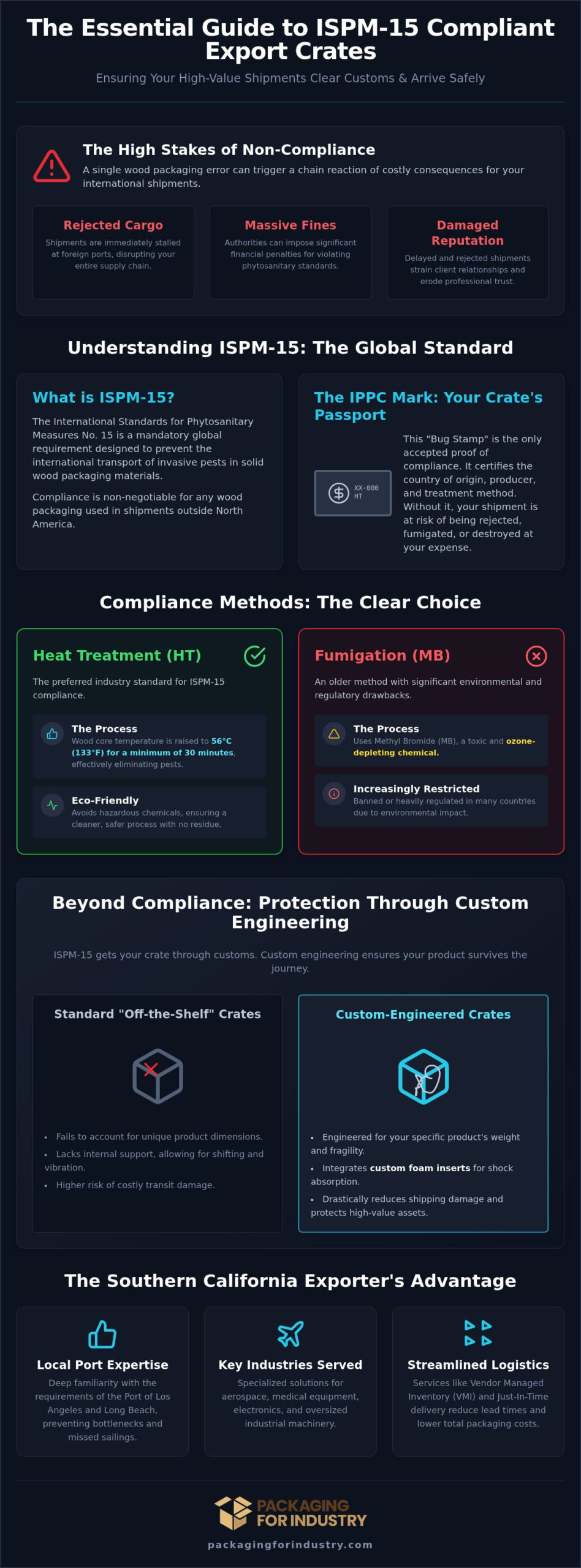
International trade relies on a set of rigid standards designed to prevent the spread of invasive species through wood packaging. ISPM-15, or the International Standards for Phytosanitary Measures No. 15, is the global benchmark that governs how wood materials are treated before crossing borders. For any manufacturer shipping goods outside North America, compliance isn’t a suggestion; it’s a mandatory operational requirement. When you procure heat-treated wood crates for export Southern California facilities must ensure every unit is properly processed to eliminate wood-boring pests that could devastate foreign ecosystems.
The most critical identifier of compliance is the IPPC mark, commonly known as the “Bug Stamp.” This permanent mark on the wood serves as the crate’s passport. It identifies the country of origin, the specific producer, and the treatment method used. Without this visible certification, your cargo becomes a significant liability. Customs officials at international destinations don’t just look for the stamp; they verify its authenticity through official databases. If a crate lacks the proper marking or shows signs of infestation, the consequences are immediate. Your shipment could be held for expensive on-site fumigation, rejected entirely, or even destroyed at your expense. These delays don’t just cost money in port fees; they damage your professional reputation and disrupt your customer’s supply chain.
The Heat-Treatment (HT) Process vs. Fumigation
The heat-treatment process involves placing the wood in a specialized kiln until its core temperature reaches 56°C for a minimum of 30 minutes. This method is the preferred industrial standard because it’s environmentally friendly and doesn’t involve the hazardous chemicals found in traditional fumigation. While some shippers still use Methyl Bromide fumigation, it’s increasingly restricted due to its ozone-depleting properties. Choosing HT certified crates from a reputable Southern California packaging supplier ensures your packaging is compliant with the strictest global regulations without the chemical residue concerns associated with fumigation. It’s a cleaner, more efficient way to guarantee your cargo is ready for global transit.
Exporting from the Port of Los Angeles and Long Beach
Southern California is home to the Port of Los Angeles and the Port of Long Beach, the busiest container port complex in the United States. Logistics managers in this region face unique pressures regarding volume and processing speed. Ensuring your crates are compliant before they reach the terminal is essential to maintaining your shipping schedule. Local compliance prevents bottlenecks that can lead to missed sailings. Because PFI operates as a certified crating facility in Anaheim, we undergo rigorous monthly inspections from third-party agencies to maintain our standing. This oversight guarantees that every unit we build meets the high-stakes requirements of these major SoCal hubs. Using heat-treated wood crates for export Southern California suppliers provide locally means your documentation is accurate and your cargo moves through the port without friction.
Custom-Engineered Export Crates: Beyond the Standard Box
Meeting compliance standards is only the first step in successful international shipping. While ISPM-15 certification gets your cargo through customs, it doesn’t guarantee your equipment survives the physical rigors of ocean or air transit. Off-the-shelf crates often fail because they aren’t designed to handle the specific center of gravity or fragile points of high-value industrial machinery. Relying on a generic catalog box for a multi-million dollar asset is a gamble that often results in expensive shipping damage and operational downtime. We focus on engineering heat-treated wood crates for export Southern California manufacturers can depend on, ensuring every structural element supports the weight and sensitivity of the contents.
True protection happens from the inside out. A well-built exterior shell is useless if the product inside is allowed to shift or vibrate. This is why we prioritize the integration of custom foam packaging for internal shock absorption. By using precision-cut polyethylene or polyurethane inserts, we create a secure environment that isolates your product from transit-related impacts. For oversized loads exceeding 10,000 lbs, engineering shifts toward heavy-duty skids and reinforced bases. These structures are built to withstand the stresses of forklift handling and crane lifting at busy terminals. Before we move to full production, we offer free prototyping to verify that the fit and weight distribution meet your exact requirements.
Material Selection: Plywood vs. Dimensional Lumber
The choice of materials depends heavily on your shipping method and the nature of your cargo. Fully enclosed plywood boxes are an excellent choice for lightweight export compliance. They provide total protection from dust and debris while keeping the overall shipment weight down to reduce air freight costs. Conversely, open-slat crates are better suited for machinery that requires ventilation to prevent moisture buildup. When dealing with extreme weights, we utilize dimensional lumber to construct heavy-duty skids that provide the necessary rigid support for industrial equipment. If you’re unsure which material fits your budget and protection needs, you can request a packaging quote to compare different engineering options.
Protective Inserts and Mil-Spec Options
Industrial goods often require more than just physical bracing. Sensitive electronics, for instance, need anti-static or ESD foam inserts to prevent electrical discharge during handling. For ocean shipments, vapor barrier packaging is essential to block salt air and moisture that cause corrosion. These specialized requirements are common in highly regulated sectors. You can explore our aerospace packaging solutions to see how we handle these technical challenges for flight-critical components. By combining heat-treated wood crates for export Southern California standards with advanced internal barriers, we ensure your goods arrive in factory-fresh condition, regardless of the destination.
Selecting the Right Crate for Your Industry
One-size-fits-all packaging doesn’t exist in the world of industrial logistics. The structural requirements for a 15,000-pound CNC machine are vastly different from the precision needs of a satellite housing or a delicate medical imaging array. Selecting the right heat-treated wood crates for export Southern California manufacturers require involves balancing material strength, internal protection, and logistical efficiency. We analyze your specific industry standards to ensure your crate is more than just a box; it’s a calculated part of your quality control process.
For the aerospace and defense sectors, crating must account for high-value, flight-critical components that cannot tolerate vibration or environmental exposure. We utilize custom-engineered enclosures that often integrate with our aerospace packaging solutions to provide total security. In contrast, heavy industrial machinery often benefits from skeleton crates or heavy-duty skids. These designs offer the necessary structural rigidity for oversized loads while allowing customs officials to inspect the equipment without dismantling the entire enclosure. Medical device manufacturers, however, prioritize cleanliness and professional presentation. We provide foam-lined, clean-cut wood packaging that protects sensitive calibration while reflecting the high standards of the medical field.
Heavy-Duty vs. Lightweight Export Needs
Logistics costs are heavily influenced by the weight and volume of your packaging. While heavy-duty dimensional lumber is essential for supporting massive equipment, it adds significant weight to your shipment. For lighter goods, we often recommend plywood-based crates. These are ISPM-15 compliant by nature and help you avoid the high dimensional weight (DIM) surcharges common in air freight. We also help procurement managers decide between one-way export crates and reusable systems. If you’re shipping between your own global facilities, a rugged, reusable crate with high-quality hardware can lower your long-term packaging spend significantly compared to buying new units for every transit.
Custom Crates for Trade Shows and Recurring Use
When your equipment needs to travel to multiple international trade shows, the crate needs to be as functional as the product it holds. We design recurring-use crates with easy-access panels, recessed handles, and durable latches that don’t require specialized tools to open. This prevents damage during the unboxing process at the venue. We also incorporate internal kitting solutions to keep cables, accessories, and components organized and secure. You can find more detail on these specialized engineering processes through our custom design packaging services. By focusing on the end-user experience, we ensure your team can focus on the show rather than struggling with a broken or poorly designed shipping container.
Procurement Strategies for Southern California Manufacturers
Efficiency in the industrial supply chain depends on proximity and vendor reliability. Relying on national catalog vendors for bulky items like heat-treated wood crates for export Southern California often leads to inflated shipping costs and unpredictable lead times that stall your production. By partnering with a local bulk packaging supplier in Anaheim, you gain access to next-day delivery throughout Irvine, Los Angeles, and the Inland Empire. This proximity allows your operations team to maintain a leaner inventory, as you don’t need to store dozens of oversized crates for weeks when a local partner can deliver them exactly when your production line is ready.
Managing warehouse floor space is a constant challenge for high-volume manufacturers. We solve this through Vendor Managed Inventory (VMI) and just-in-time delivery schedules. Instead of crates sitting idle and collecting dust, we monitor your usage and restock your supply automatically. This proactive approach eliminates the stress of last-minute orders and ensures you never miss a shipping window due to a lack of compliant packaging. It’s about moving from a reactive purchasing model to a predictable, engineered flow that supports your bottom line.
Lowering Total Packaging Costs
Buying crates in isolation is often an expensive mistake for procurement managers. Many fall into the trap of paying the high markups associated with generic catalog suppliers who lack specialized engineering expertise. We help you achieve significant packaging cost savings by consolidating your industrial needs. By combining your crate orders with high-volume items like corrugated boxes, stretch film, and foam inserts, you leverage your total spend for better pricing. This holistic view of your supply chain provides a measurable ROI that single-item purchasing simply cannot match.
Streamlining the RFQ Process
A fast turnaround starts with an accurate Request for Quote (RFQ). To get the most precise pricing and ensure structural integrity, provide your supplier with the exact dimensions, weight, and fragility points of your product. Our team utilizes CAD/CAM support during the design phase to ensure every structural support is placed with engineering precision. While we focus on Southern California, we also maintain the capacity for nationwide shipping to support your multi-site operations. This ensures that whether you’re shipping from Anaheim or a remote facility, your standards for heat-treated wood crates for export Southern California remain consistent across your entire organization.
Why Choose Packaging For Industry (PFI) for Export Crating
Choosing a partner for international logistics requires more than just finding a vendor; it requires a consultant who understands the intersection of engineering and economics. Packaging For Industry (PFI) provides direct access to packaging experts from our Anaheim headquarters. We don’t hide behind a call center or a third-party broker. You work directly with the designers and builders responsible for your cargo’s safety. As a leading Anaheim packaging supplier, we offer a level of accountability that national distributors can’t match. Every unit of heat-treated wood crates for export Southern California manufacturers receive from us is built to survive the high-volume traffic of the Port of Los Angeles and beyond.
We provide a true one-stop-shop experience. While we specialize in custom crating, we’re also a premier source for wholesale shipping supplies, including stretch wrap, heavy-duty corrugated boxes, and specialized protective foam. This integrated approach ensures that your internal and external packaging work in harmony. Our facility undergoes rigorous ISPM-15 audits every month, guaranteeing that every crate leaving our dock is 100% compliant and ready for immediate export. We handle the entire process from free prototyping to final assembly, allowing your team to focus on production while we manage the logistics of protection.
The PFI Difference: Engineering Meets Economics
Our philosophy centers on the idea that the most expensive crate is the one that fails. We design our solutions to eliminate the professional stress associated with shipping damage and operational downtime. By utilizing our custom design services, you aren’t just buying wood; you’re investing in a system that reduces your total cost of risk. We also offer customized stocking programs tailored to your recurring usage. If you ship the same components monthly, we’ll keep your crates in stock for next-day delivery. This strategy frees up your warehouse space and improves your cash flow by removing the need for bulk on-site storage.
Get Your Custom Export Crating Quote
Securing your international supply chain starts with a simple conversation. Our local Southern California team is ready to analyze your current packaging spend and identify opportunities for optimization. Whether you’re looking for custom boxes in Los Angeles or specialized crating in Orange County, we provide the reliability and speed needed to keep your production moving. Don’t settle for the high markups and slow turnarounds of generic catalog suppliers. Experience the PFI difference and see how an industrial packaging supplier near me can improve your bottom line and supply chain reliability. Contact us today to request a custom packaging quote from a professional team that values your time and budget.
Secure Your International Supply Chain with Precision Crating
International shipping success depends on more than just building a box. It requires a partner that balances rigorous regulatory compliance with precise structural engineering. By sourcing heat-treated wood crates for export Southern California from an ISPM-15 certified facility, you eliminate the risk of rejected cargo and expensive port fines. Don’t settle for generic catalog boxes when you can secure a custom-engineered solution. Our local Anaheim team provides free prototyping and CAD design to ensure your high-value equipment is protected from the physical rigors of transit.
Transitioning to a local partnership also streamlines your daily operations. With next-day local delivery in SoCal, you can reduce warehouse clutter and improve cash flow through more efficient inventory management. We focus on the intersection of engineering and economics to help you lower packaging costs while maintaining absolute supply chain reliability. Our goal is to provide the peace of mind that comes from knowing your logistics are handled by experts who understand the stakes of global trade.
We look forward to helping you move your industrial goods safely and efficiently across the globe.
Frequently Asked Questions
How do I know if my wood crate is ISPM-15 compliant?
Compliance is verified by the presence of the International Plant Protection Convention (IPPC) mark, commonly called the “bug stamp.” This mark must be visible on at least two sides of the crate. It includes the country code, a unique producer identification number, and the “HT” designation for heat treatment. We maintain an ISPM-15 certified facility in Anaheim, ensuring every unit we build meets these rigorous global standards for export.
What is the lead time for custom heat-treated crates in Southern California?
Lead times depend on the complexity of the engineering, but our local proximity in Anaheim allows for significantly faster turnarounds than national catalog suppliers. For recurring orders, we often provide next-day delivery throughout the Inland Empire and Los Angeles. Custom designs involving free prototyping usually take a few business days from the initial design phase to final assembly. We prioritize speed to keep your production lines moving without interruption.
Do you provide on-site crating services in Orange County or Los Angeles?
We specialize in the precision manufacturing and delivery of custom-engineered crates from our Anaheim headquarters. While we don’t provide mobile on-site crating teams, we deliver fully assembled or kitted crates directly to your facility in Orange County or Los Angeles. This allows your team to secure cargo quickly using professional-grade enclosures designed specifically for your equipment’s dimensions and fragility points.
Can you integrate custom foam inserts into export crates?
Yes, we specialize in integrating high-performance foam inserts into our wood packaging solutions. We utilize polyethylene (PE), polyurethane (PU), and anti-static (ESD) foam to isolate sensitive components from transit-related shock and vibration. Combining these internal protective materials with heat-treated wood crates for export Southern California manufacturers use ensures that even the most delicate aerospace or medical devices arrive in factory-fresh condition.
Is heat-treatment required for plywood crates?
Plywood is an engineered wood product that is generally exempt from ISPM-15 requirements because the manufacturing process involves high heat and pressure that kills pests. However, any dimensional lumber used for the crate’s base, skids, or internal bracing must still be heat-treated and stamped. We ensure that every component of your export packaging, whether plywood or solid wood, meets the specific compliance rules of your destination country.
What is the difference between a crate and a skid for international shipping?
A crate is a fully or partially enclosed container that protects cargo from environmental debris and physical impact, while a skid is a heavy-duty platform designed for oversized machinery. Skids are often used for air freight to reduce weight or for equipment that requires crane lifting. Crates offer more comprehensive protection for sensitive goods. We help you evaluate the ROI of each option based on your product’s value and the shipping route.
How does a VMI program work for wood packaging?
Our Vendor Managed Inventory (VMI) program transfers the responsibility of inventory tracking and restocking to our team. We monitor your recurring crate usage and deliver replacements before you run out. This program is designed to eliminate warehouse clutter and reduce the administrative burden on your procurement team. It’s a proactive strategy that ensures you always have compliant packaging ready for your next international shipment.
Can PFI help with Mil-Spec wood packaging requirements?
We provide a full range of military-spec packaging solutions that meet the rigid standards of the defense and aerospace industries. This includes constructing crates to specific MIL-STD requirements and integrating vapor barriers or specialized cushioning. Our expertise in heat-treated wood crates for export Southern California defense contractors rely on ensures that your cargo meets all federal and international shipping mandates without the risk of compliance delays.