
Shipping damage isn’t just a logistical hiccup; it’s a direct tax on your company’s bottom line that erodes your margins and ruins client relationships. You’ve likely dealt with the frustration of high product rejection rates because of vibration scuffing or seen your warehouse space vanish under mountains of generic foam that doesn’t actually fit your components. Partnering with a specialized shock and vibration dampening foam fabricator Anaheim manufacturers can rely on ensures your high-value assets are protected by engineering rather than luck.
We understand that procurement managers in Orange County need more than just a supplier; they need a partner who can reduce lead times and optimize supply chain reliability. This article explores how custom-engineered foam inserts protect your industrial components from transit damage while reducing your overall logistical footprint in Southern California. We’ll look at the benefits of local CAD/CAM design, the impact of free prototyping on your ROI, and how Vendor Managed Inventory (VMI) can streamline your warehouse operations for better efficiency.
Key Takeaways
- Learn the technical differences between shock and vibration protection to ensure your high-value components are shielded from both impact and transit energy.
- Discover how a local shock and vibration dampening foam fabricator Anaheim businesses rely on can eliminate hidden freight costs and provide next-day delivery.
- Compare die-cutting and CNC routing methods to find the most cost-effective fabrication path for your specific production volume and design complexity.
- Understand how Vendor Managed Inventory (VMI) programs and local kitting services can reduce your warehouse footprint and streamline your supply chain.
- Identify the optimal foam materials, such as Polyethylene and Polyurethane, to maximize protection while minimizing material waste and overall packaging costs.
Understanding Shock vs. Vibration Dampening for Anaheim Manufacturers
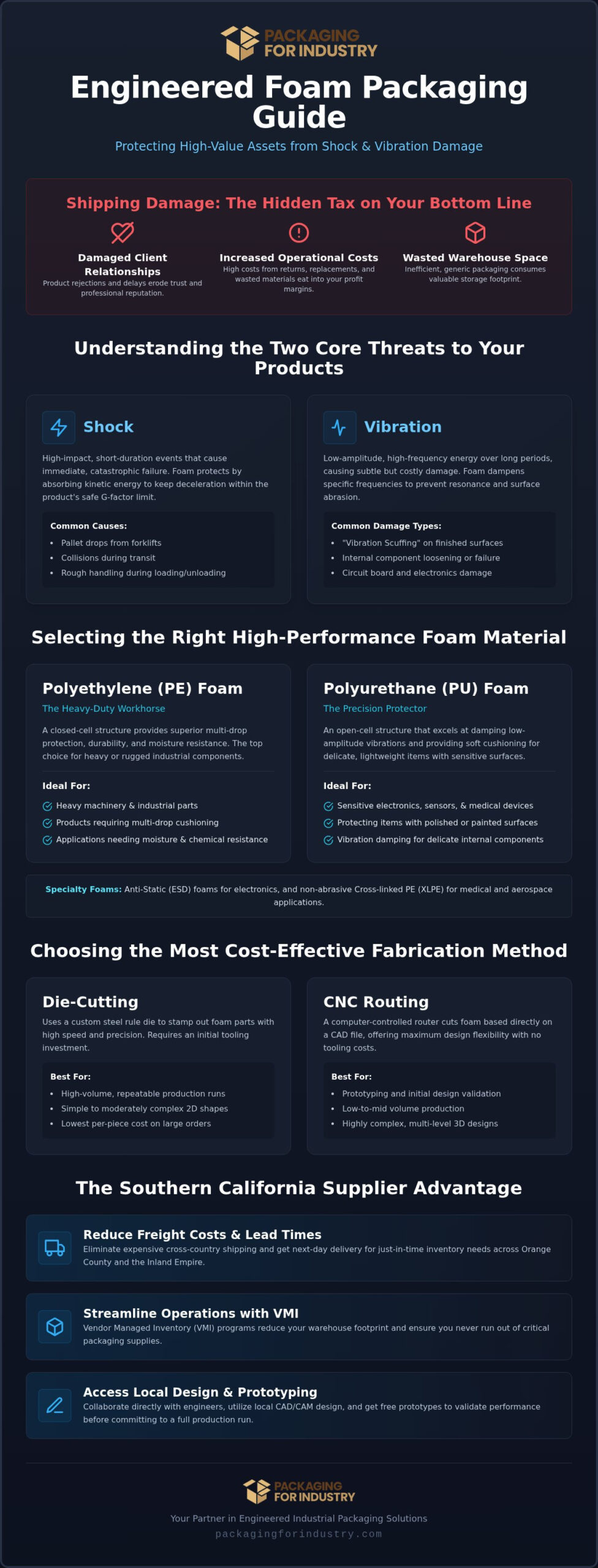
Many procurement professionals use the terms “shock” and “vibration” interchangeably when discussing protective packaging. They shouldn’t. While both forces threaten your product’s integrity, they represent different physical challenges that require distinct engineering responses. Shock refers to high-impact, short-duration events, such as a pallet dropping from a forklift or a collision during transit. Vibration, conversely, is low-amplitude, high-frequency energy that occurs over long periods, typically caused by truck beds on the I-5 or rail transit. As a specialized shock and vibration dampening foam fabricator Anaheim manufacturers rely on, we’ve seen how failing to distinguish between these two leads to either catastrophic failure or expensive over-packaging.
Anaheim’s proximity to major shipping hubs like the Port of Long Beach and Ontario International Airport creates a unique risk profile. Your products likely spend significant time on local freeways before reaching their final destination. This extended “road time” subjects sensitive electronics and medical devices to constant resonance. If your material choice doesn’t account for these specific frequencies, you’ll face high rejection rates due to internal component failure or “vibration scuffing,” even if the box arrives looking perfectly intact. Choosing the right foam packaging isn’t just about cushioning; it’s about managing the specific energy profile of your supply chain.
The Mechanics of G-Force Protection
Foam protects your product by absorbing kinetic energy and dissipating it as heat through its cell structure. Every industrial component has a fragility rating, or “G-factor,” which represents the maximum acceleration it can withstand before breaking. Our goal is to engineer an insert that decelerates the product within a safe distance. If the foam is too stiff, the shock is transmitted directly to the part. If it’s too soft, the part “bottoms out” against the outer container. We use custom design packaging techniques to find the “sweet spot” where protection is maximized without wasting material. Over-packaging is a common mistake that inflates your logistics budget and increases your warehouse footprint unnecessarily.
Vibration Scuffing and Surface Protection
Vibration damage is often more subtle than shock damage but equally costly. Constant movement during long-distance freight leads to surface abrasion, especially on polished or painted surfaces. Closed-cell foams are typically superior for these applications in Southern California because their dense cell structure provides a smoother contact surface that resists “grabbing” the product. This prevents the micro-movements that cause scuffing. By selecting a material with the correct density and cell structure, you ensure that high-value industrial components arrive in pristine condition, ready for immediate use or sale. This level of precision is why working with a local shock and vibration dampening foam fabricator Anaheim specialist is vital for maintaining your professional reputation.
Selecting High-Performance Foam Materials for Precision Dampening
Selecting the right material is the most critical step in engineering a protective solution. As a leading shock and vibration dampening foam fabricator Anaheim companies trust, we offer a variety of polymers tailored to specific G-force requirements. Polyethylene (PE) foam serves as the heavy-duty workhorse of the industry. Its closed-cell structure provides excellent multi-drop protection, making it ideal for heavy machinery or large industrial components that might face repeated impacts during long-haul shipping. It’s durable, moisture-resistant, and maintains its shape even under significant loads.
For lighter, more sensitive items, Polyurethane (PU) foam is often the superior choice. This open-cell material is highly effective at damping low-amplitude vibrations, protecting delicate internal optics or sensors from the constant resonance of transit. In Anaheim’s specialized electronics sector, we frequently provide Anti-Static and ESD foams to prevent electrostatic discharge from damaging sensitive circuit boards. When your application requires a high-end aesthetic or zero-particulate matter, such as in medical cleanrooms or aerospace assemblies, Cross-linked Polyethylene (XLPE) provides a non-abrasive, non-dusting solution that maintains its integrity under extreme conditions.
Density and Indentation Force Deflection (IFD)
Material performance isn’t just about the type of foam; it’s about the density and the Indentation Force Deflection (IFD) rating. Density directly correlates to how much weight the foam can support before it compresses too far. For heavy equipment, high-density PE is required to prevent the product from “bottoming out” against the outer box. For delicate medical devices, a softer IFD is necessary to ensure the foam actually compresses enough to absorb energy during a drop. Indentation Force Deflection is a measurement of the pressure required to compress a foam sample by 25 percent of its original height, serving as a primary indicator of the material’s firmness and load-bearing capacity.
Specialized Foam Assemblies
Complex industrial components often require multi-axis protection that a single foam block cannot provide. We create specialized assemblies by laminating different foam densities together or combining PE and PU layers to handle both heavy shock and high-frequency vibration. These inserts are often integrated with custom corrugated pads to create a single, drop-in solution that speeds up your packing line and reduces labor costs. You can explore our specific material specifications for custom foam packaging to see which density fits your application. If you aren’t sure which material your product requires, you can compare packaging pricing and material options with our engineering team to find the most cost-effective protection.
Custom Foam Fabrication Methods: Die-Cutting vs. CNC Routing
Choosing a shock and vibration dampening foam fabricator Anaheim manufacturers trust means having access to the right production technology for your specific order volume. Fabrication methods vary significantly in terms of setup speed, precision, and per-unit cost. Die-cutting is the industry standard for high-volume, repeat orders. This process uses a steel-rule die to punch out shapes from foam sheets with extreme speed and consistency. It’s the most cost-effective solution when you need thousands of identical inserts for standardized corrugated boxes, as the high initial tooling cost is quickly offset by the low per-unit production price.
For low-volume prototypes or highly complex geometries, CNC routing and water-jet cutting are superior alternatives. These methods don’t require physical tooling, allowing us to move from a digital design to a finished part in hours. This is particularly valuable for Anaheim’s aerospace and medical sectors where parts often have intricate undercuts or multi-depth cavities that a standard die cannot achieve. Additionally, for products with varying heights, convoluted foam (often called egg-crate foam) offers a versatile solution that provides consistent vibration protection across a non-uniform surface without the need for complex custom molding.
Prototyping and CAD/CAM Support
The transition from a technical drawing to a physical protective insert requires precision. We utilize advanced CAD/CAM software to ensure a perfect friction fit, which is critical for preventing internal movement during transit. This digital-first approach allows us to offer “try before you buy” physical prototypes, giving your engineering team the opportunity to verify the fit and dampening performance before committing to a full production run. Utilizing our custom design packaging services ensures that your high-value components are secured by an engineered solution rather than a best-guess estimate.
Tooling Costs and Production Scalability
Understanding when to invest in a steel-rule die is a key part of managing your packaging budget. While CNC routing eliminates setup fees for small-batch runs of specialized medical equipment, it’s slower than die-cutting for large orders. We help you evaluate the break-even point to determine which method offers the best fiscal outcome for your project. For heavy industrial crating, we often utilize custom foam assemblies made from hand-glued planks, providing the structural integrity needed for multi-ton machinery. This flexibility in fabrication allows us to scale production to match your specific speed-to-market requirements in Southern California.
How a Local Anaheim Fabricator Reduces Lead Times and Freight Costs
Shipping custom foam is often described as paying to transport air. Because protective foam is high-volume and low-density, it consumes significant trailer space while adding very little weight. This creates a “hidden tax” for manufacturers who source from out-of-state suppliers, as freight costs can sometimes rival the cost of the material itself. By partnering with a shock and vibration dampening foam fabricator Anaheim businesses can visit in person, you eliminate these inflated logistics fees. Local sourcing allows for more aggressive pricing on bulk orders and ensures that your budget is spent on product protection rather than diesel fuel and interstate transit.
Proximity also translates to superior operational agility. When production schedules accelerate, waiting two weeks for a shipment from a distant supplier can stall your entire packing line. We provide next-day delivery benefits for manufacturers across Orange County and Los Angeles, ensuring that your custom inserts arrive exactly when they are needed. If a high-value component suffers damage during a new shipping route, you don’t have to wait for a remote representative to diagnose the issue. Having a local engineering team means a designer can be on-site at your facility in Anaheim to troubleshoot the failure and revise the foam geometry immediately.
Southern California Logistics Optimization
Navigating the complex logistics landscape of Southern California requires a partner who understands the local infrastructure. Our facility is strategically located to support the aerospace and defense corridor, where precision and security are non-negotiable. Sourcing from a shock and vibration dampening foam fabricator Anaheim specialist also helps your company meet sustainability goals. By reducing the distance your packaging travels from the fabricator to your warehouse, you significantly lower the carbon footprint of your supply chain. This local focus bypasses the frequent delays associated with the Port of Long Beach and Port of Los Angeles transit corridors, keeping your outgoing shipments on schedule.
Vendor Managed Inventory (VMI) for Foam Inserts
Warehouse space in Anaheim is expensive, and storing mountains of bulky foam inserts is an inefficient use of your square footage. Our Vendor Managed Inventory services solve this problem by shifting the storage burden to us. We monitor your usage patterns and maintain stock levels at our facility, delivering just-in-time (JIT) based on your actual production needs. This approach eliminates the risk of stockouts during peak cycles while freeing up your floor space for revenue-generating manufacturing equipment. You only pay for the inserts as they are delivered, which improves your cash flow and simplifies your procurement process.
Partnering with PFI for Engineered Shock and Vibration Protection
Packaging For Industry (PFI) has established itself as the leading partner for organizations that cannot afford transit failures. As a specialized shock and vibration dampening foam fabricator Anaheim companies rely on, we provide the technical oversight necessary to protect high-value assets. Our approach focuses on the total cost of ownership, ensuring that your packaging spend reduces your overall logistical expenses. By integrating precision-cut foam inserts with corrugated boxes, we create a unified shipping system that eliminates internal movement and external impact damage simultaneously.
We recently helped a local medical device manufacturer in Orange County address a high rejection rate caused by vibration scuffing during cross-country freight. By redesigning their inserts with a specific density of Polyurethane foam and a custom friction-fit geometry, we reduced their shipping damage to near zero. This improvement didn’t just save them the cost of the devices; it protected their reputation with hospital procurement teams and reduced the administrative burden of processing returns. This case study demonstrates how local engineering solves complex logistical challenges that generic, off-the-shelf solutions cannot handle.
Integrated Packaging Solutions
Total load stability requires more than just internal cushioning. We provide comprehensive solutions that include heavy-duty pallets, custom crates, and high-performance stretch film to secure your entire shipment. Working with a local shock and vibration dampening foam fabricator Anaheim specialist allows you to integrate these foam components with outer crating for a total transit solution. For defense contractors in Southern California, we maintain strict adherence to military-spec packaging requirements, ensuring every component meets the rigorous standards for long-term storage and tactical transit. Our packaging kitting services allow you to receive pre-assembled sets of foam, boxes, and labels, which significantly streamlines your assembly line.
Start Your Custom Foam Project Today
The first step toward eliminating shipping damage is a technical assessment of your current packaging. We offer local Anaheim businesses a comprehensive packaging review to identify cost-saving opportunities and engineering gaps. To provide an accurate quote, our team typically requires the following information to begin the design process:
- Part weight and dimensions: The physical footprint and mass of the component.
- Fragility rating (G-factor): The maximum impact force the product can withstand before failure.
- Shipping environment: Whether the product travels via small parcel, LTL truck, or air freight.
- Volume requirements: Expected production runs to determine the best fabrication method.
Unlike national catalog suppliers, we offer free prototyping to ensure the fit and performance meet your exact specifications before you commit to a bulk order. This eliminates the risk of purchasing generic foam that fails to protect your specific product geometry. You can request a quote today to begin the design process with our engineering team and secure your supply chain.
Secure Your Supply Chain with Engineered Foam Solutions
Protecting high-value industrial components requires a precise understanding of the forces at play during transit. By distinguishing between shock and vibration risks and selecting materials like high-density Polyethylene or ESD-safe Polyurethane, you eliminate the professional stress of high rejection rates. Partnering with a local shock and vibration dampening foam fabricator Anaheim specialist ensures you receive expert CAD design and free prototyping to verify performance before full production begins.
Beyond material performance, the financial benefits of local Southern California sourcing are undeniable. You don’t have to overpay for shipping generic foam across state lines when local fabrication offers next-day delivery and on-site engineering support. Implementing programs like Vendor Managed Inventory further optimizes your operational efficiency by reclaiming valuable warehouse space for your core manufacturing activities.
We’re ready to help you lower your packaging costs and improve your delivery reliability with aerospace and medical grade materials fabricated right here in our local Anaheim facility.
Frequently Asked Questions
What is the best foam for vibration dampening in sensitive electronics?
Polyurethane (PU) foam is the most effective material for damping low-amplitude, high-frequency vibrations in sensitive electronics. Its open-cell structure acts as a high-performance energy absorber that shields delicate internal optics and circuit boards from transit resonance. For circuit board applications, we typically recommend PU foam with anti-static or ESD additives to prevent electrostatic discharge damage.
How do I determine the right foam density for my product’s weight?
You determine the correct density by calculating the static loading, which is the weight of the product divided by the surface area in contact with the foam. Heavy industrial machinery requires high-density Polyethylene (PE) to provide structural support and prevent bottoming out. Conversely, lightweight medical devices require lower-density foam to allow for sufficient compression and energy dissipation during an impact.
Can you fabricate custom foam inserts for existing corrugated boxes?
Yes, we can engineer custom foam inserts to fit any existing corrugated box dimensions in your inventory. Our designers use CAD/CAM software to create a precision friction fit that secures your product within your current containers. This approach allows you to upgrade your protection levels without the need to discard your existing stock of wholesale packaging supplies.
What is the typical lead time for custom foam fabrication in Anaheim?
Lead times depend on the complexity of the design and the fabrication method used. CNC routed prototypes are often completed within 48 to 72 hours to support rapid testing cycles. For production runs, die-cut inserts typically have a lead time of one to two weeks, though local Anaheim manufacturers benefit from our next-day delivery options once production is finalized.
Do you offer ESD or anti-static foam for semiconductor packaging?
We provide a comprehensive range of Electrostatic Discharge (ESD) and anti-static foams specifically designed for semiconductor and microelectronic packaging. These materials are essential for preventing static buildup that causes latent component failure. We offer these specialized foams in both Polyethylene and Polyurethane varieties to meet your specific shock and vibration requirements.
Is there a minimum order quantity for custom die-cut foam inserts?
We don’t enforce rigid minimums because we utilize different fabrication technologies for different order scales. While die-cutting is most cost-effective for high-volume runs due to the initial tooling investment, our CNC routing and water-jet services are ideal for small-batch specialized equipment. This flexibility ensures you don’t overpay for setup fees on low-volume medical or aerospace projects.
How does local Anaheim sourcing reduce my overall packaging costs?
Local sourcing eliminates the high freight costs of transporting bulky, lightweight foam over long distances. As a shock and vibration dampening foam fabricator Anaheim businesses trust, we reduce your logistical spend by providing local delivery and on-site engineering support. Buying local also allows you to utilize our Vendor Managed Inventory (VMI) programs to reclaim valuable warehouse floor space.
Can PFI help with Mil-Spec 810G vibration testing requirements?
We engineer our custom foam inserts to meet the stringent requirements of Mil-Spec 810G and other defense-grade standards. Our team uses technical material data to ensure your packaging can withstand the specific vibration and environmental stresses defined in military contracts. We focus on precision engineering during the design phase to help your components pass certified laboratory testing on the first attempt.