
The heaviest protection for your industrial components doesn’t have to come from a heavy wood crate. Many manufacturers in Los Angeles and Orange County assume that timber is the only way to secure high-value machinery, yet the resulting tare weight often inflates shipping budgets. If you’re tired of paying to ship excess wood or losing warehouse floor space to pre-assembled crates, there’s a more efficient alternative. Utilizing heavy-duty triple wall boxes for industrial parts SoCal allows you to maintain extreme durability while significantly lowering your logistical overhead.
We understand that protecting sensitive parts is your primary concern; you shouldn’t have to sacrifice safety for savings. This article explains how industrial-strength triple-wall corrugated provides the structural integrity you need at a fraction of the weight. You’ll learn how to reduce outbound freight costs by 30% or more, ensure zero transit damage for sensitive components, and leverage local next-day delivery to keep your operations lean. We’ll also explore how custom-tailored solutions and vendor-managed inventory can solve your storage challenges in crowded Southern California facilities.
Key Takeaways
- Discover how switching from heavy wood crates to triple-wall corrugated can slash your outbound freight weight by up to 40% without compromising on structural integrity.
- Learn why the 7-ply composite construction of heavy-duty triple wall boxes for industrial parts SoCal provides the vertical column strength required for stacking high-value machinery.
- Understand how custom-engineered sizing eliminates “air shipping” costs and reduces the need for expensive void fill and secondary cushioning.
- Explore how local vendor-managed inventory (VMI) programs can reclaim valuable floor space in crowded Los Angeles and Orange County warehouses.
- Find out how sourcing from a local SoCal supplier provides next-day delivery and eliminates the long lead times associated with national packaging catalogs.
Understanding Triple-Wall Corrugated: Engineering for Heavy Loads
Triple-wall corrugated isn’t a standard shipping container; it’s a precision-engineered 7-ply composite designed for the most demanding logistics environments. While standard e-commerce packaging uses single or double-wall construction, triple-wall features four flat liners and three fluted mediums. This specific architecture allows Southern California manufacturers to safely transport products weighing between 500 lbs and 2,000 lbs. Whether configured as standard RSC boxes (Regular Slotted Container) or specialized bulk bins, this material provides the vertical column strength required for stacking high-value machinery. Choosing heavy-duty triple wall boxes for industrial parts SoCal ensures your assets have the structural support that standard boxes simply cannot provide.
The Anatomy of a 7-Ply Heavy-Duty Box
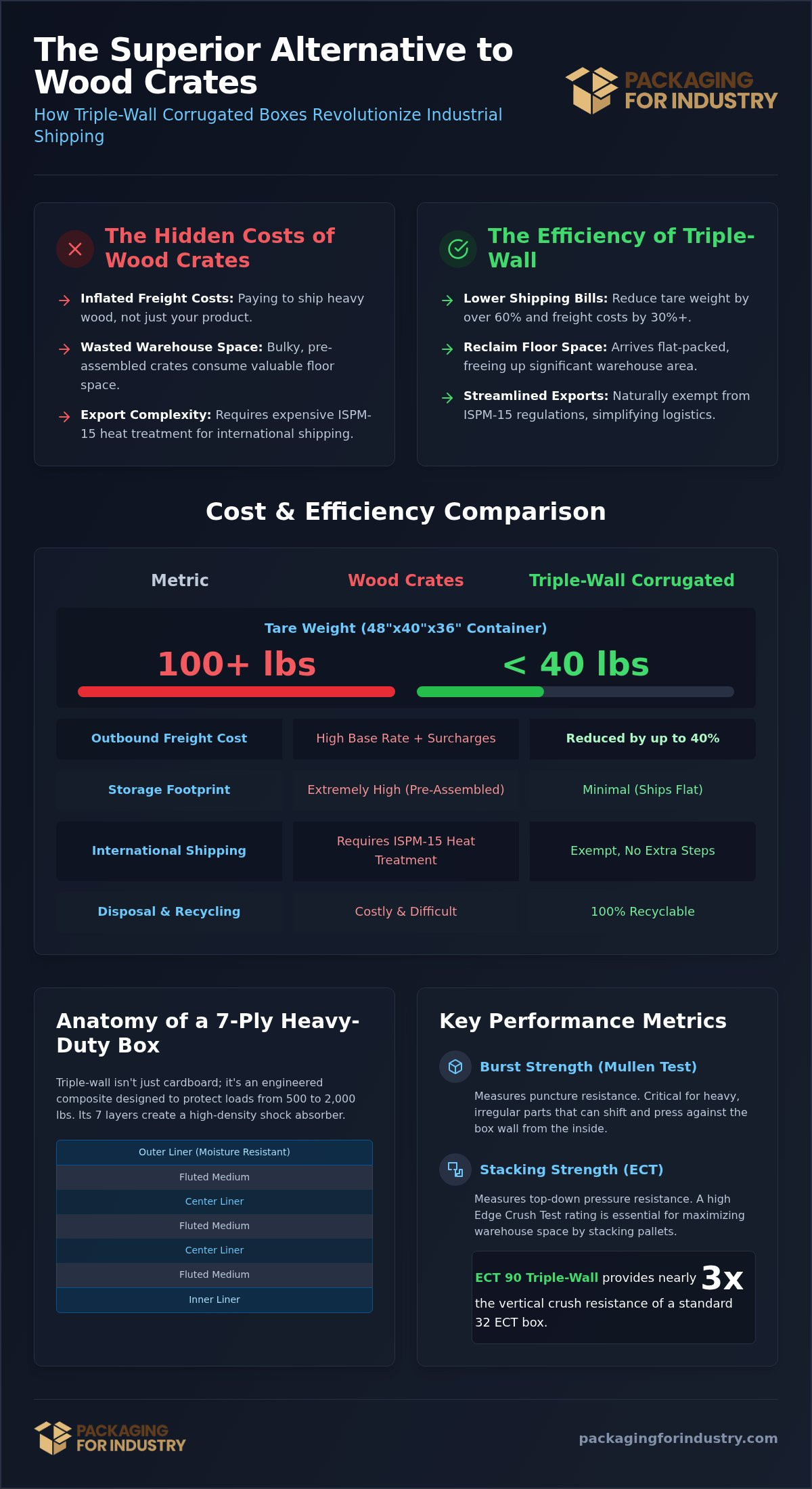
The structural integrity of corrugated fiberboard depends on its layered configuration. A triple-wall box consists of an outer liner, fluting, a center liner, more fluting, another center liner, a third layer of fluting, and a final inner liner. We use high-performance liners that provide enhanced moisture resistance and surface durability. This ensures the package remains stable even in humid Southern California shipping docks or during ocean freight. Beyond simple containment, these seven layers act as a high-density shock absorber. This cushioning effect is critical for protecting sensitive industrial parts from the vibrations and impacts common in heavy freight movement. For many companies in manufacturing, this internal resilience reduces the need for excessive dunnage.
Burst Strength vs. Edge Crush Test (ECT) for Triple-Wall
When you evaluate heavy-duty triple wall boxes for industrial parts SoCal, you’ll encounter two primary testing standards. The Mullen Test measures burst strength, or the force required to puncture the box wall. This is a vital metric for heavy, irregular parts that might shift and exert pressure from the inside out. Conversely, the Edge Crush Test (ECT) measures the material’s ability to withstand top-down pressure. High ECT ratings, such as 90 ECT or 120 ECT, indicate massive stacking capacity. It’s a significant upgrade from lighter materials; an ECT 90 triple-wall box provides nearly three times the vertical crush resistance of the standard 32 ECT boxes typically used for lighter commercial goods. This engineering allows you to stack pallets higher, maximizing your warehouse footprint without risking a collapse.
Triple-Wall vs. Wood Crates: A Cost and Efficiency Comparison
When you evaluate heavy-duty triple wall boxes for industrial parts SoCal, it’s essential to look beyond the initial unit price. The Total Cost of Ownership (TCO) includes labor, storage, and outbound freight. Wood crates are traditionally seen as the gold standard for strength, but they carry hidden burdens that impact your bottom line. For example, international shipments using wood must comply with ISPM-15 regulations, requiring expensive heat treatment and specific documentation. Triple-wall corrugated is naturally exempt from these requirements, which simplifies your export logistics. Manufacturing these containers to meet rigorous standards like ASTM D5168-22 ensures they provide the necessary protection without the regulatory headaches associated with timber.
Freight Savings: Cutting the Weight, Not the Protection
Tare weight is a primary driver of logistics expenses, especially for SoCal companies shipping high-value components nationwide. Consider a standard 48″ x 40″ x 36″ industrial container. A typical wood crate of these dimensions can weigh over 100 pounds; a comparable triple-wall corrugated box often weighs less than 40 pounds. This reduction directly lowers your LTL and air freight expenses. By switching materials, many manufacturers avoid heavy-weight surcharges from carriers like UPS and FedEx. You can significantly lower packaging costs by optimizing your material weight without sacrificing the safety of your high-value parts. If you’re looking to compare packaging pricing between traditional timber and high-strength corrugated, our team provides detailed cost-benefit analyses.
Operational Efficiency: Storage and Assembly
The operational advantages of corrugated materials extend deep into your warehouse management. Wood crates are bulky and usually arrive pre-assembled, consuming massive amounts of floor space in expensive Southern California facilities. In contrast, triple-wall boxes ship “knocked-down flat” (KDF). This allows you to store hundreds of units in the space required for just a few dozen crates. Assembly is also significantly faster and safer for your floor team. Your employees won’t have to deal with nails, splinters, or the physical strain of heavy lifting. When the shipment reaches its destination, the end-user can simply recycle the corrugated material, avoiding the disposal fees often associated with treated wood. If you’re ready to see how these efficiencies apply to your specific parts, you can request a packaging quote to evaluate your current wood crate costs against a high-performance triple-wall solution.
Custom Triple-Wall Solutions for Industrial Parts
Standard shipping containers often fail when faced with the unique geometries of industrial equipment like hydraulic pumps, engine blocks, or electrical transformers. Using a box that is even a few inches too large creates a problem called “air shipping,” where you pay carriers to transport empty space. To solve this, we provide custom design packaging that matches the exact dimensions of your components. This precision engineering reduces the need for excessive void fill, which directly lowers your material costs and improves package stability during transit.
Our process utilizes advanced CAD/CAM technology to develop the heavy-duty triple wall boxes for industrial parts SoCal operations require for high-stakes logistics. We offer free prototyping to ensure the fit is perfect before you commit to a bulk production run. This “measure twice, cut once” approach eliminates the risk of transit damage caused by internal shifting. By optimizing the box size, you can also increase the number of units per pallet, maximizing your warehouse footprint and reducing the total number of shipments needed.
Integrated Protection: Combining Triple-Wall with Foam
For sensitive industrial components, the outer box is only the first line of defense. We frequently integrate custom foam packaging directly into our triple-wall designs to provide advanced vibration dampening. Depending on the fragility and weight of your part, we select the appropriate material to cradle the item:
- Polyethylene: Best for heavy parts requiring rigid support and high load-bearing capacity.
- Polyurethane: Ideal for lighter, highly sensitive components needing superior shock absorption.
- Anti-Static Foam: Essential for electronic industrial parts to prevent static discharge damage.
These internal inserts are precision-cut to prevent any contact with the box walls. To streamline your operations, we offer these as “kitted” solutions. This means the box and the foam arrive at your facility as a single SKU, significantly reducing the labor time spent on your packing line.
Specialized Industrial Designs: Gaylords and Bulk Bins
Triple-wall construction is the ideal material for Gaylord boxes and bulk bins used in high-volume manufacturing. These large-format containers can hold thousands of pounds of smaller components or raw materials, providing a cost-effective alternative to metal or plastic bins. In the aerospace sector, we design multi-part kitting systems that allow technicians to keep all necessary components for an assembly in one organized, high-strength container. Following specific aerospace packaging standards ensures that even the most complex assemblies remain secure during multi-stage transit. This level of customization ensures that your packaging is a functional part of your production flow rather than just a shipping expense.
Sourcing Triple-Wall Boxes in Southern California
Sourcing heavy-duty triple wall boxes for industrial parts SoCal from a local partner provides logistical advantages that national catalog suppliers cannot match. When you order high-volume, bulky packaging from out-of-state, you’re essentially paying to ship empty boxes across several time zones. By choosing a supplier with a localized footprint in Orange County and Los Angeles, you eliminate these unnecessary freight costs. Our proximity to major manufacturing hubs in Santa Fe Springs, Carson, Anaheim, and Irvine allows us to provide responsive support that national competitors simply can’t offer. We operate our own fleet of trucks, which enables local next-day delivery to keep your production lines moving without interruption. While we specialize in Southern California, we also maintain robust nationwide shipping capabilities to support customers with multi-state operations.
Eliminating Shortages with Vendor Managed Inventory (VMI)
Warehouse space is one of the most expensive assets in Southern California. Storing large quantities of triple-wall corrugated can quickly overwhelm your facility and hinder operational flow. Our VMI program is designed to solve this specific challenge. We manage your inventory levels from our Anaheim facility, ensuring you never face a “stockout” of critical shipping containers. Instead of taking up your valuable floor space, we hold the bulk of your inventory and perform scheduled replenishment cycles. Whether you need weekly or biweekly deliveries, we base the flow on your actual usage data. This proactive approach eliminates the stress of manual ordering and ensures that your heavy-duty triple wall boxes for industrial parts SoCal are always available when a high-value shipment is ready to go.
Just-In-Time (JIT) Delivery for High-Volume Manufacturers
For high-volume manufacturers operating under lean principles, we offer a JIT inventory management model. This strategy is essential for reducing the capital tied up in bulky triple-wall inventory. By aligning our delivery schedule with your production output, we ensure that packaging arrives exactly when it’s needed on the assembly line. This is particularly beneficial for our clients using manufacturing solutions in sectors like aerospace and automotive, where floor space and cash flow are prioritized. JIT delivery transforms your packaging from a storage burden into a streamlined component of your supply chain.
How to Request a Quote for Heavy-Duty Triple-Wall Boxes
Transitioning from traditional wood crates to corrugated composites requires more than just a price sheet. It demands a technical evaluation of your current logistics flow. We take a consultative, “No-Fluff” approach with our B2B partners, focusing on the tangible outcomes of reduced freight weight and eliminated damage. Whether you require standard dimensions or have custom sizes available for unique machinery, our team ensures the design meets your specific load requirements. When you’re ready to Request a Quote for bulk quantities, our team works to identify where custom engineering can replace generic, oversized containers. Securing heavy-duty triple wall boxes for industrial parts SoCal starts with a professional review that looks at your entire process, from the assembly line to the customer’s receiving dock.
Step 1: Define Your Part Specifications
An accurate quote relies on the precision of the data provided. Start by gathering the exterior dimensions and the total weight of the part. If the component has irregular geometries or concentrated load points, these details are critical for determining the necessary floor strength of the box. You should also identify the fragility of the part and its sensitivity to environmental factors like moisture or vibration. If your current packaging leads to high freight costs or frequent claims, providing those details helps us engineer a solution that targets your specific financial losses. This data-driven approach ensures your quote reflects a solution tailored to your actual part, not a one-size-fits-all compromise.
Step 2: Consult with a PFI Packaging Engineer
After reviewing your specifications, you’ll work with a PFI packaging engineer to select the appropriate board grade. We’ll analyze whether ECT 90 or ECT 120 is the most efficient choice for your stacking needs. During this consultation, we’ll also design any necessary custom inserts or foam kitting required for sensitive industrial components. To ensure total confidence, we offer a free prototype for fit testing with your actual product. This step allows you to verify the protection levels before proceeding with production. Finally, we’ll discuss how a vendor-managed inventory (VMI) program can be integrated into your quote to solve the space constraints common in Southern California warehouses. This comprehensive review ensures that your heavy-duty triple wall boxes for industrial parts SoCal provide the maximum return on investment.
Optimize Your Industrial Logistics with Triple-Wall Engineering
Transitioning to high-strength corrugated composites is a strategic decision that impacts your entire operational efficiency. By replacing heavy wood crates with 7-ply materials, you eliminate the excess weight of timber and the regulatory burdens of ISPM-15 compliance. This shift allows you to maintain the structural integrity required for heavy machinery while significantly lowering your total logistical overhead. Implementing heavy-duty triple wall boxes for industrial parts SoCal provides a reliable way to protect your high-value assets during the most demanding transit cycles.
Our commitment to your supply chain includes specialized services designed specifically for local manufacturers. We offer free industrial packaging prototypes to ensure a perfect fit and expert VMI or JIT inventory management to reclaim your valuable warehouse floor space. With our local fleet providing next-day delivery across Southern California, you can maintain a lean operation without the risk of packaging shortages. We’re prepared to help you implement a more durable and cost-effective shipping solution that protects your bottom line as effectively as it protects your products.
We look forward to partnering with you to streamline your industrial distribution and secure your high-value components with precision-engineered protection.
Frequently Asked Questions
Can triple-wall boxes really hold 1,000 pounds?
Yes, triple-wall containers are engineered to support 1,000 pounds and even up to 2,000 pounds depending on the board grade and dimensions. This 7-ply composite provides the vertical column strength required for stacking heavy industrial components. When you use high-performance liners, the box maintains its structural integrity under extreme pressure. It’s a reliable alternative to wood for heavy machinery and metal parts that require maximum protection during transit.
Are triple-wall boxes considered ISPM-15 compliant for export?
Triple-wall boxes are naturally exempt from ISPM-15 international shipping regulations. Unlike wood crates, corrugated material doesn’t require heat treatment or specialized stamps to pass through customs. This makes them a more efficient choice for global logistics. You’ll avoid the extra costs and delays associated with timber inspections. Many of our aerospace and manufacturing clients prefer this material to simplify their export documentation and speed up transit times across international borders.
How much weight can I save by switching from wood crates to triple-wall?
Switching from wood crates to heavy-duty triple wall boxes for industrial parts SoCal often reduces your tare weight by 30% to 40%. For instance, a standard wood crate weighing 100 pounds can often be replaced by a corrugated container weighing under 40 pounds. This reduction directly lowers your outbound freight costs, especially for air freight and LTL shipments. It also helps you avoid heavy-weight surcharges from major carriers while maintaining the necessary structural protection.
What is the lead time for custom-sized triple-wall boxes in SoCal?
Lead times vary based on the complexity of the design, but as a local supplier, we offer significant speed advantages. For established VMI or stocking programs, we provide next-day delivery across Los Angeles and Orange County. Custom engineered designs typically move from the prototyping phase to production within a few business days. Sourcing locally eliminates the long transit delays associated with national catalogs, which keeps your production lines moving without interruption.
Do you offer VMI programs for heavy-duty boxes in Orange County?
We provide comprehensive Vendor Managed Inventory (VMI) programs for manufacturers throughout Orange County, including Anaheim and Irvine. Our team monitors your inventory levels and manages replenishment cycles based on your actual usage data. This service allows you to free up valuable warehouse floor space while ensuring you never face a stockout. We store the bulk of your heavy-duty packaging at our facility and deliver it exactly when your team needs it.
What is the difference between a double-wall and a triple-wall box?
The primary difference lies in the number of layers and the resulting stacking strength. A double-wall box is a 5-ply material with two fluted mediums, while a triple-wall box is a 7-ply composite with three fluted mediums. This extra layer provides a massive increase in vertical stacking capacity and puncture resistance. Triple-wall is specifically engineered for industrial loads exceeding 500 pounds, whereas double-wall is typically reserved for lighter commercial or e-commerce shipments.
Can triple-wall boxes be reused for multiple shipments?
Yes, triple-wall boxes are highly durable and can often be reused for multiple shipments in closed-loop systems. Their 7-ply construction resists the crushing and tearing that typically degrades standard boxes after a single trip. This longevity makes them a cost-effective choice for internal transfers or returnable packaging programs. Once the box eventually reaches the end of its service life, it remains fully recyclable, which eliminates the disposal fees often associated with treated wood.
Do you provide free prototypes for industrial parts packaging?
We offer free prototyping for heavy-duty triple wall boxes for industrial parts SoCal to ensure a perfect fit for your specific components. Our engineers use CAD technology to design custom inserts and outer containers that match your part’s geometry. This allows you to perform fit tests and transit trials before committing to a bulk order. Prototyping is a critical step in our process to guarantee that your high-value parts are fully secured.