
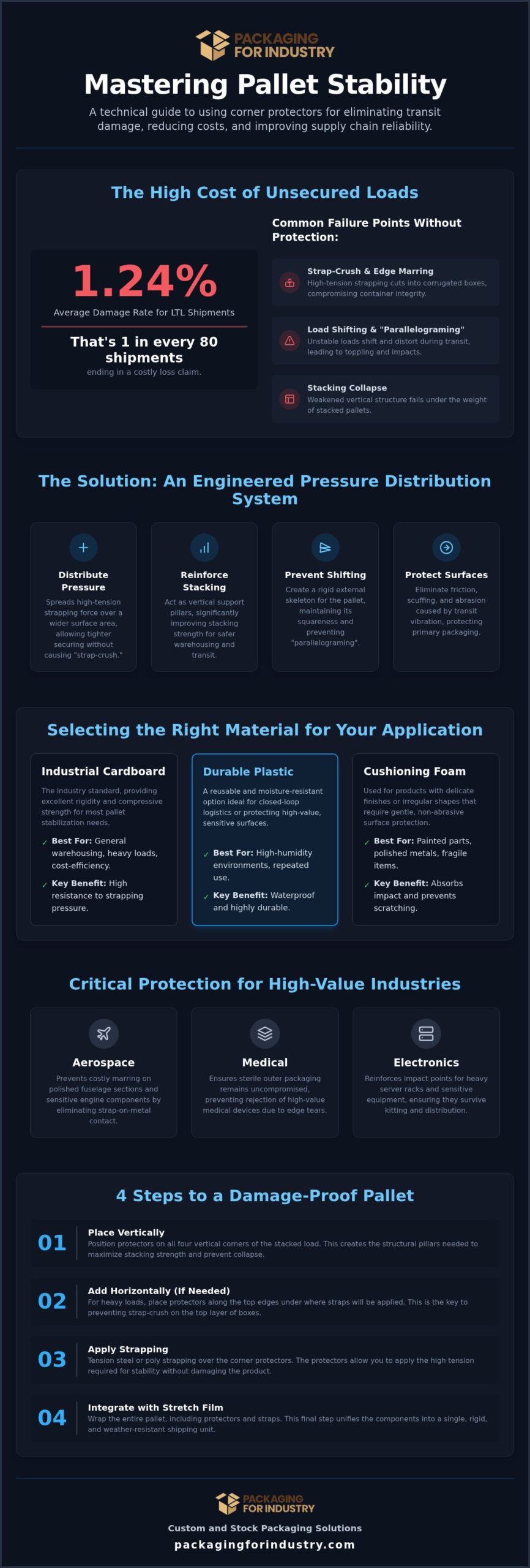
Did you know that the average damage rate for Less-Than-Truckload (LTL) shipments is 1.24%, meaning roughly one in every 80 shipments ends in a loss claim? For manufacturers in Southern California and across the country, these incidents represent a constant drain on the bottom line through “strap-crush” and edge marring. You likely already understand that securing a pallet isn’t just about wrapping it tight. It’s about maintaining structural integrity under the intense pressure of industrial transit. This guide provides a technical breakdown of how to use corner protectors for shipping to transform individual boxes into a single, rigid unit that resists shifting and compression.
We’ll master the practical application of edge protection to eliminate transit damage and improve pallet stability. You’ll learn how to select the right materials for specialized sectors like aerospace or medical devices, ensuring your high-value cargo arrives intact. By the end of this article, you’ll have a clear framework for reducing logistics costs and streamlining your warehouse operations. We’ll examine everything from initial placement to tensioning strategies, helping you move from basic packing to engineered logistical optimization. Whether you’re managing local next-day deliveries or nationwide freight, these professional techniques ensure your shipments remain secure and your customers remain satisfied.
Key Takeaways
- Understand how corner protectors reinforce the structural integrity of a pallet, preventing load shifting and “parallelograming” during LTL transit.
- Identify the optimal material for your application by comparing the durability of plastic guards against the cost-efficiency of industrial cardboard.
- Master how to use corner protectors for shipping through strategic vertical and horizontal placement that eliminates box marring from high-tension strapping.
- Improve load stability and supply chain reliability by integrating edge boards with the correct stretch film to create a unified, damage-resistant unit.
- Lower your total cost of ownership by utilizing custom-sized protection and vendor-managed inventory to ensure a steady supply and zero transit damage.
Beyond Edge Guarding: Why Industrial Shipments Require Corner Protection
Corner protectors, often referred to as edge boards, are rigid angles engineered to reinforce the structural points of a palletized load. While many warehouse managers view them as simple buffers, they’re actually a sophisticated pressure distribution system. When you apply high-tension steel or polyester strapping to a standard corrugated box, the force concentrates at the sharp edges. Without protection, this leads to “strap-crush,” where the strap cuts into the cardboard, compromising the box’s integrity and causing the load to loosen. Learning how to use corner protectors for shipping effectively involves recognizing them as a tool to spread this tension over a wider surface area. This allows for higher strapping tension, which is essential for stabilizing heavy or irregular loads.
Beyond preventing surface damage, these guards act as vertical support pillars. This reinforcement significantly improves the stacking strength of your pallets. By reinforcing the four corners of a unit, you can safely double-stack materials in your warehouse or during transit without risking a lower-tier collapse. Furthermore, corner guards address the issue of transit vibration. During long-haul transport, constant micro-movements can cause friction between boxes or against the pallet itself. Edge boards suspend the load and provide a rigid barrier that eliminates scuffing and abrasion on your primary packaging.
The Role of Corner Guards in LTL Logistics
Less-Than-Truckload (LTL) shipping presents unique challenges because freight is handled multiple times at various hubs. This increased contact raises the risk of side-impacts and load shifting. Inadequate cargo securing is a major contributor to the 1.24% average damage rate reported in LTL logistics. Edge boards act as an external skeleton for the pallet, maintaining its “squareness” and preventing it from leaning or “parallelograming” during sudden stops or sharp turns. Utilizing corner and edge protection helps you meet carrier best-practice requirements, which is vital for reducing insurance claims and ensuring supply reliability.
Surface Integrity for High-Value Industries
For specialized manufacturers, the goal isn’t just to prevent a box from breaking; it’s to protect the precision-engineered surfaces inside. We see this most often in three specific sectors:
- Aerospace: Polished fuselage sections or engine components require zero-friction environments. Custom edge protection prevents strap-on-metal contact that could lead to costly marring.
- Medical: Sterile outer packaging must remain uncompromised. Even a minor edge tear can lead to the rejection of high-value medical devices.
- Electronics: Heavy server racks or sensitive equipment need reinforced impact points to survive the kitting and distribution process.
By understanding how to use corner protectors for shipping as a structural reinforcement rather than just a buffer, you can lower packaging costs and eliminate professional stress associated with transit damage.
Selecting the Right Material: Cardboard, Plastic, and Foam Protectors
Choosing the correct substrate is as critical as the application itself. If you’re researching how to use corner protectors for shipping, start with the load’s specific environmental and structural requirements. Material selection dictates how well your pallet handles tension, moisture, and impact. While cardboard remains the industrial standard for most warehouse operations, specialized sectors like aerospace or medical manufacturing often require plastic or foam alternatives to maintain surface integrity. You can explore our full range of corner and edge protection products to see how these materials differ in application.
Industrial cardboard (paperboard) protectors provide the rigid structure needed for pallet stabilization. They’re designed to resist the compressive forces of strapping, effectively preventing the “strap-crush” mentioned in previous sections. Plastic guards offer a more durable alternative for heavy-duty reusability or environments where pallets are stored outdoors. For fragile items, foam protectors are engineered to provide shock absorption and a non-abrasive contact point. Meeting FMCSA cargo securement regulations requires selecting materials that won’t fail under the tension of tie-downs or the vibrations of transit.
When to Use Heavy-Duty Cardboard Edge Boards
Cardboard corner boards are available in a variety of thicknesses, typically ranging from 0.060″ to 0.500″. Lighter loads usually require thinner gauges, while heavy machinery or metal components need the 0.500″ industrial-grade thickness to prevent edge marring. In Southern California, humidity in areas like Irvine or Anaheim can compromise standard paperboard. We recommend moisture-resistant coatings for these regions or for export shipping where sea air is a factor. Cardboard is also the most cost-effective and recyclable option for high-volume manufacturing facilities looking to lower packaging costs without sacrificing reliability.
Foam Protection for Sensitive Finishes
When shipping components with polished finishes or delicate electronics, standard rigid boards might cause surface scratches. This is where foam protection becomes essential. We typically utilize two types of foam:
- Polyethylene (PE) Foam: A closed-cell foam that offers excellent shock absorption and resistance to moisture. It’s the go-to for heavy aerospace parts.
- Polyurethane (PU) Foam: A softer, open-cell foam ideal for cushioning lighter, highly sensitive equipment.
These materials ensure that optical glass or coated aerospace parts remain uncompromised by the kitting and distribution process. You can learn how custom foam packaging eliminates surface damage by providing a tailored fit for unique component geometries. If you’re unsure which material best suits your current logistics flow, you can request a quote for a damage reduction review of your specific application.
Strategic Placement: How to Apply Corner Guards for Maximum Stability
Strategic placement is the difference between a load that survives LTL transit and one that collapses at the first distribution hub. Understanding how to use corner protectors for shipping requires more than just placing material on a pallet; it demands a strategic approach to load geometry. When applied vertically, these guards reinforce the four corners of a pallet to prevent “parallelograming,” which is the tendency of a load to lean during lateral shifts. Horizontal application serves a different purpose, protecting the top edges of boxes from strap-crush while providing a level surface that allows for safe double-stacking in the warehouse.
Beyond external bracing, internal application offers significant benefits for high-density or heavy-duty shipments. Placing guards inside custom corrugated boxes provides internal corner reinforcement, preventing the box from buckling under the weight of stacked pallets. For loads with uneven box heights, the “over-the-top” method uses full-length boards to bridge gaps, creating a unified top surface. Adhering to these methods ensures compliance with FMCSA cargo securement regulations, which mandate proper edge protection to prevent damage to both the cargo and the tie-down equipment.
Step-by-Step: Securing a Palletized Load
Executing a stable wrap requires a methodical sequence. Follow these steps to ensure the guards remain functional throughout the journey:
- Alignment: Position the edge board so it’s perfectly flush with the top and bottom of the pallet load. If the guard hangs over the edge, it will likely be crushed or caught during handling.
- Temporary Fixation: Use a small piece of tape or the “cling” from a starting layer of stretch film to hold the guards in place. This prevents them from shifting while you prepare the main securing materials.
- Tensioning: Apply strapping or stretch film starting from the base. This locks the guards into position and creates the “skeleton” necessary to maintain load integrity under stress.
Common Mistakes in Placement
Inefficient placement often negates the benefits of using protectors. We frequently see warehouses using guards that are too short, which leaves the top or bottom boxes completely vulnerable to impact. Misalignment is another common failure; if the guard isn’t square with the corner, it creates localized pressure points that can lead to box failure rather than preventing it. Finally, avoid over-tensioning your strapping before verifying the guard is centered. If the strap pulls the guard out of alignment, the resulting “strap-crush” can be more severe than if no protection were used at all.
Integrating Protectors with Strapping and Stretch Film
Corner protectors don’t just sit on the edges of your pallet; they function as a structural foundation that allows other packaging materials to perform at their peak. When you understand how to use corner protectors for shipping, you realize they’re essential for achieving high load containment. High-performance strapping and stretch film require significant tension to keep a load from shifting. Without edge boards, this tension would immediately crush your primary packaging. By integrating rigid protectors, you can increase your machine tension settings, creating a tighter, more secure unit without damaging the product inside. This synergy is particularly vital for heavy industrial loads that face significant G-forces during transit.
For manufacturers in Southern California, environmental factors like the high heat and humidity found in the Inland Empire or Orange County can soften standard corrugated boxes over time. This loss of structural integrity makes shipments even more vulnerable to compression. Using moisture-resistant edge boards in tandem with high-performance industrial stretch film creates a barrier that maintains load “squareness” despite local climate challenges. For irregular items like steel coils or bundles of plastic tubing, specialized “V-Board” protectors allow for the same high-tension securing on curved surfaces where standard rigid angles would fail.
The Synergy of Stretch Film and Edge Protection
Using machine-applied stretch wrap without edge protection often results in “box-squish,” where the corners of the boxes are pulled inward, creating a rounded, unstable pallet. Edge boards eliminate this issue by providing a hard vertical axis for the film to pull against. This creates a unified exterior shell that prevents internal shuffling of the boxes. For Southern California freight routes that involve frequent stops and turns, this level of containment is the best defense against load failure. Selecting between blown and cast stretch film also matters; blown film offers the high puncture resistance needed for the sharp edges of heavy-duty protectors, while cast film provides the clarity required for scanning labels through the wrap.
Strapping Best Practices with Corner Guards
The choice between Polyester (PET) and Polypropylene (PP) strapping depends heavily on your load’s weight and the type of corner protection used. PET strapping is preferred for heavy-duty applications because it maintains tension better over long distances, and it pairs perfectly with 0.500″ thick cardboard protectors. To ensure even tension distribution, follow these practices:
- Use plastic inserts or “buckle guards” if you’re using steel strapping to prevent the metal from slicing through the protector.
- Verify that the strap is centered on the protector to prevent the board from twisting under load.
- Apply vertical strapping first to lock the protectors against the boxes before finishing with horizontal layers.
Optimizing Protection with PFI’s Integrated Solutions
Effective logistics management requires more than just knowing how to use corner protectors for shipping; it requires a supply chain partner that integrates these tools into a broader protection strategy. At Packaging For Industry (PFI), we combine custom design packaging with a comprehensive range of stock edge protection to address your specific operational challenges. This integrated approach focuses on lowering your Total Cost of Ownership (TCO). By preventing transit damage and the resulting “strap-crush” on high-value components, you can significantly reduce damage-related returns and lower your insurance premiums. We don’t just sell materials; we provide a system designed for fiscal responsibility and logistical flow.
Reliability is a cornerstone of our service model. We understand that a stock-out of critical supplies can halt your entire production line. To prevent this, we offer Vendor Managed Inventory (VMI) and just-in-time delivery options. This ensures you always have a steady supply of corner boards and edge guards without tying up excessive capital in warehouse space. Our goal is to eliminate professional stress by providing a steady, dependable partnership that values long-term stability over temporary fixes.
Packaging Reviews for Damage Reduction
Our PFI engineering teams act as seasoned consultants for your facility. We perform detailed packaging reviews to analyze current failure points in your shipping process. Whether you’re dealing with edge marring on polished aerospace parts or compromised sterile packaging in the medical sector, we recommend specific upgrades to your edge guarding protocols. We balance the cost of materials against the high price of replacement parts to ensure your strategy is economically sound. To validate these recommendations, we offer free prototyping for custom packaging designs, allowing you to test the effectiveness of our solutions before committing to a full production run.
Local Support for Southern California Manufacturers
Proximity matters when you need rapid responses to supply chain disruptions. PFI provides direct access to Anaheim-based experts who specialize in custom sizing and rapid prototyping for Southern California’s diverse industrial landscape. We offer local next-day delivery for stock supplies across Orange County, Los Angeles, San Diego, and the Inland Empire. This regional focus allows us to provide the level of accountability and oversight that nationwide distributors often lack. Whether you’re kitting sensitive electronics or shipping heavy machinery, our local team ensures your protection strategy is executed with precision.
Securing Your Supply Chain with Engineered Protection
Implementing a rigorous edge protection strategy is more than a warehouse best practice; it’s a critical component of logistical optimization. By mastering how to use corner protectors for shipping, you effectively eliminate the risk of strap-crush and stabilize your pallets for the rigors of LTL transit. Selecting the right substrate, whether it’s heavy-duty cardboard or specialized foam, ensures that even the most sensitive aerospace and medical components arrive without surface marring. This precision reduces insurance claims and protects your professional reputation.
Packaging For Industry supports your operations with specialized expertise and local next-day delivery across Southern California, including Orange County and Los Angeles. We provide free prototyping for custom industrial designs to ensure your protection strategy is validated before it hits the road. Our team is ready to help you lower packaging costs while improving overall supply reliability. You can rely on our consultative approach to solve your most complex shipping challenges.
Take the next step toward a damage-free supply chain and gain the peace of mind that comes with engineered reliability.
Frequently Asked Questions
Do I really need corner protectors if I already use stretch wrap?
Stretch wrap provides lateral containment, but it lacks the vertical compression strength necessary to prevent box collapse under high tension. Corner protectors provide the rigid structure needed to maintain the pallet’s shape and prevent “box-squish.” This combination is essential for ensuring your load remains square throughout transit. Using both materials together allows you to increase wrapping tension safely, which is a key part of how to use corner protectors for shipping effectively.
What is the best material for protecting furniture corners during shipping?
Foam corner protectors are the superior choice for furniture because they provide non-abrasive cushioning that prevents scratches on finished surfaces. While industrial cardboard is excellent for load stabilization, it can be too rigid for delicate wood or fabric. Closed-cell polyethylene foam absorbs shocks during handling and transit vibration, ensuring that high-value furniture pieces arrive without marring. For bulk industrial shipments, we recommend custom-engineered foam profiles for the highest level of reliability.
How do I choose the correct length for pallet edge boards?
You should select an edge board length that matches the full vertical height of your palletized load. If the boards are too short, the top or bottom boxes remain vulnerable to strapping damage and shifting. For horizontal applications, match the board to the width of the pallet to ensure even pressure distribution across all boxes. Choosing the correct length is vital for maximizing stacking strength and meeting carrier requirements for damage-free delivery.
Can corner protectors be reused for multiple shipments?
Plastic corner guards are specifically designed for heavy-duty reusability and can last for hundreds of shipping cycles. Cardboard protectors can also be reused if they remain dry and haven’t sustained structural damage or “strap-crush” from previous use. However, for high-value aerospace or medical shipments, we recommend using new protectors to ensure maximum structural integrity. Reusing damaged boards can lead to localized pressure points and eventual pallet failure during transit.
How do corner guards help with double-stacking pallets in the warehouse?
Corner guards act as external vertical pillars that significantly increase the compression strength of a palletized load. By reinforcing the corners, you distribute the weight of the upper pallet across the rigid boards rather than the vulnerable edges of the corrugated boxes. This allows for safer double-stacking in your warehouse, optimizing your floor space while preventing lower-tier collapse. It’s a cost-effective way to improve storage efficiency without investing in additional racking systems.
What is the difference between a corner protector and an edge board?
In the industrial packaging industry, these terms are often used interchangeably to describe rigid V-shaped angles. However, “corner protector” sometimes refers to smaller, individual plastic or foam pieces used for single box corners. “Edge board” or “corner board” typically describes full-length strips used to reinforce the entire vertical or horizontal edge of a pallet. Both serve the primary purpose of protecting cargo from strapping tension and improving overall load stability during shipping.
How can I prevent strapping from cutting into my cardboard boxes?
The most effective way to prevent strapping from cutting into your boxes is to apply rigid corner boards before tensioning. These boards distribute the pressure of the strap over a larger surface area, eliminating the concentrated force that causes damage. This technique is a fundamental aspect of how to use corner protectors for shipping to lower packaging costs. By protecting the boxes, you maintain the structural integrity of the entire load and reduce returns.
Does Packaging For Industry offer custom-sized corner protectors?
Yes, Packaging For Industry provides custom-sized corner protectors tailored to your specific load dimensions and weight requirements. We offer a variety of thicknesses and lengths to ensure your high-value cargo receives the exact level of reinforcement it needs. Our team can help you compare packaging pricing for custom vs. stock options to find the most cost-effective solution for your facility. Custom sizes are available with local next-day delivery for our Southern California customers.