
What if a custom package looks right on the review table but fails to fit the product, protect it in transit, or move smoothly through packing? The first article inspection process for custom packaging should test more than appearance. Without measurable acceptance criteria, approval can become subjective, and late design changes can delay production or leave you with packaging that does not meet operational needs.
A structured sample review helps manufacturers agree on what “approved” means before committing to repeat production. This guide explains how to set clear criteria, check dimensions and material performance against real packing and shipping conditions, and document the decision so later changes are managed consistently. Packaging For Industry supports custom packaging design with CAD/CAM, prototypes, and samples, helping teams work through fit and protection issues before rollout. Learn what to review on a custom box, foam insert, or crate, how to record approval, and how to reduce avoidable redesign, product damage, and supply disruption.
Key Takeaways
- Define measurable acceptance criteria before reviewing a custom packaging sample so approval is based on project requirements, not appearance alone.
- Use the first article inspection process for custom packaging to assess dimensions, fit, materials, protection, assembly, and packing workflow.
- Record findings clearly and prioritize revisions by their impact on fit, product protection, packing efficiency, and agreed requirements.
- Treat a sample that needs changes as useful feedback. Resolve issues and review the revised design before approving repeat production.
- CAD/CAM support, prototypes, samples, and packaging reviews can help align corrugated boxes, foam, and crates with product and shipping needs.
What Is First Article Inspection for Custom Packaging?
A first article inspection for custom packaging is a structured review of an initial sample against the requirements agreed for the packaging project. It checks whether the design fits the product, provides the intended protection, and works for packing and shipping before repeat production begins.
First-article approval is the documented decision that a custom packaging sample meets the project’s agreed requirements for fit, protection, construction, and use. This sample review helps teams identify design issues early. It is not, by itself, a formal certification or a third-party inspection. The First Article Inspection (FAI) concept provides a broader quality-process reference, but packaging acceptance criteria should be established for the specific project.
Appearance alone is not enough. A box can look well-made yet leave too much room for product movement, close poorly, or slow down packing. Reviewing the sample in context helps reveal problems that a visual check on a table may miss.
How a packaging first article differs from a machined-part inspection
A machined-part review often compares component dimensions and characteristics with a drawing. Packaging needs a wider, use-based assessment: Does the product fit? Does the closure work? Do foam or other protective elements hold the product in place? Can staff pack and handle it as intended? Set criteria around the product and planned shipping conditions. Include any additional requirements specified in customer contracts.
When should a business inspect a custom packaging sample?
Review a sample before repeat production for a new packaging design, a significant design revision, or a change in product or shipping needs. Fragile equipment, for example, may need a revised cushioning layout, while an electronics product update may require a new fit and handling check. An aerospace component may also need its packaging reviewed against project requirements. Finding a mismatch at the sample stage gives the team a chance to address it before it affects a larger order or routine packing work.
The first article inspection process for custom packaging works best when the criteria are agreed before the sample is assessed. Packaging For Industry’s custom packaging design support includes CAD/CAM, prototypes, samples, and packaging reviews to help teams evaluate designs against product and shipping needs. A sample review can also assess how a corrugated box, foam, or crate functions as part of the complete packaging setup.
The First Article Inspection Process for Custom Packaging, Step by Step
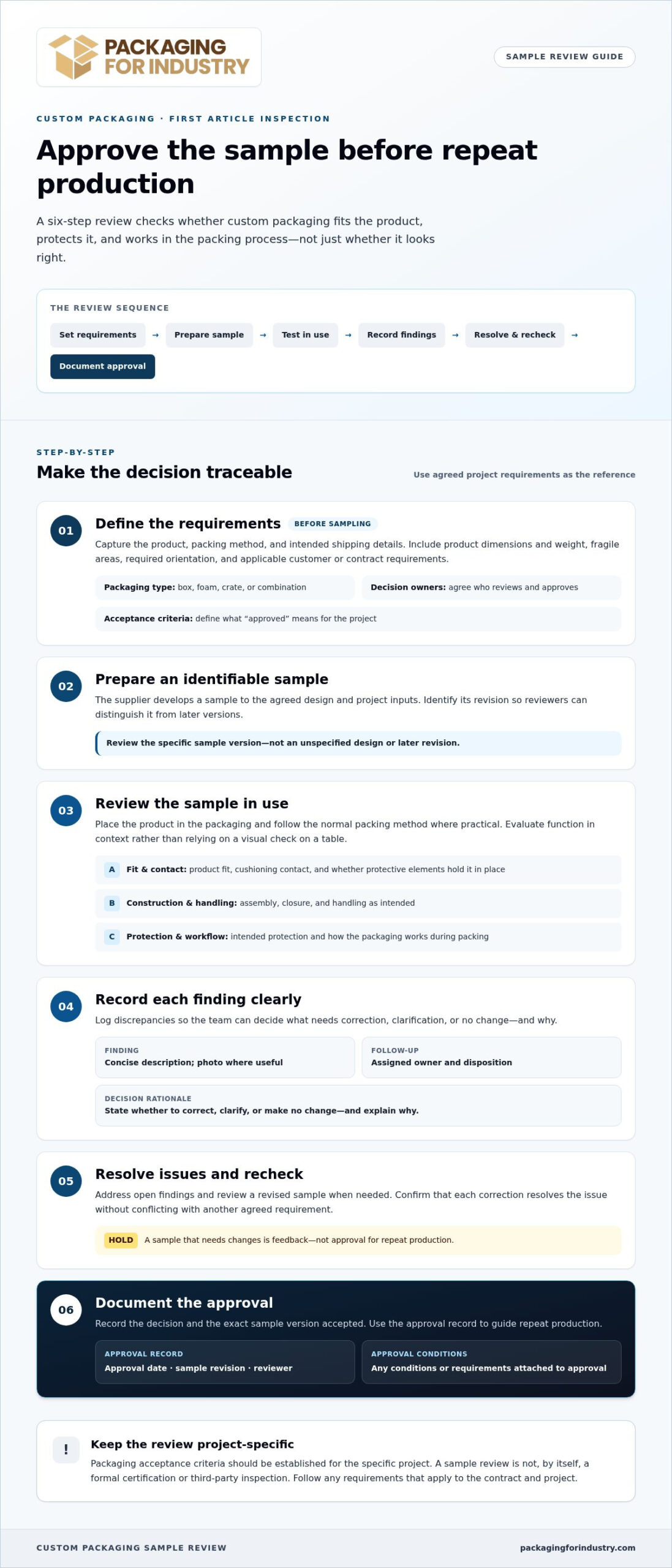
A clear review sequence separates sample preparation from customer acceptance. The packaging supplier prepares a sample using the project information, then the customer checks it against agreed requirements and records the approval decision. This makes design corrections, acceptance criteria, and the approved version traceable before repeat production.
Set requirements before the first sample is made
Start with product and process information that can guide the design. Provide product dimensions and weight, identify fragile areas and required orientation, and describe how staff will pack the item. Specify whether the solution uses a box, foam, crate, or a combination, and define the role of each component. Agree on acceptance criteria and identify who can review and approve the sample.
- Step 1: Define the requirements. Capture product, packing, and intended shipping details, along with any customer or contract requirements that apply.
- Step 2: Prepare the sample. The supplier develops a sample to the agreed design and project inputs. Keep its revision identifiable so the team can distinguish it from later versions.
- Step 3: Review the sample in use. Place the product in the packaging and check fit, closure, assembly, handling, and cushioning contact. Follow the normal packing method where practical instead of judging the sample by appearance alone.
- Step 4: Record findings. Log each discrepancy with a concise description, a photo where useful, an assigned owner, and a disposition. State whether it requires a design correction, clarification, or no change, and explain why.
- Step 5: Resolve and recheck. Address open findings and review a revised sample when needed. Confirm that each correction resolves the issue without conflicting with another agreed requirement.
- Step 6: Document approval. Record the approval date, exact sample revision, reviewer, and any conditions or requirements attached to the approval. Use this record to guide repeat production.
This process supports the first article inspection process for custom packaging without confusing a sample review with formal certification. For aerospace programs that require formal FAI documentation, SAE International publishes the AS9102 standard. Follow the requirements that apply to the specific contract and project.
Packaging For Industry provides custom design support, CAD/CAM, prototypes, samples, and packaging reviews to help teams work through sample findings. If you are planning a new packaging design or revision, request a packaging quote to discuss project requirements and sample needs.
What to Check During a Custom Packaging First Article Inspection
Use the agreed drawing and project requirements as the reference for every check. No universal packaging tolerances automatically apply to every product or shipment. The first article inspection process for custom packaging should confirm that the sample performs as intended for its specific product, packing method, and shipping application.
Packaging acceptance combines fit, protection, and repeatable use. Record observations against each agreed criterion, and distinguish measured or observed results from assumptions. Use the table as a practical review framework.
| Inspection area | What to observe | How to record findings |
|---|---|---|
| Dimensions and fit | Compare key dimensions, internal layout, and component placement with the approved drawing or project requirements. Load the product and check for unwanted movement, interference, or difficult removal. | Note the requirement and observed result. Identify the location of any mismatch, and include a photo or marked-up drawing where useful. |
| Material and construction | Check that corrugated construction, foam type, partitions, closures, and component interfaces match the agreed design. Look for damage or assembly details that could affect use. | Record the specified and observed component or construction detail, along with any discrepancy and its effect on packaging function. |
| Product protection | Confirm that the product sits securely and protective materials contact the intended areas. Look for unsupported areas, pressure points, or contact with surfaces that should remain clear. | Describe the product position and cushioning contact. Record concerns by location and relate them to the agreed protection requirements. |
| Assembly and closure | Assemble and close the package using the intended method. Check whether components align and the closure can be completed as expected. | Document the assembly steps, any difficulty, and the specific feature involved. Note whether the issue affects repeatable packing. |
| Packing workflow and handling | Follow the intended packing process. Observe whether workers can load, identify, close, and handle the package as planned. | Record workflow interruptions, unclear orientation or identification, and handling concerns. Add photos or notes showing where the process breaks down. |
Check dimensions, materials, and construction against the design
Measure the dimensions that matter to the application rather than checking every feature without a defined purpose. Review the box, foam, partitions, and closures as a complete assembly, since a change to one component can affect how the others fit. PFI’s custom packaging design services support packaging designed around specific products and shipping methods.
Assess protection and packing in context
A sample review can confirm fit and handling, but it does not establish transit-test performance unless documented testing is part of the project. For drug products, consult applicable requirements such as the government’s packaging and labeling control provisions. These are not universal acceptance criteria for all industrial packaging. Record the results clearly so approval reflects the checks actually completed.
How to Handle Inspection Failures, Revisions, and Approval
A first sample that misses a requirement does not mean the custom design cannot work. It identifies a gap to resolve before repeat production. Hold approval, compare the observed issue with the agreed criterion, and determine whether it affects product fit, protection, packing, or another project requirement.
What to do when the first sample does not meet requirements
Describe the discrepancy specifically rather than recording only “failed” or “doesn’t fit.” Note which component interferes with loading, where cushioning fails to contact the intended area, or which closure step cannot be completed as planned. Then identify whether the likely cause is the design, material choice, dimensions, or packing method. Agree on a correction and define what the next sample must demonstrate.
Use a consistent revision loop:
- Document the issue: Record the requirement, what happened, where it occurred, and its impact.
- Assign the correction: Identify who will address the finding and what change is being made.
- Review the revised sample: Check the corrected feature against the original requirement and confirm that the change has not affected another part of the packaging system.
- Update the approval record: Note the new sample revision, review outcome, approval status, and any remaining conditions.
Classifying findings by impact helps teams set priorities. A fit issue that prevents loading or a protection concern needs a different response from a minor appearance difference that does not conflict with an agreed requirement. Keep the reason for each disposition in the record so purchasing, operations, and the packaging supplier understand whether an issue will be corrected, accepted, or monitored.
Keep approved packaging consistent across repeat orders
Identify the approved sample revision in the approval record and purchasing documentation. Include the relevant drawing or project reference, approval date, and any conditions that affect production. This gives everyone a common reference for repeat orders and helps prevent an outdated sample or drawing from being treated as current.
Reopen the review if the product dimensions, shipping method, packaging design, or intended packing process changes. A crate designed around one product configuration, for example, may need reassessment if the product or shipping setup changes. Controlled revisions help reduce misunderstandings and avoidable packaging waste by ensuring changes are reviewed before they carry into repeat supply. PFI’s custom packaging design services support design adjustments and sample iterations for packaging built around specific products and shipping needs.
Use the first article inspection process for custom packaging to connect each finding to a correction and a clearly identified approval record.
How PFI Supports Custom Packaging Design and Sample Review
Packaging For Industry (PFI) supports custom packaging projects with design input, CAD/CAM, prototypes, samples, and packaging reviews. Its industrial packaging products include corrugated boxes, foam packaging, and crates, which can be designed as separate components or combined around a product’s shipping needs. This gives teams a practical way to assess the complete package rather than treating the box, cushioning, and outer protection as unrelated items.
From packaging requirements to a reviewable sample
Product dimensions, weight, fragile areas, orientation, shipping method, and packing workflow all inform packaging design. PFI uses those project details to guide sample development, and feedback from the sample review can help identify revisions before repeat production. Manufacturers, aerospace and aviation companies, electronics businesses, warehouses, and distribution operations can use this approach to evaluate packaging against their handling and shipping needs.
For example, a design may pair custom corrugated boxes with protective foam packaging or a crate. Reviewing the components together can show whether they fit the product and work with the planned packing process. This supports a better-informed approval decision and gives teams an opportunity to address design issues before they become repeat-order problems. Specifications, timing, and testing are specific to each project.
Prepare a useful custom packaging quote request
Share information that will help PFI understand the product, shipping method, and packaging requirements:
- Product dimensions, weight, orientation, and fragile areas.
- Shipping method and current concerns, such as product movement, damage, or difficult packing steps.
- Drawings or photos of the product and existing packaging, if available.
- Annual or recurring demand and the intended packing workflow.
These details connect packaging design to real production and warehouse use. PFI’s custom design support, samples, and packaging reviews help teams assess options before committing to repeat supply. The first article inspection process for custom packaging then gives purchasing and operations a clear reference for evaluating the sample and recording approval.
Approve Your Packaging With Confidence
A disciplined first article inspection process for custom packaging turns sample approval into a clear operational decision. Agree on measurable requirements, check fit, protection, and packing workflow, then document findings and the approved revision. If a sample needs changes, use the findings to guide a focused revision and review before repeat production.
Packaging For Industry supports custom design with CAD/CAM, prototypes, samples, and packaging reviews. Corrugated boxes, foam, and crates can be considered together around your product and shipping needs, helping your team address design questions before rollout. Share your product details, shipping method, and current packaging concerns to start planning a solution that fits your operation. Request a custom packaging quote.
With clear requirements and a reviewable sample, your team can move toward repeat supply with greater clarity and confidence.
Frequently Asked Questions
What should be checked during a first article inspection of packaging?
Check the sample against the agreed design and intended use. Review key dimensions and product fit, corrugated or foam components, closures, partitions, and how the package assembles. Place the product inside to assess its position and protective material contact. Then follow the intended packing steps and observe whether staff can load, close, identify, and handle the package as expected. Record discrepancies against specific requirements, not assumptions or universal tolerances.
Who approves the first article packaging sample?
The customer or a designated approver on the customer’s team typically makes the acceptance decision because they own the product requirements and packing needs. The packaging supplier prepares the sample and can support the review, discuss findings, and make design revisions. Before the review begins, identify who can approve the sample and whether purchasing, engineering, operations, or quality must contribute. Customer contracts or project procedures may define additional approval responsibilities.
What happens if a custom packaging sample fails inspection?
Pause approval and document the gap against the relevant requirement. Classify the finding by its effect on fit, protection, assembly, packing workflow, or another agreed criterion. Then identify the likely cause, such as design, material choice, dimensions, or packing method, and agree on a correction. Review a revised sample against the open findings and update the record with the new revision and decision. A first-sample issue does not automatically mean the design cannot work.
Does first article inspection guarantee every production package will be identical?
No. Approving a sample confirms that the reviewed version met the agreed acceptance criteria at the time of review. It does not guarantee that every later package will be identical or replace ongoing production controls. Keep the approved drawing or sample revision connected to purchasing records, and communicate any changes to the supplier. Clear specifications and revision control help reduce misunderstandings during repeat orders, but approval should not be treated as a blanket guarantee.
When should a business repeat first article inspection for packaging?
Review a new sample when introducing a custom packaging design or making a significant design revision. Reassessment is also prudent if the product’s dimensions, shipping method, or packing workflow changes in a way that could affect fit or protection. For example, a revised product configuration may no longer sit correctly in an existing foam insert. Use the project’s agreed requirements to decide which changes warrant a renewed sample review and documented approval.
Can PFI help develop a custom packaging prototype or sample?
Yes. Packaging For Industry supports custom packaging design with CAD/CAM, prototypes, samples, and packaging reviews. PFI can consider corrugated boxes, foam, and crates together around the product and shipping method, then use sample feedback to guide design revisions before repeat production. Manufacturers and operations teams in Orange County, Los Angeles, San Diego, and Riverside can share product details and packaging concerns to begin planning a project-specific solution.