
How much of your profit margin is currently disappearing into the trash alongside shattered components and denied insurance claims? For many manufacturers in Los Angeles and Orange County, shipping high-value electronics or medical devices feels like a recurring gamble with every pallet that leaves the dock. You likely agree that relying on standard catalog boxes and generic stuffing is an expensive way to manage risk, especially when unreliable lead times from big-box suppliers stall your production line.
We’re here to show you that zero-damage shipping cycles are achievable through engineering rather than luck. This guide explains how investing in custom packaging for fragile items can significantly reduce replacement costs and eliminate the headache of FedEx or UPS damage disputes. You’ll learn how to optimize your packing line efficiency, reduce dimensional weight surcharges, and reclaim warehouse space by moving away from bulky, inefficient materials. From precision foam inserts to heavy-duty corrugated solutions, we will outline a methodical approach to protecting your most sensitive freight while improving your operational fiscal health.
Key Takeaways
- Understand the hidden costs of transit damage and why standard catalog packaging often fails to protect high-value industrial components.
- Learn how engineered double-wall and triple-wall corrugated boxes provide the necessary structural foundation for sensitive freight.
- Discover how precision-engineered custom packaging for fragile items uses CAD/CAM design to eliminate shipping damage and reduce replacement costs.
- Compare the labor efficiency of custom foam inserts against manual void fill to lower your total cost of ownership and improve packing line speed.
- See how local Southern California support and Vendor Managed Inventory (VMI) can stabilize your supply chain and prevent costly production delays.
The Logistics of Risk: Why Standard Packaging Fails Fragile Industrial Goods
In the industrial sector, “fragile” rarely refers to delicate glassware or consumer ceramics. Instead, it describes precision-engineered components where a single hairline fracture, a microscopic misalignment, or a bent mounting bracket results in a total operational loss. This is the reality of industrial fragility. It is a state where the physical integrity of the part is tied directly to safety and performance. When these high-value items are damaged in transit, the visible cost of the box is the smallest part of the equation. The true financial impact includes the cost of the replacement part, the labor required to file insurance claims, and the expedited shipping fees to keep a customer’s production line from stalling.
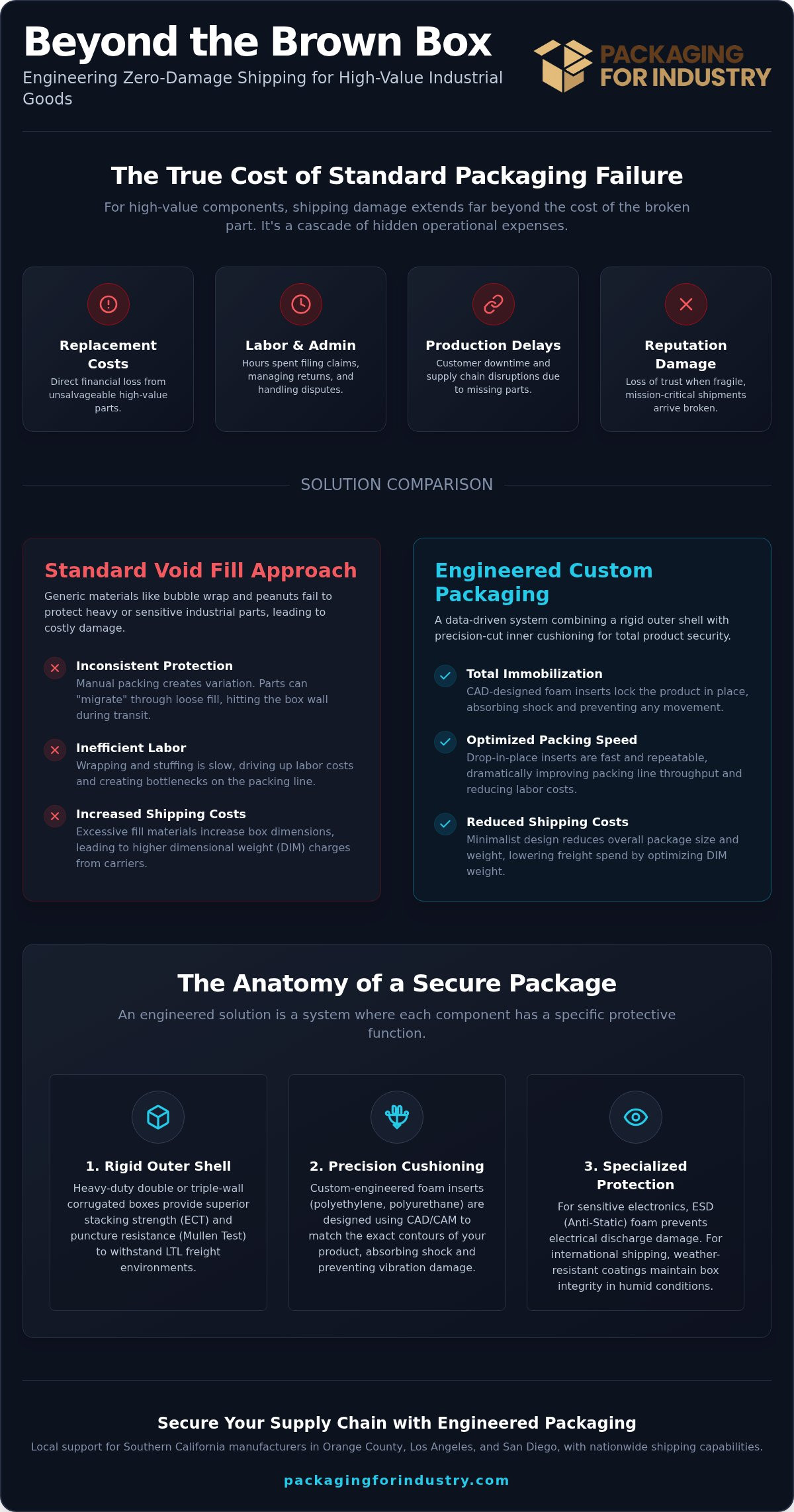
Effective protection requires viewing packaging as a coordinated system of preparing goods for transport. Standard off-the-shelf boxes from large catalog suppliers are designed for light parcel transit, not the rigors of LTL (Less-than-Truckload) freight. These generic containers often lack the stacking strength to survive being buried under heavy pallets or the puncture resistance to withstand a stray forklift tine. True security comes from an integrated protection strategy that combines a rigid outer shell with precision-cut inner cushioning. Without custom packaging for fragile items, your products are essentially unprotected against the chaotic environment of a modern distribution hub.
Identifying Vulnerability in Your Supply Chain
Damage usually occurs at three specific failure points: corner drops, sustained vibration fatigue, and vertical compression. Many shipping managers attempt to solve these issues by simply adding more layers of bubble wrap or loose-fill peanuts. This approach is rarely cost-effective. Excessive void fill increases the exterior dimensions of the box, leading to higher dimensional weight (DIM weight) surcharges from carriers. It also fails to prevent “migration,” where a heavy part eventually shifts through the soft packing material until it hits the box wall. Engineered custom packaging for fragile items eliminates this movement by using high-density foam that absorbs energy rather than just filling space.
Aerospace and Medical: High-Stakes Fragile Shipping
The stakes are highest in specialized sectors like aerospace packaging and medical device manufacturing. These industries deal with components that are both physically delicate and highly sensitive to environmental factors. For example, semiconductor equipment and circuit boards require more than just physical padding; they need ESD (Anti-Static) protection to prevent invisible electrical discharge from bricking the hardware. We focus on matching the specific material density to the G-force sensitivity of the product. Whether it is a calibrated surgical instrument or a turbine component, the packaging must act as a controlled environment that maintains the item’s precision from the cleanroom to the final assembly point.
Engineering Peace of Mind: The Anatomy of Secure Fragile Packaging
Engineering works where generic solutions fail. A truly secure package isn’t a collection of random materials; it’s a structured system designed to neutralize specific environmental hazards. For manufacturers in Orange County and Los Angeles, this means moving beyond the standard brown box to a solution that balances structural rigidity with energy absorption. Precision-engineered custom packaging for fragile items starts with a data-driven approach to material selection, ensuring that every layer serves a functional purpose.
Selecting the Right Corrugated Strength
The outer container is your first line of defense. Standard single-wall boxes often buckle under the weight of industrial stacking. We focus on the Edge Crush Test (ECT) for stacking strength and the Mullen Burst Test for puncture resistance. For heavy or sensitive parts, upgrading to heavy-duty corrugated boxes with double-wall or triple-wall construction is non-negotiable. These materials provide the vertical compression strength needed to survive LTL freight environments. If your products face international shipping or humid warehouse conditions, weather-resistant coatings can be applied to maintain structural integrity.
Precision Cushioning with Custom Foam
While the box provides the shell, custom foam packaging provides the 360-degree shock absorption required to protect internal components. Unlike loose-fill peanuts that shift during transit, die-cut foam is engineered to the exact geometry of your part. This ensures the product remains suspended and immobile. Convoluted foam is excellent for lighter, varied shapes, but high-density polyethylene or polyurethane inserts are superior for heavy industrial equipment. This level of control is why custom packaging for fragile items consistently outperforms bulk-purchased catalog supplies. If your current damage rates are unacceptable, you can request a custom packaging quote to evaluate a more robust design.
To validate these designs, we look toward established industry benchmarks like ASTM D4169 performance testing. This standard allows us to simulate real-world shipping hazards, such as drops and vibrations, before the first production run. By integrating corner and edge protection onto your pallets, we further reduce the risk of crush damage during forklift handling. This holistic view of the packaging anatomy ensures that your high-value assets arrive in factory-perfect condition, every time.
Custom Foam Inserts vs. Standard Void Fill: A Cost-Benefit Analysis
Industrial procurement isn’t just about the price per unit; it’s about the total cost of ownership. Many operations default to standard void fill like bubble wrap or packing peanuts to save on upfront material costs. This decision often backfires. Standard void fill is prone to settling during transit. Heavy items shift, eventually making contact with the box walls and leading to catastrophic failure. When you analyze the fiscal impact of packing and shipping fragile goods, the savings from reduced damage and lower return logistics costs quickly outweigh the initial investment in custom tooling.
In contrast, custom packaging for fragile items utilizes engineered foam that holds products in a fixed position. This eliminates the unpredictability of manual wrapping. Custom inserts allow for smaller exterior box dimensions because they don’t require the bulky “safety buffer” that loose fill demands. This directly lowers UPS and FedEx dimensional weight surcharges, which are often the most significant variable in a shipping budget. From a sustainability standpoint, high-quality foam inserts are often reusable for internal transfers or returnable loops, unlike single-use plastic films that immediately enter the waste stream.
Foam Material Selection: PE vs. PU vs. ESD
Choosing the right material is a balance of physics and economics. Polyethylene (PE) foam is the workhorse of the industry. It provides rigid, closed-cell support for heavy machinery and metal components that need to remain immobile. For lightweight items with highly delicate surfaces, Polyurethane (PU) foam offers a softer, open-cell structure that prevents abrasion. If you’re shipping medical sensors or printed circuit boards, anti-static (ESD) foam is essential. It prevents the latent electrical damage that standard plastics can cause during handling.
Reducing Labor on the Packing Line
The most overlooked benefit of custom inserts is the reduction in labor hours. Wrapping a complex part in bubble wrap and tape can take several minutes per unit. A custom foam insert reduces this to seconds. By implementing packaging kitting, you provide your team with pre-assembled protection that removes human error from the equation. Some industrial clients have reduced their packing time by 40% after switching from manual wrapping to custom-engineered foam assemblies. This streamlined flow allows your warehouse to handle higher volumes without increasing headcount or sacrificing protection quality.
How to Design and Test Your Fragile Packaging Solution
Design is the bridge between a vulnerable product and a secure shipment. In our Anaheim facility, we don’t rely on guesswork. We use a methodical CAD/CAM process to turn your product’s technical specifications into a protective system. This phase is where the geometry of your part meets the physics of energy absorption. By developing custom packaging for fragile items through digital modeling, we identify potential failure points before any material is cut. This proactive approach saves time and prevents the trial and error waste common with generic catalog suppliers.
From Blueprint to Prototype
Precision starts with data. You can provide us with CAD files or physical samples for a custom design packaging review. We then create a physical prototype. This is where the peace of mind begins. Our free prototyping service allows you to verify the fit and function of the foam inserts and corrugated outer shell in your own facility. If a medical sensor or aerospace component feels too loose or too tight, we iterate. We adjust foam densities or box dimensions based on these real-world results until the fit is perfect.
ISTA and Mil-Spec Testing Standards
Validation requires rigorous testing. We look at standards like ISTA 3A for individual parcel shipping and ISTA 3B for LTL freight. These tests simulate the drops, impacts, and sustained vibrations your cargo will face. For contractors requiring military packaging compliance, we ensure every crate and insert meets specific government durability requirements. Documenting these test results isn’t just about engineering; it provides essential evidence for insurance and liability protection. When you invest in custom packaging for fragile items, you gain the documented assurance that your high-value assets are protected against the most hostile shipping environments. If a carrier mishandles a shipment, you have the proof that your packaging was designed to survive the journey.
Securing Your Supply Chain: Why Southern California Manufacturers Choose PFI
Logistics efficiency in Southern California depends heavily on your choice of partners. While large national catalog suppliers offer convenience for small office orders, they often become a liability for industrial manufacturers. Shipping bulky materials from distant hubs leads to high freight costs and unpredictable lead times. As an Anaheim packaging supplier, we provide a localized advantage. We offer next-day delivery across Los Angeles, Orange County, and San Diego, ensuring your production schedule remains uninterrupted by transit delays. This proximity allows for better communication and faster design iterations when developing custom packaging for fragile items.
Reliability is the foundation of a healthy supply chain. We eliminate the risk of stockouts through our Vendor Managed Inventory (VMI) programs. Instead of your procurement team manually tracking box counts, we take responsibility for your stock levels. We monitor your usage and replenish your custom packaging for fragile items before you reach a critical low. This proactive approach transforms packaging from a recurring administrative headache into a predictable, streamlined utility that supports your broader operational goals.
Just-In-Time Delivery for Manufacturing
Warehouse space in the Inland Empire and Orange County is a premium asset that should be used for production, not for storing empty boxes. Our just-in-time management services allow you to reclaim your floor space. We store your custom-engineered crates and foam inserts at our facility and deliver them in the exact quantities your schedule demands. This lean approach prevents production stops and reduces the capital tied up in sitting inventory. It’s a pragmatic solution for high-volume manufacturers who need to balance logistical flow with fiscal responsibility.
Requesting a Fragile Packaging Quote
Transitioning to a more secure shipping system is straightforward when you have the right data. To receive an accurate assessment, have your product’s dimensions, total weight, and fragility rating ready. We also consider your typical shipping method, whether it’s local courier, parcel, or international LTL. Our team provides technical expertise rather than flashy retail sales pitches. We focus on the intersection of engineering and economics to ensure your high-value goods are protected at the lowest possible total cost. You can take the first step toward zero-damage shipping cycles by reaching out for a professional consultation.
Eliminate Shipping Damage and Optimize Your Logistical Flow
Achieving peace of mind in industrial logistics requires a shift from reactive damage control to proactive engineering. We’ve established that standard catalog boxes and loose-fill materials are insufficient for high-stakes freight. Precision-engineered solutions don’t just stop breakage; they lower your total cost of ownership by reducing DIM weight surcharges and labor hours. By moving away from generic void fill and adopting custom packaging for fragile items, you protect your high-value assets and your bottom line.
Our team brings specialized aerospace and medical packaging expertise to every project, ensuring your most sensitive components are secure. We offer free prototyping for custom fragile designs so you can verify the fit and performance before committing to a full production run. Combined with local next-day delivery in Southern California, PFI serves as a dependable partner for your manufacturing and distribution needs. You don’t have to settle for the high costs and unreliable protection of big-box suppliers.
Protecting your reputation and your profit margin starts with a better box. It’s time to build a more resilient supply chain.
Frequently Asked Questions
What is the best way to ship extremely fragile glass items in bulk?
The most effective method for shipping bulk glass is using custom-engineered corrugated boxes paired with precision-cut foam inserts. This system prevents glass-to-glass contact and provides the structural rigidity that loose-fill materials lack. Unlike bubble wrap, which can deflate or shift during transit, precision foam holds every unit in a fixed position. This level of protection is essential for medical vials or industrial lenses where even microscopic scratches result in total loss.
How do I calculate the right foam density for my product’s weight?
Foam density is determined by analyzing the product’s weight, its fragility rating (G-force sensitivity), and the expected drop height during transit. We use CAD modeling to decide if your application requires high-density polyethylene for rigid support or a softer polyurethane for delicate surfaces. This engineering-first approach ensures the cushioning absorbs energy without bottoming out. Getting this calculation right is the difference between a secure shipment and a shattered component.
Is custom foam packaging more expensive than using bubble wrap?
Custom foam has a higher material price than bubble wrap but lowers your total cost of ownership by reducing damage and labor. Manual wrapping is a slow process that’s prone to human error and inconsistent protection. A custom insert allows for faster packing line speeds and smaller box sizes. When you calculate the savings from fewer insurance claims and lower freight costs, custom packaging for fragile items is the more efficient choice.
Do you offer anti-static (ESD) foam for electronics?
Yes, we provide pink anti-static (ESD) foam specifically designed to protect sensitive circuit boards and medical sensors from electrostatic discharge. Standard packaging materials can generate static electricity during handling, which can brick electronics before they reach the customer. ESD foam safely dissipates this charge. This is a critical requirement for aerospace and semiconductor components that must remain functional and calibrated throughout the entire shipping cycle.
Can you provide custom crates for heavy machinery in Southern California?
We design and manufacture heavy-duty custom crates for industrial machinery at our Anaheim facility. These crates are engineered to handle high-weight loads and can be integrated with shock-absorbing bases or internal foam bracing. We regularly serve manufacturers across Los Angeles and the Inland Empire who need robust protection for large-scale equipment. Our local presence ensures we can provide the hands-on design support needed for complex, heavy-duty projects.
What is the typical lead time for a custom fragile packaging prototype?
We typically provide physical prototypes within a few business days after the initial design is approved. Our in-house CAD/CAM capabilities allow for rapid iterations and precise adjustments to foam density or box dimensions. This speed is a core benefit for Southern California manufacturers who need to validate custom packaging for fragile items quickly. This allows your team to move into full-scale production without long delays from national catalog suppliers.
How does optimized box sizing help reduce UPS and FedEx surcharges?
Optimized box sizing reduces the exterior volume of your parcel, which lowers the dimensional weight (DIM weight) surcharges applied by carriers. UPS and FedEx charge based on the space a box occupies if that volume exceeds its actual weight. By using precision foam inserts instead of bulky void fill, we minimize the box’s footprint. This ensures you aren’t paying to ship empty air and keeps your shipping budget under control.
Do you offer next-day delivery for packaging supplies in Orange County?
We provide local next-day delivery for stock packaging supplies and managed inventory items throughout Orange County. Our local fleet also covers Los Angeles and San Diego on a daily basis. This proximity allows us to support just-in-time manufacturing schedules and prevent costly production stops due to packaging stockouts. Whether you need bulk corrugated boxes or specialized cushioning, we ensure your warehouse remains stocked and operational.