
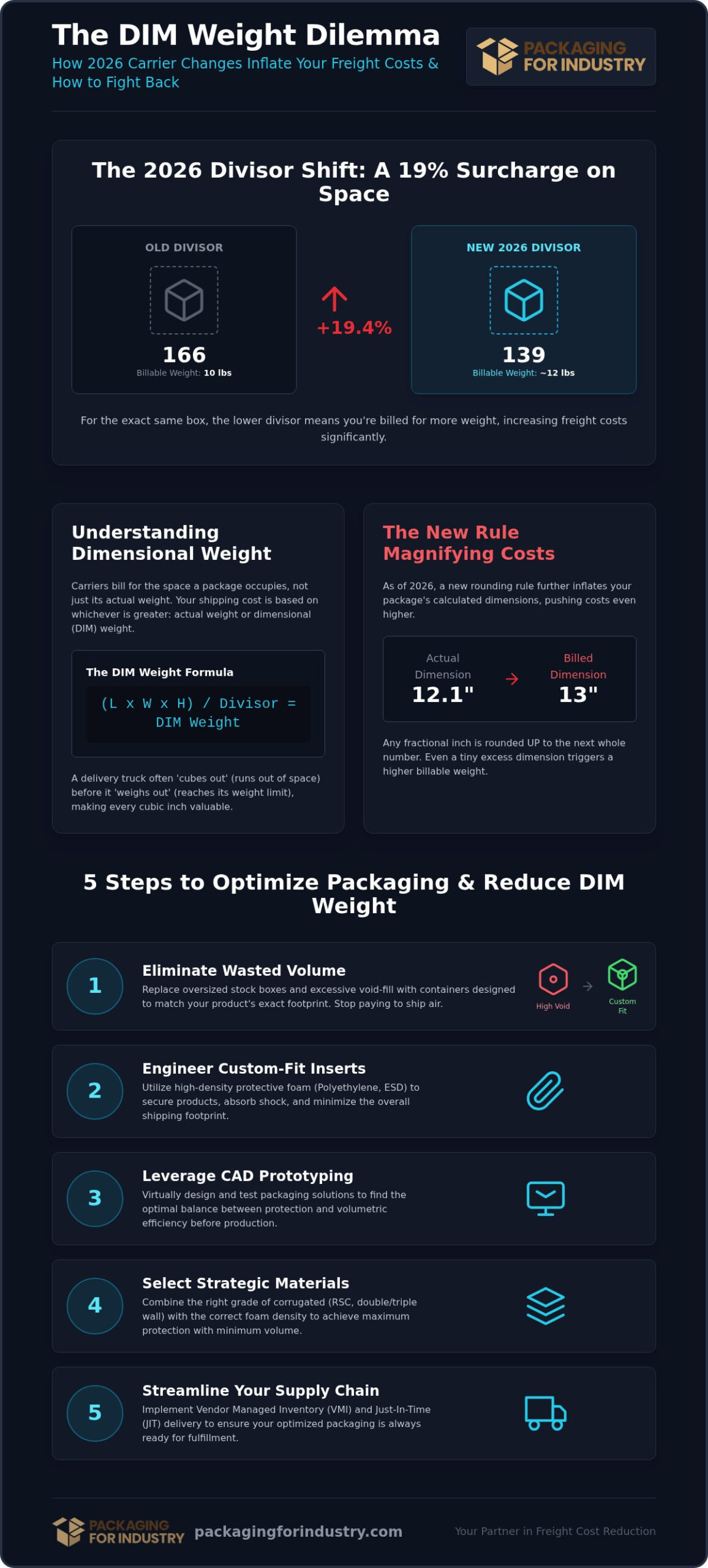
Did you know that the 2026 divisor shift from 166 to 139 can increase your billable weight by roughly 19 percent for the exact same box? It is a stark reminder that in industrial logistics, you aren’t just paying for the weight of your product; you’re paying for the space it occupies. This reality makes strategic packaging design to reduce dimensional weight a financial necessity rather than a luxury. Most manufacturers find it frustrating to see freight margins disappear because they’re essentially paying to ship air. You’ve likely felt the sting of unpredictable UPS or FedEx surcharges, yet you worry that smaller boxes might lead to compromised protection and costly damage claims.
Our goal is to help you take control of these overheads by re-engineering your industrial packaging. By utilizing precision-fit corrugated solutions and custom foam inserts, you can eliminate wasted volume without sacrificing durability. In this guide, we’ll explain how to optimize your box dimensions to match your product’s footprint exactly. We will also look at how our Southern California design team uses CAD prototyping to ensure your shipments move through the supply chain with maximum efficiency and predictable costs.
Key Takeaways
- Identify how carriers use volumetric pricing to bill for space and why traditional void-fill methods often lead to unnecessary shipping surcharges.
- Implement strategic packaging design to reduce dimensional weight by engineering custom-fit containers that eliminate wasted internal volume.
- Combine high-density protective foam with precision corrugated boxes to maintain product safety while significantly minimizing the overall shipping footprint.
- Leverage CAD prototyping and engineering expertise to turn packaging from a recurring expense into a proactive investment in freight cost reduction.
- Streamline operations with Vendor Managed Inventory (VMI) and local next-day delivery to ensure your optimized packaging is always ready for high-volume fulfillment.
Understanding the Impact of Dimensional Weight on Industrial Shipping Costs
In the current logistics climate, shipping costs are no longer determined solely by the reading on a scale. Carriers have transitioned to a pricing model known as dimensional weight, which calculates shipping rates based on the amount of space a package occupies in a truck or aircraft. For manufacturers producing lightweight but voluminous components, this shift represents a significant threat to profit margins. As of 2026, major carriers like UPS and FedEx utilize a domestic divisor of 139, and the USPS has aligned its rules to match. This means that if your box is large, you’re paying for that volume regardless of whether it contains heavy machinery or empty space. Implementing a strategic packaging design to reduce dimensional weight is no longer just an operational preference; it’s a fiscal requirement for maintaining a competitive bottom line.
The transition from general awareness to middle-of-the-funnel action usually occurs when a manufacturer receives a freight invoice that exceeds their estimates. In 2026, the cost of inaction is higher than ever. With new rounding rules requiring any fractional inch to be rounded up to the next whole number, even a half-inch of excess corrugated material can trigger a higher weight bracket. A comprehensive packaging review is a necessity to identify where your current containers are failing to meet these strict volumetric standards.
Why Carriers Prioritize Volume Over Mass
Logistics providers face a physical limit on the amount of cargo a vehicle can carry. A delivery truck often “cubes out,” meaning it reaches its maximum volume capacity, long before it “weighs out” by reaching its maximum weight limit. Because empty space on a truck cannot be sold to another customer, carriers use surcharges to recoup the lost revenue. Fuel efficiency and cargo constraints dictate that every cubic inch must generate income. The DIM Factor is the specific divisor used by carriers to convert a package’s total volume into a theoretical billable weight.
The Hidden Cost of ‘Shipping Air’ in Manufacturing
Many manufacturers rely on stock corrugated boxes because they are readily available and inexpensive upfront. However, these containers often result in excessive void space that requires additional void-fill material to prevent product movement. This creates a “tipping point” where the volumetric weight of the box far exceeds the actual weight of the product. For a manufacturer in Orange County or Los Angeles shipping nationwide, the difference between a stock 12-inch cube and a precision-engineered container can result in thousands of dollars in annual freight savings. By investing in custom design packaging, you eliminate the “shipped air” that triggers carrier penalties. This ensures that your packaging design to reduce dimensional weight effectively balances protection with logistical efficiency, preventing the 19 percent billable weight increases seen with recent divisor changes.
The Math of Logistics: Calculating Dimensional Weight vs. Actual Weight
Shipping costs are a product of geometry, not just gravity. To manage your freight budget effectively, you must understand that billable weight is the maximum of actual mass vs. volumetric calculation. Carriers use this rule to ensure they are compensated for the space a package occupies on their vehicles. The standard formula for this calculation is (Length x Width x Height) / Divisor = DIM Weight. As of July 2026, new rounding rules require any fractional inch to be rounded up to the next whole number before the multiplication occurs. This means a box measuring 12.1 inches on one side is treated as a 13-inch dimension, potentially pushing your shipment into a higher weight bracket before the divisor is even applied.
The DIM Factor: Comparing UPS, FedEx, and DHL Divisors
The 2026 domestic divisor for UPS, FedEx, and USPS is 139 for packages exceeding one cubic foot. If you are shipping internationally via DHL or other global carriers, divisors can vary between 139 and 166 depending on the specific service level. To identify if your current corrugated boxes are triggering surcharges, you must compare their physical weight to their DIM weight. If the calculated volumetric weight is higher, you are paying a premium for empty space. Effective packaging design to reduce dimensional weight focuses on narrowing this gap. By reducing the external dimensions of a container by even one inch, you can often bypass the “rounding up” penalty that inflates billable weight across thousands of shipments.
Consider a 5lb aerospace component shipped in a standard 12x12x12 stock box. At a divisor of 139, the DIM weight is 13 lbs (1,728 / 139 = 12.43, rounded up). In this scenario, you are paying for 13 lbs of freight. By switching to a custom-engineered 8x8x8 box, the DIM weight drops to 4 lbs (512 / 139 = 3.68, rounded up). Since the actual weight is 5 lbs, your billable weight becomes 5 lbs instead of 13 lbs. This simple transition eliminates the cost of 8 lbs of theoretical weight per unit.
Identifying Your ‘Billable Weight’ Threshold
Auditing your shipping manifest is the first step toward reclaiming your margins. Look for shipments where the billable weight consistently exceeds the actual weight. This discrepancy is essentially an “empty space tax” that impacts your warehouse efficiency. Inefficient packaging leads to higher warehousing costs because oversized boxes consume more pallet positions and rack space than necessary. If you’re unsure how these divisors are affecting your bottom line, you can request a packaging audit and quote to see exactly where your freight spend is leaking. Visualizing the total volume of “shipped air” across your annual output often reveals that custom packaging design to reduce dimensional weight is a high-return investment that pays for itself through immediate freight savings.
5 Steps to Optimize Packaging Design for DIM Weight Reduction
Reducing freight costs is an engineering challenge that requires a systematic approach to container geometry. While many operations attempt to lower costs by simply switching carriers, the most sustainable savings come from packaging design to reduce dimensional weight at the source. This process moves beyond the purchasing of stock supplies and into the realm of custom-engineered protection. By following a structured five step optimization plan, manufacturers can align their volumetric footprint with their actual product dimensions.
- Step 1: Precision Measurement. Successful design begins with more than basic dimensions. You must account for the furthest protrusions, handles, or fragile points that dictate the minimum clearance required for the outer container.
- Step 2: Right-Sizing the Container. This step involves moving away from “closest fit” stock boxes. Engineering a container that matches your product’s specific footprint eliminates the need for bulky void-fill and reduces the total cubic inches shipped.
- Step 3: Engineering Internal Protection. High-density materials like polyethylene foam provide superior cushioning in a thinner profile than traditional bubble wrap or peanuts. This allows for a smaller outer box without compromising safety.
- Step 4: CAD Prototyping. Digital design allows for the creation of precise templates. This ensures every component fits securely within the integrated foam and corrugated system before any physical production begins.
- Step 5: Testing and Validation. Smaller packaging must still survive the rigors of the supply chain. Validating designs against ISTA standards ensures that reducing the volumetric footprint doesn’t lead to an increase in damage claims.
Right-Sizing: Eliminating Excess Cubic Inches
The most immediate way to lower freight costs is to eliminate the empty space that carriers bill as “shipped air.” Most warehouses rely on a limited selection of stock RSC boxes, which often results in containers that are several inches larger than necessary. Because of the 2026 rounding rules discussed previously, even a one-inch reduction in a single dimension can drop a package into a lower billable weight bracket. Utilizing custom design packaging services allows you to specify dimensions down to the fraction of an inch, ensuring your box is no larger than the product and its protective inserts require. This is particularly effective for high-volume distributors in San Diego and Los Angeles who need to maximize pallet density for nationwide shipping.
Utilizing CAD Prototyping for Precision Fit
Industrial packaging engineering relies on CAD/CAM technology to minimize the margin of error. For specialized sectors like aerospace and medical device manufacturing, the tolerances for movement are incredibly tight. PFI provides free prototyping to verify the fit of your components within a custom-engineered system. This “fixer” approach identifies opportunities to nest parts or utilize integrated foam-in-box solutions that drastically reduce the outer shipping container’s dimensions. By seeing a physical prototype before mass production, operations managers can confirm that the packaging design to reduce dimensional weight provides the exact level of protection required for high-value assets while maintaining the smallest possible volumetric footprint.
Strategic Material Selection: Balancing Protection with Volumetric Efficiency
Effective packaging design to reduce dimensional weight involves more than just shrinking the outer container. It requires a fundamental shift in how you engineer the internal space. Many manufacturers rely on loose-fill materials like packing peanuts or standard bubble wrap because they are inexpensive. However, these materials are volumetrically inefficient. They require significant clearance on all sides of a product to provide adequate cushioning, which inevitably forces you into a larger box size. In the 2026 shipping environment, that extra clearance is a direct trigger for higher billable weight charges.
To optimize your freight spend, you must prioritize materials that provide maximum protection with minimal thickness. By utilizing corner and edge protection, you can reinforce the most vulnerable points of your shipment without adding bulk to the entire package. This allows for tighter tolerances between the product and the outer corrugated wall, effectively reducing the overall cubic inches of the shipment.
Custom Foam Inserts vs. Loose Fill
The transition to custom foam packaging is one of the most effective ways to lower freight costs for high-value industrial parts. Die-cut foam end caps or custom-molded polyethylene inserts lock a product in place, eliminating the risk of movement during transit. Polyethylene foam is particularly useful because it provides high-density protection in a very slim profile compared to softer polyurethane options. Because the foam is engineered to the exact shape of the part, you can significantly reduce the “buffer zone” required by loose-fill alternatives. This precision allows you to use a smaller shipping container, which is the primary driver of DIM weight savings.
High-Strength Corrugated: Double-Wall and Triple-Wall Efficiency
Sometimes, the best way to reduce a package’s volumetric footprint is to increase the strength of the material itself. Standard single-wall boxes often require bulky internal bracing or external crates to prevent collapsing under the weight of a pallet stack. Switching to double-wall or triple-wall corrugated material provides the necessary structural integrity with minimal thickness. This engineering “sweet spot” allows you to eliminate heavy wooden crates or oversized outer containers while maintaining ISTA safety standards. Multi-wall corrugated provides high-level structural integrity while adding negligible thickness to the outer dimensions of the box. For manufacturers in Los Angeles and Orange County shipping heavy components, this material shift often pays for itself by preventing the need for oversized, over-packaged containers that “cube out” a truck too early.
Partnering with a Custom Packaging Manufacturer for Long-Term Savings
Partnering with a specialized manufacturer allows you to transition from a reactive purchasing model to a proactive logistics strategy. At Packaging For Industry (PFI), we act as a “fixer” for your supply chain, identifying where oversized containers and inefficient materials are inflating your freight spend. By implementing packaging design to reduce dimensional weight, we help you eliminate the recurring surcharges that erode your margins. This engineering-led approach ensures that every box is a precision tool designed for both protection and fiscal efficiency. It’s about moving beyond just buying supplies and toward a system of logistical optimization.
The Role of Custom Engineering in Southern California Logistics
Anaheim and Orange County manufacturers face unique logistical challenges, including high warehousing costs and the need for rapid fulfillment. Our local presence allows us to offer next-day delivery, which is essential for operations running lean or just-in-time schedules. By using precision-engineered, collapsible designs, our manufacturing clients can reduce the physical footprint of their packaging inventory. This optimization frees up valuable floor space while ensuring that every shipment is sized to avoid the 2026 carrier penalties. For manufacturers across Los Angeles and San Diego, having a local partner means you can prototype and validate custom solutions without the long lead times associated with national distributors.
Leveraging VMI to Maintain Optimized Inventory
A common cause of freight cost spikes is the “emergency” use of oversized stock boxes when custom inventory runs low. To prevent this, we integrate Vendor Managed Inventory (VMI) with our optimized designs. We monitor your usage and manage the stocking of your custom-sized boxes so your lines never stop. This level of oversight is critical for maintaining the benefits of packaging design to reduce dimensional weight over the long term. It ensures you always have the correct, right-sized container on hand, preventing the need to “ship air” in a standard RSC box just to meet a deadline.
The long-term ROI of this partnership is realized through the simultaneous reduction of shipping damage and freight surcharges. When your packaging is engineered to the exact dimensions of your product, the risk of movement is virtually eliminated. Simultaneously, the reduced volumetric footprint ensures your billable weight remains as low as possible. You can request a packaging cost-savings analysis to begin identifying the specific areas where your current operations can be optimized for the 2026 shipping standards.
Optimize Your Logistics Strategy for 2026 and Beyond
Navigating the complexities of modern freight requires a shift from standard boxes to engineered solutions. As carrier rules tighten and divisors remain aggressive, the most effective way to protect your margins is through precision packaging design to reduce dimensional weight. By eliminating excess volume and utilizing high-density protective materials, you can avoid the “empty space tax” that currently inflates your shipping invoices. This approach turns your packaging from a recurring overhead cost into a strategic asset for freight reduction.
Our Southern California team specializes in aerospace and industrial logistics, providing the technical expertise needed to solve these volumetric challenges. We offer free prototyping for custom designs to ensure a perfect fit for your high-value components before you commit to production. With local next-day delivery across Orange County, Los Angeles, and San Diego, we ensure your supply chain remains both reliable and fiscally responsible. It’s time to stop paying for shipped air and start shipping with precision.
Taking control of your shipping costs starts with a single engineering review. We look forward to helping you streamline your operations and improve your bottom line through smarter packaging design.
Frequently Asked Questions
What is the formula for dimensional weight in 2026?
The standard formula for domestic dimensional weight is (Length x Width x Height) / 139. This specific divisor applies to UPS, FedEx, and USPS Ground Advantage shipments exceeding one cubic foot as of July 2026. You must round each dimension up to the nearest whole inch before multiplying to ensure your calculations align with carrier billing systems.
How do I know if I am being overcharged for shipping air?
You can identify these hidden costs by comparing the “actual weight” to the “billable weight” on your freight invoices. If the billable weight is consistently higher, you’re paying a premium for the volume of the container rather than the mass of your product. This discrepancy indicates that your current boxes contain excessive void space that a custom solution could eliminate.
Can custom foam inserts actually help reduce my shipping costs?
Yes, custom foam inserts allow for much tighter tolerances than traditional loose-fill materials. By using high-density polyethylene or polyurethane foam, we can secure your product with minimal clearance on all sides. This precision in packaging design to reduce dimensional weight allows for a smaller outer box, which directly lowers the billable weight of every shipment.
Is custom packaging design more expensive than using standard stock boxes?
While the unit price of a custom-engineered container may exceed that of a mass-produced stock box, the total cost of fulfillment is usually lower. Stock boxes often force you into higher freight brackets because they aren’t optimized for your product’s footprint. The freight recovery from right-sizing your shipments typically offsets the initial engineering and material costs within a few shipping cycles.
How much can I realistically save by reducing my box size by one inch?
Reducing a single dimension by just one inch can drop a package into a lower billable weight category, particularly with current carrier rounding rules. Because volume is calculated cubically, small reductions in length, width, or height have a compounding effect on the final DIM weight. For high-volume manufacturers in Orange County or Los Angeles, these incremental changes result in substantial annual freight recovery.
What industries benefit most from DIM weight reduction strategies?
Specialized sectors like aerospace, medical device manufacturing, and electronics see the highest ROI from these strategies. These industries frequently ship lightweight components that are bulky or oddly shaped. By engineering custom corrugated and foam systems, these businesses can protect high-value assets while avoiding the massive surcharges typical of lightweight, oversized shipments.
Does PFI provide CAD prototypes for custom-sized boxes?
PFI provides free CAD/CAM prototyping to verify the fit and structural integrity of your custom solutions. Our proactive approach ensures that your packaging design to reduce dimensional weight is fully validated before you move to mass production. This allows your operations team to test the smaller footprint and ensure it meets ISTA safety standards without risking product damage.
What is the difference between volumetric weight and dimensional weight?
There’s no functional difference between these two terms in the logistics industry. Both volumetric and dimensional weight refer to the pricing technique carriers use to bill based on a package’s size rather than its actual mass. Carriers will always apply the higher of the two values to your invoice to ensure they’re compensated for the space occupied on their vehicles.