
What makes a hardware package feel high-end without making it harder to ship or unpack? It is not extra layers added for appearance alone. A high-end unboxing experience for B2B hardware starts with packaging that protects the product, presents each component clearly, and works reliably in a real fulfillment operation. When valuable hardware arrives damaged, loosely packed, or difficult to identify, the package can undermine confidence before the product is even put to use.
For B2B buyers, premium presentation and practical handling need to work together. The process starts with matching a corrugated box and protective foam to the hardware, then arranging components so recipients can identify and access them easily. Custom packaging design, CAD/CAM support, prototypes, and samples can help teams assess the fit and pack-out before a broader rollout. The goal is a repeatable package that protects hardware in transit and gives customers a consistent first impression without adding unnecessary complexity to packing and shipping.
Key Takeaways
- Define the hardware’s protection, identification, and unpacking needs before selecting a package configuration.
- Compare stock and custom options by fit, repeatability, presentation, and how they work with your packing process.
- Use product dimensions, vulnerable areas, included components, and shipping methods to guide package design.
- Review prototypes and samples before rollout to assess the pack-out and make it easier to standardize.
- A high-end unboxing experience for B2B hardware should support product protection and a clear, efficient presentation at shipping scale.
What Makes a High-End Unboxing Experience for B2B Hardware?
A high-end unboxing experience for B2B hardware is a coordinated package that protects the product, organizes its contents, and makes hardware easy to identify and access. Quality is not measured by the number of layers or decorative touches. It shows in whether the package arrives in good condition and supports the recipient’s next task, whether that means inspection, installation, evaluation, or storage.
Quotable definition: A premium B2B unboxing experience combines dependable product protection with clear organization and efficient handling from the first opening through the next operational step.
The person opening a shipment may be a technician, engineer, receiving employee, or procurement team member. They need to locate the main unit, accessories, and relevant documentation without disturbing other components or searching through loose fill. A package that gives each item a clear place can simplify inspection and help the recipient move from delivery to use with less friction.
The concept of unboxing is often associated with presentation and the opening sequence. In a B2B setting, that sequence should also communicate practical care: the product is held in place, components have a clear home, and the package does not create unnecessary work. Each layer should protect, organize, identify, or provide access.
How B2B hardware unboxing differs from retail gift packaging
Retail gift packaging may prioritize visual impact. Packaging for business hardware has a different job: preserve product condition, keep components together, and make contents straightforward to identify. Recipients may need to inspect a shipment, install the equipment, store unused parts, or return hardware for service. A package designed around those tasks supports handling without relying on decorative extras.
Check that every packaging element has a clear function. A fitted insert can separate accessories from the primary unit and limit movement. A clearly placed document pouch can keep instructions or product paperwork accessible. Extra layers that add packing steps or material without improving protection, identification, or access can make the process less efficient.
What buyers should expect from a premium package
Expect a considered opening sequence: the recipient can see what to remove first, find accessories in an organized position, and access documentation without unpacking the entire box. The arrangement should suit the hardware and the way it will be handled, not simply create a visual reveal.
Fit supports that presentation. A corrugated outer box and suitable cushioning can work together to hold hardware in position while keeping contents arranged. PFI’s custom packaging design can combine packaging materials and support prototypes and samples, helping teams assess the layout before a broader rollout. The right configuration depends on the product and packing workflow. A clean presentation matters, but it cannot substitute for a package designed to protect hardware through shipping and handling.
Engineer the Unboxing Sequence Around Hardware Protection
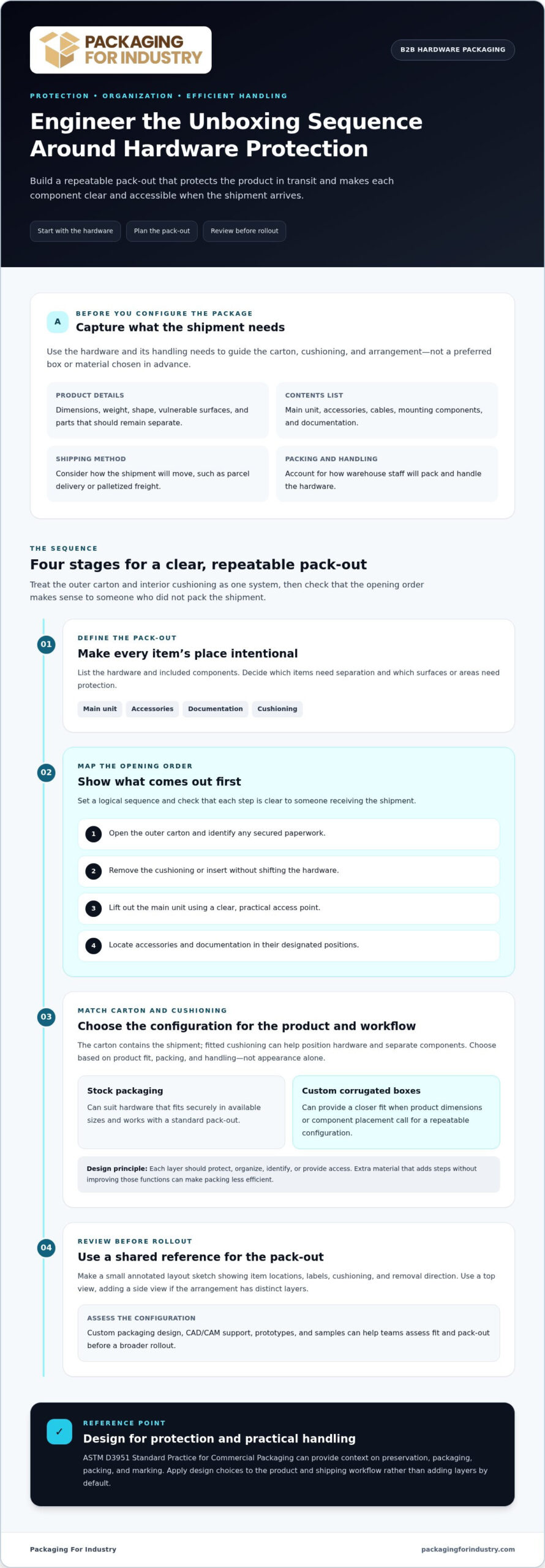
Start with the hardware, not a preferred box or cushioning material. Record the product’s dimensions, weight, shape, vulnerable surfaces, and parts that should remain separate. Make a contents list that includes accessories, cables, mounting components, and documentation. Then note how the shipment will move, such as by parcel delivery or palletized freight, and how warehouse staff will pack and handle it. These details help shape a package that protects the product and makes each item straightforward to locate.
Design the outer carton and interior cushioning as one system. The carton contains the shipment, while fitted cushioning helps position the hardware and separate components. A packaging reference such as the ASTM D3951 Standard Practice for Commercial Packaging can provide context on preservation, packaging, packing, and marking. Apply design choices to the product and shipping workflow rather than adding layers by default.
Plan the opening sequence from outside in
Set a logical order for opening and removing the contents, then check that each step is clear to someone who did not pack the shipment. One product may need a simple carton and insert; another may benefit from separate compartments or a protective layer over the main unit. The goal is controlled access, not complexity. A small annotated layout sketch can show item locations, labels, and removal direction to guide both packing and receiving.
- Open the outer carton and identify any secured paperwork.
- Remove the cushioning or insert without shifting the hardware.
- Lift out the main unit using a clear, practical access point.
- Locate accessories and documentation in their designated positions.
Use the sketch to show the actual pack-out from above, adding a side view if the arrangement has distinct layers. Label the main unit, accessories, documents, and cushioning. Mark which items come out first. This gives packaging and fulfillment teams a shared reference for reviewing the sequence and repeating it consistently.
Match box and cushioning choices to the shipment
Product shape, weight, fragile areas, and shipping method all affect package design. Stock packaging can suit hardware that fits securely within available sizes and works with a standard pack-out. Custom corrugated boxes can provide a closer fit when product dimensions or component placement call for a repeatable configuration. Choose based on how the package is packed and handled, not only on how it looks when opened.
Custom foam inserts can hold a unit and its accessories in defined positions, helping organize and cushion the contents. PFI’s protective foam packaging can be considered alongside the corrugated carton as part of the overall design. Review the arrangement with a physical sample or prototype before standardizing it, so teams can assess fit and packing steps. If you are planning a hardware pack-out, request a packaging quote based on the product and shipment details.
Compare Packaging Options for a Premium Hardware Unboxing
The best configuration balances product fit, protection, presentation, and pack-out requirements. A simple carton may work well for robust hardware with few components. A unit with exposed surfaces, accessories, or more demanding shipping needs may call for cushioning or a coordinated package with separate interior positions. Compare how each option affects packing steps, storage, and unpacking, not just how it looks when opened.
The table outlines typical trade-offs. Actual performance depends on the hardware and shipment, so treat these configurations as starting points for evaluation rather than fixed specifications.
| Configuration | Potential advantages | Trade-offs to assess |
|---|---|---|
| Box only | Fewer components and a straightforward pack-out when the product fits securely. | Limited separation for loose accessories; fit and movement need careful review. |
| Box plus cushioning | Cushioning can help position the unit and provide a cleaner, more organized opening. | Adds a packing material and step; the insert must fit the product and workflow. |
| Coordinated multi-material package | Corrugated, foam, and, where appropriate, a crate can serve distinct protection and organization needs. | More elements can require additional storage, assembly, and pack-out coordination. |
When stock packaging is a practical fit
Stock packaging can be a sound choice when available box sizes and standard cushioning fit the hardware, limit unwanted movement, and keep contents accessible. For recurring shipments, a familiar configuration can also support consistent purchasing and straightforward packing. Stock packaging does not have to look generic: orderly placement, clear component identification, and a tidy pack-out can still create a considered unboxing. Review the fit and packing steps with the team that prepares the shipment.
When custom packaging creates a better fit
Custom dimensions or inserts can help organize irregular hardware, separate accessories, and avoid unused space that complicates handling. Custom corrugated boxes paired with foam can create a repeatable arrangement, while crates may suit shipments with different handling requirements. Each added material should solve a defined need, since a more involved pack-out also affects storage and assembly.
To select a configuration, compare how well it holds the product in place, how easily staff can pack it the same way, and whether recipients can remove components without disturbing others. Consider the shipment method and fulfillment workflow alongside protection and presentation. A high-end unboxing experience for B2B hardware is most practical when its presentation follows from a package that fits the product and works in routine operations.
How to Design, Prototype, and Standardize the Unboxing
A repeatable package starts with a clear brief, not a material choice. Document what ships, how recipients use the contents, and how the fulfillment team prepares each order. This connects the customer-facing opening sequence to the work required on the packing line. PFI’s custom packaging design services include CAD/CAM support, prototypes, and samples to help teams review a configuration before broader rollout.
Translate product and fulfillment requirements into a packaging brief
Capture the details that affect fit, protection, and workflow. Record product dimensions and weight, vulnerable areas, accessories, documentation, shipping methods, and storage or handling constraints. Note how each component should appear and be removed, along with the sequence packers follow to assemble the shipment.
Include recurring-order needs in the brief. A design should be practical to replenish and straightforward for different team members to pack consistently. Define presentation priorities, but weigh them against product protection, material storage, and the space available at the packing station. A brief that records these requirements gives design reviews a shared basis for decisions.
Prototype, review, and prepare the packing process
Use a prototype or sample to test the package with the actual hardware and included components. Check that parts sit in their intended positions, the main unit can be removed without disrupting accessories, and documents remain accessible. Review the package in the order it will be assembled and opened. A sample can reveal fit or access issues that are hard to catch from a drawing alone.
Bring the employees responsible for packing and fulfillment into the review. Ask them to work through each assembly step and flag unclear placement, awkward handling, or steps that may vary between packers. Update the design or instructions based on those observations, then review the revised pack-out before adopting it for repeat shipments. PFI’s packaging kitting and assembly can support coordinated pack-out workflows.
- Gather requirements: document the product, components, handling needs, shipment method, and repeat-order considerations.
- Develop the configuration: map how the materials, inserts, and contents should fit together.
- Review a sample: assess fit, access, assembly, and presentation with the hardware in place.
- Standardize the pack-out: document component locations and packing steps so teams can repeat the approved arrangement.
This process turns the high-end unboxing experience for B2B hardware into a package that can be reproduced, not just a one-time presentation. Consistent instructions and a reviewed sample help align procurement, packing, and the recipient’s experience while keeping protection central to the design.
Request a custom packaging quote
Build a Repeatable B2B Hardware Packaging Program with PFI
Packaging For Industry (PFI) supplies hardware shipments with custom and stock corrugated boxes, foam packaging, crates, and packaging kitting. Treating these options as parts of a packaging program, rather than separate purchases, gives procurement and operations teams a clearer way to align materials with product requirements and recurring orders.
This approach can serve aerospace and aviation suppliers, electronics and medical device manufacturers, industrial equipment companies, and warehouse and distribution operations. PFI supports businesses in Orange County, Los Angeles, San Diego, and Riverside, as well as nationwide. For teams managing multiple hardware configurations, a coordinated supply plan can simplify purchasing, support consistent pack-outs, and help maintain packaging availability for ongoing production and shipping.
What to include in a packaging quote request
Share the product dimensions, weight, vulnerable areas, and components shipped together. Add the shipping method, current damage concerns, packing steps, and recurring order needs. Note whether custom sizes, foam inserts, crates, or packaging kitting are relevant. This information helps PFI assess the full requirement and develop a quote around the hardware and its operating context.
Connect presentation goals with reliable supply
A packaging plan also needs to work for the people who purchase, store, and prepare orders. Consider how many configurations teams will manage, how supplies fit into available storage, and how the pack-out can be maintained as orders recur. PFI’s packaging kitting and assembly can support coordinated pack-outs. The practical benefit is a defined approach that connects packaging choices with purchasing and fulfillment needs, helping teams work toward lower costs, less product damage, and more reliable supply.
Share your hardware and shipping requirements to request a packaging quote and discuss a repeatable packaging program for your operation.
Turn Your Packaging Requirements into a Practical Next Step
Before adopting a new package, decide who owns the approved specification and how future hardware changes will be reviewed. A revised component, accessory, or product configuration can affect fit and packing instructions. A simple change-control step helps purchasing and fulfillment teams work from the same current requirements instead of relying on outdated assumptions.
A high-end unboxing experience for B2B hardware can evolve with the product while staying grounded in what recipients and operations teams need. Set a clear review point whenever the hardware or shipment process changes, and keep packaging decisions connected to those real requirements.
Start with the hardware, shipping method, and recurring supply needs to develop a package your team can use consistently.
Frequently Asked Questions
How do you create a premium unboxing experience for B2B hardware?
Start with the recipient’s next task: inspection, installation, evaluation, or storage. Make the most important contents easy to recognize, and use concise labels or a contents list when several parts ship together. Keep the presentation focused on what helps the recipient act, rather than decorative additions. A high-end unboxing experience for B2B hardware should feel considered because the package communicates care and makes the handoff clear.
Can custom packaging reduce damage to high-value hardware?
Custom packaging can be designed to address known handling risks, but it cannot guarantee damage prevention. Use receiving records to identify recurring patterns, such as damage reported on a particular surface or after a specific shipping route. Share those observations during a packaging review so design decisions target a documented issue. Tracking damage consistently also helps teams compare shipments before and after a packaging change and decide whether further adjustments are needed.
What packaging materials work best for B2B hardware?
The suitable materials depend on the shipment’s protection needs and the receiving operation. Corrugated boxes commonly serve as the outer container, while foam can support or cushion hardware; crates can be considered for appropriate heavy-duty applications. Also account for how packaging is stored, handled, and disposed of or reused at the destination. A material that protects the product but complicates receiving or takes impractical storage space may not suit the full supply chain.
Is custom packaging worth considering for recurring hardware shipments?
Evaluate custom packaging when recurring shipments involve product variations, frequent substitutions, or pack-out adjustments that make a standard setup hard to manage. Compare the number of package configurations purchasing must track, the space each takes in the warehouse, and the effort needed to train packers. Customization may make sense if it simplifies those decisions, but retain stock packaging where it already supports a stable, efficient process.
How can a company test a hardware unboxing design before production?
Include someone who has not helped design the package in the review. Give that person the sample and observe whether they understand how to handle the contents and what to do next without verbal guidance. Note questions, hesitations, or unclear labels, then revise the instructions or layout. A short review record can capture who tested it, what changed, and which version the team approved, helping prevent confusion when the design moves into routine use.
What should I include when requesting a B2B packaging quote?
Along with the product and shipment details, provide a photo or drawing of the current pack-out and identify what you want to improve. Note whether the priority is fewer packing variations, a clearer recipient handoff, easier warehouse storage, or another operational goal. If orders include more than one hardware configuration, distinguish the versions. This context helps an industrial packaging supplier assess the complete requirement and discuss a practical scope for the quote.