
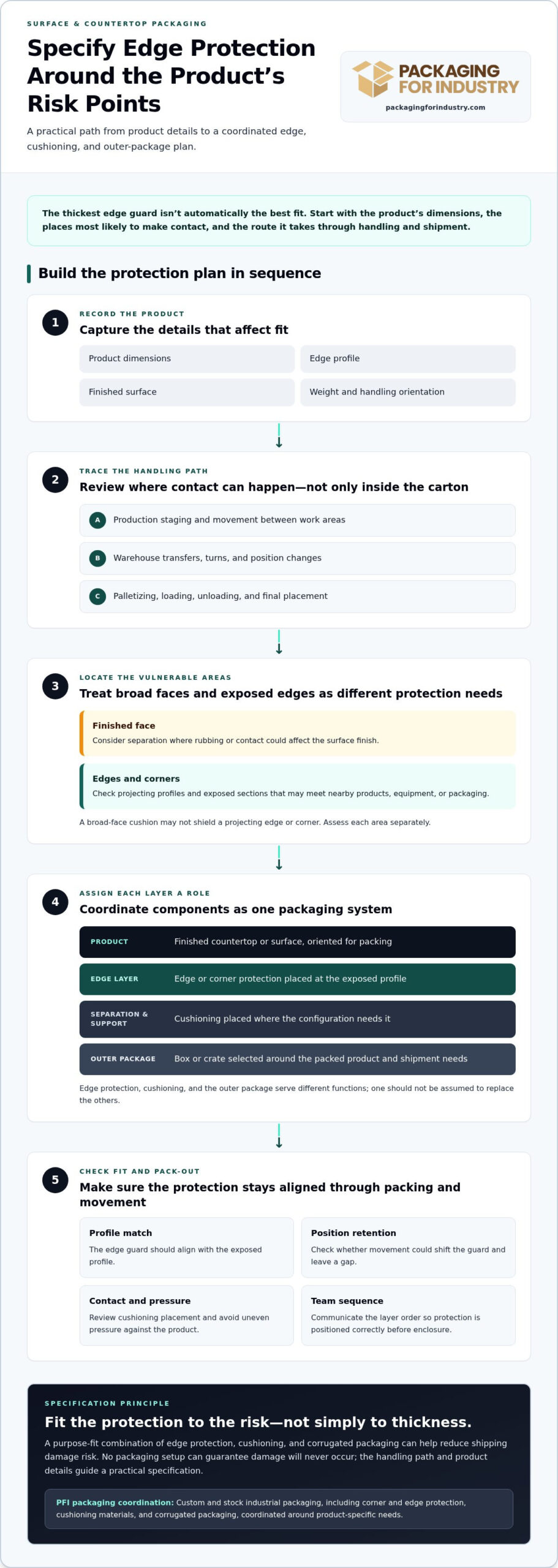
The thickest edge guard isn’t always the best fit. Effective edge protection for countertops and surfaces depends on where contact is most likely, how the product will be handled, and how it will be packed for shipment. A guard that doesn’t match the product’s dimensions or shipping path can add material without protecting the areas most at risk.
Edges and corners deserve attention because chips and scuffs can lead to product loss, rework, and customer complaints. But protection works as a system. Edge guards, cushioning, and outer packaging need to suit the finished surface and the way the product moves through handling and transit.
This guide compares practical approaches and explains how to specify a packaging combination based on product dimensions, vulnerable areas, and shipping requirements. See how corner and edge protection can work alongside protective foam, cushioning materials, and corrugated packaging to reduce damage risk without adding unnecessary handling steps. Packaging For Industry (PFI) supplies custom and stock industrial packaging and supports product-specific packaging design.
Key Takeaways
- Chipped or scuffed edges can create product loss and customer complaints, so assess exposed edges separately from broad surface areas.
- Choose edge protection for countertops and surfaces based on edge profile, finish, fit, handling, and compatibility with the outer package.
- Compare corrugated edge and corner protection with foam and cushioning by the role each material plays in the packaging system.
- Document product dimensions, edge profiles, finish, weight, and handling orientation to guide a practical packaging specification.
- Coordinate edge protection with boxes and cushioning through a supplier that offers custom and stock industrial packaging.
Why Countertop and Surface Edges Need Purpose-Fit Protection
A chipped countertop edge or scuffed finished surface can turn a sellable product into a claim, rework task, or customer complaint. Damage also interrupts warehouse and delivery workflows while teams document the issue and arrange a resolution. For manufacturers and distributors in Orange County, Los Angeles, San Diego, and Riverside, packaging decisions should account for the full handling path, not just the final shipping carton.
Edges and corners concentrate contact in a smaller area than a broad face. Cushioning across the surface may help limit abrasion or impact to that face, but it may not cover a projecting profile or shield a corner from contact with nearby products, equipment, or packaging. Packaging serves several functions, including physical protection, and edge guards are one part of the broader system.
Edge protection is a packaging component positioned to shield exposed product edges from contact during handling, storage, and shipment. Its role differs from cushioning a broad surface or containing the product in an outer package. Packaging For Industry supplies corner and edge protection that can be coordinated with corrugated packaging and cushioning materials.
Where edge damage can occur in a product’s journey
Risk can arise before a shipment leaves the facility. During production staging, products may be set down or moved between work areas. In a warehouse, repeated transfers, turns, and position changes can expose projecting edges to contact. During palletizing and loading, neighboring items or handling equipment may come close to corners. Unloading and placement create further handling points. Because exposure changes at each step, review the actual route rather than assuming protection is needed only inside the shipping package.
Broad-face protection addresses a different concern. A surface may need separation from rubbing or contact across its finish, while an edge guard focuses on the perimeter. Some packages need both, with the outer box or crate containing and supporting the packed product. Treating these components as interchangeable can leave a vulnerable area uncovered.
What buyers should protect beyond the edge itself
Assess the finished face, corners, edge profile, and exposed sections separately. A shaped or projecting profile may not sit against a standard guard in the same way as a straight edge. Consider the finish, product orientation, and points where contact is most likely during staging, movement, and shipment. The packaging combination should suit these details rather than rely on a generic layer applied to every surface.
Fit matters. A guard that shifts during movement can leave a gap, while packaging that presses unevenly against the product may create another contact concern. Review how edge protection works with cushioning and the outer package as one configuration. The objective is to reduce shipping damage risk with a practical arrangement that fits the product and handling process. No packaging setup can guarantee damage will never occur, but a purpose-fit specification gives buyers a clearer basis for selecting and coordinating materials.
How Edge Protection Works with Surface Packaging
Edge protection is one component in a packaging configuration, selected to shield exposed edges during handling and shipment. It doesn’t perform every protective role on its own. A finished surface may need separation from rubbing, edges may need guards against contact, and the outer package contains the packed product within the shipping setup. Defining these functions separately helps buyers specify what each component needs to do.
How edge protection differs from cushioning
Edge protectors are positioned at vulnerable edges or corners. Cushioning materials serve other roles, such as providing separation or support where the product may contact its surroundings. The right combination depends on the product and pack-out, not on assuming one material can replace every other component. PFI’s cushioning materials can be coordinated with edge protection in a product-specific packaging arrangement.
For example, a countertop panel may need guards along its perimeter while the broad finished face is kept separate from nearby packaging. The edge guard should align with the exposed profile, and cushioning should be placed where support or separation is needed. Neither should be treated as a substitute for a suitable outer package.
How the outer package supports an edge-protection plan
A box or crate forms the outside structure of the configuration. Select it with the product’s dimensions, protected profile, and shipment handling in mind, rather than in isolation. PFI’s corrugated box options can be part of a coordinated plan with edge protection and cushioning. Package fit and handling path are design inputs, not details to assume.
Pack-out sequence matters too. The team needs to position protection correctly and keep it in place as the product is enclosed. A simple layer map can make the sequence easier to communicate across production and warehouse teams:
- Product: Finished countertop or surface, oriented for packing.
- Edge layer: Edge or corner protection placed at the exposed profile.
- Separation and support: Cushioning positioned as required by the configuration.
- Outer package: Box or crate selected around the packed product and shipment needs.
This is a planning example, not a fixed specification. A product with a shaped edge, different finish, or alternate shipping orientation may need a different arrangement. A packaging review should consider contact points, how components fit together, and whether workers can apply them consistently without unnecessary steps. Packaging design support can translate actual product dimensions and handling requirements into a practical configuration.
The Institute of Packaging Professionals (IoPP) provides broader professional resources on packaging. For a specific shipment, buyers need to define the product and handling requirements. If you’re coordinating guards, cushioning, and an outer package for a countertop or surface, request a packaging quote based on the product dimensions and shipping setup.
Compare Edge Protection and Surface Packaging Approaches
The right choice depends on what each component needs to do. Corrugated edge and corner protection focuses on exposed profiles, while foam and other cushioning materials can add separation or support elsewhere in the package. Compare options by looking at the product, pack-out steps, and outer package together, rather than ranking one material as best for every shipment.
Comparison factor | Corrugated edge and corner protection | Foam or cushioning
Edge profile: Consider it when a formed component can be configured around exposed edges or corners. | Consider it for cushioning or separation needs beyond the edge itself.
Surface sensitivity: Pair it with suitable surface separation if the finish needs protection from contact or abrasion. | Consider placement and contact with the finished surface as part of the pack-out plan.
Fit: Review how the component aligns with the product’s profile and stays positioned in the package. | Review where cushioning is needed and how it fits around the packed item.
Handling: Account for how workers apply and maintain the protection through packing and movement. | Account for the sequence and placement needed to support the packed product.
Packaging compatibility: Coordinate it with cushioning and the outer package. | Coordinate it with edge guards and the box or crate, rather than treating cushioning as a replacement for them.
When corrugated edge and corner protection may fit
Corrugated protection is worth considering when the packaging plan calls for a formed component around an exposed edge or corner. The key is whether its configuration suits the product geometry and the way the item will be packed, stored, and shipped. Review corner and edge protection as part of the full package design, using the actual product to assess fit rather than relying on assumptions.
When foam or combined materials deserve consideration
Foam may complement edge protection when the package also needs cushioning or separation. PFI’s protective foam packaging can be coordinated with edge guards, rather than treated as a universal substitute. Choose a material combination based on product shape, shipment method, and pack-out workflow, including whether workers can position each component consistently.
There are practical trade-offs. A configuration with multiple materials may address distinct contact areas, but it also asks packers to apply more than one component. A simpler arrangement may be easier to repeat if it addresses the identified needs. Packaging design support can help assess actual dimensions and coordinate custom or stock materials for the shipment.
For a countertop shipment, the review might compare edge guards alone, foam in selected areas, or a combined arrangement inside a suitable outer package. These are configuration options, not performance guarantees. Evaluate the complete shipment, including how the product is oriented, packed, and handled, before settling on a specification. To discuss a product-specific setup, request a packaging quote.
How to Specify Edge Protection for Countertops and Surfaces
A clear specification helps purchasing, packaging, and warehouse teams work from the same requirements. For edge protection for countertops and surfaces, document the product and its journey through packing and shipment, then assess how the components fit the routine. This gives a packaging supplier the details needed to develop a practical configuration instead of relying on assumptions.
Build a useful product and handling brief
Start with a representative product and record its dimensions, weight, edge profiles, finish, and intended handling orientation. Mark which edges and corners need protection, and describe known contact, stacking, or handling concerns. Include the current packaging components and explain how the product moves through production, storage, packing, loading, and distribution.
- Document the product. Capture overall measurements and the profile of each edge or corner that may need a guard. Note differences among product models or sizes so the specification reflects the items actually being packed.
- Describe the finish and orientation. Identify the surface finish and how the countertop or panel is positioned during storage and shipment. Share known areas of concern, such as where contact occurs during stacking or routine handling.
- Map the packaging and shipment method. List existing edge protection, cushioning, and outer packaging. Describe the shipment route and handling path, including storage conditions and how products are loaded or transferred.
- Include pack-line constraints. Explain the available packing space, sequence, and steps workers follow. A configuration should fit the operation as well as the product, without adding unnecessary handling complexity.
- Plan for replenishment. Share repeat order patterns, expected packaging use, storage capacity, and consistency needs across shipments. These details help buyers consider purchasing and supply needs alongside the initial design.
An actionable edge-protection brief includes product dimensions, edge profiles, finish, weight, orientation, existing packaging, shipment route, storage needs, and pack-out constraints. Clear inputs make it easier to compare a stock component with a custom-sized packaging solution for the application.
Review fit, pack-out, and recurring purchasing needs
Before a broader rollout, a sample or prototype can help the team assess how proposed components fit the product and work in the packing sequence. Review whether guards stay positioned through pack-out, whether workers can apply the materials consistently, and how the complete configuration fits the outer package. Packaging design support and prototypes help teams evaluate these practical details.
Then weigh custom sizing against stock packaging components. A stock option may suit a repeatable product and established workflow, while custom sizing may better address a distinctive profile or a range of product dimensions. Consider storage space and reorder patterns too, so the selected approach works for ongoing packaging procurement, not just the first shipment.
With the product and operating requirements documented, request a packaging quote for your edge-protection needs.
Source Countertop Edge Protection Through an Integrated Packaging Supplier
Sourcing edge protection alongside related packaging can simplify coordination across purchasing, packing, and shipping. Rather than managing separate specifications for guards, cushioning, and the outer package, buyers can review how the materials work together and compare packaging pricing for a complete setup. This gives manufacturers, warehouses, and distributors a clearer basis for evaluating bulk packaging pricing and lowering packaging costs without adding unnecessary materials or steps.
Packaging For Industry supplies custom and stock industrial packaging, including edge protection, corrugated boxes, foam, and cushioning materials. Packaging design support helps align components with product dimensions and packing requirements. The goal is a practical specification for the operation, not a promise that any one configuration will prevent all damage.
What an industrial packaging supplier can coordinate
Edge protection needs to fit within the full package. Reviewing guards alongside corrugated packaging and cushioning helps buyers consider component fit, pack-out sequence, and the outer package together. This gives purchasing, warehouse, and shipping teams a shared basis for specifying materials, comparing options, and keeping routine packing steps manageable.
PFI supports manufacturers, warehouses, distributors, and other industrial businesses with custom and stock packaging. Buyers can assess whether a recurring order or bulk purchase suits their usage and storage needs, then compare the packaging combination and pricing with the current setup. PFI serves industrial customers in Orange County, Los Angeles, San Diego, and Riverside, with local next-day delivery across Southern California and nationwide shipping.
What to include when requesting a quote
A focused brief connects product details with purchasing and shipment requirements. Include the information your team already tracks, along with the packaging volumes you expect to source:
- Product details: Dimensions, weight, edge profile, finish, and packing orientation.
- Order volume: Typical quantities, recurring order patterns, and variations among product sizes.
- Current packaging: Existing edge protection, cushioning, boxes or crates, and pack-out sequence.
- Shipment context: Storage conditions, handling path, shipment method, and distribution requirements.
- Current concerns: Damage patterns, packaging changes under consideration, or purchasing challenges.
These details help frame a quote around the complete packaging setup and support a useful comparison of custom and stock components. Sharing recurring order needs can also help buyers assess bulk packaging pricing and purchasing consistency, rather than evaluating only the immediate shipment.
PFI connects product protection with purchasing, warehouse handling, and shipping needs. Share your brief to discuss edge protection, related materials, and packaging procurement requirements.
Put Your Packaging Requirements Into Action
Assign an owner to the approved packaging specification. Keeping one current version for purchasing and packing teams can reduce confusion when orders recur or an alternative material is considered. For edge protection for countertops and surfaces, clear revision control helps ensure teams follow the same agreed configuration.
Build that review into your normal packaging procurement process. If a product design or supply plan changes, update the specification before the change reaches routine packing. A consistent reference gives teams a practical starting point for future decisions.
A clear, maintained specification helps your operation make its next packaging decision with confidence.
Frequently Asked Questions
What is the best edge protection for countertops during shipping?
There isn’t one best option for every shipment. To select edge protection for countertops and surfaces, use damage records and handling observations to identify where the current packaging needs review. Note whether issues appear after parcel delivery, freight handling, or warehouse transfers, and whether certain product styles recur in claims. This evidence helps focus a packaging review on actual failure points instead of adding material without a clear purpose.
How do you protect countertop edges from chips and surface damage?
Build repeatable packing and inspection steps around the product’s most vulnerable areas. Train packers to check that protection is in place before closing the package, and record recurring marks or chips by product style and shipment. If damage appears inconsistent, compare affected shipments with undamaged ones to look for differences in packing or handling. These records help teams refine their process without assuming packaging alone can eliminate every risk.
Can corrugated edge protectors be used with foam packaging?
Yes. Teams can evaluate both materials in a trial pack-out and observe whether the arrangement is straightforward to apply and stays organized through the normal packing sequence. Note any interference between components, difficulty closing the package, or extra steps for packers. This operational review helps determine whether the combination suits the product and workflow, rather than relying only on a material comparison.
Which packaging details should I provide when requesting an edge-protection quote?
Along with the core product information, share a marked-up photo or drawing that identifies recurring damage locations. Describe product variations, approximate order frequency, and any planned changes to the product or packing process. If available, include examples from damage reports and details of the current packaging components. This helps distinguish a one-off issue from a pattern affecting recurring shipments.
How do I choose between custom and stock edge protection?
Consider how the choice affects SKU management and day-to-day packing. If several product styles can use the same component, a stock option may simplify purchasing and storage. If workers rely on adjustments or workarounds for particular items, a custom component may be worth evaluating. Track how many packaging items the team needs to store and whether product design revisions could change those needs.
Can edge protection be combined with a corrugated box or crate?
Yes. During a pack-out review, check that the protected product can be enclosed and that package closures, labels, and normal handling access remain practical. For palletized shipments, consider how the packed unit will be arranged with other freight and whether the packaging plan fits that process. These checks help teams catch workflow or package-assembly conflicts before adopting a configuration for routine operations.
What industries use edge protection for finished surfaces?
Manufacturers and distributors in construction and building products may use it for finished panels, countertops, and related surface products. Warehouses and logistics operations may also handle these goods between production, storage, and shipment. Other industrial businesses can have similar needs when products include finished edges or faces that need to remain presentable through distribution. The packaging requirement depends on the product and its movement, not just the industry name.