
What if the difference between a profitable quarter and a logistical nightmare was a single sheet of paper? Most industrial buyers have faced the frustration of crushed RSC boxes or inconsistent material quality from different vendors. It’s difficult to compare packaging pricing when your requirements are vague, leading to professional stress and operational delays. We understand that you need a steady, dependable partner who knows how to create a packaging specification sheet that eliminates these common industrial pain points.
In this guide, you’ll master the technical process of documenting packaging requirements to eliminate shipping damage, ensure supplier compliance, and lower operational costs. We’ll walk through the core components of a spec sheet, specialized requirements for aerospace and electronics, and the five-step process to finalize your documentation. Whether you require local next-day delivery across Orange County, Los Angeles, San Diego, and the Inland Empire, or you need to leverage PFI’s nationwide shipping capabilities, mastering these technical blueprints is the foundation of a reliable supply chain.
Key Takeaways
- Understand why a packaging specification sheet acts as a technical contract to ensure material consistency and eliminate expensive shipping damage.
- Identify the critical material components to document, including specific corrugated board grades, flute types, and protective foam densities.
- Follow a standardized five-step process for how to create a packaging specification sheet that aligns your engineering and procurement teams.
- Learn the specialized documentation requirements for high-stakes sectors, such as aerospace standards and MIL-SPEC packaging compliance for defense contracts.
- Discover how accurate specifications enable cost-saving Vendor Managed Inventory (VMI) programs and reduce lead times for custom orders.
Why Every Industrial Manufacturer Needs a Packaging Specification Sheet
A packaging specification sheet is a technical blueprint that defines every physical and logistical requirement for a shipping unit. It serves as the definitive guide for what a package must be, how it must perform, and how it must be handled. It removes the guesswork. Without this document, your supply chain relies on assumptions, which is a high-risk strategy for any industrial manufacturer.
Vague specifications lead to immediate financial loss. Ambiguity in box dimensions or board strength often results in crushed products or unexpected dimensional weight surcharges from carriers like UPS and FedEx. When you understand how to create a packaging specification sheet, you gain the ability to accurately compare packaging pricing across multiple vendors. It’s the only way to ensure that every quote you receive is based on identical material standards. This prevents suppliers from cutting corners to offer a lower price while sacrificing the safety of your goods.
For specialized sectors like aerospace and medical manufacturing, these documents are not optional. Regulatory compliance requires a documented trail of material certifications and performance standards. A well-drafted spec sheet ensures that your components are protected according to industry-specific mandates and safety protocols.
The Single Source of Truth for Your Supply Chain
A specification sheet aligns your engineering, procurement, and warehouse teams around a single objective. It eliminates the risk of “tribal knowledge,” where critical packaging details exist only in the minds of a few veteran employees. If a key member of your operations team leaves, your production doesn’t have to suffer. These documents also facilitate much smoother handoffs to packaging manufacturers. When a supplier knows exactly what you expect, lead times decrease and quality control becomes a binary pass-fail process rather than a subjective debate.
Reducing Transit Damage Through Technical Clarity
Damage during transit is often the result of technical misalignment between the product and its container. By specifying exact metrics like burst strength, edge crush test (ECT) ratings, and stacking strength, you provide the protection your product actually requires. A spec sheet allows you to define internal protection, such as the exact density and dimensions of custom foam inserts. This level of detail ensures consistent load stabilization for palletized goods. It prevents the shifting and vibration damage that plagues less disciplined shipping operations.
Core Components of an Industrial Packaging Specification
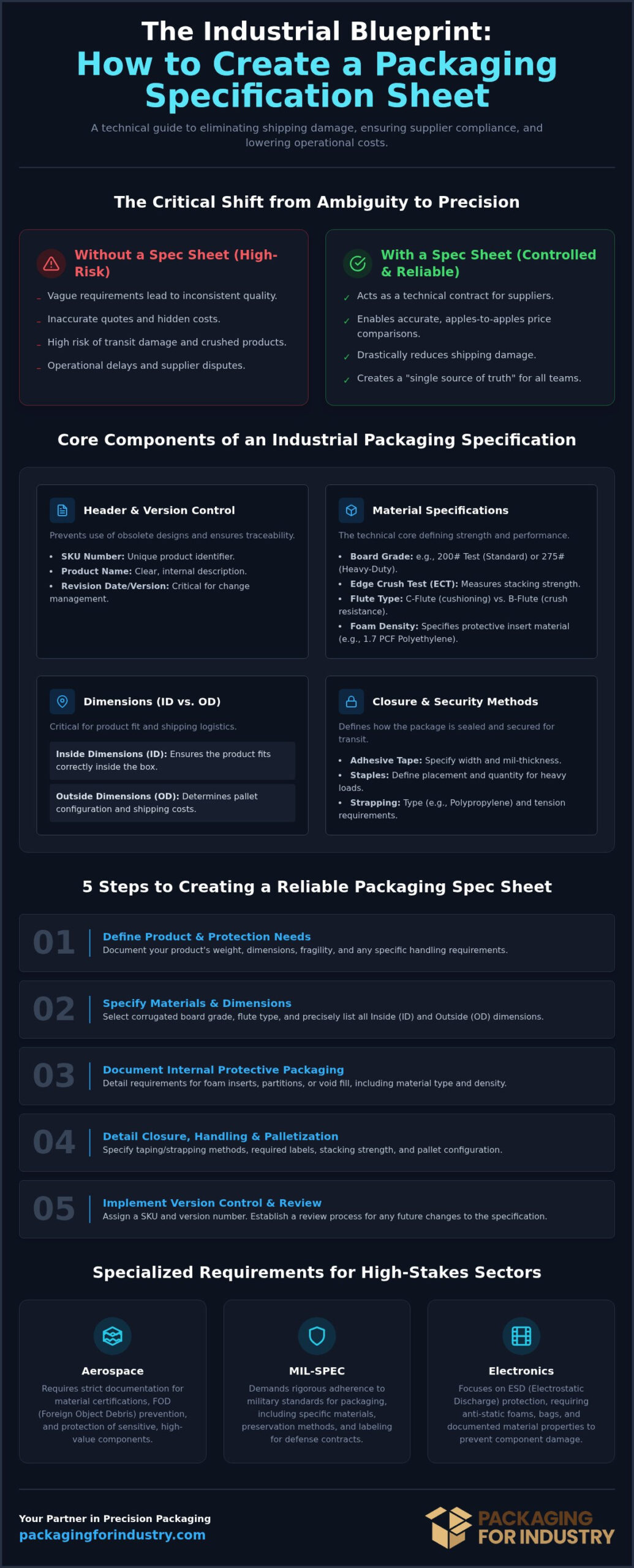
An effective industrial spec sheet moves beyond basic descriptions to provide exact material engineering data. When you’re documenting how to create a packaging specification sheet, you must start with a header containing the SKU number, internal product name, and a revision date. Version control is vital. It prevents the warehouse from using obsolete designs that no longer meet current shipping requirements. Without a clear revision history, a minor design change can lead to a major fulfillment error that stalls your production line.
Material specifications form the technical core of the document. You shouldn’t just ask for “cardboard.” You need to specify the board grade, such as 200# test or 275# heavy-duty corrugated, and the flute type. Flute B provides excellent crush resistance and a flatter surface for printing; Flute C offers better cushioning and stacking strength. Accurate dimensions are equally critical. Always distinguish between Inside Dimensions (ID), which ensure your product fits, and Outside Dimensions (OD), which determine your pallet patterns and shipping costs. Misidentifying these by even a fraction of an inch can lead to loose loads or pallet overhang.
Security and closure methods round out the primary requirements. Specify the width and mil-thickness of industrial adhesive tapes, or define the placement of heavy-duty staples and strapping. Because we specialize in industrial applications, we have custom sizes available for all materials to meet your specific load requirements. If you’re unsure which material grade best suits your application, you can request a packaging quote to review technical options with a specialist.
Corrugated Box Technical Details
Your spec sheet must define the box style. While many options exist, RSC boxes (Regular Slotted Cartons) are the industrial standard for efficiency. For complex parts, you may require a Die-Cut design for a precision fit. For heavy machinery or bulk components, specify the wall construction. While single-wall is common, double-wall or triple-wall boxes provide the structural integrity needed for high-weight loads. Don’t forget to list necessary coatings, such as weather-resistant finishes for outdoor storage or anti-static treatments for sensitive electronics.
Protective Internal Components
Internal protection is where many shipments fail. Specify the exact foam type, choosing Polyethylene (PE) for high-impact protection of heavy items or Polyurethane (PU) for softer cushioning. Include the required density and thickness for each piece. Your documentation should also detail the use of corner boards to prevent strap damage and increase vertical stacking strength. For multi-part shipments, include kitting and assembly instructions to ensure warehouse personnel pack every component in the correct sequence. Implementing these precise details is one of the fastest ways to lower packaging costs by reducing material waste and transit damage.
Specialized Requirements: Mil-Spec, Aerospace, and Electronics
Industrial sectors often require more than just physical protection; they demand strict regulatory adherence. When you’re learning how to create a packaging specification sheet for these high-stakes industries, you must integrate specific compliance codes directly into your technical blueprint. For defense contractors, navigating MIL-SPEC packaging is a matter of contract fulfillment. You’ll need to reference standards like MIL-STD-2073 to define the preservation methods and packing levels required for military components. These documents ensure that every vendor in your supply chain adheres to the same rigorous federal standards.
Aerospace standards require a difficult balance between lightweight materials and high durability. Your spec sheet should define materials that reduce freight costs without compromising the integrity of sensitive aviation parts. For electronic components, ESD protection is mandatory. This includes specifying anti-static bags and specialized ESD foam to prevent electrostatic discharge during handling and transit. Additionally, for international shipments, you must document export compliance. This involves listing ISPM-15 heat-treatment requirements for any custom crates or pallets to avoid costly customs delays and quarantine issues at international borders.
Compliance for Defense and Aerospace
Precision is non-negotiable in defense and aviation logistics. Your spec sheets must explicitly list the military standards your products must meet to ensure total compliance. Errors in these documents often lead to rejected shipments or severe contract penalties. PFI supports aerospace packaging through precision engineering that meets these rigid requirements. We focus on traceability and labeling, ensuring that every shipping unit is identifiable and compliant with its respective industrial spec. This proactive approach eliminates the stress of potential audit failures or logistical bottlenecks.
Electronics and Cleanroom Specifications
Sensitive electronics require protection from more than just physical impact. Your documentation should clearly define moisture barrier and static shielding requirements to prevent environmental damage during long-term storage or sea freight. If you’re shipping into cleanroom environments, you must specify particulate-free materials that won’t introduce contaminants into the facility. Finally, ensure your labels and ribbons meet durability standards for harsh environments. Legibility is critical, and your specs should guarantee that barcodes and tracking numbers remain intact from the manufacturing floor to the final destination.
5 Steps to Creating a Reliable Packaging Spec Sheet
Developing a technical blueprint requires a methodical approach to ensure every variable in the shipping cycle is accounted for. The process involves more than just listing dimensions; it requires an understanding of how materials interact with your product and the logistical environment. Here is how to create a packaging specification sheet through a structured five-step process:
- Step 1: Conduct a physical audit. Analyze the product’s fragility and the shipping environment. Consider if the goods face high-vibration transit or long-term stacking in a warehouse.
- Step 2: Define ‘Critical to Quality’ (CTQ) metrics. Document the exact weight and physical dimensions. Even a half-inch discrepancy can compromise the structural integrity of a pallet load or lead to carrier surcharges.
- Step 3: Select materials. Determine the necessary burst strength for boxes and the specific density for protective foam. With custom sizes available for nearly every board grade, you don’t have to settle for a standard box that doesn’t fit your product.
- Step 4: Prototype the design. Collaborate with a manufacturer for custom design and prototyping to validate the fit and performance.
- Step 5: Finalize and approve. Establish version control with clear revision dates and obtain final signatures from engineering and procurement teams.
Prototyping: The Essential Validation Step
You shouldn’t finalize a technical document without a physical sample. Prototyping allows you to catch design flaws before they become expensive production errors. By utilizing CAD/CAM support, you can refine dimensions and material placement with high precision. This phase is also the time to conduct real-world transit tests. Subjecting your prototype to drop tests and vibration simulations ensures the spec actually performs under the stress of a typical logistics cycle. Validating the design early prevents the professional stress of mass-producing a specification that fails in the field.
Refining Specs for Cost Reduction
A well-drafted spec sheet is a powerful tool to lower packaging costs. During the drafting process, look for areas of over-packaging where you might be using more material than the product’s weight truly requires. Reducing the weight of your corrugated boxes or foam inserts can significantly lower freight expenses over thousands of units. You should also look for opportunities to compare packaging pricing by standardizing sizes across multiple SKUs. This allows you to leverage bulk ordering discounts and simplify your warehouse inventory. Consult with an experienced salesperson to identify lower-cost material alternatives that maintain protection while improving your bottom line.
Optimizing Your Supply Chain with Data-Driven Specifications
Accurate technical data is the backbone of procurement efficiency. When you master how to create a packaging specification sheet, you’re not just documenting a box; you’re enabling sophisticated logistical programs like Vendor Managed Inventory (VMI). These programs rely on precise technical data to automate replenishment. Without standardized specs, a VMI provider can’t guarantee that the stock they manage will meet your engineering requirements. Data-driven specs also streamline the re-ordering process, which is essential to prevent production shortages in high-volume manufacturing environments.
For Southern California manufacturers, these specifications are the foundation for Just-In-Time (JIT) delivery. By providing a clear technical blueprint, you allow your supplier to hold spec-compliant inventory and deliver it exactly when your production schedule demands it. This approach links your spec sheets directly to recurring packaging cost-reduction analysis. It’s much easier to identify potential savings when you have a baseline of technical data to analyze against market fluctuations or material innovations. You’ll move from reactive purchasing to proactive supply chain management.
Inventory Control and Reliability
Reliable inventory management depends on the elimination of lead-time surprises. When your custom boxes and foam inserts are defined by a rigorous spec sheet, your supplier can anticipate your needs and maintain a steady pipeline of materials. This ensures consistent quality for recurring orders, even in high-volume warehouses where manual inspections of every unit are impractical. PFI uses your technical specifications to maintain stocking programs in Anaheim and the surrounding Inland Empire. This proximity, combined with accurate data, ensures that your production line never stops due to a packaging shortage.
The PFI Advantage: From Specs to Solutions
Building your first technical document can be a complex task, but you don’t have to do it alone. You can leverage PFI’s industrial expertise to help you understand how to create a packaging specification sheet that covers all your critical-to-quality metrics. Beyond the document itself, we offer custom kitting and assembly services based on your technical documentation. This provides a total end-to-end solution for your logistical needs. For manufacturers in Southern California, we offer next-day delivery capabilities for spec-compliant stock items. This level of service ensures that your operation remains agile and responsive to changing market demands.
Standardizing Your Industrial Packaging for Long-Term Efficiency
A robust specification sheet is the bridge between engineering protection and procurement savings. By documenting technical details like board grade, foam density, and mil-spec compliance, you eliminate the ambiguity that leads to transit damage. We’ve explored how to create a packaging specification sheet through a structured process that includes physical audits and CAD-driven prototyping to validate performance before bulk production begins.
Packaging For Industry (PFI) supports this transition with free prototyping to ensure perfect product fit. As specialists in Southern California industrial logistics, we provide the custom and stock solutions required for aerospace, defense, and high-volume manufacturing. Our team is here to help you move from reactive purchasing to a data-driven, optimized supply chain.
Taking control of your technical documentation is the first step toward a more reliable and cost-effective operation. We’re ready to help you refine your specifications and improve your logistical flow today.
Frequently Asked Questions
What should be included in a packaging specification sheet?
A comprehensive sheet includes SKU numbers, revision dates, and internal product names for accurate tracking. You must list technical material specs like 275# test board and flute types such as B or C. It should also define inside and outside dimensions, closure methods like industrial adhesive tape or strapping, and internal protection details like polyethylene foam density. This ensures every vendor understands your exact requirements for protection and logistics.
How do I determine the correct board grade for my industrial boxes?
You determine the board grade by analyzing your product’s weight and the anticipated stacking height during transit. For heavy industrial gear, a 275# double-wall box provides superior burst strength compared to standard 200# options. If you prioritize stacking strength, focus on Edge Crush Test (ECT) ratings. Specialists can help you evaluate these variables during the prototyping phase to ensure you don’t over-package or risk product damage.
Why is version control important for packaging specs?
Version control is critical because it prevents your warehouse or suppliers from using obsolete designs that no longer meet current shipping standards. When you update a dimension or material, an outdated spec sheet can lead to production delays or crushed loads. By maintaining clear revision dates and approval signatures, you ensure every team member and vendor is working from the same single source of truth for your supply chain.
Can a packaging supplier help me create my spec sheet?
Yes, a qualified industrial supplier like PFI can guide you through the process of how to create a packaging specification sheet. We use CAD/CAM engineering and free prototyping to help you define technical requirements that align with your budget and protection needs. This partnership is especially valuable for complex projects involving mil-spec packaging or custom foam inserts, where technical precision is required for contract compliance and logistical efficiency.
What is the difference between inside and outside dimensions in packaging?
Inside dimensions measure the usable space within the box to ensure your product and internal cushioning fit properly. Outside dimensions measure the exterior of the container, which is the data carriers use to calculate dimensional weight and shipping costs. Accurate exterior measurements are also essential for designing stable pallet patterns. Distinguishing between these two in your specs prevents loose loads and unexpected freight surcharges from carriers like UPS or FedEx.
How often should I review and update my packaging specifications?
You should review your specifications annually or whenever there is a change in your product design or shipping environment. If you’ve switched carriers or experienced a spike in transit damage, an immediate audit is necessary. Regular reviews allow you to identify opportunities to lower packaging costs by adopting new material technologies or standardizing sizes across multiple SKUs. This proactive approach keeps your supply chain lean and your protection levels optimized.
Are there specific spec requirements for international shipping?
International shipping requires compliance with ISPM-15 standards for any wood packaging, such as pallets or custom crates, to ensure they are heat-treated against pests. Your spec sheet should also include moisture barrier requirements and static shielding if you’re shipping electronics across high-humidity ocean routes. Documenting these export standards prevents costly customs delays and ensures your goods arrive at their destination without environmental damage or regulatory penalties at the border.
How do packaging specs help in reducing shipping costs?
Accurate specifications help you lower packaging costs by identifying areas where you can reduce material weight without sacrificing protection. By optimizing the outside dimensions of your boxes, you can minimize dimensional weight surcharges from major carriers. Additionally, standardized specs allow you to leverage bulk ordering discounts and implement efficient VMI programs. This data-driven approach ensures you aren’t paying for unnecessary material or inefficient shipping volumes that waste valuable warehouse space.