
A stockout of a simple corrugated box can halt a million-dollar production line just as effectively as a critical equipment failure. While packaging is often viewed as a commodity, it represents a single point of failure that can lead to expensive production stops and unacceptable damage rates for high-value components. Conducting a comprehensive risk assessment for your packaging supply chain is no longer optional for manufacturers who value operational continuity. It’s a strategic necessity to protect your bottom line from the volatility of inconsistent lead times and poorly engineered materials.
You likely recognize that relying on generic catalog suppliers often results in solutions that fail during transit or arrive too late to meet your schedule. This guide provides a master framework for identifying these vulnerabilities before they manifest as a shipping crisis. You’ll learn how to audit your current supplier network, reduce damage through better engineering, and implement a more reliable inventory model like Vendor Managed Inventory (VMI). We’re moving beyond basic procurement to build a resilient, cost-effective logistics system that ensures your products reach their destination intact and on time.
Key Takeaways
- Understand why a single packaging stockout acts as a critical failure point that can stop your entire production line.
- Perform a comprehensive risk assessment for your packaging supply chain with a checklist focused on material performance and design integrity.
- Compare the reliability of local next-day delivery in Southern California against the extended lead times of national catalog suppliers.
- Learn how Vendor Managed Inventory (VMI) programs shift stock monitoring to your supplier to prevent inventory gaps.
- Lower shipping damage for high-value components by utilizing custom engineering and rigorous prototyping before full-scale rollouts.
Identifying Critical Vulnerabilities in the Industrial Packaging Supply Chain
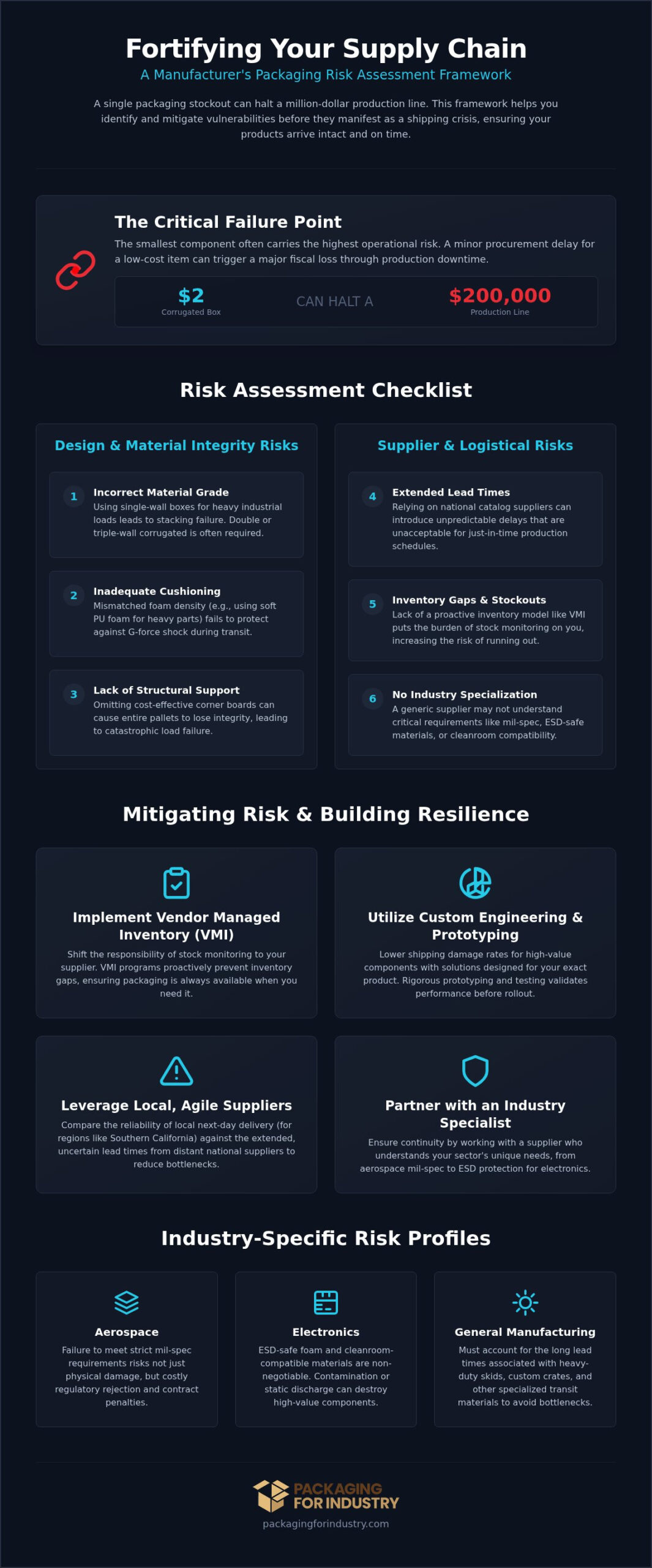
A thorough risk assessment for your packaging supply chain reveals that the smallest component often carries the highest operational risk. Imagine a $200,000 production line sitting idle because a shipment of $2 corrugated boxes failed to arrive. This isn’t a hypothetical scenario. It’s a frequent reality for manufacturers who treat packaging as an afterthought. Stockouts disrupt the entire flow of goods, turning a minor procurement delay into a major fiscal loss. Every hour of downtime subtracts from your profitability and adds unnecessary stress to your operations team.
There’s a fundamental difference between stock catalog items and custom-engineered materials. While stock items seem convenient, they often lack the precision required for specialized transit. Relying on generic sizes increases the risk of shipping damage, which erodes brand reputation and forces expensive returns. Conversely, custom solutions involve specific lead times. If your supplier isn’t agile, a single delay in custom protective foam production can halt your shipping department for days. You must balance the need for custom protection with the necessity of a reliable delivery schedule.
The Ripple Effect of Packaging Disruptions
Calculating the hourly cost of idle assembly lines is a vital part of any risk assessment for your packaging supply chain. When lines stop, labor costs continue to accrue without output. Secondary packaging failures add another layer of complexity. If an outer carton isn’t engineered to support internal foam inserts, the entire unit loses integrity. This leads to high damage rates for high-value components, causing professional frustration and straining customer relationships. Receiving damaged goods is a failure that customers rarely forget. It’s far more efficient to engineer the right solution upfront than to manage the logistics of a return and replacement.
Industry-Specific Risk Profiles
Different sectors face unique logistical hurdles. In aerospace packaging, navigating mil-spec requirements is critical. A failure to meet these standards doesn’t just risk physical damage; it risks regulatory rejection and contract penalties. For electronics, ESD-safe foam and cleanroom-compatible materials are non-negotiable. General manufacturing must account for the long lead times of heavy-duty skids and custom crates. Without a partner capable of providing local next-day delivery in Southern California, these specialized needs quickly become production bottlenecks. Reliability requires a supplier who understands the nuances of your specific industry and can anticipate these vulnerabilities before they impact your schedule.
The Packaging Design and Material Integrity Checklist
A failure in material integrity is often a failure in engineering. Auditing your current materials is a core component of a risk assessment for your packaging supply chain. It’s not enough to assume a box will hold; you must verify that the burst strength and cushioning density match the specific physical demands of your product. High-value industrial components require a level of precision that stock catalog items rarely provide. When you rely on standard RSC boxes for specialized transit, you’re essentially gambling with your shipping damage rates and your bottom line. Professional engineering helps you lower packaging costs by eliminating the waste associated with over-packaging or failed shipments.
Material Durability and Protection Standards
Selecting the right grade of corrugated material is the first line of defense. While single-wall boxes might suffice for lightweight goods, heavy industrial loads typically require double-wall or even triple-wall corrugated boxes to ensure stacking strength. You should also evaluate foam density based on the G-force protection your product requires. Polyethylene (PE) foam offers excellent durability for heavy items, while Polyurethane (PU) provides the soft cushioning needed for delicate electronics. Don’t overlook the utility of corner boards. These rigid supports are a cost-effective way to mitigate pallet-level risks during transit and warehouse handling, ensuring your loads remain stable and squared.
Prototyping and Quality Assurance
Custom engineering risks are best managed through rigorous testing before a full-scale rollout. Utilizing CAD/CAM support allows designers to identify potential design flaws in a digital environment, saving time and reducing material waste. At PFI, we believe free prototyping is a non-negotiable step for high-value industrial goods. It allows you to physicalize the design and test it against real-world stressors. This process also helps identify opportunities for freight optimization. With custom sizes available for every project, you can refine the dimensions of your custom corrugated boxes to avoid expensive UPS or FedEx surcharges while maximizing your pallet density.
Compliance is another critical factor in your integrity checklist. If you’re shipping internationally, your pallets and crates must meet ISPM-15 standards to avoid being quarantined at the border. This regulatory step is often missed by generalist suppliers but is a standard part of a professional risk-managed program. Ensuring every piece of wood packaging is heat-treated and properly stamped prevents costly logistical delays. If you’re concerned about your current material performance, you can request a packaging quote to compare packaging pricing and begin a professional analysis of your design requirements.
Supplier and Logistical Risk: Assessing Continuity and Lead Times
Logistical proximity is a primary defense in a risk assessment for your packaging supply chain. While national catalog suppliers offer a massive range of products, their lead times are often vulnerable to interstate transit delays. For a manufacturer in Anaheim or Torrance, waiting five days for a shipment of stretch film or standard RSC boxes is unacceptable. Local next-day delivery provides the agility needed to respond to production shifts without maintaining bloated inventory levels. It ensures your warehouse remains functional even when demand spikes unexpectedly.
Single-sourcing custom-engineered items creates a dangerous bottleneck. If your only supplier for specialized aerospace packaging faces a financial crisis or equipment failure, your entire shipping operation halts. Diversifying your supplier base or partnering with a stable, local provider ensures that your supply of custom crates and foam inserts remains uninterrupted. You must audit your supplier’s financial stability just as rigorously as you audit their material quality. A sudden bankruptcy can leave you without the tooling or CAD designs required to move production elsewhere quickly, causing weeks of downtime.
Evaluating Supplier Reliability
Reliability is measured by a supplier’s ability to scale during a crisis. Can your current partner handle a 50% spike in your production volume without extending lead times? A true partner offers transparent communication and a dedicated account management team that responds within hours, not days. You should also verify if they offer emergency support for critical shortages. Having access to rush orders for tubes and cores or heavy-duty corrugated can be the difference between meeting a client’s deadline and losing a major contract.
Logistical Resilience in Southern California
The “Anaheim Advantage” refers to the logistical efficiency of having a local hub in Orange County. By utilizing a supplier with deep roots in the Inland Empire and Los Angeles, you reduce transit times and lower freight costs. Optimized box sizing plays a significant role here; it helps you avoid the dimensional weight surcharges common with national carriers. Balancing nationwide shipping capabilities with local agility allows you to maintain a lean inventory model while ensuring that recurring needs are met with precision. This localized approach is a cornerstone of a resilient industrial supply chain that protects your bottom line from transport-related disruptions.
Mitigating Risk Through Inventory Optimization and VMI
Inventory management is a frequent point of failure identified during a risk assessment for your packaging supply chain. Traditional procurement models rely on manual monitoring, which is prone to human error and sudden stockouts. By implementing a Vendor Managed Inventory (VMI) program, you shift the responsibility of stock monitoring to your supplier. This proactive approach ensures that your corrugated boxes, stretch film, and pallets are always available when production lines ramp up. It eliminates the reactive firefighting that often leads to expedited shipping costs and production delays.
The VMI Process: A Risk-Reduction Framework
A successful VMI program begins with a thorough review of your usage history and storage constraints. We establish precise minimum and maximum stock levels to eliminate guesswork for your purchasing managers. This framework ensures you never run out of critical supplies, yet prevents you from over-ordering and cluttering your facility. Regular audit cycles, often performed weekly or biweekly, allow the program to adapt to your shifting production schedules. If your aerospace or medical device assembly increases, the inventory levels adjust automatically to meet the new demand without manual intervention.
Reducing Warehouse Inefficiencies
Optimizing your inventory isn’t just about availability; it’s about fiscal responsibility. Freeing up floor space allows you to dedicate more area to revenue-generating production rather than bulky packaging storage. VMI also helps prevent material obsolescence. If a product design change renders a specific protective foam insert obsolete, a managed program ensures you aren’t stuck with thousands of useless units. This significantly improves cash flow by reducing the capital tied up in excess inventory that might never be used.
For items with longer lead times, such as custom crates or specialized mil-spec packaging, integrated stocking programs are essential. We maintain these items in our local Southern California warehouses, providing just-in-time (JIT) delivery to your dock. Additionally, packaging kitting and assembly services further reduce operational risk. Receiving ready-to-use packaging sets means your warehouse team spends less time searching for components and more time shipping finished goods. This streamlined workflow is a vital part of a modern risk assessment for your packaging supply chain.
Partnering with PFI for a Resilient Industrial Supply Chain
A comprehensive risk assessment for your packaging supply chain is only effective if you have a partner capable of executing the necessary corrections. Identifying a vulnerability in your shipping durability or inventory levels requires a shift from passive procurement to active engineering. Packaging For Industry (PFI) serves as this strategic partner, providing the technical expertise and logistical agility required to protect your operations. We don’t just sell materials; we design integrated systems that combine heavy-duty corrugated boxes, protective foam packaging, and custom crates into a single, risk-managed program.
Why Industrial Leaders Choose Packaging For Industry
Our team understands the high stakes of industrial manufacturing. We speak the language of operations and procurement, focusing on the metrics that matter most to your bottom line. Industrial leaders choose PFI for several critical reasons:
- B2B Focus: We specialize in the specific needs of manufacturers, warehouses, and distributors.
- Reliability: We maintain a proven track record of keeping production lines moving with fewer shortages.
- Customization: We move beyond the catalog to solve specific shipping challenges through custom engineering and prototyping.
Geographic proximity is a cornerstone of our service model. By offering local next-day delivery throughout Orange County, Los Angeles, and the Inland Empire, we drastically reduce the transport-related risks inherent in long-distance shipping. This local agility allows us to support just-in-time inventory management and respond to urgent stock needs within hours. For manufacturers in cities like Irvine or Carson, this means less capital tied up in warehouse space and more confidence in the daily supply chain.
Next Steps: Securing Your Packaging Supply
Securing your supply chain begins with a professional risk assessment for your packaging supply chain and cost-reduction analysis. Our consultants evaluate your current packaging designs to identify where material optimization can lower shipping costs without compromising integrity. When you’re ready to compare packaging pricing and look beyond the unit cost of a box, you’ll see how our integrated approach reduces the total cost of ownership. We guide you through the process step-by-step, including the transition to a Vendor Managed Inventory (VMI) program. During the first 30 days, we conduct usage audits and establish the min/max levels required to stabilize your stock.
Strengthening Your Industrial Operational Resilience
Securing your industrial supply chain requires moving from a reactive to a proactive model. By focusing on material integrity and logistical agility, you eliminate the single points of failure that lead to production stops. Expert CAD/CAM design and free prototyping ensure your high-value components are protected from the start. Specialized experience in aerospace and medical sectors guarantees compliance with rigid standards that generalist suppliers often miss.
A consistent risk assessment for your packaging supply chain identifies vulnerabilities before they impact your shipping schedule. Shifting to a Vendor Managed Inventory (VMI) model and utilizing local next-day delivery in Southern California provides the flexibility needed to stay ahead of market shifts. These strategies don’t just protect your products; they stabilize your entire operational flow and help lower packaging costs through better engineering.
Take the first step toward a more resilient logistics program by having our team audit your current designs and inventory levels.
We look forward to helping you build a more reliable and efficient packaging system that supports your long-term growth.
Frequently Asked Questions
What are the most common risks in an industrial packaging supply chain?
Common risks include production stops caused by packaging stockouts and high damage rates for high-value components. Inconsistent lead times from national catalog suppliers often leave manufacturers vulnerable. A thorough risk assessment for your packaging supply chain also highlights regulatory risks, such as non-compliance with ISPM-15 standards for export crates. These failures don’t just cost money; they damage your professional reputation and strain long-term client relationships.
How does Vendor Managed Inventory (VMI) reduce supply chain risk?
Vendor Managed Inventory (VMI) reduces risk by shifting the burden of stock monitoring from your team to the supplier. This model uses established min/max levels to ensure you never run out of critical corrugated boxes or stretch film. It eliminates the guesswork in purchasing and prevents the “just-in-case” over-ordering that clutters warehouse space. By automating replenishment, VMI provides a reliable buffer against sudden production spikes and prevents costly assembly line downtime.
Why is custom packaging design considered a risk mitigation strategy?
Custom design is a mitigation strategy because it addresses the specific physical vulnerabilities of your product. Standard catalog boxes often leave gaps that lead to shipping damage for sensitive electronics or aerospace parts. Custom-engineered foam packaging and crates provide exact tolerances and G-force protection. This precision reduces the financial risk of returns and replacements. Prototyping allows you to test these designs under real-world stressors before committing to a full production run.
How can I lower my packaging costs without increasing shipping damage risk?
You can lower packaging costs by performing a material performance audit to identify over-engineered or inefficient designs. Right-sizing your corrugated boxes reduces dimensional weight surcharges and minimizes the need for excess void fill. Integrating corner and edge protection often allows for lighter, less expensive outer cartons without compromising stacking strength. When you request a packaging quote, ask for a cost-reduction analysis to find savings through better engineering rather than lower-quality materials.
What is the difference between stock and custom packaging lead times?
Stock packaging is typically available for immediate shipment but lacks the specific protection required for industrial goods. Custom packaging requires lead times for engineering and production, often ranging from several days to weeks. PFI mitigates this risk by maintaining custom stocking programs. We engineer your specific solutions and store them in our local warehouses. This allows you to benefit from the protection of custom designs with the immediate availability of stock items.
How does local delivery in Southern California impact my supply chain resilience?
Local delivery in Southern California eliminates the transit delays common with national carriers. Having hubs in Orange County, Los Angeles, and the Inland Empire allows for next-day delivery on critical items like pallets and stretch film. This proximity reduces your reliance on long-distance logistics, which are vulnerable to interstate disruptions. Local agility supports a leaner inventory model, allowing you to respond to production changes in real-time without the risk of extended lead times.
What industries benefit most from a packaging risk assessment?
Industries with high-value, fragile, or regulated components benefit most from a risk assessment for your packaging supply chain. Aerospace and medical device manufacturers face strict compliance requirements and cannot afford shipping damage. Electronics firms require specialized ESD-safe materials to prevent internal component failure. Heavy manufacturing sectors also benefit by auditing the integrity of their crates and pallets. Any business where a packaging failure results in significant production downtime should prioritize a formal risk review.
How do I know if my current packaging supplier is a high-risk partner?
High-risk suppliers often demonstrate poor communication, frequent backorders, and a lack of technical support. If your current partner cannot provide CAD/CAM design or free prototyping, they likely aren’t equipped to solve complex shipping challenges. High damage rates or inconsistent lead times are clear indicators that your supply chain is vulnerable. A reliable partner should offer proactive solutions like VMI and JIT delivery to ensure your production lines stay moving without constant manual intervention.