
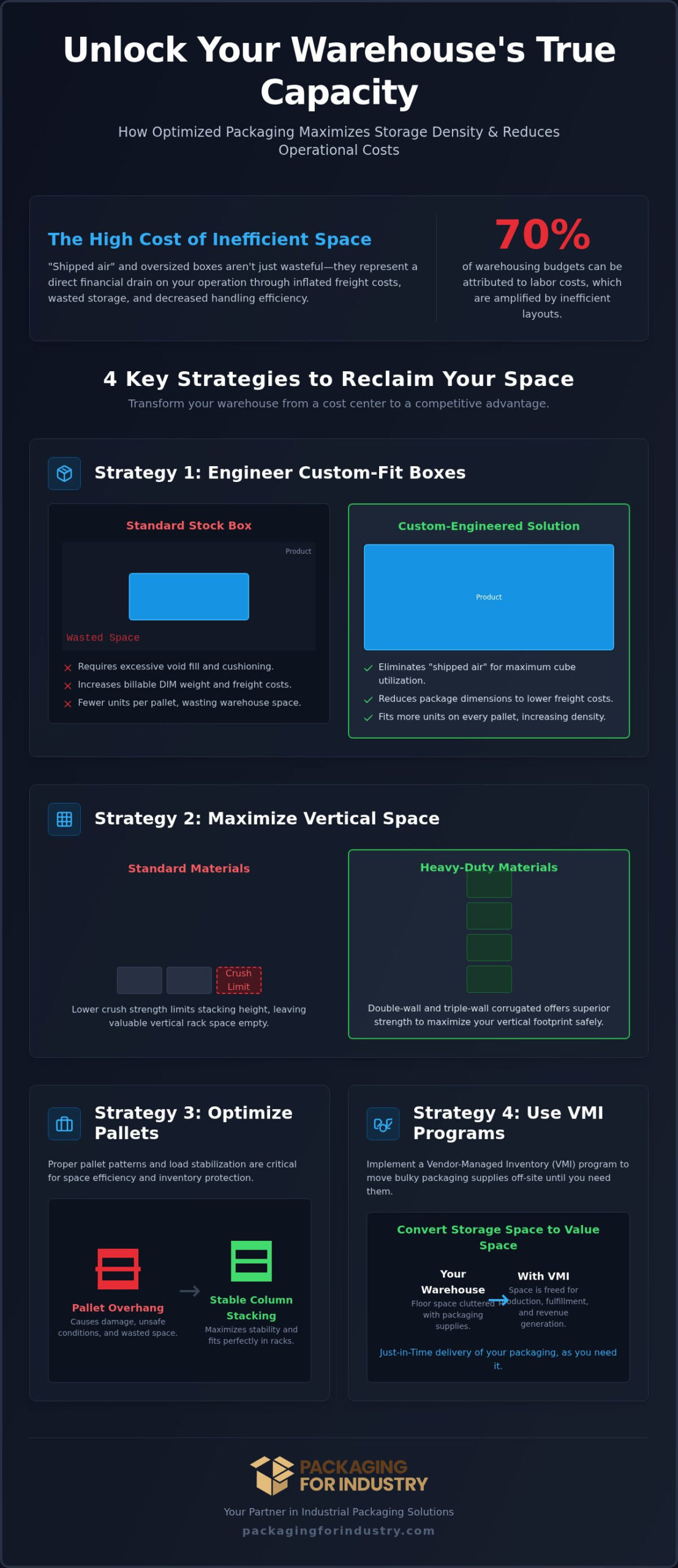
Are you paying a premium for Southern California real estate just to store empty air? With labor accounting for up to 70% of warehousing budgets and industrial rents in markets like Orange County and Los Angeles reaching record highs, every square inch of your facility must generate value. Many operations struggle with inefficient picking routes and damaged goods caused by poor stackability, yet they often overlook the most direct solution sitting on their shelves. Learning how to improve warehouse storage density with better packaging is the most cost-effective way to expand your capacity without moving walls or investing in expensive new racking systems.
You likely already know that oversized boxes and “shipped air” are draining your bottom line through increased freight costs and wasted pallet positions. We’ll show you how to maximize your existing warehouse footprint and reduce operational costs by optimizing packaging dimensions, structural stackability, and inventory management. This guide explores technical strategies for better cube utilization, from utilizing heavy-duty double-wall corrugated boxes to implementing vendor-managed inventory (VMI) programs that clear your floor of excess packaging supplies. By the end, you’ll have a clear roadmap for creating a more organized, efficient, and profitable warehouse floor.
Key Takeaways
- Identify and eliminate “shipped air” by analyzing cube utilization to ensure your packaging is not wasting valuable warehouse and transit space.
- Discover how to improve warehouse storage density with better packaging by replacing standard stock boxes with custom-engineered corrugated solutions tailored to your product dimensions.
- Maximize your vertical footprint by utilizing heavy-duty double-wall and triple-wall corrugated materials designed for superior crush strength and high-stacking stability.
- Refine pallet patterns and load stabilization techniques to eliminate overhang, which protects inventory and ensures every rack position is used efficiently.
- Free up high-value floor space by implementing a Vendor Managed Inventory (VMI) program that moves your packaging supplies off-site until they are needed.
The Fundamentals of Cube Utilization and Storage Density
Real estate in Southern California is among the most expensive in the nation. For operations in the Inland Empire or Los Angeles, every square foot represents a fixed overhead cost that must be justified by throughput. Cube utilization is the ratio of product volume to the total available storage volume. When your packaging isn’t optimized, you aren’t just wasting cardboard; you’re paying for “shipped air” that consumes rack space, increases handling time, and inflates freight bills. Learning how to improve warehouse storage density with better packaging starts with auditing how much of your facility is occupied by actual product versus empty voids.
Poor density creates a hidden tax on your operations. If your boxes are even slightly oversized, you’ll find yourself reaching maximum capacity long before your warehouse is actually full. This leads to the premature need for facility expansion or off-site storage, both of which carry significant fiscal burdens. In specialized sectors like aerospace, where high-value parts require precision protection, specialized density calculations are essential. You must balance the need for protective foam packaging with the requirement to keep footprints as small as possible to maintain logistical flow.
The Hidden Cost of Standardized Catalog Boxes
Large catalog suppliers offer convenience, but their one-size-fits-all approach often fails the logistics test. A box that’s only two inches wider than necessary can reduce the number of units per pallet by 15% or more. This inefficiency creates a ripple effect: more pallets to store, more movements for forklifts, and higher costs for corrugated boxes.
Carrier rules have also become more aggressive regarding package size. The 2026 USPS dimensional (DIM) weight changes standardized the divisor at 139 and introduced rounding rules that move all fractional dimensions up to the next whole inch. These shifts mean that “shipped air” is no longer just an operational nuisance; it’s a direct financial liability that increases your billable weight on every shipment. Custom-sized solutions are the only way to avoid these surcharges while reclaiming lost pallet positions in your racking.
Impact on Picking and Fulfillment Speed
Density isn’t just about the racks; it’s about the flow of the floor. When products are right-sized, you can fit more units per bin and more bins per shelf. This reduces aisle congestion and allows your team to pick more orders without traveling long distances between locations. Maximizing units per shelf means fewer replenishment cycles and a cleaner, more organized warehouse floor. By standardizing your packaging shapes through custom engineering, you simplify picking routes and ensure that every bin in your facility is working at peak efficiency.
Right-Sizing: Engineering Custom Boxes to Eliminate Wasted Space
Procurement teams often rely on stock RSC boxes because they’re convenient to order, but these generic containers rarely match the unique footprint of industrial components. Engineering custom corrugated boxes is the most effective way to address how to improve warehouse storage density with better packaging. With custom sizes available for every application, we use CAD/CAM support to design packaging that mirrors your product’s specific dimensions. This precision eliminates the need for excessive void fill, which often forces you to use a larger box than necessary just to accommodate bulky cushioning materials.
Integrating internal protection like custom foam inserts directly into the box design allows for a significantly smaller outer container. Instead of wrapping a part in multiple layers of generic bubble wrap, a precision-cut polyethylene or ESD foam insert secures the part while maintaining a slim profile. This engineering shift reduces the total cubic volume of each unit. As a result, you can fit more boxes on every pallet and more pallets in your racking, effectively increasing your building’s capacity without a construction project.
Custom vs. Stock: A Cost-Benefit Analysis
While custom boxes may have a higher per-unit price than stock catalog options, the total cost of ownership is often lower. You must weigh the material cost against the long-term savings in storage and freight. Prototyping is a critical step in this process, allowing you to test the design’s fit and durability before committing to a full production rollout. For example, by switching to integrated foam-lined boxes, some operations have reduced their outer dimensions by 15%, reclaiming significant rack space. This is a practical example of how to improve warehouse storage density with better packaging by focusing on engineering rather than just procurement.
Designing for the Entire Supply Chain
Effective packaging design considers every touchpoint, from the manufacturing line to the end user. Implementing packaging kitting and assembly services can further optimize density by reducing the number of individual packages you need to store. If you’re unsure where to start, you can request a packaging review to identify specific opportunities to lower costs and improve your warehouse flow. Reducing the number of unique SKUs through smart design simplifies your inventory and clears your floor of unnecessary packaging waste.
Maximizing Vertical Space with High-Performance Materials
Verticality is the most underutilized asset in many industrial facilities, yet it remains the primary answer for how to improve warehouse storage density with better packaging. While floor space is a fixed cost, the cube above your racks is often left empty because of structural limitations in standard corrugated materials. If the bottom container in a stack cannot support the weight of the units above it, your vertical density is capped by material failure rather than rack height. Transitioning to high-performance materials like heavy-duty double-wall and triple-wall corrugated provides the compression strength necessary to safely utilize the upper reaches of your warehouse.
For heavy industrial machinery or high-value aerospace components that exceed the limits of standard cardboard, custom shipping crates provide a rigid, stackable foundation. These engineered wood or reinforced corrugated solutions ensure that the weight of the upper loads is transferred through the frame of the container rather than the product itself. By strengthening the base of your stacks, you can double or triple your storage capacity without increasing your building’s footprint, turning “dead air” into valuable storage positions.
Understanding Edge Crush Test (ECT) and Stacking Strength
Standard shipping boxes are often rated for 32 ECT, which is sufficient for light parcels but inadequate for multi-level industrial stacking. Industrial environments require higher ratings, typically 44 ECT or 51 ECT for double-wall and even higher for triple-wall configurations. It is also vital to consider the impact of environmental factors; long-term storage and humidity can reduce a box’s structural integrity by as much as 50%. High-performance triple-wall corrugated can support thousands of pounds of vertical weight, allowing it to replace wood crates in specific vertical storage applications while reducing tare weight and disposal costs.
Reinforcing Loads with Corner Boards and Edge Protection
Even the strongest corrugated materials require reinforcement when subjected to the tension of industrial containment methods. Utilizing corner boards and edge protection reinforces the vertical corners where stacking strength is naturally highest. These corner boards prevent the “hour-glassing” effect that occurs when stretch wrap is applied too tightly, ensuring the box maintains its structural shape under load.
By reinforcing the edges of your pallets, you create a unified, squared load that remains stable even when placed in top-tier racking. This level of stability is essential for maintaining safety in high-density environments. When every pallet is perfectly squared and reinforced with high-quality edge protection, you reduce the risk of falling inventory and maximize your rack height with confidence. This material-first approach ensures that your packaging is a structural asset rather than a logistical bottleneck.
Pallet Pattern Optimization and Load Stabilization
Pallet patterns are the bridge between box engineering and the physical reality of your racking system. Many operations default to interlocking patterns to gain lateral stability, but this often sacrifices vertical strength. Column stacking, where boxes are aligned directly on top of one another, offers superior crush resistance because it places the weight on the corners where the corrugated material is strongest. However, column stacking requires advanced stabilization to prevent shifting. This is a primary factor in how to improve warehouse storage density with better packaging; you must balance the stacking method with the right containment tools to reach the full height of your racks.
Eliminating pallet overhang is a non-negotiable requirement for density and safety. When boxes extend past the pallet edge, they lose up to 30% of their stacking strength and are prone to impact damage from forklifts. Overhang also forces wider aisle spacing to prevent collisions, which effectively wastes valuable floor space. By ensuring your box dimensions are engineered as perfect multiples of your pallet size, you achieve a flush fit that maximizes every cubic inch of your rack positions. Using high-performance stretch film then secures these dense loads, allowing you to build taller pallets that remain stable even in high-bay racking environments.
The Role of Stretch Film in Storage Safety
Manual wrapping often leads to inconsistent tension, which can cause loads to lean or collapse in high-density storage. Switching to machine stretch film ensures consistent containment force, allowing for denser pallet loads that remain stable during forklift maneuvers. Proper tension is the key to building taller stacks without the risk of shifting. Opaque or colored films can also be used to categorize inventory by zone or security level, streamlining your picking process and reducing the time spent searching for specific SKUs in a crowded warehouse.
Standardizing Pallets for Uniform Slotting
Standardizing your pallet footprints to match your warehouse rack configurations exactly is essential for modern logistics. For specialized industrial components, custom-sized or heat-treated pallets ensure that your base is as durable as the packaging it supports. This uniformity is especially critical for Automated Storage and Retrieval Systems (ASRS), where even a half-inch deviation can cause system downtime. Integrating heavy-duty pallets directly into the design of your custom crates or heavy-wall boxes creates a seamless, high-density storage unit that moves through your facility with maximum efficiency.
Freeing Up Floor Space with Vendor Managed Inventory (VMI)
The paradox of warehouse management is that you need a steady supply of packaging to keep the line moving, but storing that packaging consumes the very rack space you’re trying to optimize. For many facilities in the Inland Empire and Los Angeles, multiple pallet positions are dedicated to empty corrugated boxes and bulky foam inserts. This is where understanding how to improve warehouse storage density with better packaging extends beyond box design and into inventory logistics. Implementing a Vendor Managed Inventory (VMI) program is a strategic answer for those looking to maximize their footprint without changing their rack layout. This program effectively moves your packaging footprint off your floor and into ours.
By shifting from a bulk-buy model to a just-in-time replenishment cycle, you reclaim high-value floor space for finished goods. Instead of housing three months of inventory, you only keep what you need for the next few days. This strategy allows you to lower packaging costs by eliminating the need for off-site overflow storage and reducing the risk of material damage during long-term warehouse handling. When you reduce the physical volume of packaging stored on-site, you immediately increase the available slots for revenue-generating inventory.
How VMI Works for Industrial Packaging
The process begins with a thorough assessment of your usage rates and storage constraints. We establish minimum and maximum stocking levels for your custom corrugated and foam supplies, then manage the replenishment cycles proactively. This approach significantly improves your cash flow by reducing the capital tied up in excess inventory. For businesses in Anaheim and Orange County, our local presence ensures next-day delivery and immediate support. You don’t have to worry about scheduling trucks or tracking lead times; we handle the logistics so your team can focus on fulfillment.
Eliminating Shortages and Emergency Orders
Managed stocking prevents production stops caused by unexpected packaging stockouts. When you handle your own procurement, a sudden spike in orders can lead to emergency shipping fees or, worse, a complete halt in shipping. PFI acts as a proactive partner, managing long lead-time custom items and ensuring they are ready for delivery the moment you need them. You can compare packaging pricing and see that the efficiency of VMI often outweighs the perceived savings of massive bulk orders that clutter your facility. If you’re ready to clear your floor and streamline your operations, request a quote for a customized VMI assessment to optimize your warehouse floor today.
Maximize Your Facility Through Engineering
Reclaiming your warehouse floor doesn’t require a capital-intensive construction project or a move to a new facility. By prioritizing right-sized corrugated boxes and high-performance materials, you eliminate the wasted space that inflates your overhead. Implementing these strategies is the most direct path to understanding how to improve warehouse storage density with better packaging while simultaneously lowering your operational overhead. From optimizing pallet patterns to moving inventory off-site through a VMI program, every cubic inch you save contributes directly to your bottom line.
Packaging For Industry (PFI) provides the technical expertise needed to solve these complex logistical challenges. We offer free prototyping for custom box and foam designs to ensure a perfect fit, alongside specialized knowledge in aerospace and industrial-grade packaging. With local next-day delivery across Southern California, we support your just-in-time operations and keep your supply chain moving without the clutter of excess inventory.
Take the first step toward a cleaner, more efficient, and more profitable warehouse floor by letting us engineer a solution tailored to your specific needs.
Frequently Asked Questions
How does custom packaging improve warehouse storage density?
Custom packaging improves density by eliminating “shipped air” and tailoring box dimensions to your specific product footprint. This right-sizing process allows for more units per pallet and more pallets per rack position. By reducing the outer dimensions of each container, you can fit more inventory into your existing racking. PFI’s custom engineering ensures every cubic inch is utilized, effectively expanding your capacity in San Diego, Los Angeles, and across Southern California.
What is the difference between cube utilization and storage density?
Cube utilization refers to the percentage of available space within a single container or rack position that is actually occupied by product. Storage density is the broader measurement of how much inventory you store within your total warehouse square footage. Learning how to improve warehouse storage density with better packaging starts with improving cube utilization at the box level. Higher utilization reduces the number of pallets needed, which clears floor space and optimizes your overall density.
Can changing my box size really save me money on warehouse space?
Yes, reducing box dimensions by even one or two inches can reclaim significant pallet positions. In high-rent areas like Orange County or San Diego, reclaiming this space translates directly to lower overhead costs. Smaller boxes also reduce the number of forklift movements required to manage inventory. This optimization allows you to store more sellable goods in the same footprint, delaying the need for expensive facility expansions or off-site overflow storage.
What are the best materials for high-density vertical stacking?
Heavy-duty double-wall and triple-wall corrugated are the preferred materials for high-density vertical stacking due to their superior Edge Crush Test (ECT) ratings. These materials provide the compression strength needed to support multiple levels of pallets without collapsing. For exceptionally heavy industrial machinery, custom wood crates or foam-lined crates offer the most rigid foundation. Using these high-performance materials ensures that your bottom-tier boxes can withstand the weight of the entire vertical column safely.
How does a VMI program help free up warehouse space?
A Vendor Managed Inventory (VMI) program moves your packaging inventory off your floor and into our warehouse. Instead of storing months of bulky corrugated boxes and foam inserts on-site, you receive scheduled, just-in-time deliveries based on actual usage. This clears multiple pallet positions in your San Diego or Inland Empire warehouse. It allows you to use those areas for production or finished goods while ensuring you never face a packaging stockout or production delay.
What is dimensional weight and why does it matter for storage?
Dimensional weight (DIM) is a pricing technique used by carriers that calculates billable weight based on package volume rather than actual weight. While DIM weight primarily affects shipping costs, it’s a critical indicator of storage inefficiency. If your products have a high DIM weight relative to their actual mass, you’re storing excess air. Right-sizing your packaging helps lower packaging costs and improves your warehouse density by reducing the physical volume of every unit you store and ship.
Should I use double-wall or triple-wall boxes for stacking heavy items?
The choice depends on the total weight of the stack and the duration of storage. Double-wall corrugated is typically sufficient for most industrial components stacked two high. However, triple-wall boxes are engineered for extreme weight and long-term vertical storage, often replacing wood crates. Triple-wall provides maximum crush resistance, ensuring that the structural integrity of your bottom boxes remains intact even under several thousand pounds of pressure in high-bay racking systems.
How can I calculate the potential space savings from right-sizing my packaging?
You can calculate potential savings by comparing your current pallet unit count against a right-sized alternative. Divide the total volume of your product by the volume of your current box to find the current void percentage. Then, determine how many more units fit on a standard 48×40 pallet if the box dimensions were reduced. PFI offers packaging reviews and free prototyping to help you visualize these density gains and compare packaging pricing for your specific facility needs.