
Can a local packaging supplier make polyurethane foam fit your product and its shipping conditions instead of relying on generic cushioning? That’s the central question behind polyurethane foam fabrication Orange County buyers should ask. A closer fit can help position a product, but the foam also needs to work with how it’s packed, handled, and shipped.
If unclear specifications are making quotes difficult to compare, start with the product and transit details. Share dimensions, weight, vulnerable areas, shipping method, and the current packaging configuration. Also describe order quantities and recurring supply needs before choosing a design.
This guide explains what to prepare for a useful foam packaging quote, how to compare options, and what to confirm about a supplier’s capabilities. Packaging For Industry supports foam design with CAD/CAM, prototypes, and samples, and can coordinate custom foam assemblies with boxes or crates. Use these steps to assess fit before a wider rollout and plan packaging around your operation.
Key Takeaways
- Custom foam can address product-specific protection needs when standard cushioning doesn’t provide a suitable fit.
- Prepare product and shipping information before requesting a quote so suppliers can assess the project clearly.
- Compare polyurethane foam and other packaging options based on fit, configuration, and handling needs, then confirm the details with the supplier.
- When evaluating polyurethane foam fabrication Orange County suppliers, ask about design support, samples, fabrication capabilities, project volume, and delivery coverage.
- Coordinating foam with corrugated boxes or crates can align product protection with the overall packaging setup.
Polyurethane Foam Fabrication in Orange County: When Custom Protection Makes Sense
Custom foam is worth evaluating when a product shifts inside its package, arrives with recurring damage, or takes too long to pack consistently. These are reasons to review the packaging, not proof that foam alone is the answer. The right configuration depends on the product’s shape and weight, vulnerable areas, shipment conditions, and how staff pack and handle it.
Polyurethane foam fabrication means shaping polyurethane foam into components for a product-specific protective packaging application. Unlike off-the-shelf cushioning, fabricated components are designed to fit the package interior and the part. For background on the base material, see this overview of polyurethane.
Which Orange County shipping problems can custom foam address?
Look for patterns such as parts moving within a box, delicate surfaces contacting other components, difficult packing steps, or inconsistent product placement. A custom insert, pad, or end cap may help position a component, but evaluate the design against actual shipping and handling conditions. Don’t assume a foam layout will prevent all damage or meet a performance standard that has not been verified.
Before requesting a quote, record the product’s dimensions and weight, identify fragile or sensitive areas, and describe how the item is lifted, packed, stored, and shipped. Include photographs or drawings if available. Note whether the packaging is used once or repeatedly, and whether parts ship individually or alongside other items.
What does polyurethane foam fabrication involve?
Fabrication shapes foam into protective components such as inserts, pads, or end caps. The goal is to match the packaging configuration to the product and packing workflow, rather than selecting a generic cushion without reference to the part. Processes, shapes, and tolerances depend on the supplier’s capabilities, so describe the geometry you need and ask what can be supported.
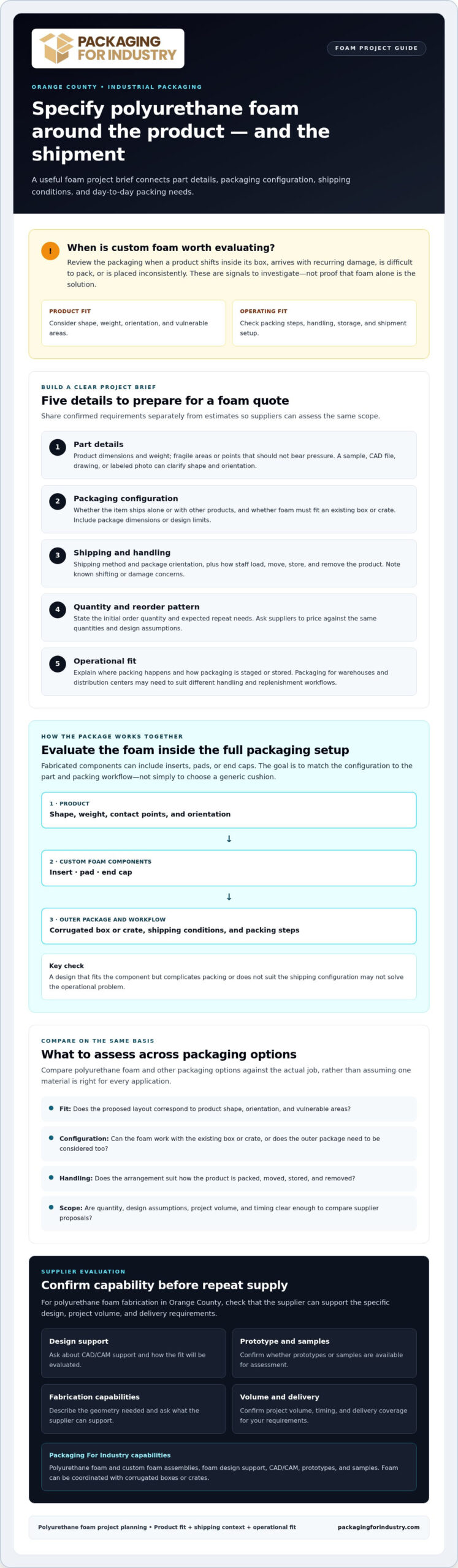
Custom geometry may be useful for fragile, heavy, or high-value industrial components when their shape, contact points, or orientation make standard cushioning difficult to use. A defined layout can also help teams repeat a packing arrangement. Evaluate the fit alongside the outer package, shipment conditions, handling steps, and expected order pattern. A design that fits the component but complicates packing or does not suit the shipping configuration may not solve the operational problem.
Packaging For Industry supplies polyurethane foam and custom foam assemblies, with foam design support, CAD/CAM, prototypes, and samples available. Its protective foam packaging can also be coordinated with boxes or crates. Confirm the fabrication approach, fit, project volume, and timing for your requirements before moving from evaluation to repeat supply.
How Orange County Buyers Should Specify a Polyurethane Foam Project
A clear project brief helps an Orange County packaging supplier assess the design and prepare a quote you can compare with other proposals. For polyurethane foam fabrication Orange County buyers should separate confirmed requirements from estimates. This helps suppliers spot open questions early and keeps quote comparisons focused on the same scope.
- 1. Part details: Provide product dimensions and weight, and identify fragile areas or points that should not bear pressure. A sample, CAD file, drawing, or labeled photograph can clarify the part’s shape and orientation.
- 2. Packaging configuration: Describe whether the item ships individually or with other products, and whether the foam must fit an existing box or crate. Share package dimensions or limits the design needs to accommodate.
- 3. Shipping and handling: Note the shipping method, package orientation, and how staff load, move, store, and remove the product. Describe known shifting or damage concerns without assuming a particular performance outcome.
- 4. Quantity and reorder pattern: State the initial order quantity and expected repeat needs. Ask suppliers to quote against the same quantities and design assumptions.
- 5. Operational fit: Explain where packing takes place and how packaging will be staged or stored. Packaging for warehouses and distribution centers may need to fit different handling and replenishment workflows.
What information should a foam fabrication quote include?
Ask each supplier to identify the proposed configuration, quoted quantity, material assumptions, and specifications that still need confirmation. If a drawing omits a dimension or the quote assumes a particular product orientation, resolve that before design or production. Compare proposals covering the same scope, including the intended package and any requested revisions.
Material information can help frame questions, but the supplier should confirm project-specific suitability. The Polyurethane Foam Association provides industry resources. Use your product and shipment details to guide the conversation with a packaging supplier.
How do prototypes and samples support fit evaluation?
A prototype or sample lets your team review fit and packing steps before a broader rollout. Where practical, test it with the actual product and intended outer packaging. Check whether staff can position and remove the part consistently, then note any changes needed. Packaging For Industry offers custom packaging design services, including prototypes and samples. Confirm availability and timing for your project.
With the brief assembled, you can request a foam packaging quote and give suppliers a consistent basis for reviewing the project.
Polyurethane Foam vs. Other Packaging Materials: How to Compare Options
No single foam material or cushioning configuration suits every product and shipment. Compare options against the part’s shape, fragile areas, package layout, handling steps, and shipping conditions. The goal is not to choose by material name alone, but to find a configuration that fits the product and works in your operation.
When should buyers compare polyurethane and polyethylene foam?
Polyurethane and polyethylene foam are options buyers may want to evaluate for a project. Don’t assume one is better based on its name alone. Ask which options the supplier can support and how each aligns with your product, handling requirements, and intended package. Packaging For Industry supplies polyurethane foam. Confirm polyethylene foam availability and project suitability directly. Its protective foam packaging can be considered as part of a broader packaging design.
| Decision point | What to compare | Confirm with the supplier |
|---|---|---|
| Fit | How the proposed foam accommodates the product’s shape and identified fragile areas. | Material suitability, design assumptions, and whether a sample can be reviewed. |
| Packaging configuration | Whether foam is used as an insert, pad, or end cap, and whether it fits the existing package. | Available configurations and compatibility with the requested box or crate. |
| Handling needs | How the product is loaded, secured, removed, stored, and shipped. | Whether the proposed arrangement supports the buyer’s actual packing workflow. |
When should foam be combined with a box or crate?
Consider the whole package, not just the cushioning. Foam may need to work with an outer carton or crate, depending on how the item is shipped and handled. Review whether the product stays positioned as intended, how staff load and unload it, and whether the package fits storage and repeat packing steps. If the foam layout complicates routine handling, it may need adjustment.
Custom foam can add complexity, so weigh that against product fit, packing time, and the full packaging configuration. A prototype or sample can help teams assess these factors before wider use. For products shipped in crates, ask whether foam can be coordinated with the crate design. Packaging For Industry can combine foam with boxes, crates, and other packaging materials. Confirm the options for your project.
For polyurethane foam fabrication Orange County buyers can compare options by sharing product details, the intended package, and the handling workflow, then asking suppliers to confirm material and configuration suitability.
Choosing a Polyurethane Foam Fabricator Near Orange County
A local supplier should understand how foam fits into the larger packaging and production environment, not treat it as an isolated item. For polyurethane foam fabrication Orange County buyers, assess whether a partner can align foam packaging with the products, teams, and supply routines involved. This broader view can support consistent packing and help coordinate recurring requirements.
What should procurement teams ask a local foam supplier?
Consider whether the supplier’s product range and experience match your operation. Packaging For Industry supplies polyurethane foam, custom foam assemblies, inserts, pads, and end caps, and can coordinate foam with corrugated boxes or crates. Its business customers include aerospace and aviation, electronics, medical device, and industrial manufacturers, as well as warehouse and distribution operations. Ask how the supplier will account for the product’s use and your team’s packing workflow.
Consider whether coordinating foam with an outer box or crate could simplify purchasing and keep packaging components aligned. For recurring projects, discuss anticipated reorder needs and how the supplier will handle product or packaging changes. Confirm project-specific capacity and supply details rather than assuming every design or volume can be supported.
How should Orange County buyers evaluate service and delivery?
Confirm the delivery address, order requirements, and timing directly with the supplier. Packaging For Industry serves Orange County as part of its Southern California coverage. Local next-day delivery is stated for the region, but availability and timing depend on the location and order. Buyers in Anaheim can review the Anaheim packaging service area and confirm details with the supplier.
Choose a partner that can discuss the complete packaging requirement, from foam and outer packaging to repeat supply considerations. Packaging For Industry’s industrial focus and packaging coordination capabilities offer a practical starting point for assessing fit. Request a packaging quote with your project requirements and delivery location so the supplier can review the request.
Get a Polyurethane Foam Fabrication Quote from an Orange County Packaging Supplier
A useful quote starts with a clear picture of the product, shipment, and packaging setup. For polyurethane foam fabrication Orange County projects, Packaging For Industry can review requirements for polyurethane foam, custom foam assemblies, design support, and samples. The right configuration and scope depend on the project, so confirm fabrication capabilities, material suitability, and timing with the supplier.
What to send with a custom foam packaging quote request
Include part dimensions and weight, along with photographs, drawings, or a CAD file if available. State the initial quantity and expected repeat needs, then describe how the package will be used. Shipping method, known damage concerns, package orientation, and existing box or crate requirements help clarify the design context. Flag estimates so they can be confirmed before production.
If the foam needs to fit an existing package, provide the box or crate dimensions and note any space limits. If you’re evaluating a new configuration, explain whether the item ships alone or with other components. This helps the supplier review foam and outer packaging as one system rather than separate purchasing decisions.
How PFI can support a broader packaging requirement
Packaging For Industry serves manufacturers and other business buyers with foam packaging and custom packaging design support, including CAD/CAM, prototypes, and samples. Foam can be coordinated with corrugated boxes or crates, and buyers can discuss recurring supply needs alongside the custom project. Ask PFI to confirm which fabrication approaches, project quantities, sample options, and lead times fit your requirements.
Before approving a design, review the sample or prototype with the actual product and intended outer package where practical. Confirm that the arrangement suits packing and handling steps, and clarify revisions, production timing, and delivery details. Local next-day delivery is stated for Southern California, but availability and timing should be confirmed for the Orange County location and order.
To help PFI assess the project, provide the product details, drawings or photos, quantity, shipping conditions, packaging requirements, and delivery location. Then request a quote for a solution your team can review against its operating needs.
Move from Foam Requirements to a Clear Quote
A dependable foam packaging decision starts with the product and its shipping conditions, then checks whether the proposed fit works with the full packaging workflow. Clear dimensions, drawings or photos, quantities, handling details, and delivery location help suppliers assess the project and clarify assumptions before production.
For polyurethane foam fabrication Orange County buyers can evaluate suppliers by confirming design support, sample options, fabrication capabilities, project timing, and repeat-order needs. Packaging For Industry lists polyurethane foam, custom foam assemblies, foam design, and prototypes or samples, and serves Orange County as part of its Southern California service area. Project details determine which options and timing are appropriate.
Bring your requirements together and take the next step toward a packaging configuration your team can review and plan around.
A clear project brief gives your supplier a stronger starting point and helps your team move forward with confidence.
Frequently Asked Questions
What information do I need for a polyurethane foam fabrication quote?
Prepare the product’s dimensions, weight, photos or drawings, quantity, and intended packaging configuration. Include fragile areas, known damage or shifting concerns, shipping method, package orientation, and existing box or crate requirements. Flag estimates for confirmation. For a useful polyurethane foam fabrication Orange County quote, also share the delivery location and whether you expect repeat orders.
Can polyurethane foam be fabricated to fit a specific industrial part?
Yes. Custom foam components can be designed around a specific part and its packaging configuration. Packaging For Industry lists polyurethane foam, custom foam assemblies, inserts, pads, and end caps, along with foam design support and samples. Share dimensions, drawings, or a product sample where available, then confirm the supplier’s fabrication capabilities, design assumptions, and project requirements before production.
How do I choose between polyurethane and polyethylene foam packaging?
Ask the supplier to assess each material against your product, vulnerable areas, shipment conditions, and packing workflow. Don’t assume one material is suitable based on its name alone. Packaging For Industry lists both polyurethane and polyethylene foam, but the appropriate option depends on the project and should be confirmed with the supplier. A sample or prototype may help your team review fit and packing steps before rollout.
Is custom polyurethane foam packaging suitable for repeated shipments?
It may be suitable, but the intended reuse and handling pattern should be part of the design discussion. Tell the supplier how often the package will be used, how products are loaded and removed, and how the foam will be stored between shipments. Ask what inspection or replacement considerations apply to your configuration. Confirm that the proposed design and supply plan match your repeat-order volume and operating needs.
How much does polyurethane foam fabrication in Orange County cost?
Pricing depends on project details, so a supplier needs to review the product, design requirements, material selection, quantity, and packaging configuration before preparing a quote. A general price cannot establish what a specific foam project will cost. To compare proposals, provide suppliers with the same drawings, quantities, outer-package details, and shipping requirements, and ask them to clarify quote assumptions.
Can a supplier combine fabricated foam with boxes or crates?
Yes. Packaging For Industry can coordinate foam with corrugated boxes, crates, and other packaging materials. Discuss the complete package, including how the part sits in the foam, how staff load and remove it, and how the outer container will be handled and stored. Sharing existing box or crate dimensions helps the supplier assess the configuration as a system rather than quoting foam in isolation.
Does PFI provide polyurethane foam packaging in Orange County?
Yes. Packaging For Industry serves Orange County as part of its Southern California coverage and lists polyurethane foam, custom foam assemblies, design support, and prototypes or samples. Share project details and confirm fabrication capabilities, sample or production timing, and delivery availability for your location and order. This helps align the quote with the product, packaging workflow, and recurring supply needs.