
Every dollar spent on an oversized box or a damaged replacement part is a direct hit to your manufacturing margins that could have been avoided with better engineering. Shipping industrial components is a high-stakes logistical challenge, especially when dealing with heavy machinery or sensitive electronics. You have likely felt the frustration of seeing a critical component arrive with surface rust or structural damage despite your team’s best efforts. We understand that in a market where truckload spot rates have jumped 60% recently, you simply can’t afford to pay for shipping air or replacing broken inventory.
This guide provides the professional engineering standards you need to master how to properly pack industrial parts to eliminate transit damage and slash your freight expenses. Whether you are shipping across the country or looking for a reliable packaging supplier in Orange County or Los Angeles, these strategies ensure your logistics chain remains efficient. We will examine how to optimize dimensional weight to avoid DIM surcharges, prevent corrosion during sea freight, and select the right protective materials to ensure your products arrive in factory condition every time.
Key Takeaways
- Learn how to evaluate weight distribution and chemical sensitivities to select the optimal grade of heavy-duty double-wall corrugated and custom foam inserts.
- Discover the engineering standards for how to properly pack industrial parts using VCI paper and poly bags to eliminate rust and corrosion during sea freight.
- Master the palletization process by using high-performance stretch film and edge protection to unitize loads and prevent shifting during transit.
- Reduce excessive freight spend and DIM weight surcharges by right-sizing your packaging and implementing professional kitting strategies.
- Improve supply reliability by standardizing your packing process to ensure zero-damage delivery for high-value aerospace, automotive, and medical components.
Assessing Industrial Parts for Transit Hazards
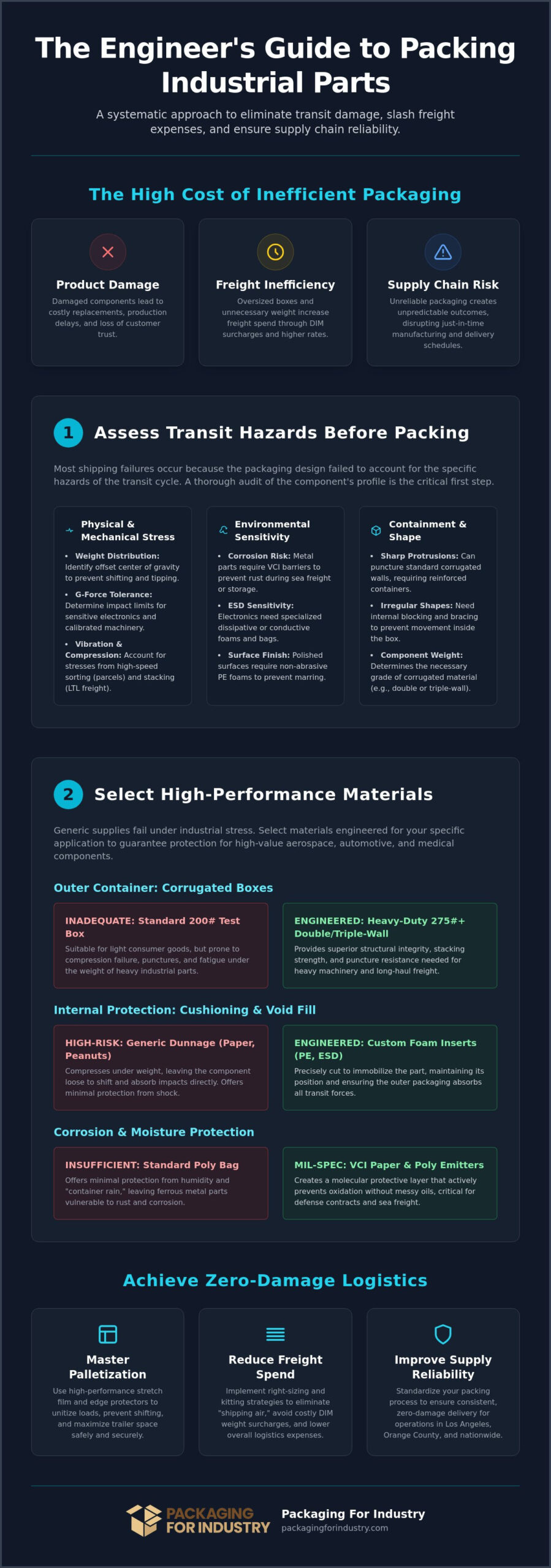
Before a single piece of tape is applied, you must conduct a thorough audit of the component’s physical and chemical profile. Most shipping failures don’t happen because of poor materials; they happen because the packaging design failed to account for the specific hazards of the transit cycle. This initial assessment is the foundation of how to properly pack industrial parts. You need to evaluate the weight distribution and identify any sharp protrusions that could puncture standard corrugated walls. If the part has an offset center of gravity, it will shift during transit, potentially causing a pallet to tip or a crate to fail.
The science of packaging and labeling involves more than just containment; it requires a deep understanding of the stresses caused by vibration, compression, and impact. You should also determine the “G-force” tolerance of sensitive electronics or calibrated machinery. Some components might fail if they experience more than 15 or 20 Gs of impact, which means your choice of cushioning must be engineered to specific deceleration rates. Analyzing the transit environment is equally critical. If your parts are crossing the ocean, they’ll face extreme temperature swings and humidity that can lead to “container rain” inside a shipping vessel.
Identifying Weight and Dimension Constraints
Small parcel shipments face different stresses than LTL (Less-Than-Truckload) freight. While small parcels endure high-speed sorting belts and frequent drops, LTL shipments are subject to heavy vibrations and stacking pressures. For heavy industrial components, standard 200# test boxes are often insufficient. You should specify heavy-duty double-wall or even triple-wall corrugated to ensure structural integrity. When dealing with irregularly shaped equipment, plan for center-of-gravity shifts by using internal blocking and bracing. This prevents the part from “walking” inside the box and compromising the outer container’s strength.
Environmental and Surface Sensitivity Factors
Chemical sensitivities are often overlooked until a customer rejects a shipment due to rust. Metal parts are prone to oxidation, especially during long-haul transit. Identifying whether a part requires mil-spec packaging is vital for defense contracts or long-term storage where moisture barriers are non-negotiable. For semiconductor or electronic components, you must account for Electrostatic Discharge (ESD) by using specialized dissipative foams or bags. Finally, consider surface sensitivity. Polished industrial surfaces are at risk of “surface marring” from abrasive packaging materials, necessitating the use of non-abrasive PE foams or soft poly liners to maintain factory finishes.
Understanding these variables is the only way to master how to properly pack industrial parts while maintaining fiscal responsibility. By identifying hazards early, you can engineer a solution that protects the product without overspending on unnecessary materials.
Selecting High-Performance Packaging Materials
Selecting the right materials is the second pillar of how to properly pack industrial parts. You can’t rely on generic supplies when shipping high-value components; you need materials engineered for industrial stress. While a standard 200# test box might work for consumer goods, heavy industrial parts often require 275# heavy-duty double-wall corrugated. This higher grade provides the structural integrity needed to prevent box fatigue during long-term stacking. If your parts are made of ferrous metals, you must also integrate VCI (Vapor Corrosion Inhibitor) materials. VCI emitters and poly bags create a molecular protective layer that prevents rust without the need for messy grease or oils.
Structural void fill is another area where many manufacturers lose money. Generic paper dunnage often fails because it compresses under the weight of heavy components, leaving the part free to bounce inside the container. Custom-engineered inserts are far more effective. They maintain their shape and keep the product centered, ensuring the outer packaging absorbs the impact rather than the part itself. If you’re unsure which material grade fits your application, you can request a custom packaging quote to get an expert recommendation based on your specific part geometry.
Industrial Corrugated vs. Custom Wood Crating
Transitioning from heavy-duty corrugated to wood crates is usually a matter of weight and “G-force” sensitivity. While wood offers maximum puncture resistance, custom corrugated boxes are often the superior choice for reducing dimensional weight and lowering freight costs. You must understand the difference between Mullen (burst strength) and Edge Crush Test (ECT) ratings. Mullen is critical for puncture resistance from sharp edges, while ECT is the standard metric for determining how high you can safely stack pallets in a warehouse or shipping container.
Custom Foam Inserts and Cushioning
Designing custom foam packaging allows you to eliminate all internal movement. Polyethylene (PE) is a closed-cell foam ideal for heavy parts that require high shock absorption. In contrast, Polyurethane (PU) is an open-cell foam better suited for light-weight, fragile components. Foam density is the mass per unit volume of the material, and it determines how effectively the cushion can absorb energy to slow down a part’s deceleration during an impact. For complex geometries, die-cut foam provides a precise fit that foam-in-place solutions can’t always match. Following OSHA Pallet Wrapping Guidelines during the final assembly stages will also ensure your team remains safe while handling these high-performance materials.
By matching the material to the specific transit hazard, you master how to properly pack industrial parts while protecting your bottom line from unnecessary damage and freight surcharges.
Step-by-Step Guide to Packing Industrial Components
Execution is where logistical theories meet the reality of the shipping dock. Even if you’ve selected the highest grade of corrugated boxes, a failure in packing technique will lead to damage. Standardizing your workflow is the only way to master how to properly pack industrial parts consistently across multiple shifts. Start by ensuring every component is clean and dry. Residual cutting fluids or finger oils can neutralize VCI inhibitors and prevent industrial-grade tapes from forming a permanent bond. Once cleaned, apply your primary protection immediately to seal out atmospheric moisture.
Corrosion Prevention and Primary Wrapping
For international transit, wrapping is about creating a micro-environment. Use VCI paper or poly bags to wrap the part tightly, often supplementing with VCI emitters for larger volumes. If you’re shipping across high-humidity zones, include desiccants to pull moisture away from the metal surfaces. Sharp-edged parts require a pre-wrap phase; use edge protection or heavy-duty foam scraps on protrusions before the final VCI wrap. This prevents the part from puncturing its own moisture barrier from within. Finally, seal the primary wrap with high-tack industrial adhesive tape that won’t flag or peel during temperature fluctuations.
Internal Blocking and Bracing Techniques
The goal of internal packing is to suspend the component in a safety zone where it cannot impact the outer walls. Use custom foam end-caps or corrugated partitions to lock the part into the center of the container. If there’s any remaining space, you must fill the void completely with structural dunnage to prevent the box from collapsing when another pallet is stacked on top. To verify your work, perform a manual shake test; if you can feel or hear the component shifting inside the box, the bracing is insufficient and requires more structural fill.
The final step is closure and documentation. Use reinforced, water-activated tape or heavy-duty pressure-sensitive tape in a six-strip H-seal pattern to prevent carton failure under weight. Before the box is palletized, document the process by taking photos of the internal bracing and the final seal. This provides essential evidence for quality control audits and simplifies the claims process if a carrier mishandles the shipment. Following these steps ensures you’re not just shipping a part, but delivering a protected asset. Mastering how to properly pack industrial parts requires this level of attention to detail to ensure zero-damage delivery.
Securing the Load: Palletization and Edge Protection
Individual boxes are only as secure as the pallet they sit on. Even if you’ve mastered how to properly pack industrial parts inside the carton, a poorly unitized load will shift, lean, or collapse during a sudden brake or sharp turn. You must start by selecting the correct pallet for your destination. For international shipments, you’re required to use heat-treated wood pallets that comply with ISPM-15 regulations to avoid customs delays. For internal closed-loop systems, heavy-duty plastic pallets offer better durability and long-term cost-efficiency. Distributing weight evenly across the pallet base is critical; a top-heavy load increases the risk of forklift accidents and pallet failure under compression.
Unitizing with Stretch Film and Strapping
Unitization turns multiple individual boxes into a single, stable block. When deciding between hand stretch film and machine-grade film, consider your volume and load profile. Hand wrapping is effective for lower volumes, but machine wrapping provides consistent tension that manual application can’t match. Use a top-down wrapping technique, ensuring the film captures the pallet base to prevent the load from sliding off. For extremely heavy loads, you may need to supplement film with strapping. While polyester (PET) bands are common, steel strapping is often required for high-tension applications where the load has zero “give” or sharp metal edges.
Utilizing Corner and Edge Protectors
One of the most common causes of transit damage is “strap-bite,” where tensioned bands crush the edges of corrugated boxes. High-quality corner and edge protection prevents this by distributing the pressure across a wider surface area. These protectors are also vital for preventing column collapse. By placing vertical edge boards on all four corners, you significantly increase the stacking strength of your corrugated shippers. This allows you to stack pallets higher without risking the integrity of the bottom layer. Reinforced bottom guards can also shield your products from direct forklift impacts during warehouse maneuvering.
Securing your freight is a matter of engineering precision and safety. If you’re struggling with load instability or high damage rates, our team can help you design a standardized unitization process. As a leading Southern California packaging supplier, we provide next-day delivery to Los Angeles and Orange County. Request a packaging quote today to optimize your palletization strategy and lower your total cost of ownership.
Optimizing for Logistics: Reducing Freight and Damage Costs
Logistical efficiency is the final measure of how to properly pack industrial parts. While previous sections focused on physical protection and material science, the financial impact of your packaging strategy depends on how well you optimize for transit costs. Carriers increasingly use Dimensional (DIM) Weight to calculate shipping fees, charging based on the volume of the container rather than its actual weight. If your boxes are even slightly oversized, you’re paying a premium to ship air. By utilizing packaging kitting services, you can consolidate multiple components into a single, custom-fit unit, reducing the total number of shipments and lowering your freight spend.
Maintaining supply reliability is equally important for high-volume manufacturers. Implementing a Vendor Managed Inventory (VMI) program ensures that your critical packing materials are always available without tying up excessive warehouse space. For our clients in Los Angeles, Orange County, and San Diego, our local Southern California presence allows for rapid prototyping and next-day delivery of emergency supplies. This proximity turns your packaging supplier into a proactive partner that can respond to production spikes or design changes in real time.
Reducing Shipping Damage and Return Costs
The true cost of shipping damage extends far beyond the price of a replacement part. You must account for the administrative labor of processing claims, the cost of return freight, and the erosion of customer trust. Custom-engineered prototypes allow you to verify the protection levels of your packaging before a full production rollout, ensuring a perfect fit for every component. PFI’s packaging reviews identify cost-saving opportunities in existing lines by pinpointing where over-packaging is driving up material costs without adding protective value.
Optimizing for Freight and DIM Weight Savings
Right-sizing your containers is the most effective way to eliminate DIM weight surcharges. You can often reduce box volume without compromising the “crush zone” by switching to custom-designed inserts that maximize internal space. For long or cylindrical components, using right-sized mailing tubes and cores protects the product while keeping shipping dimensions to an absolute minimum. We recommend requesting a packaging cost-savings analysis to identify exactly where wasted space exists in your current shipping containers. This data-driven approach ensures that your efforts in how to properly pack industrial parts result in tangible improvements to your bottom line and overall supply chain stability.
Secure Your Supply Chain with Engineered Packaging Solutions
Mastering how to properly pack industrial parts is a critical step in protecting your manufacturing margins and your reputation for reliability. By moving beyond generic supplies and adopting engineered standards, such as custom foam inserts and right-sized corrugated containers, you eliminate the high cost of shipping damage and excessive freight surcharges. The goal is always a zero-damage delivery that arrives at the lowest possible dimensional weight, regardless of the component’s complexity or destination.
At Packaging For Industry (PFI), we are specialists in Aerospace and Defense packaging standards. Our team provides free prototyping and CAD/CAM design support to ensure your components fit perfectly before you commit to a full production run. With local next-day delivery across Southern California, we help you maintain lean operations and improve supply reliability. Don’t let poor packaging compromise your bottom line or delay critical shipments. Request a custom packaging quote from PFI today to optimize your logistics. We’re ready to help you build a more resilient and cost-effective shipping process.
Frequently Asked Questions
How do I pack heavy industrial parts to prevent box failure?
You should use heavy-duty double-wall or triple-wall corrugated boxes with high Edge Crush Test (ECT) ratings to support significant weight. Standard single-wall containers often fail under the compression of heavy industrial components. It’s vital to use internal blocking and bracing to keep the part centered, which prevents the load from impacting the box walls directly. PFI offers custom box manufacturing in Los Angeles to match your specific weight requirements and prevent structural failure during transit.
What is the best way to protect metal parts from rust during shipping?
The most effective method is using Vapor Corrosion Inhibitor (VCI) materials like VCI paper or poly bags. These materials create a molecular protective layer on metal surfaces that prevents oxidation without the need for messy oils or greases. For long-haul sea freight, you should also include desiccants to manage humidity inside the container. Our team in Orange County specializes in mil-spec and corrosion-resistant solutions to ensure your parts arrive in factory condition regardless of the environment.
Do I need custom foam inserts for all industrial parts?
Custom foam inserts aren’t mandatory for every shipment, but they are essential for high-value, fragile, or irregularly shaped components. Foam provides superior shock absorption and prevents internal movement that leads to surface marring or structural damage. If your parts have sensitive calibrations or finished surfaces, custom-engineered Polyethylene or Polyurethane foam is the best choice. PFI provides free prototyping and CAD/CAM design support to ensure a perfect fit for your specific part geometry.
What is the difference between Mullen and ECT ratings for shipping boxes?
Mullen ratings measure the burst strength or puncture resistance of a box, which is critical if your parts have sharp or protruding edges. Edge Crush Test (ECT) ratings measure the stacking strength and compression resistance of the corrugated board. For most palletized industrial shipments, ECT is the more relevant metric because it determines how high you can safely stack loads in a warehouse. Choosing the right rating is a key part of how to properly pack industrial parts to maximize logistics efficiency.
How can I reduce the dimensional weight of my industrial shipments?
You can reduce dimensional (DIM) weight by right-sizing your outer containers to eliminate wasted space. Carriers charge based on volume, so oversized boxes lead to significant freight surcharges that hurt your bottom line. Utilizing custom-engineered inserts or kitting services allows you to consolidate parts into smaller, more efficient footprints. PFI offers a packaging cost-savings analysis to help you identify where you’re paying to ship air and how to optimize your container dimensions for lower rates.
Is wood crating better than heavy-duty corrugated for international shipping?
Wood crating offers maximum puncture resistance for extremely heavy machinery, but heavy-duty corrugated is often a more cost-effective alternative for many industrial parts. Corrugated is significantly lighter, which lowers your total freight costs and reduces DIM weight surcharges. However, for international shipping, any wood used must be heat-treated and ISPM-15 compliant to pass customs. We help manufacturers evaluate which material provides the best balance of protection and economics for their specific global logistics needs.
What are the requirements for shipping aerospace components safely?
Shipping aerospace components requires adherence to strict mil-spec or industry-specific engineering standards. These parts often need high-performance foam cushioning to meet specific G-force tolerances and ESD protection for electronic flight systems. Documentation and quality control are also vital for insurance and regulatory compliance. PFI is a specialized aerospace packaging supplier providing custom-engineered solutions that meet these rigorous standards. We offer next-day delivery to aerospace hubs across San Diego and Southern California to support just-in-time manufacturing.
How does palletization improve the safety of industrial part transit?
Palletization unitizes multiple individual containers into a single, stable block, which significantly reduces the risk of handling damage. When you master how to properly pack industrial parts on a pallet, you prevent boxes from shifting or falling during forklift maneuvers. Using high-performance stretch film and corner protectors ensures the load remains secure throughout the entire transit cycle. This process also speeds up loading and unloading, improving your overall warehouse efficiency and reducing the likelihood of costly transit accidents.