
You might ship a crate that arrives without a single scratch, yet the precision instrument inside is completely non-functional. This is the hidden reality of resonance. Many manufacturers find that preventing vibration damage during shipping requires much more than just extra layers of bubble wrap. It is a cumulative failure caused by harmonic frequencies that can lead to high recalibration costs and component fatigue before the pallet even reaches its destination.
We understand the frustration of seeing off-the-shelf cushioning fail to protect sensitive aerospace components or medical devices. It is an operational headache that drains your resources and damages your reputation with clients. This guide provides a clear path toward engineering integrated packaging solutions that stop vibration-induced failures at the source. You’ll learn how custom foam inserts and specialized crating systems work together to stabilize your equipment during transit. We will explore how to meet the latest ASTM D999-08 standards and optimize your logistics for local delivery in Orange County or nationwide shipping. By the end of this article, you will know how to secure your supply chain and protect your bottom line through better engineering.
Key Takeaways
- Identify the critical differences between sudden impact shock and cumulative harmonic fatigue to implement the correct dampening strategy for sensitive components.
- Select high-performance materials like custom polyethylene foam and triple-wall corrugated boxes to effectively neutralize transit frequencies.
- Master a systematic engineering process for preventing vibration damage during shipping by conducting vulnerability assessments and mapping specific distribution cycles.
- Ensure regulatory compliance and reduce recalibration costs by aligning your packaging designs with current ISTA and ASTM testing standards.
- Leverage local Southern California expertise for custom prototyping and next-day delivery to improve supply chain reliability and lower total packaging costs.
Vibration vs. Shock: Identifying the Source of Transit Damage
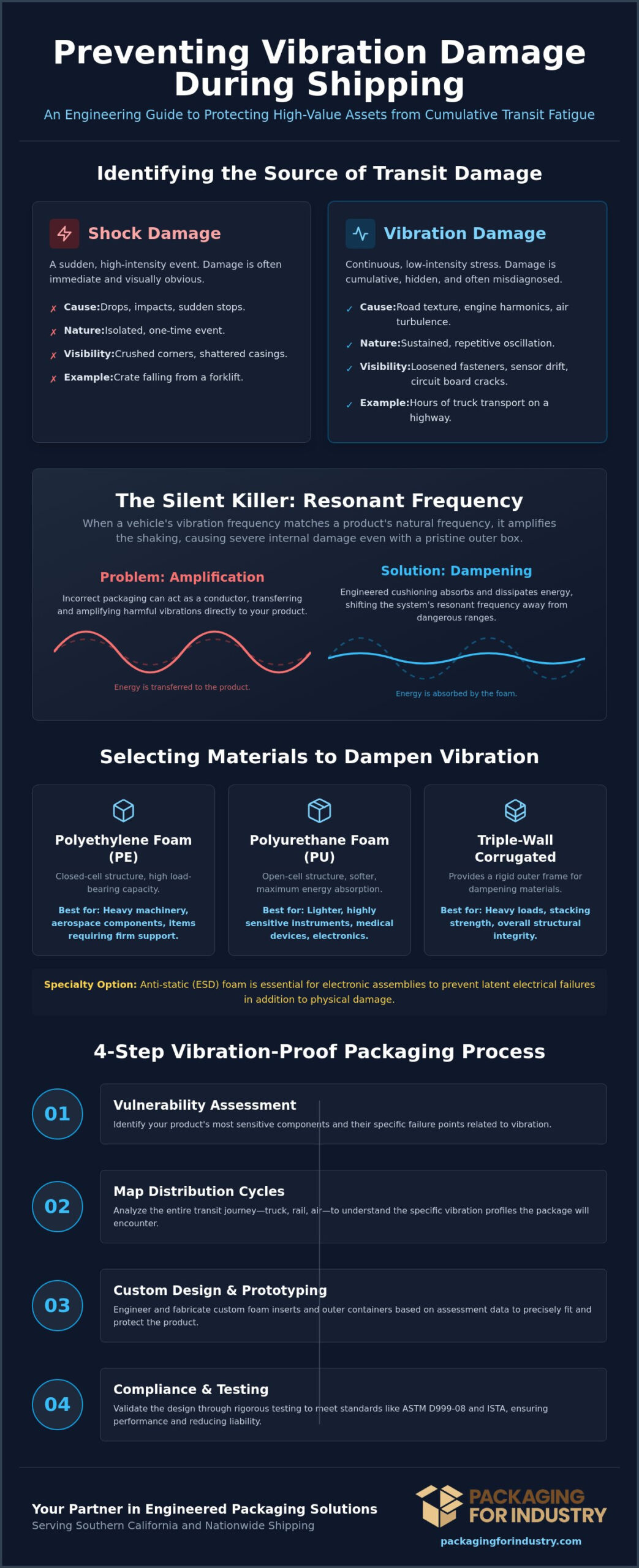
Distinguishing between vibration and shock is the first step in protecting high-value industrial assets. Shock is an isolated, high-intensity event, such as a crate falling from a forklift or a container slamming during a ship’s docking. In contrast, vibration is a continuous, low-intensity stressor caused by the constant interaction between the transport vehicle and the road, rail, or air. While shock damage is usually immediately visible through crushed corners or shattered casings, vibration damage is cumulative. It’s the result of hours or days of repetitive oscillation that fatigues materials until they fail.
Products often leave a manufacturing facility in pristine condition but arrive at their destination non-functional because of sustained transit frequencies. Common symptoms of this “silent” damage include loosened fasteners, cracked solder joints on printed circuit boards, and precision sensors that have drifted out of calibration. Because the outer corrugated boxes may appear completely untouched, these failures are often misdiagnosed as manufacturing defects. Effective strategies for preventing vibration damage during shipping focus on isolating the product from these repetitive cycles rather than just bracing against a single drop.
The Silent Killer: Resonant Frequency
Resonance is the frequency where an object naturally vibrates with maximum amplitude. If your packaging is too stiff, it doesn’t dampen energy; instead, it can act as a conductor that amplifies the vehicle’s engine or road vibrations. This amplification causes internal components to shake with much higher force than the truck or plane itself. Properly engineered Package cushioning materials, such as custom-cut foam packaging, are designed to shift the resonant frequency of the entire system. By moving this frequency away from the common ranges encountered during transport, you ensure the energy is dissipated as heat within the foam rather than being transferred to your sensitive equipment.
Common Industrial Vibration Scenarios
The shipping environment dictates the specific vibration profile your cargo will face. Truck transport is the most common source of damage for Southern California manufacturers. Constant vibration from uneven road surfaces and highway expansion joints can cause “fretting,” where metal parts rub together and wear down. Rail transport introduces “hunting oscillation,” where the railcar sways laterally at high speeds, creating unique low-frequency stresses. Air freight subjects cargo to high-frequency engine noise that can loosen even the smallest internal screws in electronic assemblies. Preventing vibration damage during shipping requires a deep understanding of these modes to select the right density of foam and crate construction for the journey. If you are unsure which environment your product faces, you can request a packaging quote to have our engineers conduct a vulnerability assessment.
Selecting Protective Materials to Dampen Vibration
Choosing the right materials is the difference between a successful delivery and a costly insurance claim. For industrial manufacturers, the selection process focuses on decoupling the product from the energy of the transport vehicle. Polyethylene foam is often the workhorse for heavy machinery and aerospace components due to its closed-cell structure and high load-bearing capacity. It maintains its shape under sustained pressure, ensuring the product stays centered within the container. Polyurethane foam, being softer and open-cell, is better suited for lighter, highly sensitive instruments that require maximum energy absorption at low frequencies. For electronic assemblies, integrating anti-static (ESD) properties into these foam types is mandatory to prevent latent electrical failures alongside physical vibration damage.
The outer container must provide a rigid frame for these dampening materials to work effectively. Heavy-duty double-wall and triple-wall custom corrugated boxes offer the necessary stacking strength and structural rigidity. If a box is too flimsy, it will flex along with the vehicle’s movement, which can cause the internal cushioning to lose its tension and fail. For unitized loads, using corner and edge protection is vital for maintaining pallet integrity. Vibration can cause individual boxes to shift or saw through stretch film; these reinforcements ensure the entire load remains stable and secure during preventing vibration damage during shipping.
Custom Foam Inserts: The Front Line of Defense
Precision is critical when designing custom foam packaging. Die-cut foam inserts are superior to generic loose-fill because they eliminate “void space” where a product might rattle. By creating a snug fit, the foam acts as a shock absorber that specifically targets the resonant frequencies identified in your shipping environment. The density of the foam must be carefully matched to the product’s weight; foam that’s too dense will simply pass vibrations through to the component, while foam that’s too soft will “bottom out” under the load. If you aren’t sure which density fits your specific application, you can request a packaging quote for a customized material analysis.
Heavy-Duty Corrugated and Wood Crating
There’s a clear point where corrugated materials may no longer be sufficient. For high-value gear weighing several hundred pounds, manufacturers should transition to custom wood crates. These crates provide a non-flexing exterior that allows for the installation of complex, multi-layered isolation systems. Designing foam-lined crates involves creating a “box within a box” structure, where the internal equipment is completely decoupled from the wooden floor and walls. This approach is the gold standard for preventing vibration damage during shipping when moving sensitive medical imaging equipment or aerospace sub-assemblies through long-haul LTL networks.
A Step-by-Step Guide to Engineering Vibration-Proof Packaging
Engineering a reliable solution for preventing vibration damage during shipping requires a methodical approach that moves beyond simple cushioning. It’s a technical process that treats the package and the product as a single integrated system. By following a structured engineering workflow, manufacturers can eliminate the guesswork that often leads to high recalibration costs and transit failures. This systematic approach ensures that every material, from the density of the foam to the thickness of the corrugated walls, serves a specific functional purpose in energy dissipation.
- Step 1: Conduct a Product Vulnerability Assessment. Identify the “fragility” of internal components. This includes finding sensitive sensors, delicate solder joints, or fasteners that are prone to loosening under sustained harmonic frequencies.
- Step 2: Define the Shipping Environment. Determine the primary mode of transport. Air freight introduces high-frequency engine noise, while LTL trucking involves repetitive impacts from road expansion joints. Mapping these variables is essential for selecting the correct dampening materials.
- Step 3: Engineer Custom CAD Designs. Use CAD/CAM software to design foam inserts that precisely match the product’s geometry and center of gravity. This ensures even weight distribution and prevents “hot spots” where vibration energy could concentrate.
- Step 4: Create a Prototype for Fit-Testing. Produce a physical sample to verify the clearance between the product and the outer container. This stage is critical for ensuring the foam isn’t too tight, which could pass vibrations directly to the component, or too loose, which allows internal rattling.
- Step 5: Finalize Production and Implement Stocking. Once the design is validated, move to a full production run. Integrating a Vendor Managed Inventory (VMI) program at this stage helps maintain supply reliability and lowers total packaging costs.
The Role of Prototyping in Damage Reduction
For aerospace and medical device manufacturers in Orange County and San Diego, precision is the highest priority. Our custom design packaging services utilize rapid prototyping to eliminate the risk of internal component fatigue. By testing physical prototypes, we can simulate how the packaging responds to specific frequency ranges. This allows us to adjust foam densities or add secondary reinforcements before you commit to a bulk order, ensuring your high-value gear arrives in factory-calibrated condition.
Load Stabilization with Stretch Film
Pallet integrity is often the weakest link in preventing vibration damage during shipping. When individual boxes are not properly secured, they vibrate independently, which increases the cumulative stress on the products inside. Using machine-grade stretch film to lock the load to the pallet creates a unified mass. This unitization ensures that the entire shipment responds to vehicle movements as a single block, which significantly dampens the harmonic oscillations that cause fasteners to back out or components to shift during long-haul transit.
Compliance and Standards: ISTA, ASTM, and Mil-Spec
Compliance with international testing standards is the only way to verify that your packaging design is capable of preventing vibration damage during shipping before it enters the field. For manufacturers in Los Angeles and Orange County, meeting these benchmarks is often a contractual requirement for aerospace, medical, and defense projects. These standards move beyond guesswork, providing a scientific framework to simulate the exact harmonic stresses of a global supply chain. By aligning your packaging with recognized protocols, you reduce the risk of catastrophic failure and establish a clear baseline for quality control.
The International Safe Transit Association (ISTA) provides the most common procedures for industrial applications. ISTA 3A is the standard for parcel delivery shipments under 150 pounds, while ISTA 3B focuses on unitized loads in the Less-Than-Truckload (LTL) environment. These tests subject a package to random vibration cycles that replicate the movement of a delivery truck or aircraft. Additionally, ASTM D4169 serves as a comprehensive distribution cycle simulation. It utilizes the ASTM D999-08(2023) standard for vibration testing, which was reapproved in late 2023 to ensure testing methods remain accurate for modern transport vehicles. If you are preparing for a complex distribution cycle, you can request a packaging quote to ensure your designs meet these rigorous specifications.
Navigating Aerospace and Defense Requirements
Avionics, satellite components, and precision guidance systems require specialized protection that standard industrial packaging cannot provide. These high-value assets often face unique high-frequency vibrations from jet engines or rocket launches. Our aerospace packaging solutions are engineered to meet these specific demands, utilizing high-density foam and custom-built crates. Mil-Spec packaging ensures survivability in extreme logistics environments. We help Southern California manufacturers navigate these complex military requirements, ensuring that every crate and insert is built to withstand the most punishing handling conditions in the defense sector.
Documentation and Quality Control
Meeting a standard once is not enough; you must ensure every production run maintains the same level of protection. Consistency in foam density and corrugated structural integrity is vital for preventing vibration damage during shipping over the long term. Implementing a Vendor Managed Inventory (VMI) program allows for tighter quality oversight. Because we manage the stock and delivery of your custom components, we can ensure that every foam insert and crate meets the exact CAD/CAM specifications of the original, tested prototype. This end-to-end accountability eliminates the material drift that often leads to unexpected product damage in high-volume manufacturing operations.
Why Choose PFI for Vibration Protection in Southern California?
Manufacturers across Los Angeles and San Diego shouldn’t settle for one-size-fits-all solutions when shipping high-value instruments. Searching for a packaging supplier near me often leads to generic catalog companies, but PFI offers the engineering depth required for preventing vibration damage during shipping. We act as a seasoned consultant for your operations, providing local next-day delivery and direct access to the designers who build your crates. Whether you’re in Orange County or managing a multi-location manufacturing footprint nationwide, our focus remains on supply reliability and logistical flow.
We provide a level of oversight that catalog retailers can’t match. Our team understands the specific road conditions and transit frequencies common to Southern California logistics networks. By choosing a partner with local manufacturing capabilities, you eliminate long lead times and ensure your production line never stalls due to packaging shortages. We prioritize your operational uptime, offering just-in-time delivery and Vendor Managed Inventory programs that keep your warehouse running smoothly while maximizing your floor space.
Reducing Packaging Costs and Damage Rates
As a specialized custom box manufacturer, we don’t just supply containers; we optimize your entire spend. Our packaging cost savings strategies target both material waste and shipping efficiency. By engineering integrated foam and corrugated solutions, we often reduce the external dimensions of your crates, which helps you avoid heavy DIM weight surcharges. Lowering your total cost of ownership also means eliminating the financial burden of return shipping and field repairs. When your sensitive electronics arrive ready for immediate use, your operational efficiency improves and your customer satisfaction remains high.
Request a Custom Packaging Quote Today
Challenging shipping problems require more than just extra tape. We encourage you to bring your most fragile components to our team for a free packaging review. We’ll demonstrate how our prototyping and CAD support can stabilize your supply chain and reduce product damage. It’s easy to start improving your logistics today. Simply request a custom packaging quote to see how we can lower your packaging costs while providing the highest level of industrial protection. We’re ready to act as the fixer for your most difficult transit issues.
Secure Your Supply Chain with Engineered Protection
Protecting high-value industrial assets requires a transition from generic cushioning to integrated engineering. We’ve established that vibration is a cumulative threat, often causing internal component failure long before the outer crate shows signs of wear. By focusing on resonant frequencies and selecting the correct foam densities, you can eliminate the hidden costs of recalibration and transit fatigue. Implementing these technical strategies is the most effective path for preventing vibration damage during shipping while protecting your professional reputation.
Packaging For Industry (PFI) is ready to help you optimize your logistics through specialized expertise in aerospace and medical device packaging. Our team provides free prototyping and CAD design support to ensure every custom insert meets your exact specifications. With local next-day delivery across Orange County, Los Angeles, and San Diego, we offer the supply reliability your operations demand. Don’t let ineffective packaging drain your bottom line with avoidable damage claims.
Request a Custom Packaging Quote to Reduce Shipping Damage today. We look forward to solving your most complex shipping challenges and helping your business achieve long-term logistical stability.
Frequently Asked Questions
What is the best material for preventing vibration damage?
Closed-cell polyethylene foam and open-cell polyurethane foam are the industry standards for dampening transit frequencies. Polyethylene provides the necessary structural support for heavy aerospace and automotive parts, while polyurethane is better for isolating lighter, high-sensitivity medical instruments. Selecting the correct density ensures the material absorbs harmonic energy rather than transferring it to your internal components.
How is vibration damage different from shock damage?
Vibration is a repetitive, low-intensity stressor that causes cumulative fatigue, whereas shock is a single, high-intensity impact like a forklift collision. While shock damage is usually visible immediately, vibration damage is often hidden. It manifests as loosened screws, cracked solder joints, or sensors that have drifted out of calibration during long-haul transport.
Can standard corrugated boxes protect against vibration?
Standard single-wall boxes often lack the structural rigidity required for preventing vibration damage during shipping. For industrial loads, we recommend heavy-duty double-wall or triple-wall corrugated containers. These provide a non-flexing exterior that allows internal foam cushioning to function correctly, ensuring the product doesn’t “bottom out” against the container walls during transit.
Do I need custom foam inserts for my product?
Custom foam inserts are essential for high-value gear that cannot tolerate internal movement. Generic loose-fill or oversized cushioning creates “void space” where components can rattle, which amplifies vibration energy. CAD-designed inserts ensure a precise fit that stabilizes the center of gravity and decouples the product from the frequencies of the truck or aircraft.
What are the most common ISTA standards for vibration testing?
ISTA 3A and ISTA 3B are the primary protocols used to verify that packaging can reduce shipping damage in parcel and LTL environments. These tests use random vibration profiles to simulate the movement of modern transport vehicles. Meeting these standards is often a requirement for aerospace and defense contracts to ensure product survivability.
How does stretch film help reduce vibration damage?
High-performance stretch film unitizes the pallet, forcing the entire load to respond to vehicle movement as a single block. When individual boxes are loose, they vibrate independently and increase the cumulative stress on the contents. Proper unitization dampens these harmonic oscillations and maintains pallet integrity throughout the distribution cycle.
How much does custom vibration-resistant packaging cost?
The total investment depends on your material specifications and production volume, but we provide competitive bulk packaging pricing for our industrial partners. When you request a packaging quote, we perform a cost-benefit analysis to show how engineered solutions can lower packaging costs by eliminating expensive product returns and repairs.
Does PFI offer local delivery in Southern California?
Yes, we provide local next-day delivery using our own fleet of trucks throughout Los Angeles, Orange County, and San Diego. This proximity allows us to support just-in-time manufacturing and Vendor Managed Inventory (VMI) programs. Our local presence ensures you have the right materials on hand to reduce shipping damage without maintaining excessive warehouse overhead.