
What if the six to eight touchpoints of a standard LTL shipment are actually designed to destroy your current packaging? For many manufacturers, the frustration of a rejected shipment or a crushed industrial component is a weekly occurrence that drains resources and damages client relationships. If you’re tired of catalog boxes failing under heavy loads, it’s time to rethink how to reduce LTL freight damage claims with better packaging. You don’t need more paperwork; you need a fortified pallet engineered to survive the hub and spoke transit system.
We understand that a lengthy claims process is a waste of your team’s time and your company’s money. This 2026 guide provides the industrial engineering tactics and packaging protocols you need to stop transit damage before it starts. We’ll explore how switching to heavy duty double wall corrugated and custom foam inserts can safeguard your high value parts while creating a streamlined workflow your warehouse team can follow with ease. From Southern California manufacturing hubs to nationwide distribution centers, these strategies turn your packaging from a cost center into a reliable system of protection.
Key Takeaways
- Identify the specific risks of the hub and spoke logistics model, where your freight typically faces six to eight touchpoints before reaching its final destination.
- Master the technical differences between ECT and Mullen ratings to understand how to reduce LTL freight damage claims with better packaging that supports heavy vertical stacking.
- Replace generic void fill with custom foam packaging to provide the precise deceleration needed to protect heavy industrial parts from G-force impacts during transit.
- Establish a standardized five step packing protocol that ensures your warehouse team maintains consistent load stability and pallet integrity for every shipment.
- Utilize Vendor Managed Inventory (VMI) to guarantee a reliable supply of heavy duty corrugated and protective materials for your Southern California manufacturing operations.
Why LTL Shipments Are Prone to Damage: The High-Touch Reality
LTL shipping is fundamentally different from a dedicated truckload. In a hub and spoke logistics model, your freight doesn’t stay on one trailer from dock to dock. Instead, it’s treated as a modular piece of a larger puzzle, moving through a series of regional terminals. This efficiency for the carrier creates a high touch environment for your products. Statistics show that the average LTL shipment undergoes six to eight touchpoints during its journey. Every time a forklift operator unloads, stages, or reloads your pallet, the risk of a puncture or a drop increases. Understanding these mechanical stresses is the first step in learning how to reduce LTL freight damage claims with better packaging.
The challenge isn’t just the handling; it’s the environment inside the trailer. LTL trailers are packed for maximum density to maintain carrier profitability. This means your pallet might end up at the bottom of a stack, supporting 2,000 lbs of unrelated freight. If your boxes aren’t engineered for high compression, they’ll buckle. Beyond the weight, constant road vibration and transit shocks can rattle internal components loose. Without specialized cushioning, even a pallet that looks intact on the outside can arrive with a non functional machine on the inside.
LTL vs. FTL: Why Your Packaging Strategy Must Change
Full Truckload (FTL) shipping allows for a “set and forget” approach because the cargo remains undisturbed until delivery. Standard corrugated boxes often suffice for FTL because the only major stressor is consistent transit vibration. LTL is a different beast. Because your freight shares space with everything from industrial chemicals to heavy machinery, your load stability is at the mercy of the trailer’s mix. A packaging protocol designed for FTL will almost certainly fail in the LTL cycle. You need materials that account for the repeated reload stress and the unpredictable nature of mixed freight loads.
The True Cost of OS&D Claims
An Over, Short, and Damaged (OS&D) claim costs you far more than the price of the replacement part. You have to account for the administrative labor required to file the claim, the freight costs for the return shipment, and the potential loss of a frustrated customer. Frequent claims also damage your reputation with carriers, which can lead to higher insurance premiums and less favorable freight rates. Analyzing your packaging cost savings often reveals that investing in higher grade materials upfront is significantly cheaper than managing a 5% or 10% damage rate. Reducing these claims is a direct path to protecting your bottom line and ensuring supply chain reliability.
Engineering the Fortified Pallet: Corrugated and Load Stability
Engineering a pallet that survives the LTL cycle requires more than just a standard shipping box. Most manufacturers rely on basic Regular Slotted Containers (RSCs), but these often collapse when subjected to the vertical pressure of stacked freight. If you want to know how to reduce LTL freight damage claims with better packaging, you must focus on the technical specifications of your corrugated materials. Stacking strength is the primary defense against the crushing forces found in a crowded trailer.
Choosing between Edge Crush Test (ECT) and Mullen ratings is a critical decision for your procurement team. ECT measures the stacking strength of the board, which is vital for pallets that’ll be double stacked. Mullen ratings measure the bursting strength or puncture resistance, which protects against sharp objects or forklift tines. Integrating corner and edge protection further reinforces these containers, preventing the stretch film and nylon strapping from crushing the box corners during high tension applications.
Selecting the Right Corrugated Grade
Standard single wall boxes aren’t built for 2,000 lb loads or the repeated reloading of LTL transit. When shipping heavy industrial components, you should specify at least 48 ECT double wall board. This grade provides the necessary vertical column strength to prevent the bottom layers of your pallet from buckling. For aerospace parts or heavy machinery that requires maximum protection, triple wall corrugated is the industry standard. It offers a level of durability that rivals wooden crates while remaining more cost effective. You can compare packaging pricing and technical specs for different corrugated boxes to match the specific weight requirements of your product line.
Maximizing Pallet Integrity with Stretch Film
Load stability is often the difference between a successful delivery and a costly claim. Many warehouse teams focus on the number of wraps, but the physics of containment force is what actually secures the load. Containment force is the result of wrap tension and the thickness of the film. Using a 60 gauge film for a heavy pallet is a common mistake that leads to load shifting. For heavy industrial freight, a higher gauge machine film provides the consistent tension needed to lock the boxes to the pallet base. If you’re looking to optimize your current setup, you can request a packaging quote to see how an engineered pallet design fits into your operational budget.
Interior Protection: Custom Foam vs. Generic Void Fill
Generic void fill often fails because it lacks the structural memory to withstand heavy industrial loads. When a 50 lb steel component is packed with bubble wrap or packing peanuts, the material compresses immediately upon the first vibration or impact. This creates a “void” where the product can move freely within the carton. If you are investigating how to reduce LTL freight damage claims with better packaging, you must address this internal movement. Once a part begins to rattle against the corrugated walls, the risk of mechanical failure or cosmetic damage increases exponentially during the six to eight touchpoints of an LTL journey.
The core function of engineered foam packaging is the science of deceleration. When a pallet is jolted during a terminal transfer, the foam absorbs the G-force energy, slowing the product’s movement over a controlled distance. Choosing the right density is vital for this process. Polyethylene (PE) is a high density, closed cell foam ideal for heavy machinery parts that require rigid support and multi impact protection. Conversely, Polyurethane (PU) is a softer, open cell foam better suited for delicate, lighter instruments. For electronics and semiconductor manufacturers, anti static (ESD) foam is a non negotiable requirement to prevent electrostatic discharge while the freight is in motion.
The Case for Custom Foam Inserts
Precision die cut inserts are the gold standard for industrial protection. Unlike generic fillers, custom inserts are engineered to the exact dimensions of your product, eliminating any possibility of shifting. Using foam end caps is a highly efficient strategy for protecting the vulnerable corners of heavy equipment while minimizing the total amount of material used. This precision also allows you to use smaller outer cartons, which reduces your dimensional (DIM) weight and lowers your overall shipping costs. It’s a pragmatic solution that balances superior protection with fiscal responsibility.
Prototyping for Zero-Damage Success
For high value aerospace and medical components, guesswork isn’t an option. Professional custom design packaging services include CAD/CAM support to ensure a perfect fit for complex geometries. Free prototyping allows your team to test the packaging in a real world environment before committing to a bulk order. This engineering first approach is a foundational element of how to reduce LTL freight damage claims with better packaging, ensuring your most sensitive gear arrives in factory condition regardless of the carrier’s handling practices.
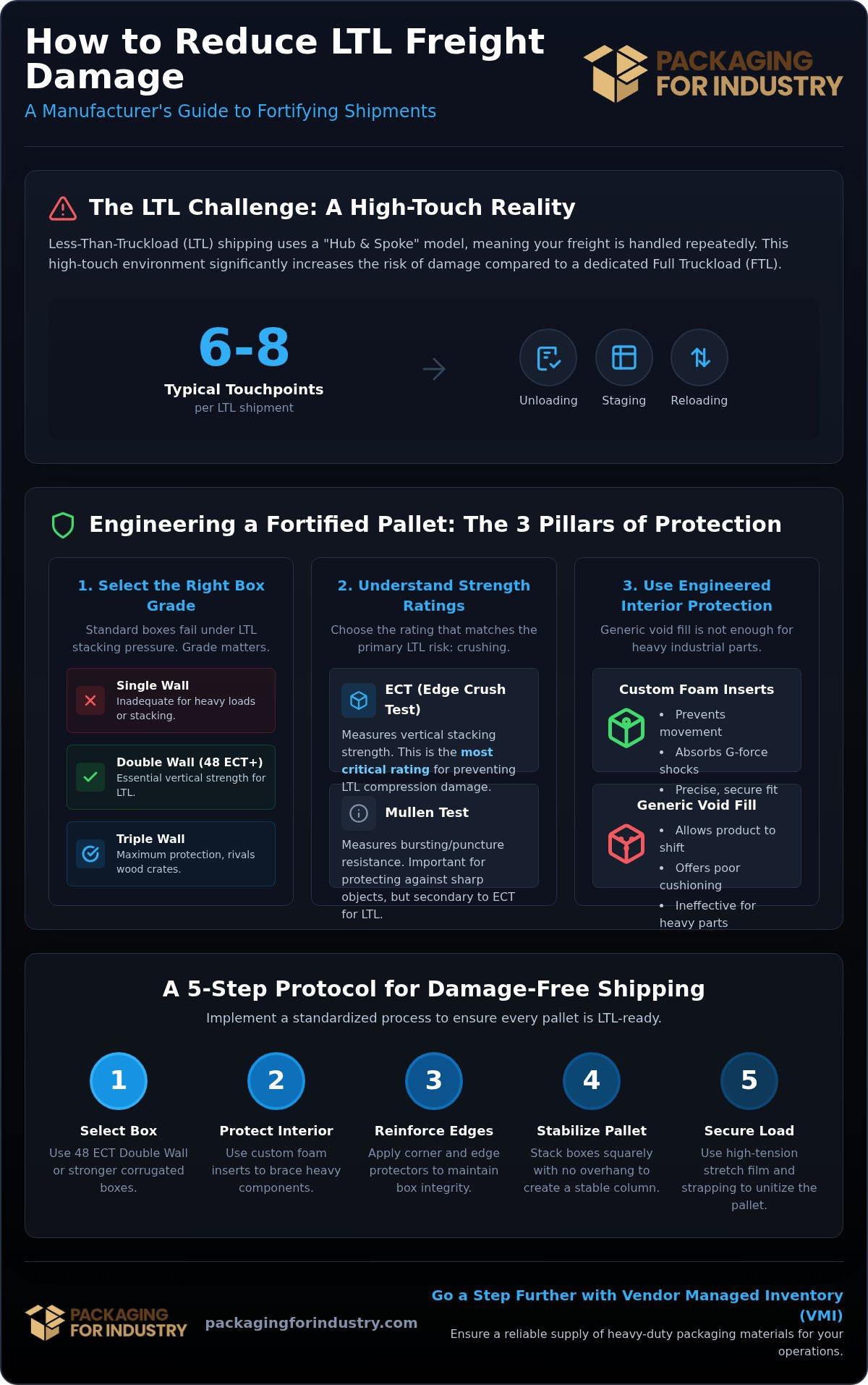
A 5-Step Protocol for Damage-Free LTL Shipping
Standardizing your shipping process is the final piece of the puzzle when learning how to reduce LTL freight damage claims with better packaging. While high quality materials provide the foundation, your warehouse team’s execution determines the ultimate success of the shipment. A repeatable protocol eliminates guesswork and ensures that every pallet leaving your dock meets the same rigorous standard for stability and protection. Training employees on these specific steps reduces human error and builds a culture of operational excellence. It’s not enough to have the best boxes; you need a team that knows how to use them properly.
The Warehouse Checklist
A formal checklist ensures that small details don’t lead to large claims. Implementing these requirements is the most direct way to show your logistics team how to reduce LTL freight damage claims with better packaging while maintaining a high speed of operation.
- Step 1: Inspect the pallet. Before any boxes are loaded, the operator must verify the integrity of the pallet itself. Broken stringers or protruding nails can puncture corrugated walls or cause the entire load to tilt during transit.
- Step 2: Center the load. You must ensure that the freight is centered on the pallet without any overhang. Overhang is the primary cause of side impact damage because it leaves the corrugated corners vulnerable to forklift strikes and trailer wall friction. Even an inch of overhang significantly reduces the load’s vertical stacking strength.
- Step 3: Apply edge protectors. Place rigid corner protectors on all four vertical edges before applying the final layers of stretch film. This step distributes the containment force evenly and prevents the film from cutting into the boxes, maintaining the structural integrity of your heavy duty containers.
Labeling and Documentation for Claims Prevention
The final two steps of the protocol focus on communication and visibility within the hub and spoke system. Clear handling instructions and durable documentation prevent the unnecessary handling that often leads to transit damage.
- Step 4: Use visual cues. If your freight cannot support top loading, place high visibility “Do Not Double Stack” cones on top of the pallet. These physical barriers are far more effective than small stickers alone, providing a clear signal to forklift operators in dimly lit terminals.
- Step 5: Optimize labeling. Place shipping labels on all four sides of the pallet at eye level. This ensures that operators can identify handling instructions regardless of how they approach the load. To maintain scanability, use high durability thermal transfer ribbons. Smudged barcodes lead to misrouting and additional touchpoints, which increases the likelihood of damage.
How PFI Reduces Claims for Southern California Manufacturers
PFI serves as a specialized industrial packaging supplier near me for manufacturers who require more than just standard off-the-shelf materials. We understand that local businesses in Anaheim and the surrounding regions need a partner who prioritizes structural integrity over high-volume retail sales. As a dedicated bulk packaging supplier, we offer the heavy-duty corrugated and custom foam solutions necessary to survive the rigorous hub-and-spoke transit system discussed throughout this guide. Our team conducts on-site audits to identify specific failure points in your current pallet builds, helping you lower packaging costs by eliminating the root causes of transit damage.
Custom Solutions for Specialized Sectors
We provide engineered protection tailored to the unique demands of high-stakes industries. For Anaheim aerospace suppliers, our expertise includes designing precision-cut foam inserts and heavy-duty crates that meet exacting flight hardware standards. If you are looking for custom boxes in Orange County or the Inland Empire, we manufacture double and triple-wall containers specifically built for heavy industrial components. We also maintain strict Mil-spec compliance for defense contractors, ensuring that every shipment remains secure from the initial loading dock to the final destination.
Just-In-Time Supply Chain Reliability
Operational efficiency depends on a consistent supply of protective materials. As a leading packaging supplier in Los Angeles and San Diego, we offer VMI services that automate your inventory replenishment. By managing your safety stock of custom boxes and foam, we ensure you never face a stockout that compromises your shipping protocols. This just-in-time approach frees up valuable warehouse space while maintaining the reliability your customers expect. To begin a comprehensive damage-reduction audit for your facility, request a packaging quote from our engineering team today.
Secure Your Supply Chain with Engineered Protection
Transit damage is a solvable engineering problem rather than an inevitable cost of doing business. By moving away from generic catalog boxes and adopting high ECT double wall corrugated with precision foam inserts, you create a fortified pallet that survives the high touch LTL environment. Standardizing your warehouse protocol ensures these materials are applied correctly, locking your load to the pallet and providing clear visual cues for carrier operators. These steps are fundamental to how to reduce LTL freight damage claims with better packaging while protecting your professional reputation.
Our team specializes in supporting aerospace and industrial manufacturing firms with high stakes shipping needs. We offer free CAD/CAM prototyping and next day delivery across Southern California to ensure your production lines never slow down. Auditing your current shipping department with industrial experts allows you to identify hidden risks before they become costly OS&D claims.
Take control of your logistics and build a more resilient supply chain with packaging designed for the real world.
Frequently Asked Questions
What is the most common cause of LTL freight damage?
Improper load stability and a lack of vertical stacking strength are the primary causes of damage in the LTL environment. Because freight moves through multiple terminals, pallets are frequently double stacked or subjected to side impacts during forklift transfers. Without heavy duty corrugated boxes or reinforced corner protection, the bottom layers often buckle under the weight of overhead freight during transit.
How do I choose between ECT and Mullen rated boxes for LTL?
You should specify ECT ratings when vertical stacking strength is your priority and Mullen ratings when puncture resistance is the primary concern. For LTL shipping, where pallets are often stacked, a high ECT double wall box provides the column strength needed to prevent crushing. If your product has sharp edges or is prone to shifting, a Mullen rated box offers superior containment and burst resistance.
Does stretch wrap really prevent damage, or is it just for unitization?
High quality stretch wrap provides critical containment force that prevents load shifting, which is a major factor in how to reduce LTL freight damage claims with better packaging. While it does unitize the load, its primary protective function is to lock the boxes to the pallet base. Proper tensioning ensures the freight moves as a single unit, resisting the lateral forces caused by terminal handling.
What should I do if my LTL shipment arrives damaged?
You must document the damage on the Proof of Delivery (POD) before the driver leaves and take high resolution photographs of the pallet while it is still in the trailer. Failure to note “damaged” or “subject to inspection” on the POD often results in an automatic claim denial. Keep all packaging materials and the damaged product in a staging area for the carrier’s inspector to review.
How can custom foam inserts actually save me money on shipping?
Custom foam inserts allow you to use smaller outer cartons by providing superior protection in a compact footprint, which lowers your dimensional (DIM) weight charges. By eliminating the need for bulky, generic void fill, you reduce the overall cube size of your pallet. This precision engineering reduces both the frequency of costly damage claims and your total freight spend per unit shipped.
Why is pallet overhang such a big risk in LTL transit?
Pallet overhang exposes the most vulnerable parts of your corrugated boxes to side impacts and friction from trailer walls or adjacent freight. When a box hangs over the edge of the wood, it loses up to 30% of its vertical stacking strength because the pallet no longer supports the box corners. This misalignment is a primary cause of bottom layer collapse in the hub and spoke system.
Do I need a custom crate for heavy industrial equipment?
You should consider a custom crate for high value equipment exceeding 500 lbs or items with irregular geometries that cannot be secured on a standard pallet. While triple wall corrugated is an excellent middle ground, wooden crates provide the ultimate protection against the heavy handling of LTL transit. We often recommend crates for aerospace components and sensitive medical machinery that require zero movement.
How does VMI help reduce my freight damage claims?
Vendor Managed Inventory (VMI) ensures your warehouse never runs out of the specialized, heavy duty supplies required to protect your freight. When teams lack the correct double wall boxes or edge protectors, they often substitute inferior materials that lead to transit failure. A VMI program maintains a consistent stock of engineered packaging, which is a vital part of how to reduce LTL freight damage claims with better packaging.