
A shipping crate is only as strong as its weakest internal support. For manufacturers of high-value aerospace components or sensitive medical equipment, a single failure during transit can result in thousands of dollars in losses while eroding your reputation with key accounts. Learning how to secure items inside a shipping crate isn’t just about filling space; it’s a critical engineering process designed to eliminate movement and absorb impact. You already know that damage claims and inefficient packing processes are hidden costs that drain your bottom line and slow down production.
This guide provides a masterclass in professional techniques for structural blocking, precision cushioning, and load stabilization. We’ll explore how integrating custom foam inserts and rigid wood bracing into your crates can streamline your operations and lower your total packaging costs. By focusing on precision and adaptability, you can move away from generic solutions that don’t fit your specific needs. By the end, you’ll have a clear framework to optimize your shipping workflow and ensure every delivery arrives in factory-perfect condition, providing the peace of mind that comes with a well-engineered supply chain.
Key Takeaways
- Identify product sensitivity and calculate the Center of Gravity to establish a foundation for internal security.
- Learn how to secure items inside a shipping crate using professional blocking and bracing to eliminate shifting and jumping during transit.
- Select the correct foam density, such as polyethylene or polyurethane, to provide precision shock absorption for sensitive components.
- Implement advanced stabilization tools like tie-down straps and corner protection to safeguard surfaces and maintain load integrity.
- Optimize your supply chain by utilizing CAD/CAM design and prototyping to create custom-tailored crating solutions that reduce waste.
Assessing Your Payload: The Foundation of Internal Crate Security
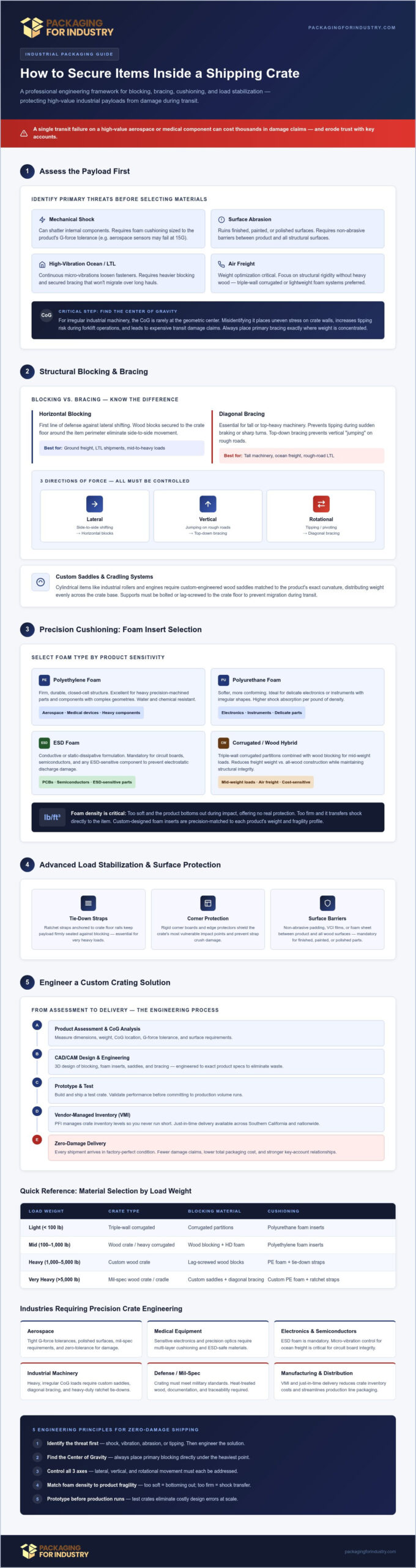
Securing a payload requires more than just a sturdy container. It demands a systematic evaluation of the item’s physical properties and the environmental stresses it’ll encounter during the journey. Before deciding how to secure items inside a shipping crate, you must identify if the primary threat is mechanical shock, which can shatter internal components, or surface abrasion, which ruins high-end finishes. High-vibration ocean freight and the rough handling typical of LTL environments necessitate different stabilization strategies. A crate destined for a long-haul truck trip faces constant micro-vibrations that can loosen standard fasteners; air freight requires a focus on weight optimization without sacrificing structural rigidity.
Determining Fragility and Surface Requirements
Every industrial component has a specific G-force tolerance. Aerospace sensors might fail at 15G, while a cast-iron engine block can withstand significantly more impact. If your item has a finished, painted, or polished surface, you need non-abrasive barriers to prevent scuffing or cosmetic damage. For mid-weight items, custom corrugated boxes using triple-wall construction offer a cost-effective alternative to wood. These heavy-duty corrugated crates provide excellent structural integrity while reducing overall freight weight. For payloads exceeding several thousand pounds, traditional custom wood crates remain the standard for maximum rigidity and stackability. Selecting the right exterior material is the first step in managing your total cost of ownership and reducing shipping damage.
Weight Distribution and Load Balancing
Finding the Center of Gravity (CoG) is a critical yet often overlooked step in the crating process. For irregular industrial machinery, the CoG is rarely in the geometric center of the footprint. An unbalanced load places uneven stress on the crate walls and increases the risk of tipping during forklift maneuvers or sudden stops. Identifying the CoG allows your team to place primary bracing exactly where the weight is concentrated. This ensures the crate remains stable on its pallet base and allows warehouse personnel to safely engage the load with standard equipment. A well-balanced crate protects the product and prevents the structural failures that lead to expensive transit damage claims. Mastering how to secure items inside a shipping crate means engineering the internal space so the load behaves as a single, unified unit during movement.
Structural Blocking and Bracing Techniques for Heavy Loads
Structural integrity begins at the base of the crate. While the outer shell provides protection from external elements, the internal blocking and bracing prevent the payload from becoming a projectile. Understanding how to secure items inside a shipping crate involves more than just tight packing; it requires the strategic placement of materials to counteract the forces of inertia and gravity during transport.
Blocking vs. Bracing: Knowing the Difference
Horizontal blocking is your first line of defense against shifting. By securing wood blocks directly to the crate floor around the perimeter of the item, you eliminate lateral movement. This is a fundamental technique when learning how to secure items inside a shipping crate effectively. Diagonal bracing serves a different purpose. It’s essential for tall or top-heavy machinery that might tip during sudden braking or sharp turns. Top-down bracing is equally vital; it prevents jumping when the crate encounters vertical shocks on rough roads or during ocean transit. While wood is the standard for heavy industrial loads, high-density foam or heavy-duty corrugated partitions can provide effective blocking for mid-weight items without adding excessive freight weight.
Custom Saddles and Cradling Systems
Cylindrical items like industrial rollers or engines require specialized support to prevent rolling. Custom-engineered wood saddles match the specific curvature of the product, distributing weight evenly across the crate base. For lighter rolled goods, such as specialized films or textiles, utilizing heavy-duty tubes and cores as internal supports can prevent the material from collapsing under its own weight. These supports must be bolted or lag-screwed to the crate floor to ensure they don’t migrate during transit. This level of precision ensures that even the most awkward shapes remain immobile throughout the supply chain.
For the heaviest payloads, friction and blocking aren’t enough. You must anchor the item directly to the crate base using industrial-grade steel hardware or lag bolts. This creates a rigid connection between the product and the pallet base, effectively making them a single unit. When you compare packaging pricing for custom solutions, ensure the design includes these critical anchoring points to avoid catastrophic failures in the field. Using the right hardware is a small investment compared to the cost of a total loss claim.
Precision Cushioning: Integrating Custom Foam Inserts
While structural wood blocking prevents a payload from shifting, it cannot absorb the kinetic energy generated by drops or high-frequency vibrations. Precision cushioning is the essential second layer of protection when determining how to secure items inside a shipping crate. High-performance foam inserts act as a decelerator, protecting sensitive internal components from the G-forces that occur during rough LTL handling or ocean transit. By integrating foam with rigid outer shells, you create a comprehensive system that addresses both structural stability and shock absorption.
Choosing the Right Foam Material
Material selection depends on the weight and fragility of your specific payload. Polyethylene (PE) foam is a closed-cell material ideal for high-load applications. It’s durable enough for heavy industrial parts and provides repeat-impact protection without losing its structural integrity. Conversely, Polyurethane (PU) foam is an open-cell, softer material designed for delicate instruments and lightweight gear. For sensitive electronics or medical devices, anti-static (ESD) foam is a mandatory requirement to prevent electrostatic discharge during transit. You can request a packaging quote for custom die-cut inserts tailored to your exact product dimensions to ensure a perfect fit.
Foam-Lined Crates for Aerospace and Electronics
In the Southern California aerospace corridor, manufacturers in Anaheim and Irvine deal with high-precision components that require total surface protection. Full-crate foam lining provides a 360-degree barrier against shock and vibration. For complex assemblies, engineered foam end caps allow the product to “float” inside the crate. This ensures the item never makes direct contact with the outer walls, a technique that’s a cornerstone of aerospace packaging where even minor surface scuffs can lead to component rejection.
Beyond protection, custom foam improves warehouse efficiency. Die-cut cavities allow for packaging kitting, where multiple small components are organized into a single crate for faster assembly at the destination. This reduces labor costs by eliminating the need for manual wrapping and the use of loose-fill materials. Integrating pre-assembled foam kits into your custom wood or corrugated crates ensures a consistent, repeatable packing process. This systematic approach is the most reliable way to maintain quality control and learn how to secure items inside a shipping crate for high-volume manufacturing lines.
Advanced Load Stabilization and Surface Protection
Once you’ve established structural blocking and integrated precision foam, the final phase of mastering how to secure items inside a shipping crate involves advanced stabilization and surface safeguarding. Many industrial components can’t be bolted directly to the crate base due to their design or material composition. In these cases, you must rely on tension-based systems and unitization to prevent internal shifting. This phase is critical because even minor movements can lead to surface marring or the loosening of internal fasteners over long transit distances.
Tie-Downs and Strapping Hardware
Selecting the right strapping material is a balance of strength and elasticity. Steel strapping offers maximum rigidity for heavy castings, while polyester and nylon provide better shock absorption for loads that might settle during transport. You must place anchor points strategically on the crate base to ensure tension is distributed evenly across the product’s frame. For multi-part loads or kitted components, using high-performance stretch film is an effective way to unitize items before they’re placed in the crate. This prevents individual parts from rubbing against each other and simplifies the final crating process. It’s a critical step in understanding how to secure items inside a shipping crate when dealing with high-volume manufacturing orders.
Edge Protection and Corner Guards
High-tension strapping can easily crush the edges of sensitive equipment or damage expensive finishes. You should always use industrial-grade corner and edge protection to distribute strap pressure across a wider surface area. V-board and foam edge protectors are particularly effective for finished surfaces that are prone to scratching. These guards don’t just protect the product; they also maintain the structural integrity of the load by preventing the straps from losing tension if the product’s edges begin to deform. For stacked loads, corner guards provide the vertical strength needed to prevent the crate’s internal structure from shifting under its own weight.
The final step in the stabilization process is filling any remaining voids with industrial dunnage. Even with perfect strapping, small gaps can lead to an internal “rattle” that causes secondary impact damage. Utilizing corrugated honeycombs, air pillows, or paper dunnage eliminates these voids and ensures the payload remains completely immobile. This comprehensive approach transforms a simple box into a high-performance shipping system that withstands the rigors of the global supply chain.
Engineering a Custom Crating Solution for Your Supply Chain
While mastering the individual techniques of how to secure items inside a shipping crate is essential, the most effective way to eliminate transit damage is through holistic custom engineering. Off-the-shelf solutions often lead to excessive voids or require redundant materials, which drives up your total packaging costs. Custom-engineered crates, whether they’re heavy-duty triple-wall corrugated or hybrid wood and foam designs, ensure that every stabilization point is optimized for your specific payload. This proactive approach identifies potential failure points before your product ever leaves the warehouse floor.
The Role of Prototyping in Damage Reduction
For complex industrial parts in the aerospace or medical sectors, a one-size-fits-all approach is a significant financial liability. Utilizing CAD/CAM design allows our team to map out precise blocking and cushioning requirements before a single piece of material is cut. We provide a free prototype to ensure the product fit is perfect and that the internal security methods can withstand simulated transit stresses. This phase is vital for reducing dimensional weight surcharges from carriers like UPS or FedEx; it eliminates unnecessary bulk while maintaining the structural integrity required for heavy-duty shipping. Testing these custom sizes during the design phase ensures that you don’t over-spend on generic packaging that doesn’t provide adequate protection.
Optimizing Procurement and Supply
Operational efficiency isn’t just about the crate’s design; it’s about how that crate integrates into your production line. Implementing just-in-time inventory management prevents warehouse clutter and ensures you have the right supplies exactly when you need them. For high-volume manufacturing lines, our vendor managed inventory (VMI) programs provide total accountability. This means your team never faces a stockout on critical shipping supplies, allowing you to focus on production rather than procurement logistics.
We support the Southern California industrial corridor with local next-day delivery across Orange County, Los Angeles, and San Diego. Whether your facility is in Anaheim, Irvine, or Torrance, having a local partner ensures lower logistics costs and faster response times for custom sizes and bulk orders. By combining engineering expertise with reliable supply chain programs, you don’t just learn how to secure items inside a shipping crate; you build a more resilient and cost-effective logistics operation. This systematic oversight from design to final delivery provides the peace of mind that comes with total accountability.
Optimizing Your Industrial Logistics for Total Protection
Securing high-value payloads requires a disciplined approach that balances structural rigidity with precision shock absorption. Mastering how to secure items inside a shipping crate means moving beyond generic fillers and adopting engineered blocking, bracing, and custom foam inserts. These professional techniques eliminate internal movement and protect sensitive surfaces from the micro-vibrations of long-distance transit. By integrating these methods, you reduce the risk of costly damage claims and streamline your warehouse operations.
Packaging For Industry (PFI) supports manufacturers with specialized expertise in aerospace and medical packaging. We offer free prototyping for custom crate designs to ensure a perfect fit before bulk production begins. With local next-day delivery across Southern California, including Orange County and Los Angeles, your operations stay on schedule without the burden of excessive inventory.
Take the stress out of your logistics chain by implementing a system built for durability and economic efficiency. We’re ready to help you lower packaging costs and improve your supply reliability today.
Frequently Asked Questions
What is the best way to secure heavy machinery inside a wood crate?
The most effective method is anchoring the machine directly to the crate base using industrial lag bolts or steel hardware. This creates a rigid connection that prevents the machine from breaking free during transit. You must also surround the base with heavy-duty wood blocking to eliminate lateral shifting. For top-heavy equipment, diagonal bracing is necessary to prevent tipping. This integrated approach is the standard for how to secure items inside a shipping crate safely.
How do I prevent my product from scratching during transit?
Prevent surface damage by utilizing non-abrasive cushioning materials like polyurethane foam or specialized surface-protection films. These materials provide a soft barrier between the product and rigid structural supports. You should also implement corner and edge protection to distribute the tension from strapping systems. For high-value aerospace parts, custom foam inserts can be designed to “float” the item, ensuring it never makes direct contact with the crate’s interior walls or floor.
Can I use corrugated crates for heavy industrial items?
Heavy-duty triple-wall corrugated containers are a viable alternative to wood for many industrial applications. These materials offer significant stacking strength and puncture resistance while reducing overall freight weight. You can often lower packaging costs by switching to corrugated for mid-weight items. However, for extremely heavy machinery exceeding several thousand pounds, a custom wood crate is still recommended to provide the necessary structural support for the base and to facilitate safe forklift handling.
What is the difference between blocking and bracing?
Blocking and bracing serve distinct roles in load stabilization. Blocking uses wood or high-density foam secured to the crate floor to eliminate horizontal movement or “sliding.” Bracing involves supports that extend from the crate’s walls or lid to the top or sides of the product. This prevents vertical “jumping” and diagonal tipping. Using both techniques ensures the payload is immobile in all directions, which is the foundation of professional internal crate security.
How much does a custom shipping crate cost?
Custom crate pricing is determined by dimensions, material specifications, and the complexity of internal supports like custom foam or saddles. To get the best value, you should compare packaging pricing based on your specific volume and lead time requirements. Factors like heat-treatment for international shipping also influence the final cost. We encourage manufacturers to request a packaging quote to receive a detailed breakdown that accounts for both material costs and long-term damage reduction.
Do I need special foam for electronic components?
Sensitive electronic and medical devices require Anti-Static (ESD) foam to prevent damage from electrostatic discharge. Standard foam can generate static electricity during transit, which can fry circuit boards or sensitive sensors. ESD foam is specially treated to dissipate these charges safely. When you’re determining how to secure items inside a shipping crate for the electronics industry, using the correct pink or blue ESD-safe cushioning is a critical step in maintaining product reliability and performance.
How can I reduce shipping damage without increasing costs?
You can reduce damage without increasing spend by optimizing the crate’s internal design to eliminate wasted space. Custom-sized crates reduce the amount of dunnage required and can lower your dimensional weight freight charges. Utilizing a Vendor Managed Inventory (VMI) program also improves efficiency by ensuring your team always has the correct materials on hand. Professional CAD/CAM design often identifies ways to use less material while providing superior protection through strategic placement of supports.
What industries require MIL-SPEC crating standards?
Industries such as defense, aerospace, and government contracting often require MIL-SPEC packaging standards. These regulations ensure that items can survive extreme temperatures, high humidity, and rough handling in military supply chains. Compliance involves specific wood treatments, moisture-resistant barriers, and high-density cushioning. If your facility handles Department of Defense contracts, you must adhere to these exact specifications. PFI provides the expertise needed to navigate these complex requirements while ensuring your shipments remain fully compliant.