
If you are still selecting industrial pallet wrap based on gauge thickness alone, you are likely overspending on materials while increasing your risk of transit damage. Effective load stabilization isn’t about how thick the plastic is; it’s about engineered containment force and precision application. Most shippers in Los Angeles and Orange County feel the strain of rising petroleum costs and the technical demands of California’s SB 54 regulations, which became effective on May 1, 2026. It’s a common frustration to deal with frequent film breakage and inconsistent quality from generic suppliers that don’t understand your specific load requirements.
We’ll help you master the engineering and economics of stretch film to eliminate transit damage and optimize your warehouse procurement. You’ll learn how to achieve maximum load containment with minimum material use while staying compliant with the June 1, 2026, registration deadline for the Plastic Pollution Prevention and Packaging Producer Responsibility Act. This guide covers everything from selecting the right high-performance film for your application to securing bulk packaging pricing from a reliable Southern California partner that offers next-day delivery.
Key Takeaways
- Understand the technical differences between cast and blown films to prioritize either cost-effectiveness or extreme puncture resistance for your specific inventory.
- Match industrial pallet wrap gauges to Type A, B, and C load profiles using our decision framework to ensure maximum containment without wasting material.
- Identify the operational tipping point for your warehouse to determine when transitioning from hand-wrapping to machine stretch film will improve your bottom line.
- Reduce freight lead times and procurement costs by leveraging local Southern California supply chains for next-day delivery in Los Angeles and Orange County.
Table of Contents
-
The Role of Industrial Pallet Wrap in Modern Load Stabilization
-
Comparing Material Types: Blown, Cast, and Pre-Stretched Film
-
Optimizing Procurement: Hand vs. Machine Stretch Film Strategies
The Role of Industrial Pallet Wrap in Modern Load Stabilization
Industrial pallet wrap serves as the final, most critical line of defense for unitized loads leaving your facility. It is not merely a plastic consumable; it is a precision-engineered tool designed to secure cargo against the rigors of transport. Most high-performance films are composed of Linear Low-Density Polyethylene (LLDPE). This material provides the essential puncture resistance and elastic memory required for heavy-duty applications. Stretch wrap functions by being pulled tight around a load, where its elastic recovery creates a constant pressure that binds individual items into a single, stable unit.
For shippers in Los Angeles and Orange County, the cost of failure is high. Improperly secured loads lead to rejected shipments, expensive freight claims, and significant safety hazards in the warehouse. Failure is expensive. Many operations focus on the price per roll of industrial pallet wrap, but this is a flawed procurement strategy. Professional logistics managers instead use the "Cost-Per-Pallet" metric. This involves calculating the total weight of film used per load multiplied by the material cost. This approach reveals that a high-performance film often reduces total spend by requiring fewer revolutions to achieve stability.
Stretch Wrap vs. Shrink Wrap: Avoiding Common Procurement Errors
Procurement errors often stem from a misunderstanding of material behavior. Stretch wrap relies on elastic recovery, meaning it wants to return to its original shape after being pulled. This creates a continuous "rubber band" effect. Conversely, shrink wrap is a loose-fitting film that requires a heat source to trigger thermal contraction. While shrink wrap is ideal for irregular machinery or weatherproofing, it is rarely the efficient choice for standard palletized boxes. Attempting to use heat on standard stretch films is a safety hazard and will destroy the material’s integrity. Use stretch wrap for palletized goods; save shrink wrap for heavy, static protective covers.
The Physics of Load Containment Force
Containment force is the total pressure holding the load together. It is the result of the film’s wrap tension and the number of layers applied. When these factors are balanced, the wrap transforms a collection of individual boxes into a single unitized block. This block resists the centrifugal forces and vibrations encountered during transit. Containment force is the primary metric for transit success. Without sufficient force, the load will shift, leading to corner damage or complete collapse. Precision matters. Achieving the correct force with the least amount of material is the hallmark of an optimized shipping operation.
Comparing Material Types: Blown, Cast, and Pre-Stretched Film
Selecting the right industrial pallet wrap requires more than just checking a price list. You must match the film’s physical properties to your specific operational environment. The three primary options, including cast, blown, and pre-stretched, each offer distinct advantages in terms of load containment and warehouse efficiency. Efficiency is a technical requirement, not a suggestion.
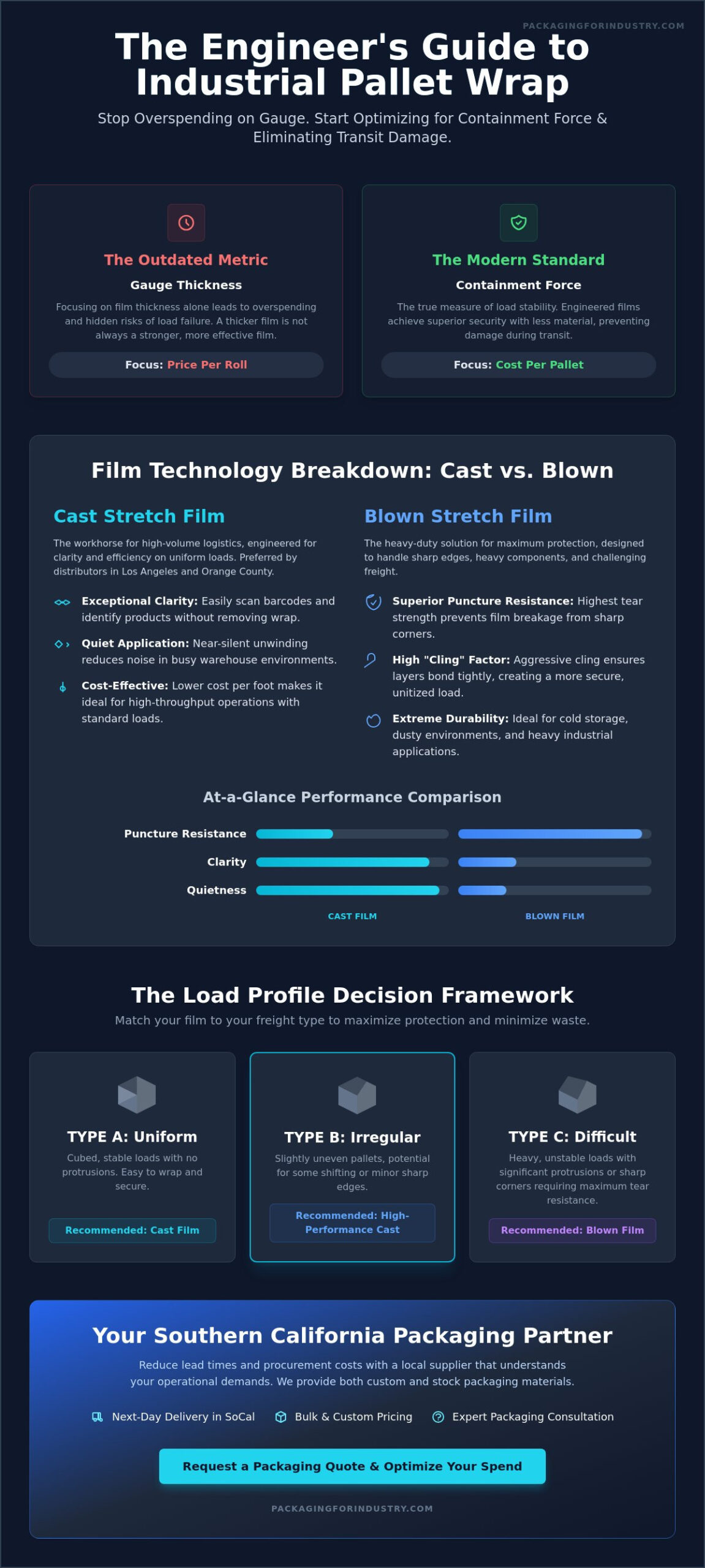
Cast stretch film is the most common choice for standard logistical needs. It is manufactured by feeding a molten polymer through a flat die and across chilled rollers. This process creates a film with exceptional clarity and a very quiet discharge from the roll. It is cost-effective for uniform loads and allows warehouse staff to easily scan barcodes through the wrap. Most high-volume distributors prefer cast film because it combines high-speed application with visual transparency.
Blown stretch film is the heavy-duty alternative. It is created by blowing a large bubble of molten resin, which is then air-cooled. This manufacturing method results in superior puncture resistance and a high degree of "cling." It is the necessary choice for irregular loads with sharp edges or heavy industrial components that might tear thinner films. While it is more expensive per roll, its durability prevents costly load failures during transit.
Blown vs. Cast Film: Which Fits Your Warehouse Environment?
Cast film is nearly silent during application, whereas blown film produces a loud, high-pitched screech. However, if you are operating in cold storage or a dusty manufacturing plant, blown film is superior. Its one-sided cling properties ensure the wrap stays secured even when surface contaminants are present. Following best practices for secure pallet wrapping often means choosing the film that maintains its integrity under your specific environmental stressors. Clarity also matters. If your inventory requires frequent visual inspection, the glass-like finish of cast film is unbeatable.
The Economic Case for Pre-Stretched Industrial Wrap
Pre-stretched film is a game changer for manual wrapping stations. This material is stretched near its breaking point during the manufacturing process, meaning the operator doesn’t need to exert as much physical force to achieve proper tension. Because it is already elongated, you use less material per pallet. A thinner pre-stretched roll can often provide the same containment force as a thicker standard roll, significantly reducing your plastic waste and per-unit cost. If you are looking to optimize your spend, you can request a packaging quote to see how a transition to pre-stretched film impacts your annual material usage.
Matching Wrap Gauge to Load Profile: A Decision Framework
Efficient load stabilization requires a technical understanding of the cargo’s physical footprint. We categorize every shipment into one of three load profiles to determine the necessary containment force and film durability. Selecting the correct gauge for your industrial pallet wrap isn’t a matter of habit; it’s a calculation of risk versus material cost. Using a 120-gauge film on a uniform load is a waste of capital, while using an 80-gauge film on a high-protrusion load is a recipe for a freight claim.
Load Profiling for Manufacturers and Distributors
Professional shippers use a standardized classification system to evaluate load stability risks:
-
Type A: These are uniform loads where the product is square or rectangular and matches the pallet dimensions exactly. With no overhang or sharp corners, these loads allow for maximum down-gauging and the lowest possible material use.
-
Type B: These loads feature staggered layers or slight overhang. The irregular surface increases the risk of punctures, requiring a film with higher tear resistance and elastic memory.
-
Type C: This profile includes sharp corners, heavy industrial parts, or irregular shapes that protrude past the pallet edge. These shipments require heavy-duty blown film and often necessitate the use of corner and edge protection to prevent the film from shearing during the first mile of transit.
Gauge vs. Performance: Breaking the ‘Thicker is Better’ Myth
The traditional belief that thicker film always equals a more secure load is outdated. Modern resin technology has fundamentally changed the gauge conversion scale. In the past, an 80-gauge (20 micron) film was the industry standard for most warehouse operations. Today, high-performance 63-gauge (16 micron) films often provide superior puncture resistance and higher containment force than their thicker predecessors. This "down-gauging" strategy allows you to use less plastic while maintaining total load integrity.
When selecting a gauge, you must match the film’s micron thickness to the total load weight. A 60-gauge film is typically sufficient for light loads under 1,600 lbs, while a 120-gauge (30 micron) application is reserved for extreme loads exceeding 3,000 lbs or those with severe Type C protrusions. Gauge selection must account for both weight and vibration during transit. A load that seems stable on the warehouse floor can easily shift under the constant micro-vibrations of a long-haul trailer if the film lacks the proper elastic recovery.
Optimizing Procurement: Hand vs. Machine Stretch Film Strategies
Deciding between manual application and automated systems is a pivotal moment for any growing warehouse. Most operations begin with hand-applied industrial pallet wrap because of its low entry cost and portability. However, as your daily volume increases, the labor costs and material waste associated with manual wrapping often exceed the capital investment of a machine. The tipping point typically occurs when a facility wraps more than 15 to 20 pallets per day. At this volume, the lack of consistency in manual application begins to impact your bottom line through increased damage and excessive film use.
When using hand film, it’s essential to manage tension correctly when securing corrugated boxes. Excessive tension can crush box corners, compromising the structural integrity of the entire stack. Conversely, insufficient tension leads to load shifting. Finding this balance manually is difficult for even the most experienced staff. To evaluate your current material efficiency and reduce operational waste, you should request a packaging quote to see how machine-grade film impacts your total spend.
Manual Wrapping Techniques for Maximum Stability
Stability starts at the base. The most common failure in manual wrapping is a weak "pallet-to-load" bond. Staff must secure the film to the pallet itself to prevent the cargo from sliding off the wooden base during sudden stops. Patterns also matter. A bottom-up approach is standard, but you should apply extra revolutions at the top and bottom to manage the center of gravity. Ergonomics are equally important. Walking backward while bent over is a primary cause of repetitive motion injuries. We recommend using lightweight rolls and ergonomic dispensers to protect your workforce while maintaining high output.
Scaling Up with Automated Pallet Wrappers
Automated wrappers provide a level of repeatable containment force that manual labor cannot match. A machine applies the exact same tension and pattern every time, eliminating human error. The most significant advantage is the pre-stretch carriage. High-performance machines can achieve pre-stretch ratios of up to 300%. This means the machine turns 1,000 feet of industrial pallet wrap on the roll into 3,000 feet of usable film on the pallet. This 3:1 yield ratio drastically reduces your material consumption and environmental footprint. Integrating these cycles into your broader industrial packaging strategy ensures total supply chain visibility and consistent protection for every shipment leaving your dock.
Sourcing Industrial Pallet Wrap in Southern California
Packaging For Industry (PFI) serves as a technical partner for high-volume shippers who require more than just a commodity supplier. Based in Anaheim, we provide localized expertise and immediate inventory access to manufacturers throughout Los Angeles, Orange County, and San Diego. Sourcing your industrial pallet wrap from a local partner eliminates the logistical volatility and high freight costs associated with long-distance shipping. Because film pallets are heavy and dense, reducing the distance between the warehouse and your loading dock directly improves your operational margin.
Our proximity to major Southern California industrial hubs allows us to offer next-day delivery on most stock materials. This capability is essential for businesses managing tight production schedules where a stock-out can halt the entire supply chain. While our local presence is a core strength, we also leverage a robust logistics network to support nationwide shipping for multi-site industrial operations. This ensures that your facility in Riverside receives the same engineered film and pricing structure as your satellite locations across the country.
Why Local Inventory Matters for JIT Operations
Lead time anxiety is a primary driver of overstocking, which ties up valuable capital and warehouse floor space. We help Southern California manufacturers implement Just-In-Time (JIT) delivery strategies to reduce their inventory footprint. By utilizing PFI’s Anaheim facility as your primary stock point, you can maintain leaner operations without risking shipping delays. For example, some of our partners in Irvine have successfully lowered their total procurement costs by transitioning to a local Vendor Managed Inventory (VMI) model. This system ensures that industrial pallet wrap is always available exactly when the production line requires it, moving the burden of inventory management from your team to ours.
Request a Custom Packaging Quote and Prototyping
Every specialized sector, from aerospace to medical electronics, has unique stabilization requirements that standard off-the-shelf films cannot always meet. We offer a free prototyping service to ensure your film selection provides the necessary containment force without damaging sensitive components. This is especially critical when your load includes custom foam packaging or specialized crates that require specific puncture resistance and cling properties. Our team analyzes your load profile and transit conditions to engineer a solution that balances protection with material efficiency.
If you are ready to optimize your warehouse procurement and ensure compliance with California’s evolving packaging regulations, the first step is a technical consultation. You can request a packaging quote to compare bulk packaging pricing and explore our custom size availability. Whether you need mil-spec materials or high-performance machine film, we provide the direct support and technical data required to stabilize your shipments and your bottom line.
Stabilize Your Supply Chain with Engineered Load Containment
Optimizing your warehouse procurement requires a shift from viewing industrial pallet wrap as a simple commodity to treating it as a precision-engineered component of your logistics strategy. By matching specific film gauges to your unique load profiles and leveraging high-performance resins, you can significantly reduce material waste while eliminating the risk of transit damage. The right selection doesn’t just protect your cargo; it protects your bottom line by lowering the total cost-per-pallet wrapped.
Packaging For Industry (PFI) provides the technical expertise and local inventory needed to maintain a reliable supply chain in Southern California. Our Anaheim specialists offer local next-day delivery across Los Angeles and Orange County, alongside free packaging prototyping and fit testing to ensure your loads are secured for the most demanding environments. We specialize in aerospace and military-spec logistics, providing the documentation and precision required for high-stakes shipping operations.
Take the next step in improving your operational efficiency. Request a Bulk Pallet Wrap Quote from our Anaheim Specialists today and secure your shipments with confidence.
Frequently Asked Questions
What is the difference between hand stretch film and machine stretch film?
Hand stretch film is designed for manual application with lightweight rolls, while machine film is engineered for automated equipment. Machine rolls are significantly heavier and can achieve pre-stretch ratios up to 300%. This allows a machine to maximize your industrial pallet wrap yield, whereas hand application relies on the physical strength of the operator. Choosing the right format depends on your daily pallet volume and available warehouse space.
How do I determine the correct gauge of pallet wrap for my load weight?
You determine the correct gauge by matching the total load weight and profile to the film’s micron thickness. For uniform loads under 1,600 lbs, a 60-gauge high-performance film is often sufficient. Heavier shipments exceeding 3,000 lbs or those with sharp protrusions require 100-gauge to 120-gauge blown films. Modern resin technology allows for down-gauging, so a thinner, high-performance film may provide more containment force than a traditional, thicker product.
Can industrial stretch wrap be recycled in Southern California?
Yes, industrial stretch wrap is made from Linear Low-Density Polyethylene (LLDPE) and is fully recyclable in Southern California. Most regional recycling centers in Los Angeles and Orange County accept clean, dry film. Under California’s SB 54 regulations, businesses are encouraged to implement better reporting and source reduction strategies. We recommend collecting used film in dedicated bins to prevent contamination and ensure it remains a high-value material for secondary plastic markets.
Is pre-stretched film actually stronger than standard stretch wrap?
Pre-stretched film provides equivalent containment force to standard wrap while using significantly less material. It’s manufactured by elongating the film nearly to its breaking point before it is wound onto the roll. This means the operator doesn’t need to pull as hard to achieve a tight bond. While it’s thinner, its elastic memory keeps the load secure. It’s an ideal solution for reducing material costs on uniform Type A loads.
How many layers of wrap are typically required for a standard pallet?
A standard pallet typically requires three to five revolutions at the base and two to three layers throughout the rest of the load. The base layers are critical for creating a secure pallet-to-load bond that prevents sliding during transit. If you’re shipping irregular or heavy loads, you may need additional layers to achieve the necessary containment force. Testing your wrap pattern ensures you use the minimum amount of film required for safety.
What happens if I use too much tension when wrapping corrugated boxes?
Applying excessive tension to corrugated boxes causes corner crushing and structural failure of the packaging. This damage reduces the vertical stacking strength of the boxes, which can lead to a collapsed pallet in a crowded trailer. To prevent this, warehouse staff should use the appropriate wrap tension for the box weight or integrate corner and edge protection. These accessories distribute the pressure of the industrial pallet wrap evenly across the load’s edges.
Does PFI offer next-day delivery for stretch film in Orange County?
Yes, PFI provides local next-day delivery for stock stretch film and other packaging materials throughout Orange County and the greater Southern California area. Our Anaheim facility is strategically located to support high-volume manufacturers and distributors with Just-In-Time delivery. This proximity helps you maintain lower inventory levels on-site while avoiding the high freight costs associated with out-of-state suppliers. Contact us to confirm availability for your specific roll sizes and quantities.
What is the shelf life of industrial-grade stretch film?
Industrial-grade stretch film typically has a shelf life of approximately 12 months when stored in a cool, dry environment. Over time, the chemical additives that provide the "cling" property can degrade, especially if the rolls are exposed to direct sunlight or extreme temperature fluctuations. To maintain peak performance, we recommend rotating your stock using a first-in, first-out (FIFO) system. This ensures the film retains its full elastic memory and puncture resistance during application.