
An industrial paper core does more than hold a roll together: it supports wound materials and can carry printed information. Manufacturers can specify dimensions and wall thickness to suit the roll, while printing can help identify the material or product.
That support matters when a roll must stay stable during winding, handling, storage, or transport. Paper and printing operations use cores for kraft paper, tissue, and printing substrates; textile producers use them to carry yarn. Film, tape, label, carpet, and flooring operations also rely on cores suited to their rolls.
This article explains how paper tubes differ from winding cores, how cores support rolled materials, and what affects core selection. It also covers printing and recycling to help manufacturers in Orange County, Los Angeles, and San Diego assess where paper cores fit into packaging and production.
Key Takeaways
- Match core dimensions, wall construction, and cut length to the roll and the demands of your winding or handling process.
- Paper and printing, textiles, film, tape, labels, carpet, and flooring are among the industries that use cores to support rolled materials.
- Printing can add identification or branding, while the core’s structure helps maintain support as material is wound, stored, and moved.
- Recycling depends on the core’s material and condition; dimensions, wall thickness, branding, and construction are useful design considerations.
- Core pricing depends on the specifications and order requirements. Packaging For Industry can also support related needs with foam packaging, stretch film, VMI, and JIT packaging inventory management.
Industrial Paper Core Products
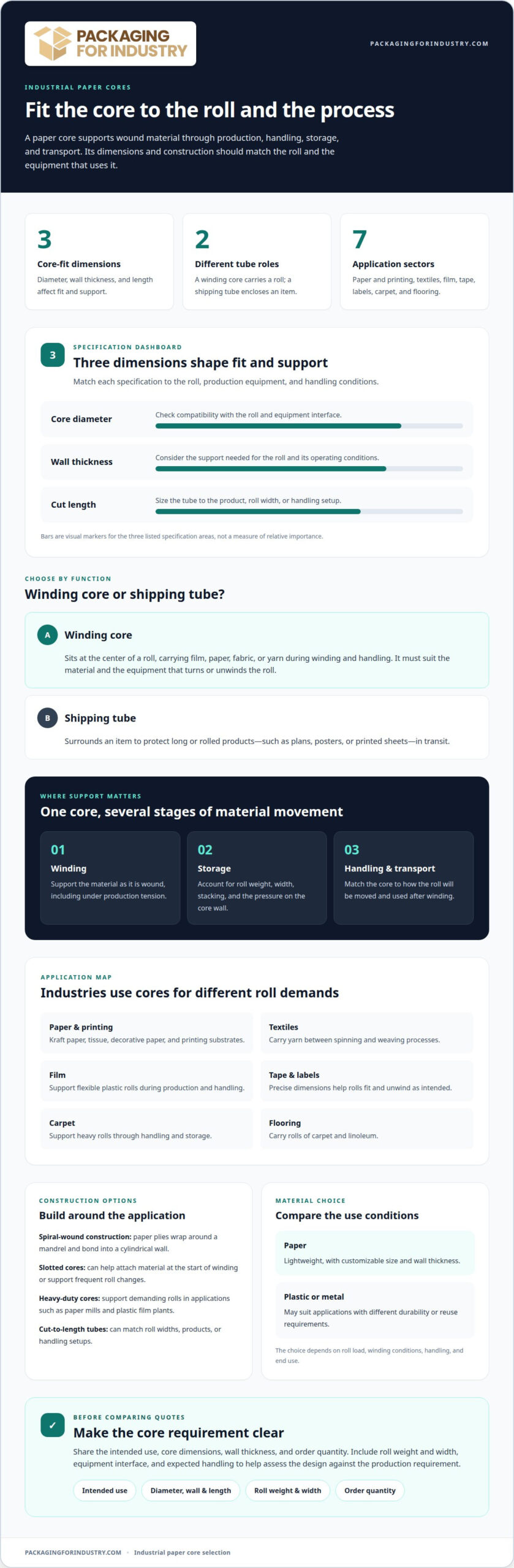
Manufacturers use paper tubes for two distinct purposes: supporting wound materials and enclosing products for shipment. A winding core sits at the center of a roll, carrying film, paper, or fabric during winding and handling. A shipping tube surrounds an item instead, protecting long or rolled products such as plans, posters, or printed sheets in transit.
Winding cores must suit both the material and the equipment that turns or unwinds the roll. A film line, for example, needs a core that supports the roll under winding tension, while a textile operation may use cores to carry yarn between production steps. Core diameter, wall thickness, and length affect fit and support, so match them to the roll and process.
Some paper tubes serve specialized manufacturing tasks rather than ordinary shipping. Paper blasting tubes are used in mining as components associated with blasting operations. Their purpose differs from that of a shipping tube or winding core: they are designed for an industrial application, not simply to protect a long item in transit. Requirements depend on the intended use and operating conditions.
Cut-to-length tubes let manufacturers match tube length to a product, roll, or handling setup. A converting operation can specify lengths for different roll widths, while a packaging line can use tubes sized to enclose long products. Standardizing lengths around products and equipment can also simplify storage and feeding through production.
Paper tubes and cores can also be engineered around material movement. A slotted core, for example, can help operators attach material at the start of winding or change rolls in high-speed applications. Heavy-duty cores support demanding rolls in paper mills and plastic film plants. Custom dimensions and wall thicknesses shape fit and load support.
Compared with plastic and metal, paper cores are lightweight and customizable in size and wall thickness. Plastic or metal may suit applications with different durability or reuse requirements. The right choice depends on the roll’s load, winding conditions, handling, and end use, not material alone.
For manufacturers in Orange County and Los Angeles, core specifications help make supplier quotes comparable. Identify the intended use, dimensions, wall thickness, and order quantity before reviewing bulk packaging pricing or comparing a custom packaging quote. These details clarify whether a quoted tube meets the production requirement. Paper tubes and cores can be tailored around material, equipment, and handling needs.
Industries Served
Spiral-wound construction suits manufacturers that need tubes with consistent dimensions and controlled performance. Paper plies wrap around a mandrel at an angle and bond into a cylindrical wall. The winding pattern, paper selection, and wall thickness influence stiffness and resistance to crushing. Manufacturers can tailor this construction to different rolled products, equipment, and handling conditions.
Paper mills and printing operations use cores for kraft paper, tissue, decorative paper, and printing substrates. A core must stay round as material winds under tension, then support the roll through converting and transport. Tape and label producers also depend on precise core dimensions, because a poor fit can affect roll handling and unwinding.
Textile manufacturers use cores to carry yarn between spinning and weaving processes. Film producers wind flexible plastic onto cores that must resist deformation during production and handling. Carpet and flooring operations need support for heavy rolls of carpet and linoleum. Each application places different demands on core strength, diameter, length, and compatibility with winding equipment.
Load performance depends on how a core is loaded, stored, and used. A long roll can place pressure across the core wall, while winding tension stresses the tube during production. Stacking adds compression forces. Before selecting a design, consider the roll’s weight and width, the equipment interface, and expected handling. Slotted cores can also suit high-speed lines that require frequent material changes.
Quality criteria and safety requirements depend on the application, equipment, and purchaser specifications. They can include consistent dimensions, suitable load performance, secure material handling, and compatibility with the winding process. A core intended for textile yarn may not suit a heavy flooring roll without a different design.
Other applications include paperboard converting, packaging production, and industrial distribution. Stackable textile cores can help organize rolled goods, while heavy-duty cores in paper mills or plastic film plants may be designed for return and reuse. Manufacturing operations benefit from matching core construction to each process, rather than treating every rolled product as the same load. That tailored approach connects material requirements with production speed, storage, and shipment conditions.
Benefits of Paper Cores for Wound Materials
A paper core provides a stable center during winding, storage, and use. It helps keep material organized as it moves between production steps. For a wide paper roll, the core supports the wound layers and gives equipment a central point for handling. That support helps the roll retain a usable shape through processing.
In printing, consistent roll shape matters as paper feeds through converting or press equipment. A core designed for the roll can help maintain roundness and even tension during unwinding. If tension varies, material may feed unevenly or become harder to handle. The core therefore works alongside the paper, press setup, and winding process.
Packaging operations also use cores to keep rolled materials manageable. Tape and label rolls rely on precisely engineered cores for winding and smooth unwinding. A tape converter, for example, can use a core sized to the roll and dispensing equipment. The right fit supports orderly handling during packaging, storage, and use on a production line.
During transport, the core supports the roll from within while the outer layers remain wound around it. Kraft paper, protective liners, and other rolled materials can be handled as a single unit rather than loose sheets. For a large paper roll, the core also gives handling equipment a stable center. Careful core selection helps limit deformation under tension or handling pressure.
Paper mills show how cores support material through multiple stages. Jumbo rolls can be mounted for conversion into smaller rolls, then wound again for downstream packaging. At each stage, the core must suit the roll and process. A mismatch can complicate mounting, unwinding, or transfer between equipment and disrupt material flow.
Core geometry can address different support needs. Round cores are common for standard rolls, while square paper cores can provide added stability for rectangular products and help reduce bending or warping. Dimensions and wall construction affect fit and support, making them important to both the converting line and the finished roll.
For a practical specification, consider the core’s full path: winding, printing or converting, packaging, storage, and transport. A precision-fit core supports consistent unwinding, while a poor fit can interfere with handling. Matching the core to the roll and equipment helps manufacturers protect material quality and keep production moving.
Recyclability and Biodegradability
Paper tubes and cores are described as recyclable and biodegradable because their main structure is paper or paperboard. Spiral construction bonds paper layers into a tube that can support rolls during use. At the end of its service, the core’s material and condition affect its next destination. A clean paperboard core differs from one carrying adhesive residue, product debris, or added materials.
For recycling, separate used cores from other packaging and keep them as clean and dry as practical. Paper mills and packaging operations may generate cores with different residues, so consider what has contacted the tube. Local recycling programs determine which materials they accept. A paper construction alone does not mean every local collection stream will take the core.
Biodegradability also depends on the material and conditions after disposal. Paper-based construction can break down over time, but coatings, adhesives, moisture, and disposal conditions affect the process. A branded shipping tube and an unprinted winding core may have different material details. Neither should be assumed to break down at the same rate in every setting.
Design choices made before production can support material efficiency. Specify the tube’s inner diameter, length, and wall thickness to match the roll or product. A core that fits the winding equipment and load avoids unnecessary material from an oversized design. For example, a narrow paper roll may need a different wall construction from a heavy carpet roll.
Branding can identify a tube without changing its core purpose. Printed markings may show a product name, handling direction, or manufacturing information. However, the print method, coating, and adhesive can affect how a recycling facility handles the material. Clear branding requirements help production teams balance identification with end-of-life handling.
Spiral-wound construction also affects a core’s performance before disposal. Paper layers bond to form a wall, and wall thickness contributes to the tube’s support. The specification should account for the roll, winding tension, storage, and transport conditions. These factors matter for paper, film, and textile applications, where a core may pass through several process stages.
For a practical review, document the core’s dimensions, wall thickness, spiral construction, and any branding or added materials. Then relate those details to the roll’s application and local recycling practices. This gives purchasing and operations teams a clearer basis for selecting paper-based cores and handling used tubes responsibly.
Industrial paper core costs in the United States
Industrial paper core prices in the United States vary by specification and order. A narrow core for a light roll needs different construction than a heavy-duty core for carpet or jumbo paper. Compare quotes using matching dimensions, load requirements, quantities, and delivery terms. Otherwise, a lower unit price may reflect a different product.
Diameter, length, and wall thickness affect both the amount of paperboard used and core performance. A longer tube or thicker wall requires a different material build from a shorter, lighter-duty core. A carpet roll and a label roll, for example, place different demands on support. Specify for the application rather than defaulting to a familiar size.
Paper grades and spiral-wound construction also influence production requirements. Core design must balance material use with the load and winding conditions. A high-speed film line may require different performance from a paper roll intended for storage. Printing, slots, or other design details can add production steps compared with a plain core.
Order quantity affects how suppliers price production and fulfillment. A standard repeat order can differ from a custom run requiring particular dimensions or specialized setup. Bulk quantities may spread production effort across more units, while smaller or varied orders can involve different handling. Compare quotes based on the same quantity and specifications.
In the United States, shipment origin, destination, handling, and order size affect freight planning. A quote for cores delivered to a Southern California facility may not compare directly with one using different delivery terms. Include the destination and packaging requirements in the purchasing comparison, along with any delivery schedule that affects receiving operations.
Prices depend on the specification and order, and are provided after a quote request. Cost factors include core dimensions, wall thickness, paper construction, printing or slots, quantity, and delivery. A clear request identifies the rolled material, winding process, and storage and transport conditions. These details help match the quoted core to its production task.
Purchasing teams can compare quotes more accurately by recording each supplier’s unit specification, quantity basis, and delivery terms. Separate custom features from standard requirements, such as branded printing versus essential dimensions. Then assess whether the construction supports the load without unnecessary material. This makes the comparison useful for budget planning and consistent manufacturing operations.
Why Choose Packaging For Industry (PFI)
Packaging For Industry (PFI) helps manufacturers address packaging and inventory needs around their production lines. If paper cores support a roll but the finished material needs added protection or a dependable packaging supply, PFI can help with related requirements. The focus is practical: protect products, manage packaging flow, and support steady operations.
For wound materials or finished goods that need cushioning during handling, PFI offers Foam Packaging. Foam can address a separate protective-packaging need, such as cushioning a component packed alongside rolled material. The right application depends on the product and how it moves through storage and shipping. This is a useful next step when core support alone does not protect the product.
Stretch Film can help secure packaged loads for warehouse handling and distribution. Operations teams can use it when unitized shipments need to stay together during movement. Pairing appropriate load securing with product packaging helps coordinate the shipping process. Packaging choices should reflect how goods are handled at the facility and in transit.
Inventory planning matters as well. With Vendor Managed Inventory (VMI) for Packaging, PFI supports businesses seeking better visibility and continuity for recurring packaging needs. Just-In-Time (JIT) Inventory Management for Packaging can align deliveries with production demand and available storage. These programs help teams coordinate packaging availability with operating requirements.
PFI can help when the challenge extends beyond selecting a core: foam protection, load securing, or packaging inventory management may also affect the production line. A conversation can cover materials, packaging consumption, storage constraints, and replenishment timing. This context helps identify which related solution fits the operational need instead of treating every facility the same.
For manufacturers in Orange County, Los Angeles, and San Diego, reliable packaging supply can support production schedules and reduce disruption from missing materials. PFI helps businesses address packaging needs practically, whether the priority is protective foam, stretch film, or managed inventory. The next step depends on the packaging task and how it connects to daily operations.
To discuss your packaging requirements and request a quote, contact Packaging For Industry (PFI).
Frequently Asked Questions
Can you print on the tubes and cores?
Yes. Printed details can help staff identify a core’s contents or intended production line without opening the roll. For a useful layout, decide what information operators need to see and where they will handle the tube. Keep the design readable on its curved surface, and distinguish product identification from branding. These choices help printing serve a clear operational purpose rather than adding markings teams will not use.
What Factors Determine the Right Wall Thickness?
Start with the core’s performance requirements and the consequences of failure in its intended process. Assess a replacement for an established line against the current core’s fit and performance. For a new application, define the required support before choosing a construction. A production trial can show whether the core works with the actual material and equipment before teams adopt the specification for repeat orders.
Why Is Cut Quality Important for Large ID Paper Cores?
Clean, consistent ends help operators handle and position large-diameter cores without catching on adjacent materials. Inspect samples for uneven edges, crushed ends, or visible separation at the cut. These defects can complicate routine handling and create inconsistent finished pieces. Specifying cut length and acceptable end condition gives manufacturing and receiving teams a shared basis for inspecting incoming cores.
How do paper cores function in packaging and protection applications?
A core can provide internal support, but it is not automatically a complete protective package. A rolled material may need a core to maintain its shape, while outer packaging handles shipment. Sensitive materials may also need a cushioned outer layer around the core to help absorb impact. Giving each packaging component a specific role helps avoid gaps or unnecessary overlap in protection.
What are some specialized industrial applications of paper core beyond winding and packaging?
Padded paper cores offer a specialized option for sensitive materials that need impact protection during transport. Their cushioned outer layer adds a protective surface around the core rather than relying on the tube’s structure alone. This may suit material that is vulnerable to contact damage. The application and handling route determine whether the added layer addresses a real protection need.
Can Large ID Cores Be Customized for Specific Equipment?
Yes. For an equipment-specific core, record the machine interface and the dimensional tolerances required for mounting and operation. Include the roll’s inside diameter and width, along with any space constraints around the equipment. If replacing an existing core, a sample can help communicate the required fit. A clear specification reduces ambiguity between purchasing, production, and the core manufacturer.
What are industrial paper cores used for?
Paper cores provide central support for rolled materials and help operators handle rolls as a unit. In a converting facility, for example, the core is part of the roll assembly moving through production and into storage or shipping. Requirements vary with the material and process, so procurement records should link each specification to its intended line or product family.
What types of industrial paper cores are available?
Available designs can include slotted, square, padded, reinforced, or returnable cores, depending on the application. A slot can support material attachment, while a square design suits products needing a different form of stability. Padded construction adds a cushioning layer, and some heavy-duty cores can be designed for return. Each feature addresses a different handling need, so specify the function rather than choosing by name alone.