
What if the tube that presents your product well also helps protect it during shipping? Custom paper tubes can be designed around the product, with choices such as wall thickness and a base-and-cap structure or sealed ends. The right configuration depends on what the tube must hold and how it will move through your operation.
It makes sense to weigh appearance and protection together. A tube used for product display may need different dimensions, printing, or finishes than packaging intended primarily for transit. Materials and construction also affect how the tube fits your product and works with your packing process.
This guide explains how paperboard and kraft materials, tube dimensions, printing, and finishing influence presentation and shipping protection. You’ll also learn what information helps a packaging professional develop a practical custom solution, and which factors to discuss when requesting a quote for your Southern California operation.
Key Takeaways
- Match tube dimensions, construction, and closure to the product and how it will be displayed or shipped.
- Compare paperboard, kraft, and other material options alongside printing and finishes to balance presentation with practical packaging needs.
- Consider how handling, storage, and shipping conditions affect the protection a tube can provide.
- Share product dimensions, intended use, and order requirements to help shape a useful custom packaging quote.
- Packaging For Industry can help manufacturers coordinate tube needs with broader packaging solutions, including foam packaging, stretch film, and custom packaging design.
Custom Paper Tube Products and Options
Custom paper tubes can be specified around product dimensions, presentation, and shipping needs. Material, construction, closures, and print choices shape the finished package.
In the United States, specialist paper-tube converters and custom packaging manufacturers with tube-forming capabilities make custom tubes. Their capabilities vary by winding method, board materials, closure, and printing process.
Recyclable Tube Packaging
Kraft paper tube packaging can suit businesses considering how packaging materials are handled at end of life. Review the tube’s paper components, coatings, and closure when assessing the complete package. A kraft exterior can also provide a natural look for coffee, cosmetics, and other packaged products. Choose materials to suit both protection requirements and presentation.
Size, Color, and Style Choices
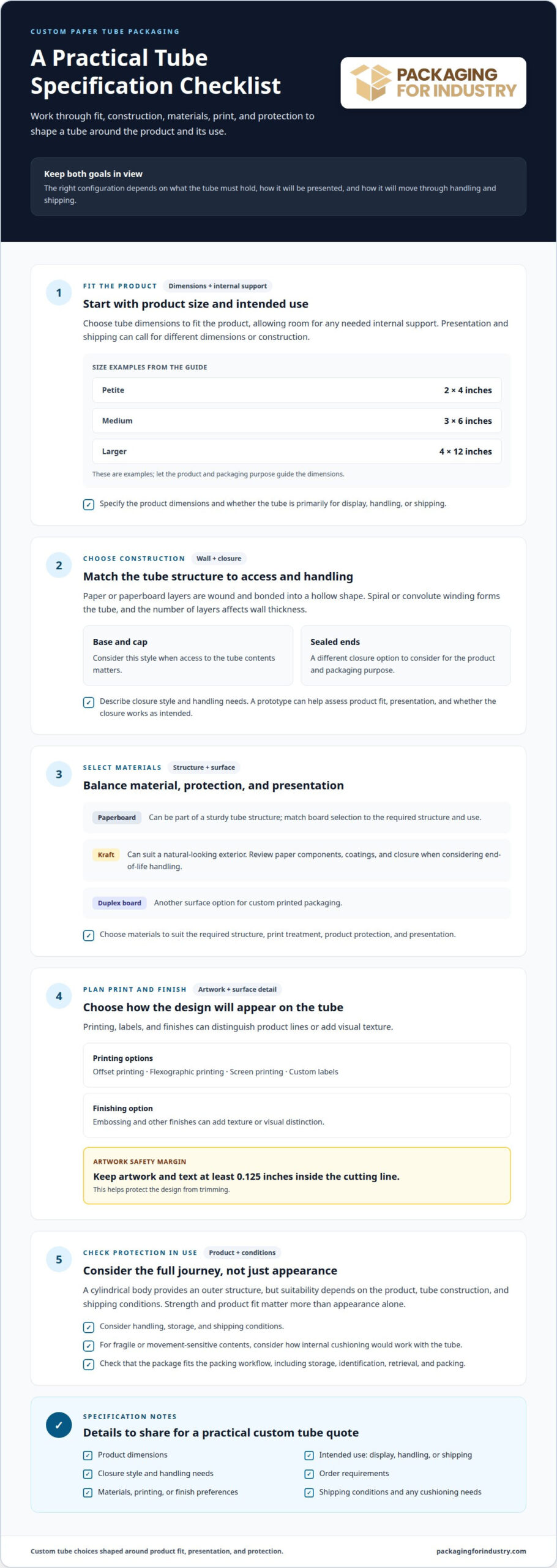
Tube dimensions should fit the product while leaving room for any needed internal support. Common examples include petite tubes at 2 x 4 inches, medium tubes at 3 x 6 inches, and larger tubes at 4 x 12 inches. Color choices and custom printing can distinguish product lines, while base-and-cap and sealed-end styles serve different access and closure needs. The product and packaging purpose should guide each choice.
Design, Structure, and Prototyping
Paper tubes are made by winding and bonding layers of paper or paperboard into a hollow shape. Spiral or convolute winding forms the tube, and the number of layers affects wall thickness. During design, specify product dimensions, closure style, and handling needs. A prototype can help assess fit and presentation before production. Check how the product sits inside and whether the closure works as intended.
Applications and Product Protection
Tube packaging can present products such as coffee or cosmetics while enclosing them during handling and shipping. The cylindrical body provides an outer structure, but suitability depends on the product, tube construction, and shipping conditions. For fragile or movement-sensitive contents, consider how internal cushioning would work with the tube. Strength and product fit matter more than appearance alone.
Printing and finishing extend the design beyond the tube’s shape. Offset printing transfers artwork from a metal plate to a rubber blanket, then onto paper. Flexographic printing uses an anilox roller to transfer ink to a plate and then the substrate. Screen printing and custom labels offer additional ways to apply branding. Embossing and other finishes can add texture or visual distinction. Keep artwork and text at least 0.125 inches inside the cutting line to protect them from trimming.
Paperboard, kraft paper, and duplex board support different packaging solutions. Paper and cardboard layers create a sturdy cardboard tube, while kraft materials suit a natural-looking exterior. Duplex board can provide another surface option for custom printed packaging. Match board selection to the required structure, print treatment, and product presentation. A sustainable material choice should also fit the product’s protection needs and the intended packaging use.
Industries Served
Packaging requirements vary among Southern California manufacturers, warehouses, distributors, fulfillment centers, and other industrial businesses. Product dimensions, handling steps, storage conditions, and shipping routes shape the plan. A paper tube may work as a product container or shipping format for some operations, while other products need corrugated boxes, cushioning, or foam.
Manufacturers and Industrial Businesses
Manufacturers often need packaging that fits a production line and protects goods moving between workstations, storage, and shipment. Aerospace, electronics, and construction suppliers handle different product forms, so packaging choices should reflect the item’s shape, fragility, and packing workflow. A long component may suit a tube format, while a sensitive electronic assembly may call for protective foam inside an outer carton. Packaging for manufacturers should support repeatable packing and dependable replenishment, not create extra handling at the line.
Warehouses and Distributors
Warehouses and distributors manage incoming stock, storage, picking, and outbound orders. Packaging must fit those steps: a tube or carton should be easy to store, identify, retrieve, and pack. Distributors may handle products from several manufacturers, resulting in multiple sizes and packaging formats in one inventory area. Clear identification and consistent pack configurations help staff choose the right package and prepare orders efficiently.
Fulfillment, Food, and Medical Operations
Fulfillment centers balance order accuracy with packing speed, while food and medical companies need packaging suited to their products and handling processes. A tube can package a suitable dry product or protect an elongated item, but it is not right for every order. Food, medical, and cosmetics businesses should align package design with product presentation and distribution needs. Outer shipping packaging may require separate protective materials.
Packaging Across Southern California
Across Los Angeles, Orange County, San Diego, and the Inland Empire, businesses coordinate packaging with production schedules, warehouse capacity, and delivery routes. A local manufacturer may use tubes for selected products and cartons for larger shipments, while a distribution center may need supplies for mixed orders. Matching packaging to the operating environment helps reduce avoidable handling problems and supports a steady flow from production through dispatch.
Packaging decisions also affect supply planning. A company using several packaging formats can coordinate designs, cushioning, and replenishment around its shipping workflow. For example, a construction supplier shipping long components may evaluate tube packaging alongside corner protection, while an electronics operation may prioritize foam and carton combinations. The right setup depends on the products each industry ships and how teams receive, store, and pack them.
Product Protection During Display and Shipping
Paper tubes, cardboard boxes, plastic tubes, and metal cans suit different packaging needs. Tubes work well for elongated or cylindrical products, while boxes accommodate varied shapes and metal cans provide a rigid container. The best format depends on product dimensions, display requirements, handling, and shipping conditions.
Custom paper tubes surround their contents with a formed outer wall and enclosed ends. Their structure can help shield suitable products from routine handling and contact during transport. Lightweight tubes are also easy to transport and stack, supporting storage and product display. The protection a tube provides depends on its construction, fit, closure, and shipping conditions.
Product shape is a practical starting point. Posters, rolled materials, and other elongated items can fit a tube more naturally than a standard carton. Smaller items may also use tubes for retail presentation if the internal space and closure suit the product. Coffee or cosmetics packaging has different considerations from industrial components, so appearance alone should not determine whether a tube is suitable.
Transit creates demands that display packaging may not face. Packages can be handled, stacked, or placed inside a larger shipping container. A tube can serve as the product’s primary package or travel inside an outer carton with cushioning. This combined approach can help limit movement around the tube when contents need additional support. The complete packing method matters, not just the tube.
Material and construction affect how the package performs. Kraft paper provides a paper-based exterior, while the number of wound layers affects wall thickness. A close product fit can limit excess movement inside the tube, but the package must still suit the item’s fragility and shipping route. Paper packaging does not automatically replace cushioning or an outer shipping package.
Production planning is another consideration. Custom paper tube orders may require a minimum of 1,000 pieces, and production takes 6 or more weeks. These requirements affect launch schedules, inventory planning, and packaging changes. Allow time for design decisions and production before a new product introduction or seasonal rollout. The schedule should account for packaging approval as well as the manufacturing run.
Production capacity depends on order volume, tube design, materials, printing, and the manufacturer’s schedule. Larger runs require coordination between production quantities and available storage. Align order plans with expected usage, warehouse space, and replenishment needs. A tube selected for one product line may not suit another, even when both products move through the same facility.
For shipping-sensitive products, design should account for the full packing sequence. A packaging professional can assess product fit, closure, and whether cushioning or an outer container is needed. Custom packaging design helps align these choices with the product and handling process. Evaluate custom paper tubes as part of the overall system, especially when other materials also protect the shipment.
Customization and Order Process
A custom tube project moves from product requirements to an approved production specification. Each decision affects fit, branding, order planning, or the manufacturing schedule.
Customization Steps
Start by defining the product’s dimensions, intended use, and packing method. Custom paper tubes can then be specified around the product, including material, closure, and print requirements. The manufacturer uses these details to prepare a design and artwork for review. A prototype can help assess fit and appearance before production. This process helps identify design changes before they affect a full production run.
Next, align the visual design with the tube format. Artwork should reflect the printable surface, closure, and branding priorities, whether the package needs a simple mark or a more detailed design. Custom paper tubes should also suit how staff pack, store, and ship the product. For example, a tube handled as part of an automated packing process may need different specifications from one packed individually.
Order Quantities and Minimums
Custom orders have a minimum order quantity of 1,000 pieces. This minimum affects launch planning, storage requirements, and how purchasing aligns packaging with product demand. A manufacturer should consider anticipated usage and available warehouse space before setting the order quantity. Planning around the minimum helps avoid committing to packaging volumes that don’t fit the operation’s needs.
Quantity planning should also account for the product schedule. A new product rollout may need packaging on hand before manufacturing or distribution starts. For an existing product line, purchasing can be aligned with usage and replenishment cycles. Because the custom minimum is 1,000 pieces, forecasting demand and storage capacity helps teams plan the order more effectively.
Turnaround Time
Production takes 6 or more weeks for custom paper tubes. Treat this as production time, and plan separately for design decisions and artwork approval. A product launch with a fixed date needs those steps scheduled early enough to accommodate manufacturing. Order volume, printing, and construction details all form part of the production plan.
Work backward from when the packaging must be ready for use. Allow time for design review, artwork approval, production, and delivery to the facility. For a seasonal rollout, coordinate packaging with the product manufacturing and distribution calendar. This helps prevent finished goods from waiting for their packaging.
Before production, the specification should capture the approved dimensions, materials, closure, and artwork. These details connect the design to the order quantity and schedule. If branding or product dimensions change after approval, production plans may need revision. Keeping purchasing, operations, and packaging requirements aligned helps limit avoidable manufacturing changes.
Why Choose Packaging For Industry (PFI)
Packaging For Industry (PFI) helps manufacturers coordinate packaging design, protection, and supply planning around their products and workflows. For a paper tube project, this can include the surrounding packaging system, such as internal cushioning, outer protection, or replenishment needs. The aim is a practical fit for handling and shipping, not a one-size-fits-all package.
Tube packaging may solve one part of the shipping challenge, while the full shipment calls for other materials. A product moving inside a tube may also need cushioning or an outer container, depending on its fragility and handling. PFI’s custom packaging design services can help businesses plan packaging around product fit, protection needs, and the steps their team uses to pack and ship.
Protection needs differ by product. A fragile item may require foam to limit movement, while a shipment already secured for transit may need stretch film to stabilize its load. PFI offers foam packaging and stretch film for broader packaging requirements. Matching materials to the product and shipping process can help reduce avoidable damage without adding packaging that serves no clear purpose.
Supply planning matters as much as package design for operations with recurring demand. PFI’s Vendor Managed Inventory (VMI) for Packaging supports packaging supply management, while Just-In-Time (JIT) Inventory Management for Packaging can align replenishment with operational needs. These approaches may suit manufacturers and warehouses managing multiple packaging materials, changing usage patterns, or limited storage space. The best fit depends on how the operation uses and replenishes supplies.
Consider PFI when a packaging change affects more than one step in the workflow. Examples include a product redesign that changes shipping protection, recurring damage that calls for a cushioning review, or replenishment that complicates warehouse planning. PFI can address these needs through custom packaging design, foam packaging, stretch film, and packaging inventory management services.
For a useful discussion, prepare the product’s dimensions, how it is packed, and where damage or handling issues occur. Include details about current cushioning, outer packaging, storage constraints, and expected usage patterns. These specifics help connect the packaging challenge to a workable design or supply approach. If a paper tube is part of the system, describe how it fits into the shipment and what protection the product still needs.
For Southern California manufacturers, distributors, and warehouses, packaging decisions affect purchasing, storage, and shipping routines. PFI can help evaluate related packaging needs and identify where design, protective materials, or inventory planning may improve the process. To discuss your packaging requirements, contact Packaging For Industry (PFI).
Frequently Asked Questions
What products are cylindrical paper packages suited to?
Tubes suit products whose shape or presentation works well with a cylindrical package. For industrial buyers, the key question is whether the package fits the product’s route through packing, storage, and shipping. Consider how the item is loaded, removed, and handled at its destination. A format that works for display may need additional outer packaging for distribution through a warehouse or fulfillment operation.
How should I compare material and construction options?
Compare the packaging specification with the product’s handling conditions and the package’s purpose. Ask the manufacturer to clarify the selected material, construction, and surface treatments in the proposal. This helps purchasing and operations teams compare equivalent designs rather than relying on a material name alone. Include the intended use in the specification so comparisons reflect actual requirements.
What dimensions and closures should I specify?
Provide product measurements and explain how the package will be loaded and opened. The fit should let the product be packed and removed without disrupting the workflow. Also consider whether staff, equipment, or customers will handle the package. Clear dimensional and access requirements help prevent a design that looks suitable in a drawing but creates friction during packing or use.
What determines the price of a custom order?
There is no single price for a custom order. Pricing depends on the project and is provided after a quote request. The proposal can reflect the design, material choices, production requirements, print treatment, and order volume. To compare pricing usefully, keep specifications consistent across alternatives. Include the intended application and required quantity so the quote addresses the same packaging need.
How should I plan order quantities and timing?
Custom production requires a minimum of 1,000 pieces and takes 6 or more weeks. Plan the order around the date packaging must be available, while allowing time for internal approvals and receiving. If a product launch depends on the package, align purchasing and production schedules early. Storage capacity and expected usage also matter, since the minimum order may exceed immediate demand.
How can I choose printing and finishing for a branded package?
Choose a print and finish to suit the artwork, desired presentation, and how the package will be handled. A restrained logo treatment may have different production needs from full-surface graphics. Share final artwork and branding priorities with the packaging manufacturer before approval. Reviewing a production-ready proof helps teams assess placement and appearance before authorizing a run, reducing the chance of avoidable changes later.
How can I assess recyclability or recycled content?
Treat recyclability, compostability, and recycled content as separate material attributes. Ask for the package’s material composition and consider every component, not just its visible paper surface. Coatings, adhesives, and closures can affect how a finished package is handled after use. For purchasing records or sustainability goals, document the specific claim that applies to the complete package rather than assuming one environmental attribute establishes another.
What U.S. requirements should product teams consider?
Requirements depend on the product, the package’s function, and whether its materials contact the contents. Packaging used only as an outer shipping layer can raise different considerations from packaging that directly holds a product. Food, cosmetics, and industrial goods may also involve different labeling and material questions. Define the intended use and product category early, then have the responsible compliance team review the applicable requirements and packaging claims.