
The true cost of your packaging isn’t found on a purchase order. It’s hidden in your waste disposal fees, rising material costs, and the high damage rates of sensitive components. As regulations like California’s SB 343 take effect in October 2026, the pressure to move away from single-use materials is mounting. Most industrial operators in Southern California recognize that traditional corrugated boxes often fail in high-volume, closed-loop systems. Finding the right reusable packaging solutions Irvine manufacturers can depend on is no longer just a sustainability goal; it’s a financial necessity.
We understand that transitioning to a reusable system feels complex, especially when you’re managing bulky assets and limited floor space. This guide will show you how custom-engineered reusable packaging reduces transit damage to zero and lowers your long-term supply chain costs. You’ll discover how to optimize your logistics through durable material selection and streamlined inventory management via VMI. We’ll look at the intersection of engineering and economics to help you build a more reliable and cost-effective operation.
Key Takeaways
- Combine durable outer shells with custom-engineered internal foam to protect high-value components throughout multiple transit cycles.
- Identify the specific reusable packaging solutions Irvine manufacturers use to eliminate vibration damage and reduce the total cost of ownership.
- Transition from single-use OpEx to strategic CapEx by calculating the long-term savings found in reduced disposal fees and lower damage rates.
- Utilize Vendor Managed Inventory (VMI) and just-in-time logistics to solve the challenge of tracking and managing reusable asset levels.
- Partner with a national supplier that offers free prototyping to validate your packaging design and ensure operational reliability before full-scale implementation.
Evaluating Industrial Reusable Packaging Solutions for Modern Logistics
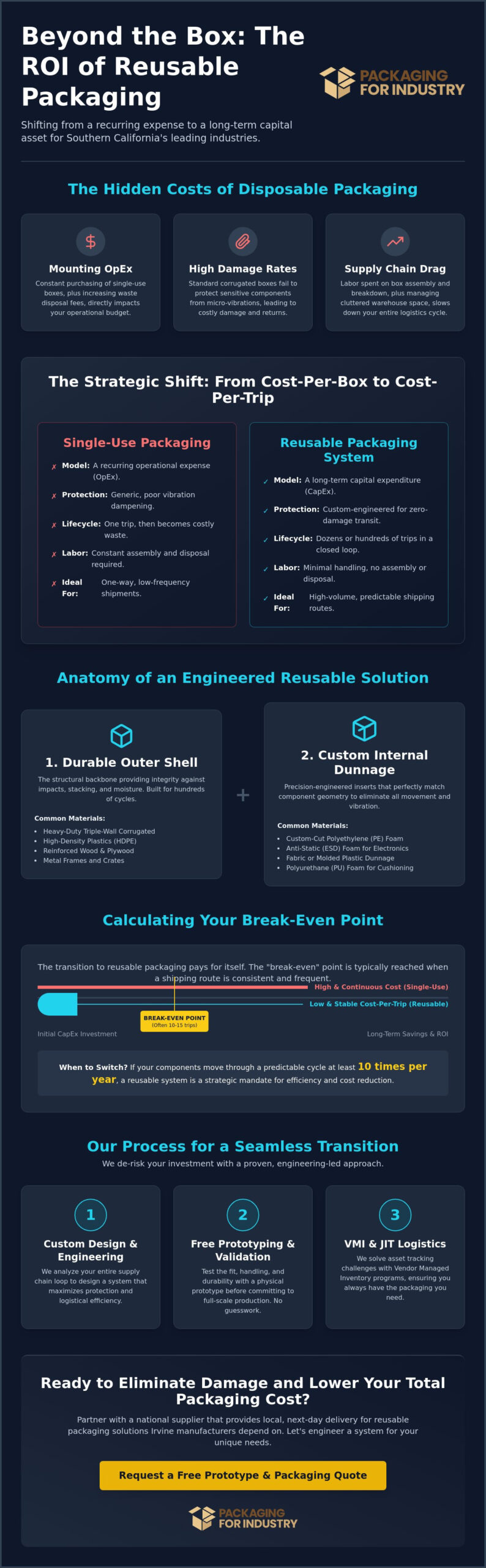
Industrial logistics requires a shift in how we view material handling. Reusable transport packaging (RTP) refers to durable containers, pallets, and protective inserts designed for multiple trips throughout a supply chain. In a high-volume industrial context, these assets aren’t just boxes; they’re engineered tools that facilitate the movement of high-value components. For companies seeking reusable packaging solutions Irvine logistics managers rely on, the focus is on creating a system where the “cost-per-trip” replaces the traditional “cost-per-box” metric.
A successful RTP system relies on two primary elements: a rugged outer shell and precision-engineered internal protection. The outer shell, often made of heavy-duty plastic or metal, provides structural integrity during handling. The internal protection, such as custom-cut foam or fabric dunnage, ensures that parts remain stationary and cushioned. This dual-layer approach is critical for sectors like aerospace, automotive, and medical manufacturing, where even minor transit vibration can lead to catastrophic component failure. Using reusable packaging effectively turns a recurring supply expense into a long-term capital asset.
The Mechanics of a Closed-Loop Supply Chain
In a closed-loop system, packaging assets circulate between a central manufacturing hub and Tier 1 suppliers or dedicated distributors. For these assets to survive dozens or even hundreds of cycles, they must be designed with returnability in mind. This means using materials that resist moisture, impact, and fatigue. Standardized sizing is also vital; it ensures that every load is optimized for palletized stabilization, reducing the risk of shifting during transit. When you request a packaging quote for these systems, we look at the entire loop to ensure the dimensions work for both outbound shipping and inbound return freight.
Single-Use vs. Reusable: When to Make the Switch
The decision to move away from single-use corrugated isn’t always immediate. The “break-even” point typically occurs when a shipping route is consistent and the frequency of trips justifies the higher initial investment. High material waste in single-use systems doesn’t just hurt the environment; it clogs warehouse floors and increases labor costs associated with assembly and disposal. When evaluating reusable packaging solutions Irvine businesses often find that the reduction in disposal labor alone justifies the initial CapEx. If your components move through a predictable cycle at least ten times per year, the transition to reusable assets becomes a strategic mandate for operational efficiency.
Engineering Custom Reusable Crates and Protective Foam Systems
When you rely on off-the-shelf containers for high-value logistics, you’re gambling with your inventory. Stock solutions rarely provide the precise tolerances required for multi-trip cycles. These gaps allow for micro-vibrations that can degrade sensitive components over long distances. Effective reusable packaging solutions Irvine manufacturers implement rely on custom design packaging that mirrors the exact geometry of the part. This precision ensures that the payload remains stationary, regardless of the handling conditions. By focusing on sustainable materials management, companies can select materials that balance durability with long-term environmental responsibility.
Longevity is the primary requirement for any reusable asset. We utilize heavy-duty triple-wall corrugated, reinforced wood, and high-density plastics to build the structural backbone of our systems. These materials don’t just protect; they survive the rigors of forklift handling and stacking in high-density warehouses. To de-risk the transition to a reusable model, we offer free prototyping. This allows your operations team to validate the component fit and handling ergonomics before you invest in a full production run.
High-Density Foam Inserts for Multi-Trip Protection
Polyethylene (PE) foam is the industry standard for reusable applications because it’s closed-cell and resistant to moisture. It’s significantly more durable than Polyurethane (PU) foam, which tends to degrade after repeated compression cycles. For manufacturers in the electronics or medical sectors, we also integrate ESD (Electrostatic Discharge) foam to protect sensitive circuits from static buildup. You can review our specific material grades on our foam packaging page to determine which density is right for your cycle counts.
Heavy-Duty Custom Crates for Heavy Industrial Equipment
For heavy machinery and large-scale industrial equipment, standard pallets aren’t enough. We engineer custom wooden or plastic crates that feature shock-absorbing bases and reinforced corners to withstand international transit. These crates are designed for easy breakdown or nesting to save space on return trips. For a deeper look at how these systems handle global shipping challenges, see our guide on engineering custom crates for international transit. If you’re ready to see how a custom-engineered system can improve your reliability, you can request a packaging quote to start the design process.
The Economics of Reusable Packaging: Calculating ROI and Long-Term Savings
Shifting to reusable packaging solutions Irvine operations depend on requires a move from an expense-based mindset to a capital investment strategy. Procurement teams often focus on the initial purchase price, or Capital Expenditure (CapEx), but the true value of a reusable system is found in the reduction of recurring Operational Expenses (OpEx). While a single-use corrugated box is cheap to buy once, the cumulative cost of purchasing thousands of units over a fiscal year quickly outpaces the one-time cost of a durable, multi-trip container.
Single-use packaging carries several “hidden costs” that often go uncalculated in standard procurement reviews. These include the labor required for box assembly, the high cost of waste disposal for tons of cardboard, and the financial impact of higher damage rates. When you invest in durable assets, packaging cost savings are realized through the drastic reduction of these replacement cycles. To find your break-even point, you must analyze the “Cost Per Trip” across the expected lifespan of the asset:
- 50 Cycles: At this stage, most high-density plastic or custom-engineered crates have paid for themselves by eliminating 50 individual corrugated purchases.
- 100 Cycles: The system begins generating a significant return on investment as the cost-per-trip drops well below the price of even the cheapest disposable alternative.
- 500 Cycles: For long-term industrial loops, the packaging cost becomes a negligible fraction of the total logistics budget, providing a permanent competitive advantage.
Reducing Transit Damage and Insurance Claims
Financial savings aren’t just about the container’s price; they’re about the protection of the payload. Superior internal engineering reduces the frequency of Return Merchandise Authorizations (RMAs) and the administrative burden of processing insurance claims. Beyond the direct costs, there’s the “soft cost” of brand reputation. Delivering a damaged component to a Tier 1 aerospace or automotive partner can damage customer trust more than it hurts the bottom line. Engineered reusability eliminates the disposable mindset that leads to careless handling and transit damage.
Tax Incentives and Sustainability Credits
Many organizations now operate under strict corporate sustainability goals that prioritize waste reduction. Moving to a reusable system significantly lowers warehouse waste management costs and can help your facility meet local environmental compliance standards. These high-quality assets also retain their value over time, serving as a functional part of your inventory rather than a consumable expense. By partnering with a local reusable packaging solutions Irvine provider, you also reduce the carbon footprint associated with shipping bulky packaging materials long distances.
Strategic Implementation: VMI and Just-In-Time Logistics for Reusable Assets
The primary objection to adopting high-value assets is the fear of loss. If you can’t track your containers, your ROI disappears. We solve this by integrating Vendor Managed Inventory (VMI) into your workflow. Instead of your team manually counting pallets or crates, we take accountability for the stock levels. This ensures that reusable packaging solutions Irvine manufacturers deploy stay in circulation without creating an administrative burden. By utilizing tracking technology like RFID or advanced inventory software, we provide real-world visibility into your asset pool.
Streamlining Procurement with Packaging Kitting
We often recommend packaging kitting to maximize the efficiency of reusable systems. In this model, we pre-assemble your durable containers with their custom foam inserts and any necessary labels or accessories before they arrive at your dock. This reduces the labor required on your assembly line. Your workers don’t have to hunt for the right insert or spend time fitting components together. Kitting reduces the footprint of materials on your floor and ensures that every part of the packaging system is ready for immediate use. It creates a seamless synergy between the container and the component it protects.
Managing Asset Retrieval and Reconditioning
A successful loop requires a disciplined retrieval strategy. You need a clear process for getting empty containers back from your Tier 1 suppliers or customers. We help you establish inspection protocols to identify worn or damaged assets before they go back into the field. While these materials are durable, they aren’t indestructible. Regular reconditioning, such as cleaning or replacing foam inserts, extends the life of the outer shell. When an asset finally reaches the end of its functional life, it should be retired and recycled to maintain the integrity of your fleet. If you’re ready to modernize your inventory management and reduce logistical friction, request a packaging quote to see how our VMI and JIT services can support your operations.
Partnering with a National Packaging Manufacturer for Custom Engineering
Our approach centers on de-risking your transition to a reusable model. We provide free prototyping to ensure every component fits perfectly and every crate handles correctly before you commit to a full production run. By serving as a single source for both custom-engineered crates and stock industrial supplies like stretch film or edge protectors, we simplify your procurement process. This holistic oversight ensures that your protective systems are integrated, durable, and cost-effective from the first trip to the five-hundredth.
Southern California Expertise with Nationwide Reach
We provide a unique advantage for manufacturers located in Southern California. Our local presence allows for next-day delivery across Orange County, Los Angeles, San Diego, and Riverside, ensuring your production line never stalls due to material shortages. While we offer the responsiveness of a local partner, we maintain the infrastructure to support national distribution networks. Whether you’re shipping components across town or managing a closed-loop system across the country, we have the capacity to scale your solutions. You can reach out to our team via our contact us page to schedule a personalized consultation for your facility.
Requesting a Custom Packaging Quote
Our consultative process begins with a thorough audit of your shipping environment. To provide an accurate engineering quote, we look at several critical data points, including part dimensions, component weight, and your projected annual trip counts. We move from the initial design phase through prototyping and testing, ensuring the final rollout meets your specific durability requirements. This methodical approach eliminates the guesswork from your logistics budget. To begin optimizing your supply chain and reducing your total cost of ownership, request a packaging quote today. We’ll help you build a more reliable, sustainable, and profitable industrial operation with reusable packaging solutions Irvine businesses trust.
Modernizing Your Industrial Logistics Strategy
Transitioning to a reusable system is a strategic investment that pays dividends through increased reliability and lower total cost of ownership. By moving away from the disposable mindset, you’ll eliminate transit damage for high-value components and streamline your warehouse operations. Implementing reusable packaging solutions Irvine manufacturers rely on ensures that your logistics move as efficiently as your production line.
We provide specialized expertise in aerospace and military packaging to ensure your most sensitive assets remain protected through every transit cycle. Our team offers free prototyping for custom designs, allowing you to validate every crate and foam insert before full-scale implementation. With local next-day delivery in Southern California, we remain a responsive partner for your day-to-day operational needs. We don’t just sell boxes; we engineer systems that protect your bottom line.
Request a custom packaging quote today to optimize your supply chain. We’re ready to help you build a more durable and cost-effective logistics framework.
Frequently Asked Questions
How many trips can I expect from a high-quality reusable crate?
High-quality plastic or custom wooden crates typically survive between 50 and 100 trips in a standard industrial loop. Some heavy-duty plastic assets can even reach 500 cycles if they’re managed in a controlled environment. The actual lifespan depends heavily on handling conditions and your reconditioning schedule. Regularly replacing worn foam inserts or repairing small structural issues can extend the functional life of the outer shell significantly.
What is the typical ROI timeframe when switching to reusable packaging solutions?
Most industrial operations realize a full return on investment within 12 to 18 months. If your facility manages high-frequency daily shipments in a tight closed loop, the break-even point often occurs much faster. We help you move from recurring single-use expenses to a one-time capital investment by analyzing your specific cycle counts and disposal costs. This transition stabilizes your long-term logistics budget and eliminates material price volatility.
Can reusable packaging be customized for sensitive aerospace or medical equipment?
Precision customization is essential for protecting sensitive components from vibration and impact damage during transit. We engineer precision-cut foam inserts and utilize ESD-safe materials specifically for the aerospace and medical sectors. These reusable packaging solutions Irvine manufacturers depend on are built to meet strict industry tolerances. We focus on creating a perfect fit that prevents micro-movements, which are the leading cause of damage in high-value electronics and medical devices.
How does Vendor Managed Inventory (VMI) work with returnable packaging?
VMI allows our team to monitor your asset pool and manage the replenishment of your reusable containers automatically. We track the movement of crates through your system to ensure you always have enough shipping materials for your production schedule. This service removes the administrative burden from your procurement team and prevents production bottlenecks. It’s a proactive approach that ensures your capital assets are always where they need to be.
What happens if a reusable asset is lost or damaged in transit?
We recommend establishing a replacement fund to account for an industry-standard loss rate of approximately 5% to 10% per year. While the materials we use are industrial-grade, they’re still susceptible to forklift accidents or logistical errors. We provide clear inspection protocols to help your team identify when an asset needs repair or retirement. Having a small buffer stock of reusable packaging solutions Irvine assets ensures your operations continue without interruption.
Is reusable packaging more expensive to ship due to increased weight?
Reusable containers are heavier than single-use corrugated, but the freight cost is often offset by improved pallet density and a total lack of transit damage. Modern high-density plastics provide extreme durability without adding unnecessary weight to your shipments. Our goal is to lower the total cost of ownership (TCO) across the entire supply chain. Often, the savings from reduced damage and lower waste disposal fees far outweigh any minor increase in freight weight.
How do I handle the storage of empty reusable containers?
We design many of our reusable crates and containers to be either collapsible or nestable when they’re empty. This design feature can reduce the storage footprint in your warehouse by up to 70% compared to rigid, non-collapsible containers. For high-volume operations with limited space, our JIT delivery services ensure that empty assets are retrieved or replaced exactly when you need the floor space. This keeps your facility lean and organized.
What materials are best for long-term industrial reusable packaging?
High-density polyethylene (HDPE) and triple-wall corrugated are the preferred materials for long-term industrial durability. For internal protection, we often use cross-linked polyethylene foam because it resists moisture and maintains its shape after repeated compression cycles. The specific material choice depends on your trip requirements and the fragility of your components. We select materials that balance structural integrity with the economic realities of your specific shipping loop.