
How much is it costing you to store air inside empty corrugated boxes while Southern California industrial real estate prices continue to climb? For manufacturers in Los Angeles, Orange County, and the Inland Empire, every square foot of warehouse floor space occupied by excess inventory is a square foot that isn’t generating revenue. Partnering with a bulk packaging supplier that provides a just-in-time packaging supply for lean manufacturing SoCal operations isn’t just about convenience; it’s a financial necessity. If you have been searching for an industrial packaging supplier near me to help navigate 2026’s regulatory and logistical pressures, the goal is to transform your warehouse from a storage center into a production powerhouse.
We understand that your primary focus is keeping production lines moving without the constant threat of a packaging stockout. This guide will demonstrate how to transition from a “just-in-case” inventory model to a lean, scheduled delivery system that frees up capital and floor space. You’ll discover how local logistics can manage long-lead custom items like foam inserts and heavy-duty boxes, ensuring your materials arrive exactly when they’re needed for assembly. We’ll explore the economic benefits of reclaiming your warehouse floor for production equipment while maintaining a seamless, reliable supply chain.
Key Takeaways
- Reclaim valuable warehouse floor space for production equipment by eliminating months of excess corrugated and foam inventory.
- Learn how a reliable just-in-time packaging supply for lean manufacturing SoCal strategy minimizes inventory waste and improves cash flow by aligning deliveries with actual usage.
- Overcome the logistical challenges of managing long-lead custom items like protective foam packaging and engineered crates through local, scheduled replenishment cycles.
- Mitigate the financial impact of the WAIRE program (Rule 2305) by optimizing your facility’s footprint and reducing the storage of bulky packaging materials.
- Establish precise replenishment triggers using min/max inventory levels to ensure production continuity and eliminate the need for expensive emergency orders.
The ‘Warehouse Tax’: Why SoCal Manufacturers Are Moving to Just-In-Time Packaging
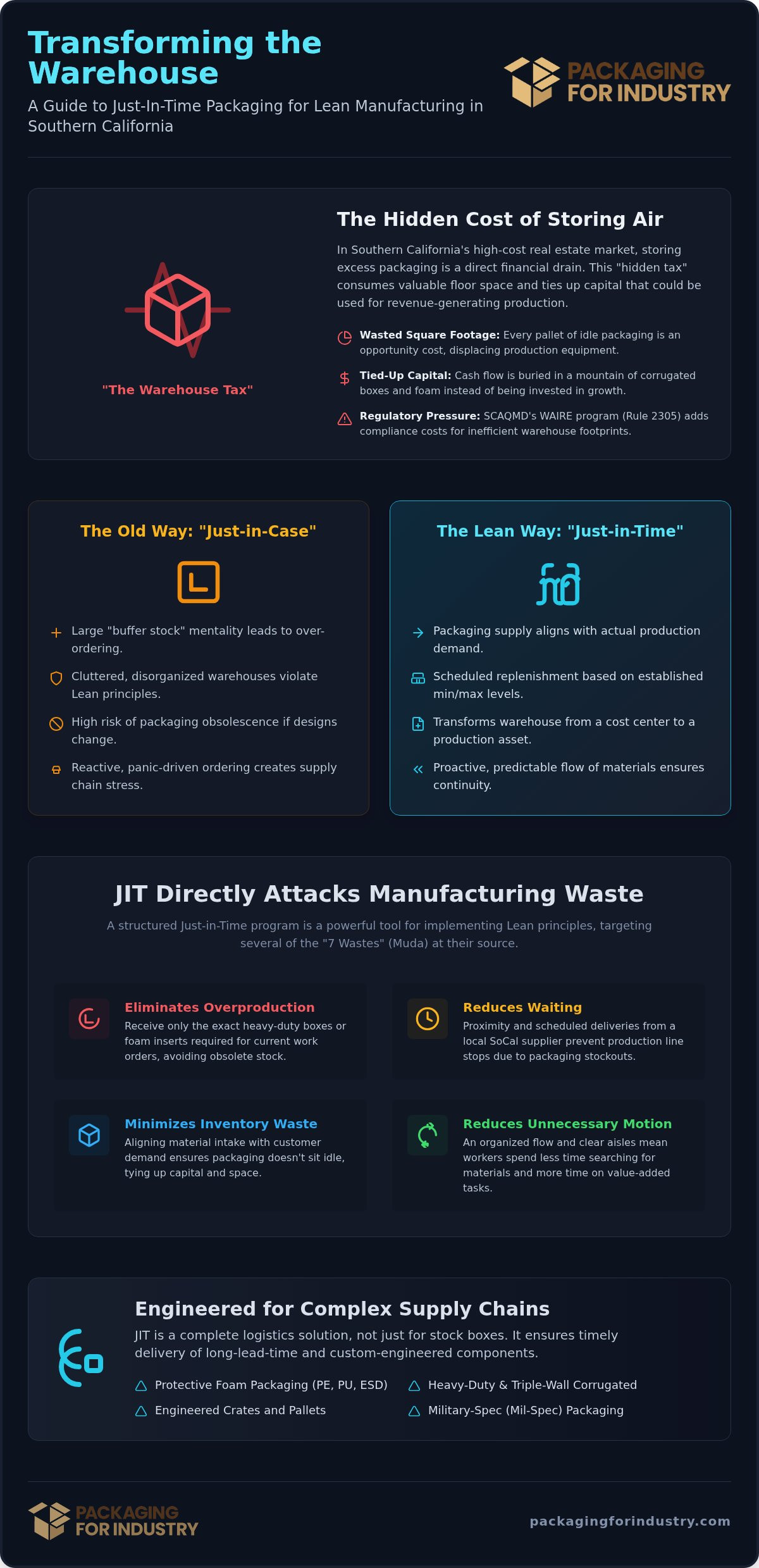
The term “Warehouse Tax” isn’t just a metaphor in Southern California. In 2026, manufacturers in Los Angeles, Anaheim, and Irvine face some of the highest industrial real estate costs in the country. When you fill your facility with months of bulky corrugated boxes or protective foam packaging, you’re paying a premium to store air. A just-in-time packaging supply for lean manufacturing SoCal strategy flips this model by ensuring materials arrive exactly as your production line requires them. This approach eliminates the “hidden tax” of tied-up capital and wasted square footage that could be used for revenue-generating machinery. The South Coast Air Quality Management District (SCAQMD) Rule 2305, known as the WAIRE program, has added another layer of complexity. With mitigation fees set at $1,000 per point for non-compliance as of 2026, optimizing your warehouse footprint is no longer optional.
The Cost of Wasted Square Footage in Orange County and LA
Every pallet of packaging sitting in your warehouse represents an opportunity cost. In the competitive markets of Orange County and LA, floor space is a finite resource that should be dedicated to assembly lines and finished goods, not raw packaging materials. Industrial supply chains in 2026 define just-in-time as a logistical synchronization where packaging components reach the point of use only when production demand triggers a replenishment. By partnering with an Anaheim based supplier, you reduce transit times and the risk of shipping delays. This proximity allows for smaller, more frequent deliveries that keep your aisles clear. Beyond the physical space, long term storage increases the risk of obsolescence. If a customer changes a specification, those thousands of custom boxes in your rack become expensive scrap.
Eliminating the ‘Buffer Stock’ Mentality
Traditional purchasing often relies on a “buffer stock” mentality to prevent stockouts. While this feels safe, it creates a cluttered environment that violates core Lean manufacturing principles by introducing unnecessary inventory waste. Over-ordering leads to disorganized warehouses and production delays when workers can’t find the right materials. Transitioning to a just-in-time packaging supply for lean manufacturing SoCal requires a psychological shift from owning inventory to managing flow. It’s about moving from reactive, panic-driven ordering to a proactive replenishment system. Instead of checking your stock levels and hoping you have enough for the next shift, you rely on a predictable schedule and established min/max levels. This shift reduces the stress on your procurement team and ensures that your cash flow isn’t buried in a mountain of double-wall corrugated.
How JIT Packaging Supply Supports Lean Manufacturing Principles
Lean manufacturing is built on the aggressive elimination of waste. In a warehouse environment, inventory is often the most visible form of muda, or non-value-added activity. Implementing a just-in-time packaging supply for lean manufacturing SoCal facilities allows operations to align their material intake with actual customer demand. This synchronization ensures that packaging doesn’t sit idle on racks, taking up space and tying up capital. By focusing on flow rather than bulk storage, manufacturers can maintain a more responsive and organized shipping department.
Mapping JIT to the 7 Wastes of Lean
A structured JIT program directly targets several of the classic “7 Wastes” identified in lean methodologies. When you optimize your packaging supply chain, you address these inefficiencies at the source:
- Overproduction: JIT ensures you only receive the specific heavy-duty corrugated boxes or foam inserts required for current work orders. You won’t find yourself with thousands of obsolete containers if a product design changes.
- Waiting: Production stops when packaging runs out. Local proximity in the Inland Empire or Orange County eliminates downtime caused by waiting for freight carriers traveling from out-of-state.
- Motion: Warehouse staff spend significant time moving bulk pallets of empty boxes to clear floor space. Reducing on-hand inventory minimizes unnecessary forklift travel and labor.
Enhancing Operational Agility
Modern industrial operations must remain agile to survive market volatility. According to the EPA, JIT and lean manufacturing methods focus on producing only what’s needed, when it’s needed, and in the amount needed. This level of precision is achieved by leveraging Vendor Managed Inventory (VMI) to automate the replenishment process. When your packaging supplier takes responsibility for monitoring stock levels, your team can focus on production rather than procurement logistics.
This streamlined approach also supports 5S organizations by keeping the shipping area clean and free of clutter. Visual management becomes simpler when inventory levels are low enough to monitor at a glance. Instead of searching through towering stacks of pallets, your team can see exactly what’s available for the day’s shipments. Integrating packaging reviews into your daily stand-up or Kaizen process ensures that logistics remain a core part of your continuous improvement efforts. You can request a packaging quote to see how a structured replenishment plan can streamline your specific workflow and improve your bottom line.
Engineering Custom JIT Solutions: Beyond Standard Corrugated Boxes
Most JIT programs encounter friction when they move beyond stock items. While scheduling a pallet of standard RSCs is straightforward, managing a just-in-time packaging supply for lean manufacturing SoCal becomes complex when your products require custom-engineered crates or protective foam packaging. These specialized components typically involve longer lead times and multi-stage manufacturing processes that don’t always align with rapid replenishment cycles. PFI bridges this gap by integrating the engineering phase directly with our inventory management system. We use precision prototyping to verify fit and function before a full rollout, ensuring that your custom packaging is production-ready from the first delivery.
The strategic implications of just-in-time go beyond simple space savings; it’s a risk mitigation strategy. By consolidating multi-material solutions, such as custom corrugated boxes, foam inserts, and specialized mailing tubes for technical components, into a single delivery, we eliminate the logistical headache of tracking separate arrivals. This integrated approach ensures that every element of your packaging system reaches your facility simultaneously. You don’t have to worry about having boxes but no inserts, or foam but no tape. It’s a comprehensive system designed to maintain the flow of your assembly line without the burden of excess inventory.
Custom Foam and Mil-Spec Requirements
The SoCal aerospace and defense sector requires a level of precision that standard packaging providers often struggle to meet. For these operations, JIT is essential for maintaining material compliance. Storing specialized ESD or anti-static foam for extended periods can lead to material degradation or non-compliance with strict military specifications. Our JIT program ensures you receive fresh, compliant materials that meet your exact engineering tolerances. Our in-house CAD/CAM support facilitates rapid adjustments to packaging designs, which allows your supply chain to adapt to engineering changes without leaving you with thousands of obsolete custom inserts.
Integrated Kitting for Manufacturing Lines
Efficiency often stalls when shipping teams have to gather multiple packaging components from different warehouse locations. Implementing packaging kitting delivered just-in-time solves this by providing a single SKU that contains everything required for a specific unit. This process drastically reduces the part count your procurement team has to manage. A medical device manufacturer in San Diego, for instance, significantly reduced assembly time by receiving pre-assembled kits that included custom-cut PE foam and heavy-duty double-wall boxes. This transition allowed them to reclaim floor space previously dedicated to kitting operations and redirect that labor toward their core manufacturing goals.
The Financial Impact: Measuring ROI on JIT Packaging Programs
ROI in industrial packaging isn’t just about the price per box; it’s about capital liquidity and operational throughput. When you compare packaging pricing across different vendors, it’s easy to focus solely on the unit cost of a thousand RSCs. However, the real savings appear when you evaluate a just-in-time packaging supply for lean manufacturing SoCal strategy. Paying for materials as they are consumed keeps capital in your bank account instead of letting it sit on a pallet rack for six months. This model also eliminates the “emergency order tax” that occurs when manufacturers spend thousands on overnight freight because they didn’t realize they were out of custom foam or double-wall corrugated. JIT replenishment triggers prevent these panics and the associated shipping surcharges.
Hard Cost vs. Soft Cost Savings
Hard costs are easy to track on a balance sheet. These include storage fees, insurance premiums for on-hand inventory, and the inevitable material waste when boxes are crushed or become obsolete during long-term storage. Soft costs are more insidious but equally damaging to your margins. Your procurement team spends hours every week auditing stock, chasing down lead times, and managing administrative overhead. PFI serves as a cost-saving alternative to large catalog suppliers by removing these burdens. Redirecting warehouse staff from managing empty packaging inventory to revenue-generating production tasks provides an immediate boost to your operational efficiency.
Analyzing the ‘Total Cost of Ownership’ (TCO)
Many buyers focus solely on unit price, but a lower price for 5,000 boxes is often a financial trap. When you factor in the labor required to move and organize bulk shipments, the Total Cost of Ownership (TCO) for bulk storage often exceeds JIT. Additionally, a just-in-time packaging supply for lean manufacturing SoCal allows for optimized box sizing. Smaller, more frequent deliveries mean you can use exactly the right size for your current product revisions without worrying about using up old stock. This reduces freight costs and minimizes shipping damage through better-fitting protection, which in turn reduces the financial drain of returns and replacements. We can help you identify these hidden expenses to find your true packaging spend.
Implementing JIT Packaging with PFI: Your SoCal Logistics Partner
Transitioning to a structured replenishment program requires a methodical approach that balances your production needs with your available footprint. We begin every partnership with the PFI Discovery Process. This involves a comprehensive audit of your material consumption patterns, lead times for custom items like protective foam packaging, and current warehouse layout. We don’t rely on guesswork. We analyze your historical data to understand peak seasons and assembly speeds. This allows us to calculate the precise science behind your replenishment triggers. By setting accurate min/max levels, we ensure your just-in-time packaging supply for lean manufacturing SoCal operations remains uninterrupted without the burden of excess safety stock.
Local next-day delivery serves as the logistical backbone for our clients in Anaheim, Los Angeles, and the Inland Empire. Our proximity to these major manufacturing hubs allows us to act as a proactive “fixer” for your space constraints. We don’t just drop off pallets; we synchronize our delivery schedules to match your specific production shifts. As your demand fluctuates, we perform ongoing optimization reviews to adjust your inventory levels. This ensures your program adapts to new product launches or engineering changes without bloating your warehouse with obsolete heavy-duty corrugated boxes or stretch film. Our goal is to maintain the purposeful speed of a well-oiled supply chain that supports your bottom line.
Transitioning from Bulk to JIT
Moving away from a bulk-buying model doesn’t have to disrupt your current production workflow. We help you phase out existing inventory strategically to prevent waste. While you consume your remaining stock, we establish the initial VMI review cycle. This phase includes setting up clear communication protocols between your floor managers and our logistics team. Whether your facility requires weekly or bi-weekly reviews, we ensure the hand-off is seamless. This shift replaces the traditional, reactive cycle of manual counts and emergency reorders with a predictable, automated flow of materials.
Why PFI for Southern California Lean Teams?
PFI is uniquely positioned to support Southern California lean teams because we understand the regional landscape. Our headquarters in Anaheim provides us with a strategic advantage in serving Los Angeles and Riverside counties. We also bring deep engineering expertise to solve common shipping challenges that impact your margins. For instance, we frequently help manufacturers avoid expensive UPS or FedEx surcharges by designing custom-sized corrugated containers that maximize protection while minimizing dimensional weight. This focus on the intersection of engineering and economics makes us a dependable partner for long-term operational stability. We take total accountability for your packaging logistics so your team can focus on manufacturing excellence.
Request a custom JIT packaging quote today
Reclaim Your Warehouse Floor and Optimize Your Cash Flow
Transitioning from bulk storage to a lean, scheduled replenishment model solves the regional “warehouse tax” while improving operational agility. You’ve seen how managing custom-engineered foam and heavy-duty corrugated boxes through a local partner eliminates inventory waste and prevents production line stoppages. Implementing a just-in-time packaging supply for lean manufacturing SoCal allows your procurement team to shift focus from manual stock counts to strategic growth and production excellence.
PFI serves as a seasoned industrial consultant for high-stakes sectors, specializing in custom aerospace and medical packaging solutions. We provide a free packaging cost-reduction analysis to identify hidden inefficiencies in your current total cost of ownership. With local next-day delivery across Los Angeles, Orange County, and the Inland Empire, we provide the steady and dependable support required for modern manufacturing. Our team is ready to help you engineer a more resilient and cost-effective supply chain today.
Your facility deserves a logistics partner that values precision and fiscal responsibility as much as you do. We look forward to helping you streamline your Southern California operations.
Frequently Asked Questions
What is the difference between JIT and VMI in packaging?
Just-In-Time (JIT) refers to the delivery strategy where materials arrive exactly when your production line requires them. Vendor Managed Inventory (VMI) is the broader service model where your supplier monitors your stock levels and triggers those replenishments automatically. While JIT focuses on the timing of the delivery, VMI focuses on the accountability of inventory management. Combining both creates a seamless system that removes the administrative burden from your procurement team.
How does JIT packaging reduce warehouse costs in Southern California?
Implementing a just-in-time packaging supply for lean manufacturing SoCal facilities reduces costs by reclaiming expensive floor space. Instead of storing bulky pallets of empty corrugated boxes, you use that square footage for revenue-generating production equipment. This also helps mitigate costs associated with the South Coast AQMD Rule 2305. You reduce the physical footprint of your inventory and the associated logistical overhead of managing massive, infrequent bulk shipments.
Can custom-sized boxes be included in a just-in-time program?
Yes, custom-sized corrugated boxes and engineered foam inserts are primary candidates for JIT programs. We manage the longer lead times of custom manufacturing on our end, holding the finished stock in our Anaheim facility for scheduled delivery to yours. This ensures you get the exact protection your product needs without the storage burden. Custom prototyping is included to verify that your specific dimensions are production-ready before the program begins.
What happens if my production schedule suddenly increases?
Our system utilizes established min/max inventory levels to absorb sudden demand spikes. Because we’re a local Southern California supplier, we can trigger an additional delivery outside of your normal schedule to prevent a production stoppage. We maintain a safety buffer of your specific custom items at our headquarters. This proximity allows for a level of responsiveness that out-of-state catalog suppliers simply cannot match during peak production cycles.
Is there a minimum order volume required for JIT packaging supply?
Minimum order requirements are typically determined by your annual consumption and the complexity of your custom items. We focus on mid-to-large scale manufacturing operations where the volume of corrugated and foam inventory creates a significant space or cash-flow challenge. During our discovery process, we’ll audit your usage to ensure the program provides a clear ROI. We aim to build long-term partnerships rather than fulfilling one-off transactions.
How does local SoCal delivery improve my supply chain reliability?
Local delivery eliminates the volatility of long-haul freight and national carrier delays. Our own fleet provides next-day delivery throughout Los Angeles, Orange County, and the Inland Empire. This proximity ensures that your just-in-time packaging supply for lean manufacturing SoCal stays on schedule regardless of national supply chain disruptions. Shorter transit times also reduce the risk of shipping damage to your raw packaging materials before they even reach your floor.
Will JIT packaging help me comply with California environmental regulations?
JIT packaging supports compliance with the WAIRE program (SCAQMD Rule 2305) by optimizing warehouse operations and reducing total truck traffic associated with inefficient bulk ordering. By receiving only what you need, you also minimize material waste and the energy consumption required to manage a larger facility. This lean approach aligns with 2026 sustainability standards that prioritize resource efficiency and the reduction of industrial emissions within the South Coast basin.
How do I start a lean packaging assessment for my facility?
You can begin by requesting a comprehensive packaging audit from our engineering and logistics team. We’ll visit your facility to evaluate your current storage footprint, material usage patterns, and shipping damage rates. From there, we provide a detailed proposal outlining the transition from bulk purchasing to a scheduled replenishment model. This assessment identifies specific hard and soft cost savings to ensure the program meets your fiscal and operational goals.