
Are you still paying your carriers to ship California air? In 2026, with USPS joining UPS and FedEx in using the 139 dimensional weight divisor, shipping oversized boxes has become an expensive mistake for any manufacturer. Optimizing your packaging design to minimize dimensional weight charges from California is no longer a secondary warehouse goal; it’s a critical financial necessity for staying competitive in the Southern California market.
We understand the frustration of seeing unpredictable freight surcharges eat into your margins, especially when those costs stem from wasted space and excessive void fill. You shouldn’t have to choose between product safety and shipping efficiency. This guide outlines the specific engineering strategies we use to right-size your industrial packaging, helping you slash freight costs while reducing material waste. We’ll examine the latest carrier rounding rules, custom corrugated solutions, and how to navigate California’s evolving SB 54 regulations without sacrificing your bottom line.
Key Takeaways
- Understand how the 2026 industry-wide shift to a 139 dimensional weight divisor across UPS, FedEx, and USPS impacts your total freight spend.
- Learn how professional packaging design to minimize dimensional weight charges from California replaces oversized stock boxes with precision-engineered, custom corrugated solutions.
- Discover the financial benefits of using custom foam inserts to provide superior product protection while significantly reducing the cubic footprint of your shipping containers.
- Implement a structured 30-day shipping audit to identify “air-heavy” packages and consolidate your inventory into a few optimized, right-sized box dimensions.
- Leverage local expertise and next-day delivery from an Anaheim-based supplier to ensure your logistics strategy remains compliant with California’s evolving SB 54 regulations.
The 2026 DIM Weight Crisis: Why California Manufacturers are Paying More
For manufacturers in Anaheim and Los Angeles, the logistics landscape shifted significantly on July 12, 2026. This date marked the final alignment of major domestic carriers, as the USPS lowered its dimensional weight divisor to 139. With UPS and FedEx already operating at this threshold, every major shipping channel now penalizes volume over mass. If you rely on stock boxes from national catalogs, you’re likely paying a “hidden tax” on every shipment. These standard sizes rarely align with industrial components, forcing you to pay for the empty space between your product and the corrugated wall.
The “California Factor” compounds these costs. High-volume hubs like the Port of Los Angeles and the Anaheim distribution corridors are under immense pressure. Carriers use aggressive DIM weight pricing to maximize truck capacity in these congested zones. For a local manufacturer, poor packaging design to minimize dimensional weight charges from California doesn’t just increase freight bills; it also strains warehouse efficiency in high-rent areas like Orange County, where storing oversized, air-filled boxes wastes valuable floor space.
Calculating Your Billable Weight Threshold
Carriers determine your freight cost by comparing actual weight to the DIM weight, then billing for the higher of the two. The standard formula is (Length x Width x Height) / 139. If you ship a five-pound component in a 12x12x12 box, you aren’t paying for five pounds. You’re paying for 13 pounds. Identifying where your shipments “cube out” before they “weigh out” is the first step toward recovery. The DIM Factor is the primary driver of 2026 logistics inflation, and ignoring it means accepting a permanent increase in your operational overhead.
The Hidden Costs of ‘Shipping Air’ in Industrial Logistics
The impact of oversized packaging extends far beyond parcel shipping. In the LTL (Less-Than-Truckload) sector, “shipping air” can move your cargo into a higher freight class, significantly increasing the rate per hundredweight. Additionally, every inch of unnecessary void fill represents a triple loss. You pay for the material, such as bubble wrap or peanuts; you pay the carrier to move that material; and you pay for the warehouse labor required to pack it.
In regions like the Inland Empire, where logistics speed is paramount, using custom corrugated boxes engineered for your specific product dimensions is the only way to protect your margins. Our team at PFI helps warehouse managers transition away from bulky, inefficient stock packaging toward precision-fit solutions that lower billable weight immediately.
Engineering Structural Efficiency: Right-Sizing Your Corrugated Boxes
Standard Regular Slotted Cartons (RSC) are the traditional workhorses of the shipping department, but they are often the primary cause of inflated logistics budgets. Because these boxes are manufactured in fixed, stock sizes, they rarely align with the exact dimensions of industrial components. This mismatch leaves internal gaps that must be packed with expensive void fill. By transitioning to custom die-cut designs, you can achieve a precision fit that fundamentally lowers your actual shipping costs by eliminating the volume that carriers now penalize.
Engineering a better box is about more than just reducing size. It involves a strategic look at how your products are oriented and protected within the container. Custom partitions and dividers play a vital role here. They allow you to consolidate multi-part shipments into a single, high-density package. This approach is far more cost-effective than shipping several smaller, air-heavy boxes that each trigger their own minimum DIM weight charges.
Custom Die-Cut Solutions for Precision Fit
Die-cut boxes offer significantly tighter manufacturing tolerances than standard slotted containers, often holding dimensions within 1/8th of an inch. This level of accuracy is essential for packaging design to minimize dimensional weight charges from California. When you reduce the exterior footprint by even a fraction of an inch, you can frequently drop your shipment into a lower carrier pricing tier. Our custom corrugated boxes are engineered to wrap tightly around your product, removing the “slop” that leads to box bulging and carrier re-measurements at the hub.
Material Selection: Strength vs. Volumetric Efficiency
Optimizing for DIM weight does not mean you have to compromise on structural integrity. The key lies in selecting the appropriate flute profile for your specific application. For many industrial parts, high-strength B-flute or C-flute provides excellent compression strength without the excessive wall thickness of larger flutes. For heavier loads, double-wall or triple-wall corrugated provides the necessary stacking strength for long-haul transit.
Strategic use of corner and edge protection can also allow for thinner box walls. By reinforcing the points of highest stress, you can maintain a high safety factor while keeping the outer dimensions as lean as possible. This is particularly effective for California manufacturers shipping to the East Coast, where weather-resistant corrugated helps prevent box softening during climate shifts. If you are ready to evaluate your current box sizes, you can request a quote to see how an engineered design fits your specific needs.
Custom Foam Inserts: Protecting Products While Shedding Cubic Inches
While corrugated redesign provides the structural foundation for your shipping strategy, the internal cushioning often dictates the final volume of the box. Traditional void fill materials like bubble wrap, air pillows, or packing peanuts are inherently inefficient. They require oversized containers to be effective. Transitioning to engineered custom foam inserts allows you to secure your products with high-performance materials that take up significantly less space. This precision is a cornerstone of packaging design to minimize dimensional weight charges from California. It enables the use of smaller outer containers that avoid the heavy penalties of the 2026 carrier divisor shifts.
We utilize various densities of Polyethylene (PE) and Polyurethane (PU) to achieve the ideal balance between protection and volumetric efficiency. For many industrial applications, foam end caps are the most effective solution. Instead of wrapping an entire component in bulky layers, end caps suspend the item securely within the box. This technique minimizes the exterior footprint of the package. In addition, our packaging kitting services allow you to organize multiple components into a single, compact foam assembly. This consolidation reduces the number of individual shipments; it is a direct way to lower your total billable weight.
Engineering the ‘Perfect Fit’ with CAD Prototyping
Precision is the primary defense against inflated shipping costs. Our team uses CAD/CAM support to design foam inserts that mirror the exact geometry of your product. This eliminates internal movement during transit, which is the leading cause of product damage. To ensure your new design meets both safety and cost goals, we provide free prototyping services. This allows your operations team to verify the exact DIM weight savings and fit before moving into mass production. If you are searching for an industrial packaging supplier near me in the Anaheim or Los Angeles area, our local engineering support can help you transition from “stock and stuff” methods to precision-engineered protection.
ESD and Anti-Static Foam for Electronics and Aerospace
Specialized sectors require packaging that meets strict technical requirements without ballooning the logistics budget. Our ESD and anti-static foam solutions are designed to meet aerospace packaging standards while remaining optimized for freight costs. By integrating ESD protection directly into the foam insert, we remove the need for extra shielding layers that often require larger boxes. Combining these custom inserts with our heavy-duty corrugated results in a complete, DIM-optimized solution. It protects sensitive electronics while keeping your shipping profile as lean as possible. This hybrid approach is essential for manufacturers in Orange County and the Inland Empire who need to maintain high safety standards while managing the rising costs of 2026 logistics.
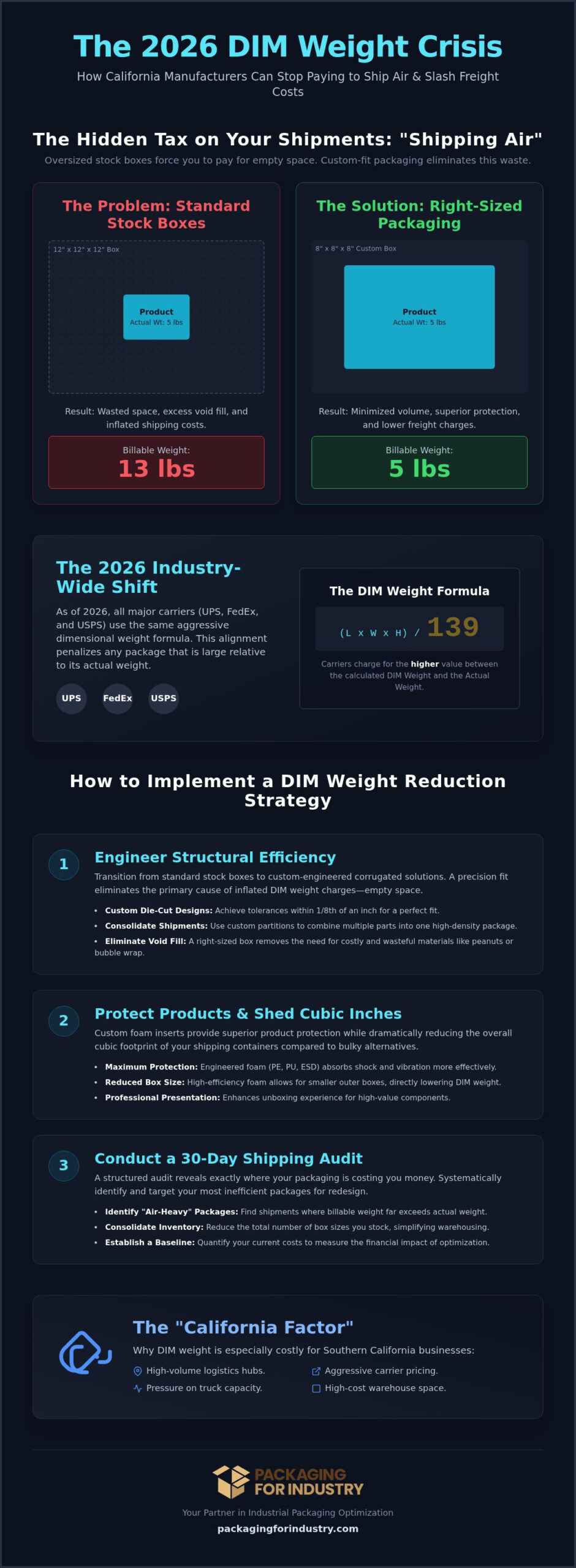
How to Implement a DIM Weight Reduction Strategy: A 5-Step Guide
Transitioning from reactive shipping to proactive packaging design to minimize dimensional weight charges from California requires a methodical approach. It isn’t enough to simply buy smaller boxes; you need a strategy that balances protection with carrier pricing thresholds. By following a structured reduction plan, you can transform your packaging from a cost center into a competitive advantage.
Step 1: The Volumetric Audit
Start by reviewing your shipping data from the last 30 days. Identify your top 10 most shipped SKUs and compare their actual scale weight to their billable weight. This process exposes the “DIM Factor” for each shipment, pinpointing the biggest cost offenders in your current lineup. You can calculate your potential savings by taking your current box dimensions, multiplying the length by the width by the height, and dividing by 139 to see exactly where your billable weight exceeds the actual mass.
Once you’ve identified the offenders, group your products by their physical dimensions to see where overlap exists. Instead of stocking dozens of standard box sizes from a catalog, aim to standardize on 3 to 5 optimized custom box sizes. This consolidation simplifies warehouse operations and ensures that every package follows a packaging design to minimize dimensional weight charges from California. Reducing the variety of boxes on your floor also improves picking speed and reduces the likelihood of a packer choosing an oversized container.
Step 3: Prototyping and Freight Simulation
After grouping your items, consult with a professional packaging manufacturer for a structural redesign. This stage involves creating physical prototypes that you can use for freight simulation. By using a custom quote and prototype, you can see the physical footprint reduction in real time. Simulate shipping costs with the new dimensions using your current carrier rates to quantify the savings before you commit to a bulk order by visiting our request a quote page for a free design review.
Before final approval, test these prototypes against ASTM standards to ensure product safety hasn’t been sacrificed for size. It’s vital to confirm that a smaller box still provides the necessary compression strength for stacking in a carrier’s hub. Integrate these optimized designs into your Vendor Managed Inventory (VMI) program. This proactive management ensures you always have the right-sized packaging on hand for your production lines, preventing the use of oversized stock boxes that trigger high freight costs.
Why Southern California Manufacturers Choose PFI for Logistics Optimization
Manufacturers in Anaheim and Los Angeles face unique logistics pressures that national suppliers often overlook. In a region where warehouse space is at a premium and carrier hubs are constantly congested, your choice of partner directly impacts your operational stability. We function as more than just a bulk packaging supplier; we act as a seasoned industrial consultant and a proactive problem-solver. Our packaging design to minimize dimensional weight charges from California focuses on the intersection of engineering and economics. We ensure that every shipment is as lean and cost-effective as possible.
Reliability is the foundation of our service model. We provide local next-day delivery across Southern California, including Orange County, San Diego, Riverside, and the Inland Empire. This proximity allows us to support high-volume manufacturing and warehouse operations with a level of responsiveness that generic fulfillment centers cannot match. When your production line is moving, you don’t have time to wait for a shipment from a distant warehouse. Our team ensures you have the right-sized materials exactly when you need them.
Beyond the Box: Integrated Industrial Solutions
We take a holistic approach to protection by combining custom crates, protective foam, and heavy-duty corrugated materials into a single, high-performance system. This integrated strategy is particularly effective for heavy-duty industrial needs where standard packaging fails. By utilizing our just-in-time inventory services, you can free up valuable floor space in your facility while maintaining a steady supply of optimized packaging. We offer a pragmatic, cost-saving alternative to massive catalog distributors. We provide custom-tailored responses that address your specific billable weight challenges without the overhead of “one-size-fits-all” options.
Get a Custom Packaging Quote Today
It’s time to stop paying for air and start reclaiming your freight margins. Our Anaheim headquarters serves as a local hub for Southern California support. We provide you with direct access to our engineering team for design reviews and prototyping. We invite you to compare your current packaging pricing against a precision-engineered solution designed for the 2026 carrier environment. Whether you need to lower your billable weight or reduce shipping damage, our team is ready to help you optimize your supply chain. Contact the PFI engineering team today to request a custom packaging quote and take the first step toward total logistical optimization.
Take Control of Your 2026 Logistics Overhead
The 2026 carrier shift to a 139 divisor is a permanent change that demands a structural response. Relying on oversized stock containers isn’t just inefficient; it’s a drain on your operational budget. By investing in packaging design to minimize dimensional weight charges from California, you turn your shipping department into a center for efficiency. Precision-engineered corrugated and foam solutions provide the protection your products need without the “air tax” imposed by major freight carriers.
Our Anaheim-based engineering team specializes in Aerospace and Defense standards, providing a detailed cost-reduction analysis with every project. We offer local next-day delivery to keep your production lines moving without delay. You have the tools to engineer your way out of these surcharges and regain control over your logistics spend. It’s time to stop paying for volume you don’t use.
We’re ready to help you streamline your operations and eliminate wasted freight spend today.
Frequently Asked Questions
What is the dimensional weight divisor for 2026?
The industry-standard dimensional weight divisor for 2026 is 139 across all major domestic parcel carriers, including UPS, FedEx, and USPS. This recent harmonization means that the cost advantage previously associated with shipping lightweight, bulky items through the postal service has effectively ended. Shippers must now optimize every cubic inch of volume to avoid paying for excess air in their containers.
How do I calculate dimensional weight for my industrial shipments?
To calculate dimensional weight, you must multiply the package’s length, width, and height and then divide the total by 139. Carriers now round each dimension up to the nearest whole inch before performing this calculation. If the resulting dimensional weight is higher than the actual scale weight, you’ll be billed for the volume rather than the mass of the shipment.
Can custom packaging really lower my freight costs from California?
Yes, precision-engineered packaging design to minimize dimensional weight charges from California is one of the most effective ways to lower logistics overhead. By replacing oversized stock boxes with custom-sized corrugated containers, you reduce the exterior footprint that carriers use to determine billable weight. This is especially critical for manufacturers in high-volume hubs like Anaheim and Los Angeles where regional surcharges compound volumetric costs.
What is ‘right-sizing’ in industrial packaging design?
Right-sizing refers to the engineering process of designing a shipping container that fits the product’s exact dimensions with minimal internal void space. This strategy eliminates the need for excessive cushioning materials while ensuring the box remains within the smallest possible carrier pricing tier. It’s a pragmatic approach that reduces both material waste and the cumulative cost of shipping unneeded volume across your supply chain.
How do custom foam inserts help reduce dimensional weight?
Custom foam inserts allow you to secure industrial components within smaller outer boxes by providing superior protection compared to bulky bubble wrap or peanuts. Using engineered foam end caps or kitted inserts suspends the product securely, which prevents damage while significantly shedding cubic inches from the final package dimensions. This hybrid approach is a key component of packaging design to minimize dimensional weight charges from California.
Does PFI provide free prototypes for custom packaging designs?
PFI provides free prototyping services for custom packaging designs to ensure a precision fit before you commit to mass production. This allows your operations team to verify both the physical protection levels and the projected dimensional weight savings. Our CAD/CAM support ensures that every prototype matches your product geometry exactly, giving you peace of mind that your new packaging will perform in the field.
What industries benefit most from DIM weight optimization?
Specialized sectors like aerospace, electronics, medical device manufacturing, and high-value automotive parts benefit most from DIM weight optimization. These industries often ship lightweight but complex components that are prone to damage in oversized, poorly fitted boxes. Implementing a custom strategy helps these companies maintain strict protection standards while successfully navigating the 2026 carrier divisor shifts and rising freight rates.
How quickly can PFI deliver custom boxes in Orange County?
As an Anaheim-based supplier, PFI offers local next-day delivery across Orange County and the surrounding Southern California regions. Our proximity to major manufacturing hubs allows us to support just-in-time inventory needs and Vendor Managed Inventory (VMI) programs. This ensures your warehouse never runs out of the right-sized materials required to keep your production lines moving and your shipping costs low.