
The quickest packing improvement may be a better-fitting box, not a faster packing line. Custom packaging to reduce pack time starts with right-sized boxes that need less filler, inserts that hold products in place, and workflows that keep materials accessible. For warehouse teams in Orange County, Los Angeles, and San Diego, these choices can help reduce handling while protecting orders from damage and shipping delays.
When orders are backing up, faster packing matters, but packaging choices can create extra work at every station. The right box and insert make packing more consistent, while a workflow review can uncover repeated steps or misplaced materials. This guide explains how to assess box fit, select protective inserts, and improve fulfillment tasks without compromising product protection.
Key Takeaways
- Review box fit against the product to spot excess space, unnecessary materials, and avoidable packing steps.
- Use inserts and void fillers to secure products and reduce the need for packers to improvise protection.
- Map the packing workflow to find repeated handling, misplaced supplies, and bottlenecks that slow fulfillment.
- For e-commerce orders, consider packaging designs that make product placement, protection, and order identification more consistent.
- Match packaging choices to both shipping protection and packing speed so efficiency improvements don’t create new damage risks.
1. Right-sized packaging and shipping efficiency
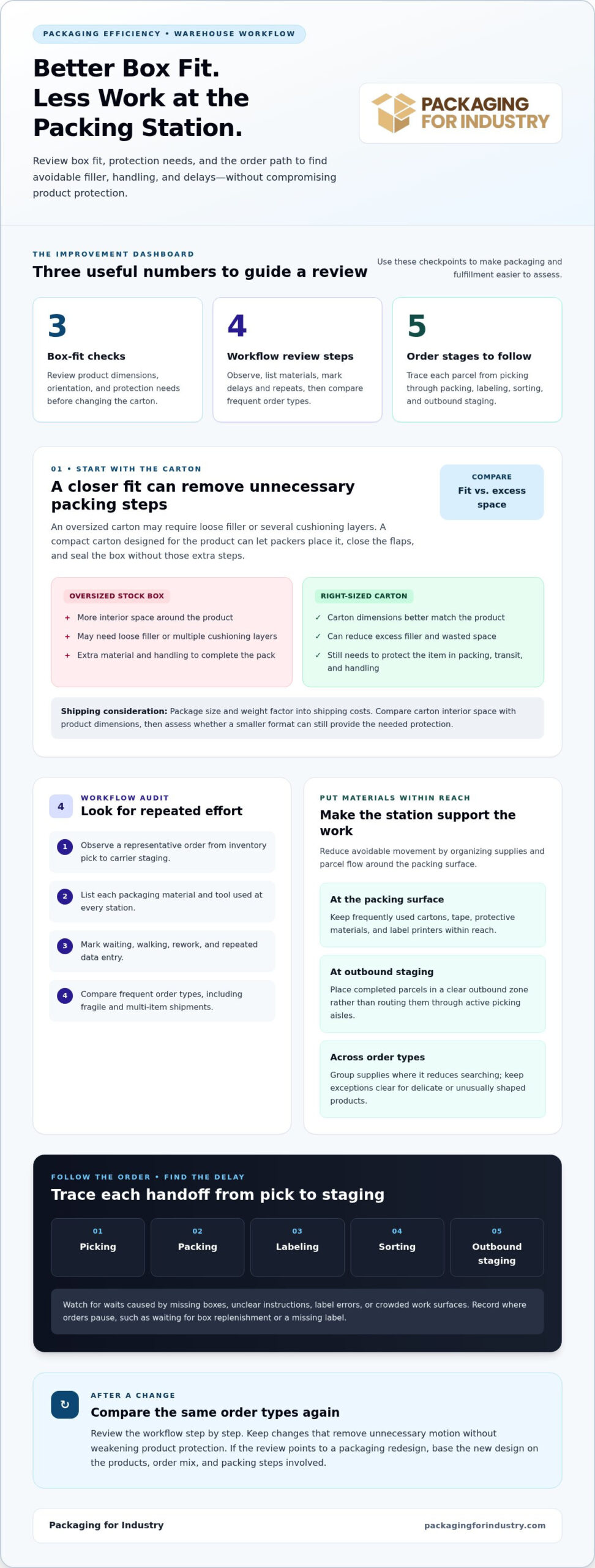
A right-sized box can shorten packing by eliminating steps that oversized cartons create. Packers can place the product, close the flaps, and seal the carton without adding loose filler or trimming excess material. For example, a compact carton designed for a machine component can reduce handling compared with a large stock box that needs several cushioning layers. Before changing the packaging design, review the product’s dimensions, orientation, and protection needs.
In the United States, requirements for special packaging are codified at 16 CFR part 1700, according to the U.S. Consumer Product Safety Commission. Shipping requirements also depend on the product and its destination, so packaging should suit the item’s protection needs and the conditions it may encounter in transit.
Right-sizing can affect shipping costs as well as packing time. Package size and weight factor into shipping costs, so reducing either can improve shipping efficiency. Compare the carton’s interior space with the product’s dimensions, then assess whether a smaller format can still protect it. A closer fit can also reduce excess material and wasted space in storage or transit.
Recycled and recyclable shipping boxes can support material-use goals while meeting practical warehouse needs. First specify the required dimensions and protective performance, then assess box materials and how the packaging will be handled after delivery. Using less board may reduce material use, but the box still needs to protect the product during packing, transit, and handling. Keep recycling instructions separate from claims about box performance.
Rush production and expedited shipping can address an urgent shortage, but neither replaces a stable packaging plan. A last-minute box change may require design approval, production scheduling, and receiving time before packers can use it. Identify recurring packaging needs before inventory runs low, and reserve rush requests for urgent gaps. Planning ahead helps avoid emergency decisions that add handling or shipping costs.
A dedicated packing and shipping area can reduce time lost retrieving cartons and moving finished orders. Place the most-used box sizes, tape, labels, and protective materials beside the packing station. Keep a clear path from the work surface to the outbound staging area. Warehouse teams can use a dedicated warehouse packing area to organize supplies and separate packing tasks from general storage activity.
Production and shipping turnaround depend on design readiness, material availability, order volume, and the steps between production and warehouse use. Map each handoff: approve the design, schedule production, receive and stage cartons, then make them available at packing stations. Track where orders wait, such as for box replenishment or a missing label. Removing these delays supports consistent packing without relying on staff to work faster.
3. Reviewing packaging and fulfillment workflows
A workflow review shows where orders wait, materials move unnecessarily, or packers repeat tasks. Follow an order from picking through packing, labeling, sorting, and outbound staging. Record each handoff and note whether delays stem from missing boxes, unclear instructions, label errors, or a crowded work surface. For example, if a picker leaves the station to find a carton, track how often that interruption occurs during a normal shift before changing the layout.
Assess the full sequence, not just the time spent sealing a box. Compare the steps for single-item and multi-item orders. A team handling both may need separate work instructions or staged materials. Check whether staff remeasure products, choose among similar box sizes, add filler by guesswork, or print labels twice. Each repeated decision can slow packing and introduce errors.
- Observe a representative order from inventory pick to carrier staging.
- List every packaging material and tool used at each station.
- Mark waiting, walking, rework, and repeated data entry.
- Compare the steps for frequent order types, including fragile or multi-item shipments.
Use the findings to improve the physical setup. Keep frequently used cartons, tape, protective materials, and label printers within reach of the packing surface. Place completed parcels in a clear outbound zone instead of routing them through active picking aisles. Group supplies by order type where this reduces searching, and remove obsolete materials that take up station space. These changes reduce avoidable movement without asking staff to rush.
Then review information flow. A warehouse management system can coordinate packaging tasks with inventory data, helping teams match each order to the product and required packing steps. Automated labeling and sorting can reduce manual handling and shipping errors when order volume and system setup justify them. Before introducing automation, identify the specific task it will replace. Automating an inconsistent process may preserve its errors rather than resolve them.
Standardize only when orders share the same requirements. A common packing sequence can help new staff follow consistent steps, while exceptions should remain clear for delicate or unusually shaped products. Track packaging performance over time by reviewing rework, damage reports, and order delays. If an online order regularly needs extra handling, assess its packaging instructions and station setup together.
After changes, observe the same order types again and compare the workflow step by step. Keep the changes that remove unnecessary motion without weakening product protection. If the review points to a packaging redesign, you can request a packaging quote based on the products, order mix, and packing steps involved.
4. Custom inserts and void fillers
A custom insert can hold a product in a consistent position, so packers don’t have to arrange loose cushioning for every order. For example, a shaped cavity can keep a pump housing from shifting inside its carton. Void fill can protect the product from shocks during transit by cushioning remaining open space. The goal is secure placement with fewer adjustments at the packing station.
Start by identifying how the product could move inside its shipping box. Note contact points, fragile edges, protrusions, and parts that should not press against one another. A multi-piece assembly, for instance, may need separate compartments for the main unit and its accessories. These observations guide an insert layout that makes placement clear and reduces repeated handling.
Choose an insert based on the product’s shape, protection needs, and packing sequence. A flat separator may suit stable components, while a fitted insert can hold an irregular part in a set position. Foam is one protective packaging option; paper-based cushioning may suit other shipments. Avoid adding layers without a clear purpose, since extra materials can slow packing and complicate removal.
Review packer movements with a sample shipment. Can the product be placed into the insert in one motion? Do packers need to rotate it, add loose fill, or reposition accessories? A well-arranged cavity can make the correct orientation obvious. For example, a connector recess can keep a cable end from pressing against the product surface.
Test the layout with actual products and the intended shipping carton. Place each component, close the package, and check whether the contents stay in position during handling. Structural design and prototyping help verify packaging performance before full production. Record fit issues, such as a cavity that grips too tightly or a gap that lets a component shift, then revise the design.
For brands managing several product models, inserts can have a shared base with model-specific spaces. This can simplify material selection while keeping each item separated. It also makes training more straightforward: staff match each product to a visible cavity instead of deciding how to arrange loose filler. The design should still distinguish similar-looking components clearly.
Compare the entire packing task, not just the insert’s material cost. Include the time spent placing components, adding filler, closing the carton, and correcting poor fit. A cost-effective insert balances material use, protection, and repeatable handling. Packaging design should also account for storage, replenishment, and how easily packers can identify the correct insert.
Digital product drawings can help communicate cavity positions and component orientation during design reviews. Share product dimensions, the accessory list, and the packing sequence with the packaging designer. Then assess a sample at the actual packing station. This practical check reveals whether the insert supports faster, more consistent packing without adding handling steps.
5. Right-sizing custom boxes
Right-sizing starts with the product, not the carton already on the shelf. Measure its length, width, and height in the orientation used for packing. Include fixed protrusions, handles, and parts that can’t be compressed. Then define the clearance needed for protective materials and easy placement. A metal component with a projecting connector, for example, needs space for that connector without leaving large unused areas elsewhere.
Use those measurements to compare current cartons with the packed product. Record the space remaining on each side, where packers add filler, and whether the product shifts after the carton is closed. Shipping costs depend on package size and weight, so excessive dimensions can affect freight efficiency. A closer fit can also reduce material use and give packers fewer decisions with each order.
Designing custom packaging to reduce pack time starts with the packing sequence as well as the product. Test whether a worker can orient the carton, place the item, close the flaps, and seal it without repeatedly turning the package. For a long component, a carton that opens along its length may make loading easier than one that requires vertical insertion. The right structure depends on handling and protection requirements.
Don’t automatically create a separate box for every product variation. Map product dimensions and identify items that can share a carton without excessive empty space or reduced protection. A distributor shipping several related parts might use a small set of box sizes instead of choosing from a crowded shelf. Fewer, clearly defined options can streamline packing, inventory control, and replenishment.
Retail orders may need a different balance from industrial shipments. A retail product may require a compact presentation box inside its shipping carton, while a replacement machine part may need protective clearance and fast warehouse handling. Separate presentation needs from transit protection during design. This helps avoid using a large outer carton simply because the inner retail packaging has unused space.
Assess sustainable material use alongside protection and handling. A smaller box may use less corrugated material, but its board strength and construction still need to suit the product and shipping conditions. Compare a packed sample with the current format, checking closure, product movement, and packer handling. Recycled or recyclable box materials can be part of the review, but material claims alone do not demonstrate protective performance.
Before rollout, test the proposed size with actual products and normal packing procedures. Have packers complete representative orders, then note awkward folds, repeated repositioning, or extra filler. Review the results with shipping and purchasing teams, since carton dimensions affect storage, material ordering, and outbound handling. Choose a design that removes unnecessary space while preserving reliable protection and a consistent packing method.
5. What custom packaging designs reduce packing time for e-commerce orders?
E-commerce packing moves faster when each common order type has a clear packaging setup. Start by grouping orders by product, quantity, and protection needs. A single-item order may need a fitted carton, while a bundle may need a divider to keep components organized. These groups help teams select materials consistently instead of making fresh packaging decisions for every order.
Design the opening and closure around the packer’s sequence. A wide-opening carton can simplify loading products that sit flat, while a self-locking structure can reduce separate closure steps where suitable. Test the design with actual items and station tools. If staff must repeatedly turn the package or reach for extra tape, revise the structure or work instructions.
Consider inserts for recurring product bundles. A divided insert gives each item a defined position, helping packers confirm that an order is complete before closing the box. For a product shipped with a cable and manual, separate compartments make the contents easier to place and inspect. Keep the layout simple enough for temporary or newly trained staff to follow.
- Group orders by the products and quantities packed together.
- Match each group to a carton and protection method.
- Place labels and closure materials where packers use them.
- Test sample orders through packing, labeling, and outbound staging.
Labeling is another design consideration. Printing directly on packaging can eliminate separate labels, removing an application step for orders with consistent information. For orders that need variable details, keep a clear label area accessible and avoid placing seams where they interfere with scanning. Test the finished package using the warehouse’s actual labeling and scanning process.
Online orders often vary by color, replacement part, or promotional bundle. Late packaging customization can help businesses delay final packaging choices until closer to distribution. A neutral package can be customized for a particular order mix, reducing the need to hold many preprinted versions. Identify which details change by order, then keep the rest of the packaging consistent.
Review packing performance using the same order categories before and after a design change. Record where packers pause, add materials, correct placement, or reprint labels. Check damage reports alongside packing observations, because a faster package still needs to protect products in transit. For example, a fragile item may need a fitted protective arrangement even if a simpler mailer takes less time to close.
A useful e-commerce design makes the right carton, insert, and labeling process clear at the station. Align the design with actual order patterns and test complete shipments before standardizing it.
Packaging For Industry (PFI): Foam Packaging
Packaging For Industry (PFI) helps teams address packing delays and product movement with foam packaging designed for their packing process. Custom foam inserts can position parts consistently, reducing the need to arrange loose cushioning for every shipment. This can help manufacturers shipping repeat products and warehouses handling components that need organized protection.
For operations that also manage packaging inventory, Vendor Managed Inventory (VMI) and Just-In-Time (JIT) inventory management can support supply planning. The right approach depends on usage patterns, storage space, and replenishment needs. PFI can help assess packaging requirements and identify a practical fit for your operation.
Make your next packaging improvement measurable
Choose an order type that creates friction, then document its current packing steps. Use that baseline to assess a packaging change against real warehouse needs, including product protection, material handling, and replenishment. This makes custom packaging to reduce pack time an operational improvement you can evaluate, not a design change made in isolation.
Packaging For Industry (PFI) offers Foam Packaging for protective product fit, Stretch Film for packaging operations, and Vendor Managed Inventory (VMI) for Packaging to support supply planning. These offerings address different parts of the packing process, from protecting individual products to keeping packaging materials available for ongoing work.
Bring your product details, order patterns, and current packing challenges into your next discussion with PFI. A focused review can help identify a practical starting point for improving your packaging workflow.
With a clear operational goal, your team can take the next step toward a more consistent packing process.
Frequently Asked Questions
How do right-sized boxes and mailers speed up order packing?
Clear packaging choices reduce the decisions and adjustments packers make at the station. For example, a pick-list code can identify the right mailer for a flat replacement part and the right carton for a bundled order. This eliminates repeated carton comparisons and helps staff start packing promptly. Clear box identification also helps purchasing and warehouse teams organize packaging options around actual order profiles.
How much time can custom packaging save per order?
There isn’t one time saving that applies to every order. Results depend on the current packing steps, product mix, and how often staff add materials or correct fit. To measure the effect, record hands-on packing time for comparable orders before and after a design change. Track picking and carrier wait times separately so the comparison reflects packaging work, not unrelated delays.
How can packaging be customized for different products or order types?
Match the package configuration to product dimensions, handling needs, and order contents. A service kit with several small components, for example, can have designated positions and a packing checklist linked to its order code. A single replacement part can use a different configuration. Documenting these differences helps staff select the right setup without relying on memory or improvising.
What are the risks of reducing packaging steps, such as damage or returns?
Removing protection without accounting for product handling can lead to damage, returns, and rework. Track damage by product and shipment type, noting patterns such as crushed corners, surface abrasion, or loose components. Compare those records with the packaging configuration and handling route. This helps distinguish a packaging issue from a recurring handling problem and directs corrective action to the source.