
Can just-in-time packaging keep production supplied without adding stockout risk? It can when inventory planning and local replenishment work together. Manufacturers need corrugated boxes, foam, stretch film, and other packaging materials on hand, but buying too much ties up working capital and warehouse space. A missed replenishment, meanwhile, can disrupt production, fulfillment, or shipping. For companies seeking just in time packaging delivery Southern California, the key is a clear process that matches inventory levels to actual usage and lead times.
Packaging For Industry helps manufacturers plan replenishment around their recurring needs through just-in-time inventory management and vendor managed inventory programs. This article explains how a structured approach can maintain access to essential packaging supplies, reduce emergency purchasing, and ease pressure on storage space. You’ll also learn what to consider when setting stocking levels and review schedules, and how local next-day delivery throughout Southern California can support a dependable replenishment plan. PFI manages a range of packaging materials together, helping operations coordinate supply instead of reacting to each shortage as it arises.
Key Takeaways
- Set replenishment levels using packaging usage, lead times, storage capacity, and production schedules.
- JIT inventory is planned around agreed stock levels, not a zero-inventory approach.
- Separate frequently used packaging from custom or longer-lead-time materials when building a replenishment plan.
- Coordinate corrugated boxes, foam, stretch film, tapes, tubes, pallets, crates, and cushioning through one packaging program.
- Learn how just in time packaging delivery Southern California can support steadier supply and help reduce emergency orders.
What Just-in-Time Packaging Delivery Means for Southern California Businesses
Just-in-time packaging delivery is planned replenishment of packaging materials in line with actual usage and operating schedules. Instead of relying only on large bulk purchases or ordering after a shortage appears, a business sets inventory levels and review points, then replenishes items as they are used. The approach applies the principles of Just-in-Time (JIT) manufacturing to the supplies that protect, pack, and ship products.
A JIT program isn’t the same as keeping no inventory. It uses agreed stocking levels, informed by usage, lead times, available storage, and production needs. That distinction matters: packaging shortages can delay production, fulfillment, or shipping, while excess inventory occupies space and working capital. Planned replenishment helps buyers manage both pressures. It also differs from one-off bulk buying and emergency orders, which can leave purchasing teams reacting to demand instead of following a repeatable schedule.
Which Southern California operations benefit from JIT packaging?
Manufacturers, warehouses, distributors, and fulfillment operations can benefit when they regularly use the same packaging supplies. A production line may draw on corrugated boxes and foam; a warehouse may use stretch film, tape, and pallets to prepare shipments. When demand recurs and storage space is limited, replenishment planning can help keep essential items accessible without requiring large on-site reserves.
That can be valuable across Anaheim and Orange County, Los Angeles, the Inland Empire, and San Diego, where businesses need packaging supply plans that fit their own operating schedules. Rather than treating each material as a separate purchase, buyers can plan recurring needs across multiple packaging categories.
What does dependable local packaging delivery solve?
A replenishment plan gives purchasing teams a regular way to review stock and arrange supply before materials run low. That can reduce last-minute purchasing and the pressure to substitute packaging simply because the preferred material isn’t on hand. Keeping the right boxes, foam, film, or tape available supports more consistent packing and shipping workflows.
Packaging For Industry provides local next-day delivery throughout Southern California as part of its supply support. Delivery timing works alongside the inventory plan; it isn’t a substitute for setting appropriate stock levels and replenishment schedules. For businesses in Anaheim, the Anaheim packaging service area offers details about local coverage. With usage, lead times, and inventory limits considered together, just in time packaging delivery Southern California can help businesses reduce rush orders while maintaining a practical supply buffer.
How a Just-in-Time Packaging Program Plans Inventory and Replenishment
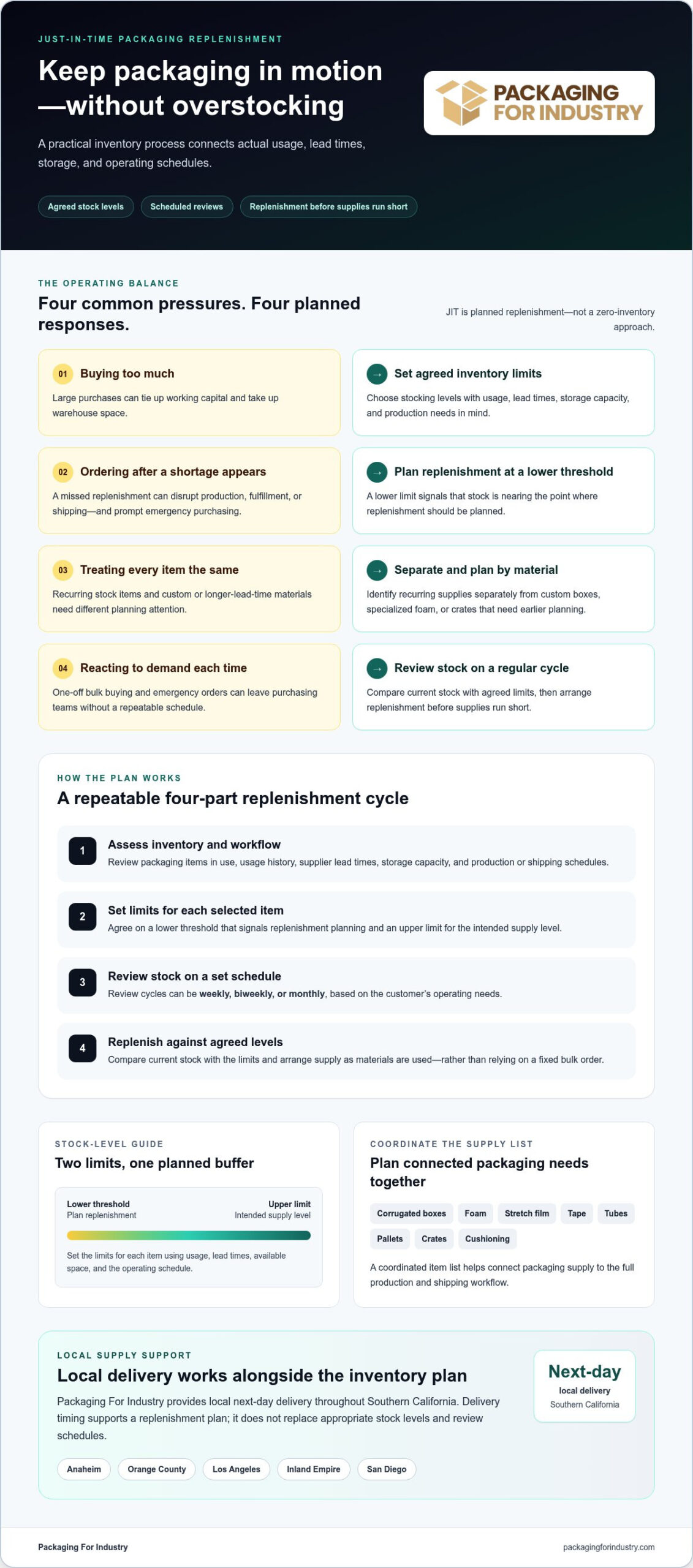
A reliable program turns packaging purchases into a repeatable process rather than a series of urgent decisions. It starts with an inventory assessment, identifies which items belong in the plan, sets stocking limits, establishes review dates, and replenishes materials as they approach agreed thresholds. Each step connects purchasing to actual use, available storage, and the schedule of the operation.
What happens during the initial packaging inventory assessment?
The assessment reviews the packaging items in use, their usage history, supplier lead times, storage capacity, and production or shipping schedules. Operations staff can explain when demand rises or shifts; purchasing teams can share ordering patterns and lead-time concerns. Together, that context helps distinguish recurring stock items from custom materials that need earlier planning, such as specialized boxes, foam, or crates.
The item list should reflect how packaging supports the work, not simply what has been ordered before. For example, a manufacturer may rely on several box sizes, protective foam, stretch film, and tape across different production or shipping steps. Including those connected needs helps build a replenishment plan around the whole workflow.
How do planned stocking levels trigger replenishment?
For each selected item, the customer and supplier agree on inventory limits. In plain terms, a lower threshold signals that stock is getting close to the point where a replenishment should be planned; an upper limit defines the intended supply level. These limits can account for usage, lead times, available space, and the operating schedule, rather than applying one rule to every material.
Scheduled reviews give purchasing teams a consistent opportunity to compare current stock with those agreed limits and arrange replenishment before supplies run short. PFI review cycles can be weekly, biweekly, or monthly, based on the customer’s operating needs. That structure can reduce guesswork while keeping inventory decisions connected to actual demand. For a general business perspective on how JIT inventory can reduce storage costs, Forbes also explains the approach and its associated risks.
With just-in-time inventory management, PFI reviews packaging items, usage, lead times, storage, and schedules, then replenishes against agreed inventory limits. This makes the plan adjustable as operating needs change, rather than locking purchasing into a fixed bulk order. Businesses preparing to organize recurring packaging needs can request a packaging quote to discuss a replenishment plan suited to their materials and workflow.
JIT Packaging vs. Bulk Buying and Emergency Orders: Managing Stockout Risk
Choosing how to buy packaging involves balancing supply continuity, warehouse space, and purchasing effort. Bulk buying can create a larger on-site reserve, while emergency orders respond to an immediate shortage. Planned replenishment takes a different path: inventory is monitored against agreed levels, and restocking is arranged as part of an ongoing process. This reflects JIT’s broader management philosophy of reducing waste through better coordination, not simply ordering less.
| Approach | Stock availability | Space and purchasing effort |
|---|---|---|
| Planned replenishment | Maintains agreed on-site stock and schedules replenishment around use and lead times. | Can limit excess inventory while reducing repeated urgent purchasing. |
| Bulk buying | Builds a larger reserve, which may suit predictable demand or purchasing needs. | Requires space for stored materials and commits working capital to inventory. |
| Emergency ordering | Responds to a shortage after it becomes urgent, with availability dependent on the order and supply process. | Can add purchasing pressure and leave less time to plan alternatives. |
No single approach fits every operation. A business with stable demand and adequate storage may choose to buy some materials in bulk. A company with limited space or several packaging items to coordinate may benefit from planned replenishment. Over-ordering can occupy warehouse space and tie up working capital, while relying only on emergency orders makes purchasing reactive. The aim is to balance supply needs with storage and operating realities, not to promise a specific level of savings.
Does just-in-time packaging mean keeping no inventory?
No. JIT packaging means maintaining planned on-site stock and replenishing it against agreed minimum and maximum levels, not operating with zero inventory. Those limits give teams a practical buffer and a point for arranging more supply. They should reflect actual demand, changes in production schedules, and packaging lead times, since a shift in any of these can affect how much stock is appropriate.
When does vendor managed inventory complement JIT delivery?
Delivery is the movement of packaging to a facility; inventory management is the process of tracking items and coordinating replenishment. A managed program can include recurring-use materials such as corrugated boxes, foam, stretch film, and tape, with reviews tied to the operation’s needs. Explore vendor managed inventory for packaging as a related approach for coordinating stock oversight and replenishment.
How to Prepare a Southern California Packaging Replenishment Plan
A useful replenishment plan starts with information your operations and purchasing teams already work with: what packaging they use, how demand changes, and where supplies need to be available. Organizing these details before setting stocking levels helps build a plan around real workflows rather than a broad estimate. PFI’s packaging solutions for manufacturers support recurring packaging needs with custom and stock materials.
What information should buyers gather before requesting a program?
Prepare a practical item list and note the details that affect replenishment:
- Packaging types and specifications: Include box sizes, foam or cushioning needs, stretch film, tape, pallets, and other supplies used in daily operations.
- Usage patterns: Record approximate consumption and note seasonal, project-based, or production-related changes.
- Lead times and ordering history: Identify how far ahead materials need to be planned and which items have prompted emergency orders.
- Storage and receiving constraints: Document available space, receiving schedules, and where supplies should go at each operating location.
- Product or shipping changes: Flag new products, revised shipping methods, or protection requirements that could change box, foam, or crate needs.
For businesses managing more than one Southern California facility, separate each location’s usage and receiving needs. A shared item may be used at several sites, but demand and storage capacity can differ. That distinction helps purchasing teams plan local stock without treating every facility as if it operates the same way.
How should custom and stock packaging fit the plan?
Group frequently used stock supplies separately from custom or longer-lead-time materials. Commonly used boxes, stretch film, and tape may follow a recurring replenishment rhythm. Custom boxes, foam inserts, and crates may need to be planned further ahead so materials are accounted for before production or shipping requirements arise. Keeping these categories distinct makes it easier to see which items need routine review and which require advance coordination.
As demand shifts, update the item list and planned levels rather than relying on outdated ordering patterns. This gives operations and purchasing a shared reference for managing just in time packaging delivery Southern California across recurring needs, custom materials, and multiple locations.
Just-in-Time Packaging Delivery from PFI Across Southern California
Packaging For Industry supports recurring industrial supply needs with just-in-time inventory management and a coordinated range of packaging materials. Manufacturers, warehouses, distributors, and fulfillment operations can plan replenishment across key items instead of managing each purchase as a rush. Reviewing usage and supply needs can also help businesses compare packaging pricing and identify opportunities to lower packaging costs without compromising packaging performance.
Which packaging products can a JIT program help manage?
A replenishment plan can cover materials used throughout packing, product protection, and shipping, including:
- Corrugated boxes, with custom sizes available for specific products or shipping needs
- Foam packaging and cushioning materials to help reduce shipping damage
- Stretch film and packaging tape for preparing cartons and palletized loads
- Tubes and cores, pallets, and crates for additional shipping requirements
Stock supplies and custom packaging can be planned together. Frequently used materials may follow a recurring replenishment schedule, while custom boxes, foam, or crates with longer lead times can be planned in advance. Coordinating these items can support packaging for manufacturers, warehouses, distribution centers, and fulfillment operations. Reviewing recurring requirements can also help purchasing teams assess bulk packaging pricing alongside inventory and storage needs.
What should Southern California buyers do next?
Start with a summary of the packaging your operation uses, approximate demand patterns, storage limits, recurring supply issues, and the locations that need materials. PFI serves businesses across Orange County, Los Angeles County, the Inland Empire, and San Diego County, with local packaging delivery and local next-day delivery throughout Southern California. Delivery is part of a planned supply approach, supported by reviewing needs and replenishing against agreed inventory limits.
Share your packaging types, usage, and delivery needs to discuss a replenishment plan for your operation.
Build a More Predictable Packaging Supply Plan
Packaging shortages can interrupt production and shipping, while excessive stock takes up space and working capital. A planned replenishment program helps balance these demands by connecting packaging usage, lead times, storage capacity, and operating schedules to agreed inventory levels. Separating recurring stock items from custom or longer-lead-time materials also helps purchasing teams plan supply with fewer last-minute decisions.
For manufacturers and distribution operations, just in time packaging delivery Southern California works best when inventory planning and local replenishment support each other. Packaging For Industry offers just-in-time inventory management and vendor managed inventory programs, with review cycles set weekly, biweekly, or monthly around operational needs. PFI also provides local next-day delivery throughout Southern California as part of its supply support.
Share the packaging you use, your demand patterns, storage limits, and recurring supply challenges to discuss a replenishment approach tailored to your operation.
A clearer plan can help your team maintain packaging supply and keep production and shipping moving with greater confidence.
Frequently Asked Questions
What is just-in-time packaging delivery?
Just-in-time packaging delivery is a planned process for replenishing packaging supplies in line with actual usage and operating schedules. A business identifies recurring items, reviews how quickly they’re used, and arranges replenishment around agreed stock levels and lead times. This can help keep materials available for production and shipping without relying solely on large bulk orders or emergency purchasing.
How does a packaging supplier manage JIT replenishment?
A packaging supplier begins by reviewing current materials, usage history, lead times, storage, and operating schedules. The supplier and customer identify which items to include, agree on stocking levels, and set a review frequency. During scheduled reviews, inventory is compared with those limits and replenished as needed. PFI’s review cycles can be weekly, biweekly, or monthly, based on the customer’s operating needs.
Can just-in-time delivery include custom packaging with longer lead times?
Yes. Custom packaging can be included in the plan alongside stock supplies, with its longer lead time taken into account during inventory planning. Custom boxes, foam inserts, and crates may need to be arranged earlier than frequently used stock items. Reviewing their usage and lead times helps teams plan ahead, maintain access to packaging designed for their products, and avoid treating every replenishment need as a last-minute order.
What packaging supplies can a JIT program manage?
A JIT program can manage recurring industrial packaging supplies such as corrugated boxes, protective foam, stretch film, packaging tape, tubes and cores, pallets, crates, and cushioning materials. A business can plan related materials together when they support the same production or shipping workflow. PFI supplies custom and stock packaging for manufacturers, warehouses, distributors, and fulfillment operations, with inventory plans shaped around actual usage and storage needs.
Does PFI offer just-in-time packaging delivery in Southern California?
Yes. Packaging For Industry offers just-in-time inventory management and vendor managed inventory programs for business packaging needs. PFI provides local next-day delivery throughout Southern California, serving Orange County, Los Angeles County, the Inland Empire, and San Diego County. Replenishment is planned against agreed inventory limits and operating needs, helping businesses coordinate packaging supply instead of depending only on emergency orders.
How can a business reduce packaging stockouts without overordering?
Start by tracking recurring packaging use, current lead times, storage limits, and past supply interruptions. Separate frequently used stock items from custom or longer-lead-time materials, then establish inventory levels and review schedules that reflect demand. This gives purchasing teams a clearer replenishment trigger while limiting excess stock. As production or shipping needs change, update the plan so inventory remains aligned with the operation.