
What if a lower-cost anti-static bag leaves a sensitive component without the shielding it needs during transport? For buyers sourcing ESD static shielding bags wholesale, the challenge is not simply choosing a bag in bulk. It is matching the bag to the component, handling process, and customer requirements while avoiding excess inventory and supply gaps.
Compare bag types, pricing, and order quantities before committing. Static shielding, anti-static, and moisture barrier bags serve different packaging needs, so the right choice depends on how parts are handled, packed, and shipped. Packaging For Industry supplies static shielding and moisture barrier bags, along with ESD cushioning, anti-static foam, labels, and tapes for a more coordinated packing process.
This guide covers what to specify, how to compare wholesale options, and how to plan bulk purchasing around storage space and repeat demand. Custom design, samples and prototypes, kitting, and recurring inventory programs can help align ESD packaging with your workflow. For manufacturers and warehouses in Los Angeles, Orange County, San Diego, Riverside, and across Southern California, the goal is a dependable packaging supply that supports component protection and efficient operations.
Key Takeaways
- Match the bag category to the component, handling environment, and customer packaging requirements.
- Distinguish static shielding, anti-static, and moisture barrier bags by their packaging function before comparing options.
- Evaluate ESD static shielding bags wholesale by fit, packing workflow, documented requirements, and repeat-use needs, not unit price alone.
- Prepare a useful bulk quote request with the application, bag dimensions, usage pattern, and delivery context.
- Plan ESD bags alongside cushioning, foam, labels, and tapes to support an efficient, reliable packaging process.
Why ESD static shielding bags wholesale buyers need a clear specification
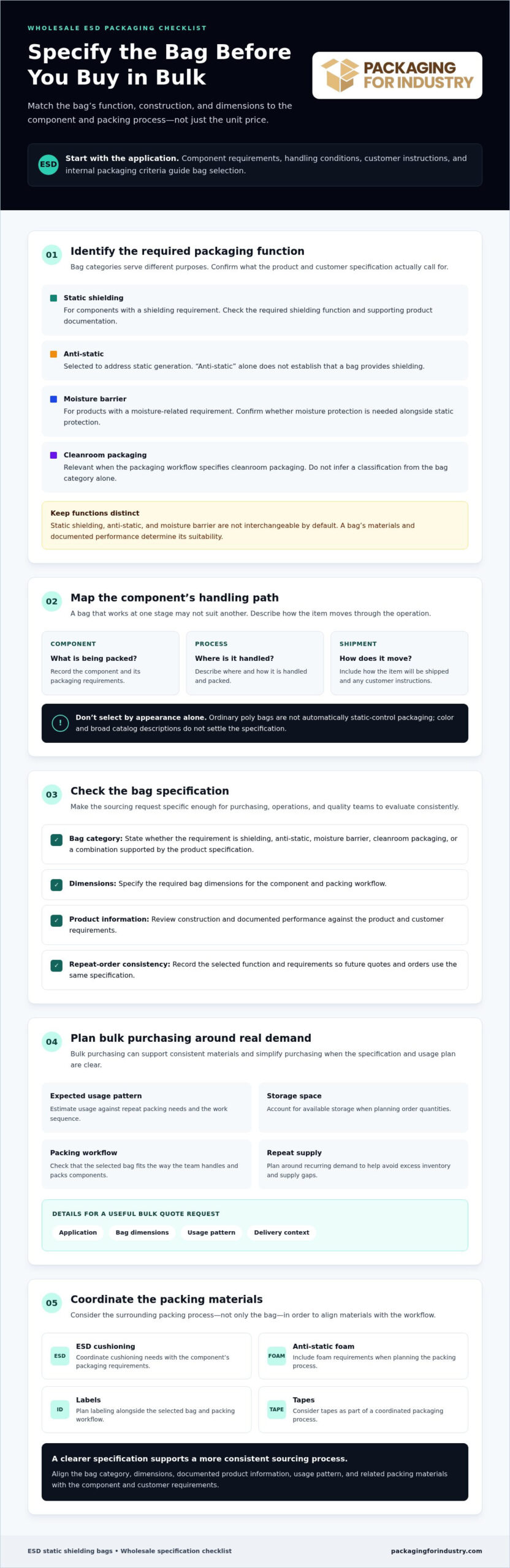
Start with the packaging decision, not the order quantity. The right bag depends on the component, where it will be handled, how it moves through production and shipping, and any packaging requirements set by the customer. A bag that works for one stage of an operation may not suit another.
Ordinary poly bags are not automatically static-control packaging. Their material and construction may not be intended for static-sensitive electronics, so choosing by appearance or a general “anti-static” label can leave key requirements unanswered. For ESD static shielding bags wholesale, define the application first, then match the bag construction and documented performance to the product specification and packing process.
What does an ESD static shielding bag do?
An ESD static shielding bag is packaging intended to help protect static-sensitive electronic components from electrostatic discharge during handling and transport. Its construction is designed for a shielding function, but specific performance depends on the bag materials and verified product specification. An antistatic bag is a broad category, not a guarantee that every bag provides the same type of protection. Anti-static, conductive, and shielding bags are not interchangeable by default.
In practical terms, select an ESD static shielding bag according to the component’s protection needs and handling path. The component requirements, customer instructions, and applicable internal packaging criteria are essential inputs. Do not choose by color or trade name alone. Identify the required bag category and review the supporting product information.
Which businesses buy ESD bags in bulk?
Electronics and semiconductor manufacturers, contract manufacturers, and industrial distributors often need ESD bags for repeat packing operations. Procurement teams manage sourcing and inventory, while production and warehouse teams need packaging that fits the work sequence. Quality teams help ensure the selected materials align with component and customer requirements.
Bulk purchasing can support consistent materials across repeat orders and simplify purchasing, but only when the specification is clear. Before requesting bulk packaging pricing, document:
- The component and its packaging requirements.
- Where and how the item will be handled, packed, and shipped.
- The required bag category, dimensions, and any customer instructions.
- Expected usage patterns and the needs of the packing workflow.
These details turn a general bag request into a practical sourcing specification. Purchasing and operations teams can then evaluate options and plan repeat supply against the same requirements.
ESD bag types and packaging functions buyers should understand
Bag categories describe different packaging functions, so a familiar label is not a complete specification. Static shielding, anti-static, moisture barrier, and cleanroom bags address distinct requirements. An application may need more than one function, but buyers should not assume a bag provides combined protection unless its product documentation and customer requirements support that choice.
Static shielding bags versus anti-static bags
Static shielding bags are intended for packaging that requires shielding protection for static-sensitive components. “Anti-static” generally describes a bag selected to limit static generation, but that description alone does not establish that it provides shielding. A bag’s suitability depends on its construction and documented performance. Use component, handling, and customer specifications to determine the required function, then compare product information against guidance such as the ESD Association standards.
Do not select a bag by color or a broad catalog description. For a repeat production line, first determine whether the requirement calls for shielding, reduced charge generation, or both. Record that decision in the purchasing specification so the team can apply it consistently to quotes and repeat orders.
When do moisture barrier and cleanroom bags matter?
Moisture barrier bags serve a separate purpose: managing moisture exposure when the product or customer specification calls for it. Moisture protection and static protection may both be needed for an application, but they are not interchangeable functions. Confirm whether both are required instead of assuming an ESD bag also provides a moisture barrier.
Cleanroom poly bags are relevant when the packaging workflow specifies cleanroom packaging. Let the required handling and packaging criteria guide selection. Do not infer a cleanroom classification or moisture performance from the bag category alone.
Use this comparison to frame a purchasing discussion and identify what the product specification still needs to resolve:
| Bag type | Intended role | Buyer specification questions |
|---|---|---|
| Static shielding | Packaging for components with a shielding requirement | What shielding function and product documentation does the application require? |
| Anti-static | Packaging selected to address static generation | Does the requirement call for anti-static properties alone, or shielding as well? |
| Moisture barrier | Packaging for products with a moisture-related requirement | Is moisture protection specified, and must the bag also meet an ESD requirement? |
| Cleanroom poly | Packaging for workflows specifying cleanroom packaging | What handling and cleanliness criteria govern the packing process? |
Clear distinctions make ESD static shielding bags wholesale easier to specify without confusing categories or buying a function the application does not require. To match bag options to your product and packing needs, request a packaging quote.
How to compare wholesale ESD static shielding bags for your operation
A lower unit price does not automatically make a bag the better purchase. If two quotes use different dimensions, bag categories, quantities, or order assumptions, their prices are not an equivalent comparison. Compare ESD bags against the same documented application and purchasing assumptions. This gives procurement a clearer basis for evaluating options while keeping production and quality requirements in view.
Which specifications should purchasing teams compare?
Start with the details that define the job. Record the component, its dimensions, the required packaging function, how it moves through handling and shipping, and any applicable customer documentation. Then compare candidate bags against that shared specification instead of relying on a general product description.
- Application: Identify the part being packed and its documented packaging requirements.
- Dimensions: Compare bag size with the component and any required pack-out arrangement.
- Closure and pack-out: Review these details against confirmed product specifications and the actual packing sequence.
- Documentation: Include customer requirements and relevant product information in the purchasing record.
Keep technical values tied to current product documentation. If the component is revised or the packing configuration changes, review the bag requirements before using an old quote for the new order.
How should buyers assess total operational fit?
Look beyond the price per bag. Consider how the packaging works on the production floor and fits purchasing and warehouse routines. A bag that is awkward to load or poorly matched to the part may complicate pack-out. An unnecessarily large bag can affect material use and storage, while an unsuitable fit may make component handling less consistent.
Compare wholesale pricing using equivalent assumptions: bag category, documented requirements, dimensions, order quantity, and expected ordering pattern. Note whether demand is steady or variable, how much storage space is available, and whether orders will be placed in bulk or replenished over time. These factors help teams weigh unit pricing against inventory needs and supply continuity without assuming a particular cost outcome.
For ESD static shielding bags wholesale, production, procurement, warehouse, and quality teams should use one agreed specification when reviewing options. Packaging For Industry supports this review with custom design, samples, and prototypes, helping teams assess product fit and pack-out before setting repeat purchasing assumptions.
How to source ESD bags wholesale and manage repeat supply
A useful wholesale quote starts with a clear application and shared specifications. Before requesting pricing, gather the details procurement, production, warehouse, and quality teams need to evaluate the same bag and order assumptions. That makes it easier to compare packaging pricing fairly and plan supply around actual operations.
What information should an ESD bag quote include?
Describe the component, packaging environment, and documented protection requirements. Include customer specifications so the quote reflects the requirements your operation must meet, not just a general bag category.
For an ESD static shielding bags wholesale request, prepare:
- Application: Identify the component and where it will be packed and handled.
- Bag requirements: Specify the required category and dimensions.
- Usage: Provide estimated consumption and expected order cadence.
- Delivery context: Include the delivery location and any receiving considerations.
- Supporting documents: Share customer specifications that affect selection.
These details help match packaging for manufacturers to the production workflow. If fit or product protection needs a closer review, PFI’s custom packaging design services can support an application review. Samples and prototypes can help teams assess pack-out before setting repeat purchasing assumptions. A well-matched design may help reduce shipping damage and support efforts to lower packaging costs without compromising documented requirements.
How can buyers plan bulk orders and recurring supply?
Use usage history and production schedules to estimate demand, then compare that estimate with available storage and replenishment timing. A bulk order may suit steady demand and sufficient warehouse space. More frequent replenishment may better fit variable production or tighter storage. Include lead-time information in the plan so purchasing can align orders with operational needs.
Review the plan when production volumes, component requirements, or customer instructions change. For recurring demand, vendor-managed packaging inventory can support a replenishment approach based on usage and inventory reviews. This lets teams plan for supply continuity alongside order size, storage capacity, and pricing.
For operations in Los Angeles, Orange County, San Diego, Riverside, and the wider Southern California region, include the delivery location and receiving context in your request. This gives PFI practical information for preparing a quote around your ESD packaging needs and repeat-supply plan.
Source ESD static shielding bags wholesale with PFI
Packaging For Industry supports industrial buyers sourcing ESD packaging for their products and repeat packing operations. Its ESD and cleanroom packaging range includes static shielding bags, moisture barrier bags, anti-static foam, ESD cushioning, cleanroom poly bags, labels, and tapes. Electronics and semiconductor manufacturers are common users, along with contract manufacturers, medical device companies, aerospace suppliers, and industrial distributors with documented packaging requirements.
PFI connects packaging selection with how materials are used on the floor. Coordinating related packaging supplies can simplify purchasing and keep pack-out requirements clear across teams. For repeat demand, bulk supply and recurring inventory programs can support a consistent replenishment plan. Custom packaging design, samples, and prototypes help address applications where a standard pack-out needs review. Packaging kitting and assembly can bring multiple materials together for an established workflow.
When does an integrated packaging solution help?
Consider the complete pack-out when a component needs both its specified bag and cushioning or other protective materials. Reviewing these elements together can help assess fit and handling, while coordinating purchases can reduce the effort of managing related packaging items separately. PFI supplies ESD and protective foam packaging for applications that call for cushioning. Select the combination based on the component and its packaging requirements.
What should buyers include in a quote request?
Help PFI scope the request by providing the component context, required bag category, dimensions, documented packaging requirements, expected usage, and delivery location. Include recurring demand and related supplies, such as cushioning, labels, or tapes, if they are part of the same workflow. These details give purchasing and operations teams a clear basis for evaluating the packaging program and planning repeat orders. PFI serves Southern California customers and supports nationwide packaging needs.
Share your application and supply requirements to start sourcing ESD static shielding bags wholesale with an industrial packaging partner focused on practical fit and supply coordination.
Set Up a More Reliable ESD Packaging Supply
Choosing ESD bags starts with the application. Match the bag category and dimensions to component needs, handling requirements, and customer specifications. Then compare wholesale options using equivalent product requirements and order assumptions, accounting for packing workflow, storage capacity, and repeat demand.
Packaging For Industry supplies static shielding and moisture barrier bags, along with ESD cushioning, labels, and tapes. Custom packaging design, samples, prototypes, and packaging kitting can help address fit and pack-out needs beyond the bag itself. PFI serves customers in Orange County, Los Angeles, San Diego, and Riverside, as well as other Southern California locations, and supports nationwide packaging needs. Industrial buyers can plan for bulk and recurring supply around their operations.
Share your application, bag requirements, expected usage, and delivery context to request a quote tailored to your operation.
With a clear specification and practical supply plan, your team can make more consistent ESD packaging decisions.
Frequently Asked Questions
How do I choose the right ESD static shielding bag for my product?
Start with the component’s documented packaging requirements, dimensions, handling environment, and packing process. Identify whether the application calls for static shielding, moisture protection, cleanroom packaging, or a combination. Customer or quality documentation should guide the specification when it sets packaging criteria. Then compare bags using equivalent requirements and product information, rather than selecting by unit price alone. This gives procurement and production teams a consistent basis for evaluating options.
What is the difference between an anti-static bag and a static shielding bag?
Anti-static and static shielding describe different packaging functions, so buyers should not treat the terms as interchangeable. Anti-static packaging is associated with limiting static generation, while shielding packaging is intended for applications with a shielding requirement. A broad label alone does not establish that a bag suits a particular component or shipment. Check the documented product and customer requirements, then use current product specifications to guide selection for production or transport.
Can ESD static shielding bags also protect products from moisture?
Some bags are designed for moisture barrier needs, but moisture protection and static protection are separate requirements. Do not assume a shielding bag provides the moisture protection a component needs. Review product and customer documentation to determine whether one or both functions are required, then compare the relevant packaging categories and product specifications. For a wholesale quote, state each required function clearly so the options can be assessed against the application.
What information should I provide for a wholesale ESD bag quote?
Provide the component context, required bag category, dimensions, documented packaging requirements, estimated usage, and preferred order cadence. Include customer specifications that affect bag selection. If the bags will be packed with ESD cushioning or other materials, describe that workflow too. For ESD static shielding bags wholesale, these details support a meaningful comparison of equivalent options and help purchasing teams plan repeat supply and delivery.
Are ESD bags suitable for electronics and semiconductor components?
ESD bags are used in electronics and semiconductor packaging, but the appropriate category depends on the component’s documented requirements and how it will be handled and packed. Shielding, anti-static, moisture barrier, and cleanroom needs are distinct, so do not assume one bag addresses them all. Use customer instructions and current product documentation to guide purchasing. PFI supplies ESD packaging for industrial buyers in Orange County, Los Angeles, San Diego, and Riverside.
How can I avoid overordering ESD bags when buying wholesale?
Review usage history, production plans, order cadence, available storage, and supplier lead-time information before setting order quantities. A bulk order should reflect actual demand and warehouse capacity, not just a unit-price comparison. For recurring packaging needs, a vendor-managed inventory program can support planned replenishment based on usage and inventory reviews. Align purchasing and operations on expected consumption so stock decisions fit production needs and available space.
Can I order ESD bags along with foam and other packaging supplies?
Yes. PFI supplies static shielding bags, moisture barrier bags, anti-static foam, ESD cushioning, labels, and tapes. Include related needs in the same quote request, including how components are bagged, cushioned, and prepared for shipment. Reviewing materials as part of one packing workflow can help keep requirements clear across the package. Custom design, samples, prototypes, and packaging kitting can also support industrial applications.