
If you’re relying on a national catalog supplier for generic foam, you’re likely paying for it twice: once at checkout and again when your high-value components arrive at their destination damaged. Finding a specialized polyurethane foam fabricator Los Angeles businesses can trust is no longer just about buying material. It’s about securing your bottom line against a volatile 2026 market where feedstock shortages have caused polyol prices to surge and supply chains to tighten.
You already know that standard sizes rarely fit complex industrial parts, and waiting weeks for a shipment from across the country isn’t a viable strategy for an efficient warehouse. We understand that your priority is a reliable, local partner who can provide precision-engineered protection without the administrative headache of long lead times. This guide will show you how to partner with a local fabricator to eliminate shipping damage, navigate new California SB 54 packaging regulations, and stabilize your supply chain through Vendor Managed Inventory (VMI) programs.
We’ll examine the specific benefits of custom polyurethane inserts, the advantages of local next-day delivery, and how to lower your total packaging costs despite rising raw material prices.
Key Takeaways
- Learn how to select the optimal polyurethane grade and density to balance shock absorption with material longevity for sensitive industrial parts.
- Discover the cost-efficiency of die-cutting for high-volume orders versus the precision of CNC routing for complex aerospace components.
- Identify a reliable polyurethane foam fabricator Los Angeles to secure next-day delivery and bypass the long lead times of national catalog suppliers.
- Utilize free prototyping and engineering support to validate your packaging design, ensuring zero-damage transit for high-value goods.
- Streamline your operations by integrating custom foam inserts with heavy-duty corrugated boxes or wood crates for a total protective packaging system.
Understanding Polyurethane Foam Fabrication in Los Angeles
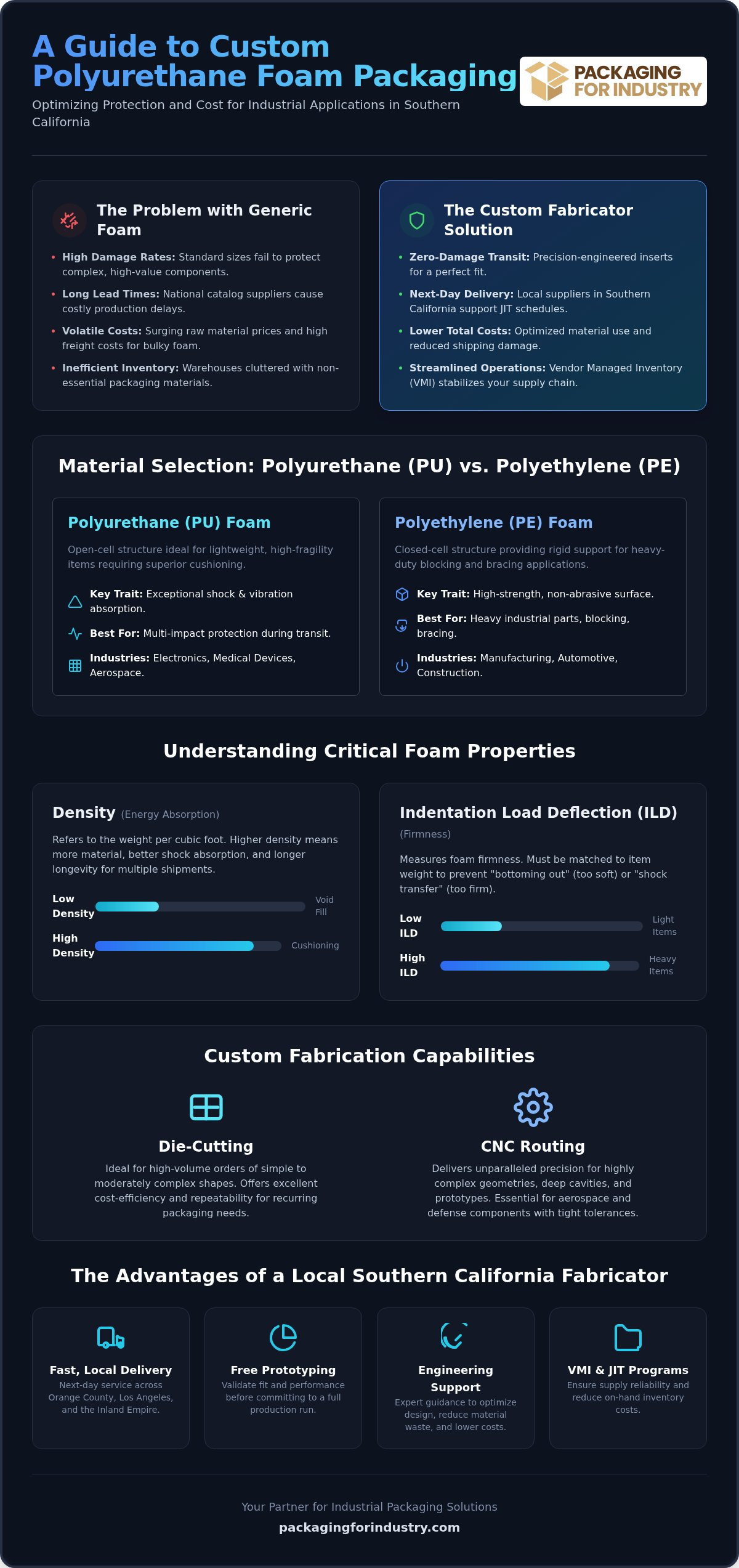
Polyurethane (PU) foam is a highly versatile, open-cell cushioning material that provides exceptional energy absorption for sensitive equipment. Unlike rigid alternatives, its cellular structure allows it to compress and recover, making it the primary choice for manufacturers who need to protect lightweight, high-fragility items. When Understanding Polyurethane Foam, industrial buyers should focus on its ability to provide multi-impact protection, which is vital for the rigors of modern logistics. Partnering with a specialized polyurethane foam fabricator Los Angeles manufacturers trust allows for the creation of custom-fit protection that generic catalog solutions can’t match.
Los Angeles serves as a global hub for the aerospace, medical device, and electronics sectors. These industries require high-precision foam packaging to ensure that expensive components arrive without a scratch. Local fabrication offers a distinct economic advantage by reducing the high freight costs associated with shipping air-filled foam over long distances. Proximity to your supplier also enables faster design iterations, allowing your engineering team to refine packaging specs in days rather than weeks.
The Role of a Custom Foam Fabricator
A seasoned fabricator acts as an extension of your engineering department. They translate complex product dimensions into protective CAD designs that optimize the space inside a corrugated box or crate. This precision ensures that your parts don’t shift during transit, which is a leading cause of shipping damage. At PFI, we provide free prototyping to validate the fit before you commit to a full production run. This process is essential for meeting aerospace and defense packaging standards where tolerances are tight. Local suppliers also support Just-In-Time (JIT) manufacturing schedules, ensuring you have the exact amount of inventory needed without cluttering your warehouse floor.
Polyurethane vs. Polyethylene: When to Choose PU
Choosing the right material is a balance of engineering requirements and fiscal responsibility. While polyethylene (PE) is excellent for heavy-duty support and blocking, polyurethane is the superior choice for soft cushioning and vibration dampening. This makes PU indispensable for the sensitive Los Angeles tech and medical sectors, where even minor tremors can recalibrate delicate instruments. Polyurethane is often more cost-effective for recurring industrial needs because it can be fabricated into complex shapes with less material waste. With the 2026 implementation of California’s SB 54 Packaging Producer Responsibility Act, choosing the right material and volume is no longer just about protection; it’s a matter of regulatory compliance and supply chain efficiency. Integrating custom foam inserts into your manufacturing workflow reduces the total cost of ownership by lowering damage rates and optimizing box sizes.
Selecting the Right Polyurethane Grades and Densities
Density is not weight. While many buyers confuse density with firmness, density actually refers to the weight of one cubic foot of foam and directly dictates how well the material absorbs energy over multiple shipments. Higher density foams contain more polymer material, which improves shock absorption and extends the material’s longevity. Understanding the material properties and applications of different foam grades is the first step toward reducing damage. Partnering with an experienced polyurethane foam fabricator Los Angeles ensures that your material selection is backed by data, not guesswork.
To achieve precision protection, you must also consider Indentation Load Deflection (ILD). This metric measures the firmness of the foam. If you select a low ILD for a heavy industrial part, the foam will bottom out, leaving the component vulnerable to impact. Conversely, using a high ILD for a lightweight medical instrument can result in “shock transfer” where the foam is too rigid to cushion the item. To calculate the correct ILD, divide your product’s weight by its surface area to determine the load; then select a grade that supports the part without fully compressing. You can compare packaging pricing for different grades to see how optimized density selection impacts your total unit costs.
Ether vs. Ester Polyurethane
The chemical composition of your foam determines its performance in specific environments. Ether-based polyurethane’s primary advantage in industrial settings is its superior resistance to moisture and hydrolysis, preventing the material from degrading in humid warehouse conditions. It’s the standard for general cushioning and long-term storage. Ester foam, however, offers a finer cell structure and superior chemical resistance. It’s often preferred for delicate finishes or when the packaging might come into contact with oils and solvents. A polyurethane foam fabricator Los Angeles can provide samples of both to ensure the material doesn’t react with your product’s coating or sensitive surfaces.
Specialty Additives for Industrial Use
Standard polyurethane is often modified with additives to meet specific sector requirements. For Southern California’s electronics manufacturers, ESD (Electrostatic Discharge) foam is essential. These anti-static foams dissipate electrical charges that could otherwise fry circuit boards or sensors. Aerospace and military applications often require fire-retardant (FR) additives to comply with strict safety regulations. We also utilize color coding to help your warehouse team identify parts quickly; blue might signify a heavy-duty grade while charcoal indicates a standard cushioning insert. This level of organization reduces picking errors and streamlines the kitting process.
Custom Fabrication Capabilities: From Die-Cutting to CNC
Selecting the right fabrication method is a balance between your production volume and the complexity of your part. While the material properties discussed in previous sections provide the protection, the fabrication process determines the unit cost and lead time. A professional polyurethane foam fabricator Los Angeles operations rely on will offer multiple cutting technologies to ensure your packaging is both precise and economically viable. Whether you need high-volume inserts for consumer electronics or a single, complex cradle for an aerospace sensor, the method of manufacture is critical to your bottom line.
Die-Cutting for Volume and Speed
Die-cutting is the industry standard for high-volume, repeatable foam inserts. This process utilizes steel-rule dies to stamp shapes out of foam sheets with extreme speed and consistency. It’s the most cost-effective option for large runs because it minimizes labor costs per unit. To maximize efficiency, we recommend Custom Design Packaging Services that focus on nesting shapes to reduce material waste. By optimizing the layout on the raw foam sheet, you can lower your total material spend. Die-cut inserts are typically designed to fit perfectly into custom corrugated boxes, providing a total protective solution that is ready for the assembly line.
Precision CNC Routing for Complex Geometries
For low-volume production or highly complex parts, CNC routing is the superior choice. Unlike die-cutting, CNC (Computer Numerical Control) routing requires no physical tooling or expensive dies. This eliminates upfront costs for prototypes and short runs, making it ideal for the specialized needs of the aerospace and medical industries. CNC machines can achieve much tighter tolerances and create three-dimensional profiles that a flat die cannot. If your part has varying depths or intricate cavities, CNC routing provides the precision necessary for a secure fit. When comparing CNC vs. die-cutting, consider that CNC is often faster for the initial design phase because we can move from a CAD file to a finished prototype in hours.
Beyond these primary methods, convoluted or egg-crate foam offers a versatile solution for varying product heights within the same container. For items requiring multi-layered protection, we utilize laminating and assembly processes. By heat-sealing or gluing different foam densities together, we create a composite insert that offers soft cushioning on the top and rigid support on the bottom. This integrated approach ensures your product is protected from every angle, especially when housed within heavy-duty wooden crates for international shipping. Designing the foam and the container simultaneously ensures there are no gaps in protection during transit.
Evaluating Your Local Los Angeles Foam Supplier
Selecting a polyurethane foam fabricator Los Angeles businesses can rely on requires looking beyond the price per unit. You need a partner that understands the logistical friction of Southern California manufacturing. While national catalog suppliers offer convenience, they can’t match the responsiveness of a local hub. Delivery reliability is the foundation of a stable supply chain; a local partner ensures that your production line never stalls due to a late shipment of protective inserts. Proximity also facilitates faster response times for design changes or urgent restocks, which is essential for high-velocity distribution centers.
Design support is another critical differentiator. Look for a supplier that provides in-house CAD/CAM assistance and free prototyping. This allows your engineers to validate the fit and function of an insert before committing to a full production run. It’s about eliminating risk early in the process. A fabricator should be able to look at your part and recommend the specific density and grade that provides the best protection at the lowest cost. This consultative approach is what separates a mere vendor from a long-term logistical partner.
The Importance of Integrated Packaging
Buying your foam and corrugated boxes from separate vendors often leads to dimensional errors. If the foam is a fraction of an inch too large, it can bow the box walls or cause transit damage. By using an integrated supplier, you ensure that the foam, box, and even the pallets or crates are engineered as a single system. This consolidation lowers your total landed cost by reducing freight shipments and administrative overhead. It also improves warehouse efficiency through kitting, where the box and foam arrive pre-assembled and ready for use on the packing line.
Vendor Managed Inventory (VMI) for Foam
Packaging material is bulky and consumes valuable floor space in Los Angeles warehouses. Our PFI Vendor Managed Inventory Services solve this by shifting the storage burden to our facility. We monitor your stock levels and replenish inventory on a schedule that matches your actual usage, ensuring you never run out of critical supplies. This proactive approach prevents the production stops caused by sudden packaging shortages. It transforms your packaging from a storage headache into a streamlined logistical flow that supports your bottom line and frees up capital for other operations.
Why PFI is the Preferred Polyurethane Foam Fabricator in Southern California
PFI operates at the intersection of technical engineering and logistical efficiency. Choosing a specialized polyurethane foam fabricator Los Angeles businesses can trust means more than just buying material; it’s about securing a consultant who understands your bottom line. We provide direct access to engineering expertise across our Anaheim and Los Angeles hubs, ensuring that every design is optimized for both protection and cost. Our commitment to cost reduction isn’t based on vague promises. It’s built on detailed damage analysis and precision design that minimizes material waste while maximizing shock absorption for high-value components.
Our solutions are specifically tailored to the rigorous standards of the aerospace, defense, and medical sectors. We understand that a failure in packaging can lead to catastrophic losses, so we integrate our foam fabrication with our broader offerings of corrugated boxes and heavy-duty crates. This holistic approach ensures that your entire packaging system functions as a single, reliable unit. While we offer fast nationwide shipping, our local next-day delivery across Southern California provides a competitive edge for regional manufacturers who need to maintain lean inventory levels.
Solving the “Catalog Supplier” Problem
Many industrial buyers find that large catalog suppliers are too rigid for complex needs. These giant distributors rely on automated systems and standard sizes that often lead to excessive “dead space” in your shipments, driving up freight costs. PFI serves as a proactive alternative, offering personalized service that national distributors can’t match. We design custom sizes and bulk quantities around your specific shipping methods. Instead of dealing with an automated call center, you work directly with a team that knows your warehouse needs and your operational challenges. This flexibility allows us to pivot quickly when your production schedules change or when you need a custom-engineered solution for a new product launch.
Request a Custom Foam Packaging Quote
Getting started with a more reliable supply chain is straightforward. When you provide specs for a polyurethane foam quote, our team evaluates the weight, fragility, and dimensions of your product to recommend the ideal grade and density. We don’t just send a price list; we offer a strategy to lower packaging costs through better engineering. One of PFI’s most significant advantages for recurring industrial orders is our free prototyping service. This allows you to validate the design in a real-world shipping environment before committing to a bulk purchase. By testing the fit and performance early, you ensure that your polyurethane foam fabricator Los Angeles partner is delivering exactly what your components require for zero-damage transit.
Optimize Your Industrial Packaging Strategy
Securing your supply chain starts with choosing the right materials and a partner who understands your operational constraints. By matching polyurethane grades and densities to your specific product weight, you eliminate the technical guesswork that leads to high shipping damage rates. Transitioning from generic catalog options to a specialized polyurethane foam fabricator Los Angeles manufacturers rely on ensures your components are protected by precision engineering rather than just excessive bulk.
Our team provides the technical oversight required for aerospace and mil-spec compliant packaging while maintaining the agility of local next-day SoCal delivery. We utilize free prototyping and CAD design to validate every insert, ensuring a perfect fit before you commit to a full production run. This methodical approach reduces material waste and lowers your total packaging costs over the long term. It’s about moving beyond simple cushioning to a complete system of logistical optimization.
We’re ready to help you solve your most complex logistics challenges and improve your supply reliability starting today.
Frequently Asked Questions
What is the typical lead time for custom polyurethane foam inserts in Los Angeles?
Lead times vary based on design complexity, but as a local polyurethane foam fabricator Los Angeles companies rely on, we maintain responsive production schedules. While national suppliers often face transit delays, our Anaheim hub facilitates faster turnarounds. We also offer Vendor Managed Inventory (VMI) programs to eliminate lead time concerns entirely by stocking your custom inserts in advance of your production needs.
Can I get a custom foam prototype before placing a bulk order?
Yes, we provide free prototyping and CAD/CAM design support for recurring industrial orders. This process allows you to validate the fit and protective qualities of your custom foam inserts before committing to a full production run. Testing a physical sample ensures that the selected foam density and grade provide adequate shock absorption for your specific high-value components or delicate instrumentation.
Do you provide anti-static polyurethane foam for electronics?
We supply specialized anti-static and ESD (Electrostatic Discharge) polyurethane foam specifically for the electronics and semiconductor industries. These materials dissipate static charges that can damage sensitive circuit boards or sensors during transit. Our ESD foam options are available in custom die-cut shapes or standard planks to integrate seamlessly with your existing shipping containers and protect against electrostatic damage.
How do I choose between polyurethane and polyethylene foam for my product?
The choice depends on your product’s weight and fragility. Polyurethane is an open-cell, soft foam ideal for lightweight, highly fragile items needing vibration dampening. Polyethylene is a closed-cell, rigid foam better suited for heavy-duty support and blocking. We conduct packaging reviews to help you determine which material provides the best protection while keeping your total packaging costs as low as possible.
Do you offer local delivery for foam packaging in Orange County and Los Angeles?
We provide local next-day delivery across Southern California, including Orange County and Los Angeles. Our company fleet services Anaheim, Irvine, Long Beach, and all surrounding industrial hubs. Local delivery reduces freight costs and eliminates the logistical delays common with out-of-state catalog suppliers. It’s a key part of how we support lean manufacturing and just-in-time production schedules for local businesses.
Can you design foam-lined crates for heavy industrial machinery?
Yes, we engineer custom foam-lined crates for heavy industrial machinery and aerospace equipment. We combine heavy-duty wood crates with custom-fabricated foam assemblies to create a single, integrated protective solution. This approach ensures that even the largest components remain stabilized and protected from impact and vibration throughout the shipping process. It’s especially effective for high-value machinery requiring export-ready packaging.
What information do I need to provide for a custom foam fabrication quote?
To provide an accurate polyurethane foam fabricator Los Angeles quote, we need your product’s dimensions, weight, and fragility level. It’s also helpful to know your estimated annual usage and the type of outer container you’ll use, such as a corrugated box or wood crate. If you have existing CAD files or a physical part sample, we can use those to accelerate the design.
Do you handle the corrugated boxes for the foam inserts as well?
We handle the entire integrated solution, including custom and stock corrugated boxes designed to house your foam inserts. Buying both components from a single industrial supplier prevents dimensional errors and simplifies your procurement process. We offer everything from standard RSC boxes to heavy-duty double-wall and triple-wall corrugated for maximum protection, ensuring your foam and box fit perfectly every time.