
The convenience of a massive national catalog might actually be the most expensive mistake in your supply chain. Many procurement managers believe that partnering with a global giant is the only way to ensure stability for bulk corrugated or protective foam orders. However, when you factor in hidden freight surcharges and a lack of specialized technical support, that perceived convenience often dissolves into operational stress. Choosing a local supplier vs national for packaging materials is not just about proximity. It is a strategic decision that directly affects your total procurement costs and shipping reliability.
We understand that your primary goals are to eliminate shipping damage and keep production lines moving without interruption. This comparison explores the critical differences between these two supplier models to help you optimize your logistics. You will discover how a local partner in regions like Orange County or Los Angeles can reduce lead times for custom packaging through engineering expertise and Vendor Managed Inventory (VMI) programs. We will examine how localized support helps you reclaim warehouse space and improve cash flow by moving away from the bulk-buy traps of national carriers.
Key Takeaways
- Identify the hidden costs of national logistics and why choosing a local supplier vs national for packaging materials often results in lower total procurement costs.
- Leverage logistical proximity in Southern California to secure next-day delivery and eliminate the delays associated with long-distance LTL freight.
- Improve product protection through localized technical support and custom engineering for complex foam packaging and heavy-duty corrugated boxes.
- Optimize warehouse efficiency and cash flow by utilizing Vendor Managed Inventory (VMI) to maintain stock levels without over-ordering.
The Procurement Dilemma: National Reach vs. Local Agility
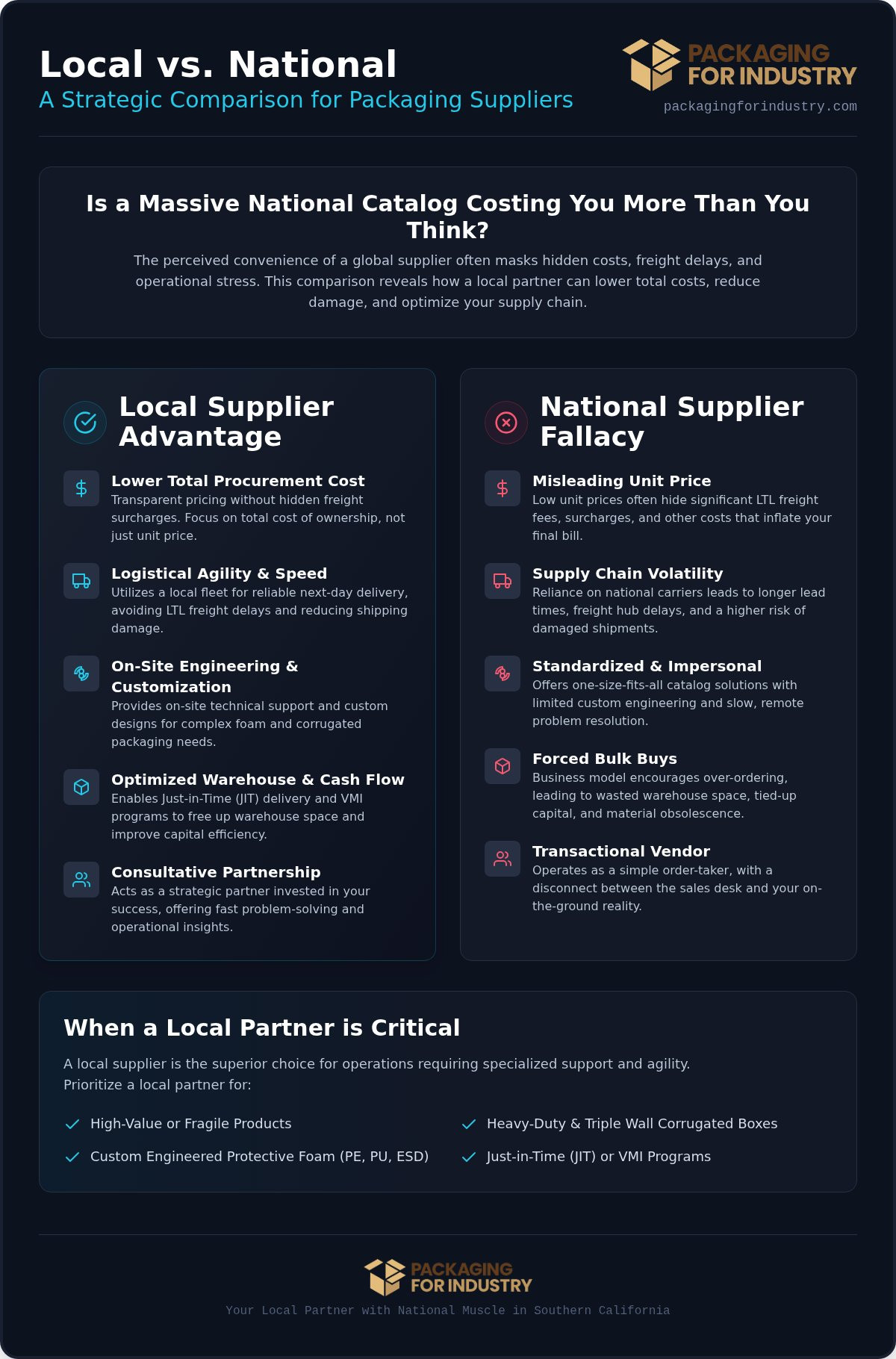
For many procurement managers, the decision of a local supplier vs national for packaging materials feels like a choice between scale and intimacy. National brands offer a sense of security through massive catalogs and standardized ordering systems. However, this perceived safety often masks significant hidden costs in logistics and operational downtime. In 2026, supply chain volatility remains a primary concern for industrial manufacturers. A national supplier might offer a lower “unit price” on a double wall corrugated box, but that figure rarely accounts for the total cost of ownership.
When you rely on a distant national carrier, you’re at the mercy of their freight schedules and rising surcharges. If a shipment of custom boxes is delayed or arrives damaged, the distance between you and the decision-maker becomes a liability. Proximity isn’t just about shipping speed; it’s about the speed of problem-solving. A local partner can address shipping damage or design flaws within hours; they don’t require a corporate ticket system to authorize a replacement or a design adjustment.
The National Supplier Fallacy
National catalog suppliers are built for volume. Their business models prioritize stock items that fit the widest possible range of customers. This approach often leaves specialized manufacturers struggling with “out of stock” notifications on critical components. There’s a fundamental disconnect between a national sales desk in another time zone and the immediate needs of a warehouse in Anaheim or Riverside. Without the ability to provide custom engineering for complex foam inserts, these suppliers push one-size-fits-all solutions that lead to wasted warehouse space and increased product breakage during transit.
The Local Partnership Advantage
A local supplier functions as a consultative partner rather than a simple vendor. They don’t just ship products; they provide engineering expertise directly on your production floor. This hands-on approach allows them to adapt packaging designs to your specific manufacturing cycles. Whether you need a just-in-time delivery of heavy duty crates or a redesign of your protective foam inserts, a local expert understands the nuances of your operation. This level of accountability ensures that your packaging is an asset to your logistics, not a recurring bottleneck. Moving from a transactional relationship to a partnership means your supplier is as invested in your shipping success as you are.
Logistical Agility: Why Proximity Matters in Southern California
Southern California’s industrial landscape operates at a pace that national logistics networks often struggle to match. When evaluating a local supplier vs national for packaging materials, the geographic advantage of an Anaheim headquarters becomes a strategic asset for your supply chain. National suppliers typically rely on third-party Less-Than-Truckload (LTL) carriers to move bulk corrugated or foam orders. These shipments often sit in regional hubs, moving through multiple touchpoints that increase the probability of shipping damage. In contrast, a local fleet provides direct delivery, ensuring your materials arrive intact and on schedule.
Eliminating the LTL freight nightmare is a primary driver for cost reduction. By 2026, national carrier surcharges are projected to rise significantly, particularly for bulky items like double wall boxes or large foam inserts. A local partner avoids these complex pricing structures by utilizing their own trucks for deliveries in Orange County, Los Angeles, and the Inland Empire. This proximity also allows for a drastically reduced carbon footprint, as your supplies travel miles instead of crossing state lines, aligning your procurement with corporate sustainability goals.
Southern California Shipping Dynamics
Navigating the logistics hubs of the Inland Empire and the busy ports of Los Angeles requires local expertise. A local supplier understands regional traffic patterns and facility requirements, enabling reliable next-day delivery that national desks cannot guarantee. This logistical agility is essential for warehouse space optimization. Instead of dedicating valuable floor space to bulk orders that sit for months, you can order exactly what you need for current production cycles. This shift to a leaner inventory model frees up capital and reduces the risk of material obsolescence. If you are struggling with warehouse congestion, you might consider how a customized delivery schedule could streamline your operations.
Lead Time Reduction for Custom Orders
The gap in lead times between local and national providers is often the difference between a smooth production run and a costly stoppage. National suppliers often quote four to six weeks for custom corrugated boxes or specialized protective foam packaging. A local manufacturer can frequently complete the same production run in a single week. This speed is critical when emergency production deadlines arise or when a design change is needed mid-cycle. Shorter lead times directly improve manufacturing ROI by minimizing capital tied up in safety stock and preventing production line stoppages caused by packaging shortages. By choosing a partner near your facility, you gain the ability to respond to market demands with precision and speed.
National vs. Local Supplier: A Direct Comparison for 2026
While national catalog companies often lead with an aggressive unit price, industrial buyers are increasingly recognizing that the initial quote is only one piece of the puzzle. When evaluating a local supplier vs national for packaging materials, the true differentiator is the Total Cost of Ownership (TCO). A national supplier’s price might look attractive on a spreadsheet, but it doesn’t account for the 2026 reality of escalating freight costs and the high price of shipping damage caused by generic, under-engineered materials. National providers often stock “economy” grade materials to maintain those low price points, whereas a local industrial supplier focuses on high-performance films and heavy-duty corrugated that withstand the rigors of industrial handling.
Service levels provide another sharp contrast. National giants typically funnel technical questions through centralized call centers where agents lack specific knowledge of your manufacturing constraints. In contrast, a local partner provides a dedicated representative who understands your facility’s layout and operational flow. This relationship allows for greater flexibility in billing and stocking, such as specialized credit terms or tailored delivery schedules that align with your fiscal quarters. You aren’t just a customer number; you’re a partner with direct access to decision-makers who can authorize custom stocking programs or urgent production runs.
Cost vs. Value Framework
The math of procurement is simple: a cheaper box that fails during transit is an expensive liability. To accurately calculate value, you must weigh the unit price against freight costs and damage rates. National shipments often incur “oversize” or “dim-weight” surcharges that aren’t apparent until the final invoice arrives. The cost of downtime when a critical shipment of stretch film or double wall boxes is delayed can dwarf any marginal savings on the product itself. Local engineering plays a vital role here, as a partner can design out waste and use higher-grade materials to lower overall packaging costs by reducing both material use and shipping claims.
Engineering and Prototyping Capabilities
National suppliers operate on a “pick from the catalog” model, which forces your product to fit their stock dimensions. This often results in excessive dunnage and increased shipping weights. Local suppliers operate as an extension of your engineering team, adopting a “we design for your product” philosophy. This is particularly critical for the aerospace and defense sectors, where high-value components require precision-engineered foam inserts and custom-sized crates. Access to free prototyping allows you to test designs before committing to bulk production, ensuring the packaging performs exactly as required in the field without the guesswork of catalog shopping.
When to Choose Local: High-Value and Custom Applications
There are instances where a national catalog supplier is the logical choice. If your facility only requires standard acrylic tape, generic bubble mailers, or high-volume commodity stretch film, a large national distributor can provide competitive pricing through sheer scale. However, the calculation for a local supplier vs national for packaging materials shifts dramatically when your products require precision engineering. Commodities don’t require a design consultation; high-value industrial components do. When the cost of a single damaged part exceeds the cost of a thousand boxes, the expertise of a local partner becomes your primary insurance policy.
Custom corrugated boxes are not just containers; they are engineered systems designed to interact with internal cushioning. A national supplier often sells you the box and the dunnage as separate, unrelated line items. This disjointed approach frequently results in “box creep” or internal movement that leads to surface abrasion. A local supplier provides the technical oversight to ensure that your heavy-duty double wall boxes and protective foam packaging function as a single, cohesive unit. This level of precision is difficult to achieve through a web portal or a remote sales desk.
Custom Corrugated and Foam Synergy
The primary advantage of a local partner is the ability to design the outer container and the internal foam inserts under one roof. This integrated design process eliminates the measurement errors that occur when sourcing components from multiple vendors. Localized die-cutting capabilities allow for rapid prototyping, meaning you can test a physical sample on your production line within days rather than weeks. This speed is indispensable for high-stakes sectors. Aerospace components require custom foam assemblies to mitigate high-frequency vibration and multi-axis impact during global transit. Having an engineer visit your facility to measure a part ensures the final assembly provides a exact, repeatable fit every time.
Handling Specialized Industry Requirements
Specialized sectors like medical device manufacturing and automotive assembly have zero tolerance for packaging failure or contamination. Medical device packaging often requires strict oversight to ensure materials meet cleanroom standards and don’t introduce particulates into the supply chain. Similarly, Automotive Tier 1 suppliers rely on just-in-time delivery and returnable packaging systems to keep assembly lines moving. A local supplier can manage these complex requirements through regular site visits and adjusted stocking levels. For heavy machinery manufacturers, a local partner can build custom crates designed for international transit, ensuring compliance with ISPM-15 heat-treatment standards while providing the structural integrity needed for multi-ton loads.
Packaging For Industry: The Local Partner with National Muscle
PFI operates as a premier industrial packaging supplier near me for manufacturers across the region. As a bulk packaging supplier, we combine the engineering depth of a national firm with the accountability of an Anaheim packaging supplier. While our headquarters serves as a strategic hub for custom boxes in Los Angeles and Orange County packaging supplier needs, our shipping network ensures your satellite facilities remain stocked nationwide. We provide the technical expertise required for high-stakes sectors like aerospace and medical devices while maintaining the logistical reach and material volume of a national giant.
Our Managed Inventory Solutions
Managing wholesale packaging supplies often creates a bottleneck in lean manufacturing environments. Our Vendor Managed Inventory (VMI) program solves this by housing your safety stock in our local facility. You benefit from improved cash flow by paying for materials only as you pull them for production. This system reduces the administrative burden on your team and ensures you never face a line stoppage due to a shortage of heavy duty corrugated or protective foam. By reclaiming your warehouse floor space, you can expand your own production capacity while we handle the logistical oversight.
Why Choose PFI
Manufacturers choose PFI because we are a specialized stretch wrap supplier and corrugated expert that prioritizes engineering over simple catalog sales. We offer free prototyping and custom engineering reviews to ensure every assembly is optimized for weight, fit, and protection. Our team provides local site visits to help you lower packaging costs and reduce shipping damage through data-driven design. We act as a steady partner, offering the stability of national shipping capabilities and the precision of local manufacturing for your most complex industrial applications.
Request a Custom Packaging Quote Today
Starting a cost-reduction analysis is straightforward with our technical team. We invite you to schedule a local site visit to evaluate your current shipping performance and identify hidden inefficiencies in your supply chain. From military-spec crates to high-performance stretch film, we provide the industrial-grade materials your operation demands to maintain reliability. Contact our Anaheim team to start a free prototyping project and see the difference that localized engineering makes for your high-value goods.
Optimizing Your Industrial Supply Chain for 2026
The decision between a local supplier vs national for packaging materials ultimately depends on your need for precision and logistical reliability. National suppliers excel at commodity items, but they often fall short when your operation requires custom engineering or rapid response times. By partnering with a regional expert, you gain access to specialized engineering for aerospace, medical, and electronics sectors that national call centers simply cannot provide. This approach transforms packaging from a recurring expense into a strategic asset that protects your bottom line.
PFI is committed to solving your most difficult shipping challenges through free prototyping for custom industrial designs and local next-day delivery throughout Southern California. We help you eliminate the hidden costs of shipping damage and excessive lead times while improving your cash flow through managed stocking programs. It’s time to stop overpaying for inefficient catalog solutions and start building a more resilient supply chain.
We’re ready to visit your facility and demonstrate how a tailored packaging strategy can improve your operational efficiency.
Frequently Asked Questions
Is a local packaging supplier more expensive than a national catalog company?
A local supplier is often more cost-effective when you evaluate the total cost of procurement rather than just the unit price. While national catalog companies lead with low headline prices, they often add significant freight surcharges and “dim-weight” fees that inflate the final invoice. Choosing a local supplier vs national for packaging materials allows you to reduce these hidden expenses while minimizing the high cost of shipping damage associated with generic, under-engineered materials.
Can a local supplier handle high-volume corrugated box orders?
Yes, local suppliers like PFI maintain the manufacturing capacity to handle high-volume corrugated box orders for large-scale industrial operations. We regularly produce bulk quantities of heavy-duty double wall and triple wall boxes for manufacturers in the Inland Empire and Orange County. Our facility is equipped to manage recurring large-scale runs while providing the personalized oversight and accountability that national giants often lack during peak production cycles.
What are the freight savings when switching to a local Southern California supplier?
Switching to a local Southern California supplier typically eliminates the expensive LTL freight surcharges and national carrier fees that apply to bulky items. PFI utilizes its own fleet of trucks for deliveries throughout Anaheim, Los Angeles, and San Diego. This direct delivery model avoids the multiple touchpoints of national hubs, which lowers your transportation budget and significantly reduces the risk of material damage during transit.
Does Packaging For Industry offer nationwide shipping for multi-location companies?
Packaging For Industry provides nationwide shipping capabilities to support multi-location companies with facilities across the United States. While we provide local engineering and prototyping from our Anaheim headquarters, we leverage a network of national shipping partners to ensure your satellite locations receive consistent, high-quality materials. This model allows you to centralize your packaging procurement while maintaining regional agility for your primary manufacturing hubs.
How does a Vendor Managed Inventory (VMI) program work with a local supplier?
A local VMI program involves your supplier housing and managing your safety stock at a nearby facility to eliminate stockouts. PFI monitors your usage levels and replenishes your warehouse just-in-time, meaning you only pay for the materials as they’re pulled into production. This system frees up valuable floor space in your warehouse and reduces the administrative burden on your purchasing team by automating the reordering process.
What is the typical lead time for custom foam inserts from a local provider?
Typical lead times for custom foam inserts from a local provider are approximately one week, compared to the four to six weeks common with national suppliers. Because our engineering team is located nearby, we can finalize prototypes and move into production much faster. This speed is essential for manufacturers facing tight deadlines or those requiring rapid design iterations for new product launches in the medical or electronics sectors.
Can a local supplier help reduce shipping damage for fragile industrial parts?
Local suppliers significantly reduce shipping damage by designing custom-engineered inserts that provide a precision fit for your specific components. Unlike generic catalog dunnage, our protective foam packaging is engineered to mitigate the exact vibration and impact risks your products face. Having an expert visit your production floor to measure parts ensures that the final assembly provides the structural integrity needed to survive the most rigorous shipping environments.
Do local suppliers provide mil-spec and aerospace-compliant packaging?
Yes, specialized local suppliers like PFI are experts in providing mil-spec and aerospace-compliant packaging that meets strict regulatory standards. We understand the complex requirements for high-value defense components, including ESD protection and specialized cushioning. Our proximity allows for hands-on oversight and rigorous quality control, ensuring that every shipment complies with the necessary certifications and arrives at its destination without compromising sensitive technical specifications.