
With LLDPE resin prices climbing nearly 9% in May 2026 and California’s SB 54 now mandating a 25% reduction in single-use plastics, your current wrapping strategy might be costing you more than just material fees. Every time a load shifts in transit or a roll of machine stretch film snaps mid-wrap, your throughput takes a hit that impacts the bottom line. You likely already know that inconsistent wrap quality is a silent profit killer, yet finding a balance between containment strength and material efficiency remains a constant challenge for high-volume operations.
This article provides the technical and economic framework you need to eliminate transit damage and optimize your shipping department. You’ll learn how to leverage precision-engineered materials and modern down-gauging techniques to achieve a lower cost-per-pallet without sacrificing load stability. We will examine the specific film grades available to Orange County and Los Angeles manufacturers, the impact of new state regulations on your procurement, and how to select a supplier that keeps your machines running at peak performance.
Key Takeaways
- Transitioning from manual wrapping to automated systems ensures consistent load containment and significantly increases total warehouse throughput.
- Selecting the appropriate machine stretch film—balancing cast film’s clarity with blown film’s puncture resistance—is critical for managing material costs effectively.
- Modern multi-layer nano-films enable strategic down-gauging, which reduces plastic consumption and lowers your cost-per-pallet without sacrificing load stability.
- Specialized applications in the aerospace and automotive sectors require high-performance resins and UVI additives to protect critical components during long-distance transit.
- Partnering with a reliable regional supplier provides access to both stock and custom film sizes, ensuring your high-volume operations maintain a steady supply chain.
Understanding Machine Stretch Film for High-Volume Operations
Machine stretch film is a high-performance, co-extruded material engineered specifically for use with automated wrapping equipment. Unlike manual alternatives, these films are designed to withstand the high-tension environment of turntable or rotary arm wrappers. Most modern varieties utilize Linear Low-Density Polyethylene (LLDPE) to provide a balance of puncture resistance and elastic recovery. Stretch wrap or stretch film serves as the primary method for unitizing loads, ensuring that individual boxes or components stay together as a single, stable unit throughout the supply chain. This stability is the first line of defense against the rigors of transit.
For high-volume operations, transitioning to machine application isn’t just about speed; it’s about operational reliability. Hand-wrapping is inherently inconsistent because the tension applied depends on the operator’s fatigue level and physical strength. This variability often leads to loose pallets that shift during transit, resulting in expensive freight claims and product loss. By utilizing machine stretch film, you gain total control over wrap patterns and tension. This control eliminates the guesswork from your shipping floor and provides a standard level of protection for every pallet that leaves your facility.
Using the wrong film often introduces hidden costs that outweigh any initial savings on roll price. Frequent film breaks cause machine downtime, forcing operators to restart the cycle and wasting both material and labor. If the film lacks the proper specifications for your equipment, you may also see increased wear on machine components like pre-stretch rollers. Investing in the right gauge and material ensures your warehouse throughput remains steady and your pallets arrive intact.
The Mechanics of Load Containment
Load containment is the total force applied to a pallet to prevent movement. This force is generated by the “memory” of the film. When the machine stretches the material during application, the film’s natural tendency is to return to its original, un-stretched state. This creates a constant inward pressure that keeps the load secure. There is a critical difference between simply wrapping a pallet and truly securing it. Securing a load requires consistent pre-stretch levels to maximize the material’s structural integrity and prevent load shifting during abrupt stops or turns in transit.
When to Scale: Transitioning from Hand to Machine Film
Determining when to scale to automated wrapping is a matter of fiscal necessity. Most operations find that once they reach a threshold of 10 to 15 pallets per day, the labor costs of manual wrapping become unsustainable. Beyond the financial aspect, machine application offers significant ergonomic benefits. It removes the physical strain of walking backwards around heavy loads, which reduces the risk of workplace injuries. Automated systems provide the repeatable performance needed to scale your operations without increasing your headcount or compromising on safety.
Cast vs. Blown Stretch Film: Selecting the Right Material
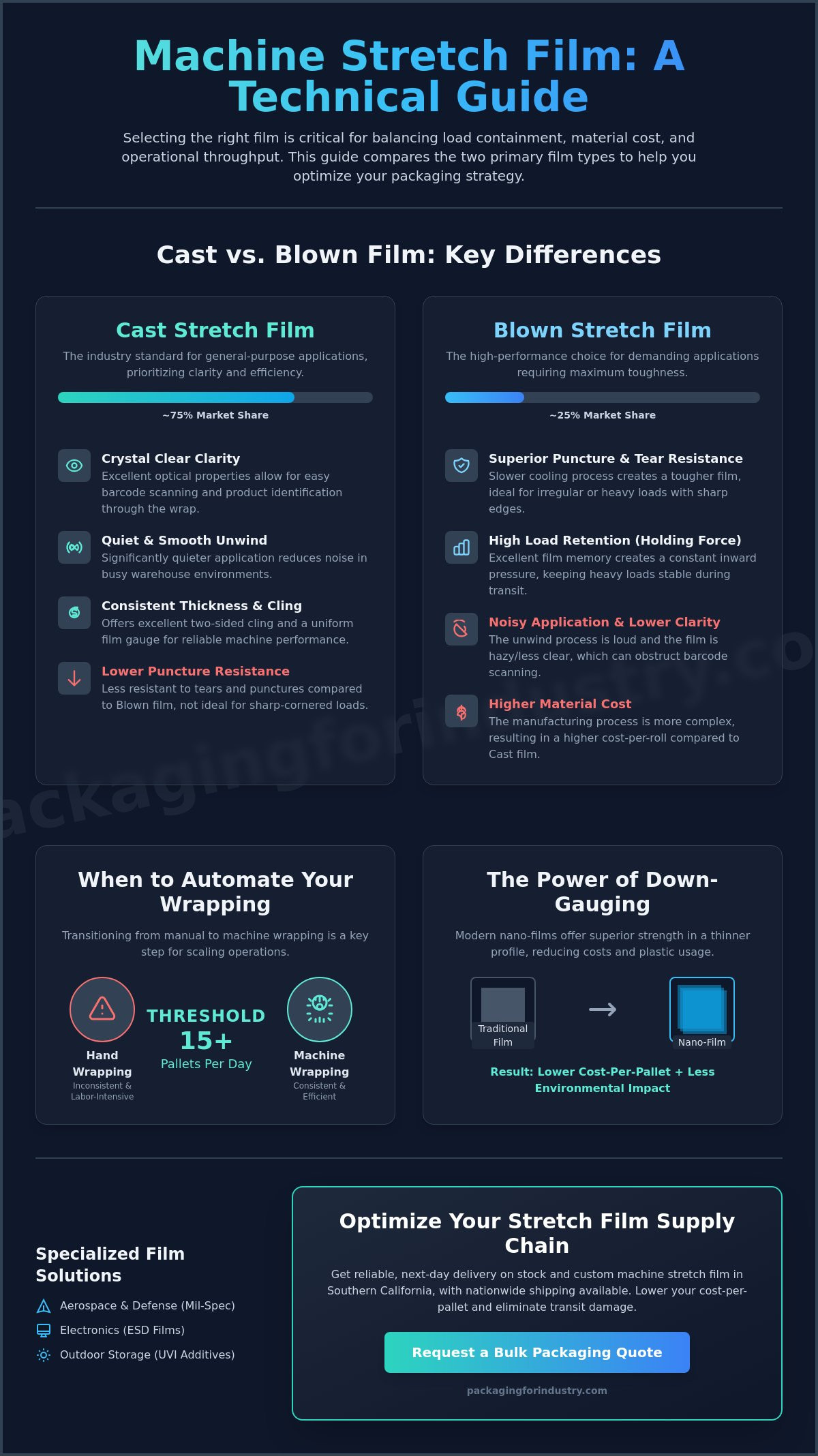
Selecting between cast and blown extrusion is a strategic decision that dictates the efficiency of your automated wrapping line. The manufacturing process creates distinct physical properties in the finished product. Cast film is produced by feeding molten resin through a flat slot die and onto chilled rollers; this rapid cooling results in a crystal-clear material. Blown film is created by blowing a large bubble of plastic upward through a circular die, allowing it to cool slowly in the air. This slower cooling process creates a denser, more resilient molecular structure. For high-volume users, the choice of machine stretch film usually comes down to whether you prioritize optical clarity and cost or maximum puncture resistance and holding power.
Cast Stretch Film: High Clarity and Quiet Application
Cast film accounts for approximately 75% of the market share in 2026 because it meets the requirements of most general warehouse operations. Its primary advantage is optical clarity. This allows warehouse teams to scan barcodes and read shipping labels through multiple layers of film without errors or the need to cut windows in the wrap. Additionally, cast film is significantly quieter during application. In a busy logistics hub, reducing the high-pitched screech of film unwind improves the working environment for your staff. It offers consistent thickness and excellent tear resistance, making it the most cost-effective solution for uniform, palletized goods.
Blown Stretch Film: Maximum Strength for Heavy Loads
While more expensive to produce, blown film is the industry standard for securing heavy-duty industrial parts or uneven loads with sharp edges. Its superior puncture resistance prevents the film from zipping or shredding when it encounters a corner of a crate or a protruding metal component. A unique feature of blown film is its high level of one-sided cling. This ensures the film sticks to itself but doesn’t cause pallets to stick to one another inside a shipping container. For companies in the automotive or construction sectors, the holding power of blown film is often necessary to prevent load shifting during long-haul transit. If you’re unsure which material fits your specific application, you can compare packaging pricing and material specifications with our technical team to find the most efficient fit for your budget.
Optimizing Film Gauge and the Economics of Down-Gauging
Many procurement managers assume that a thicker gauge automatically provides better load security. This is an outdated perspective. In the current market, the performance of machine stretch film is determined by resin quality and multi-layer extrusion technology rather than simple thickness. Modern nano-films use dozens of ultra-thin layers to create a web that is significantly stronger than traditional mono-layer films. This engineering allows you to reduce material usage while maintaining, or even increasing, containment force. It shifts the focus from the bulk of the plastic to the structural integrity of the wrap.
Transitioning from a standard 80-gauge film to a high-performance 50 or 40-gauge alternative reduces the total volume of plastic required per pallet. This shift is essential for compliance with California’s SB 54, which mandates that producers reduce single-use plastic by 25% by 2032. Beyond regulatory requirements, thinner films offer a practical operational advantage: more feet per roll. This results in fewer roll changes, less machine downtime, and a substantial reduction in warehouse waste. By optimizing your gauge, you address both environmental responsibility and fiscal efficiency simultaneously.
The High-Performance Revolution: 39-Gauge vs. 80-Gauge
Engineered films allow for significant gauge reduction without losing containment force. A high-performance 39-gauge film can often replace a standard 80-gauge product because it is designed to stretch further without snapping. This increase in elasticity translates directly to higher machine uptime, as operators spend less time clearing film breaks. Before committing to a full-scale rollout, you should implement rigorous testing protocols. Puncture tests ensure the film can handle your specific load profile, while stretch tests verify that the containment force meets your safety standards for long-haul transit.
Calculating Your ROI on Material Savings
To accurately assess your packaging spend, you must move away from “cost per roll” and focus on “cost per pallet.” A cheaper roll that requires twice as many wraps to secure a load is a financial liability. Procurement managers should perform a film audit by weighing the amount of plastic used on a finished pallet to determine the true material cost. A 20% reduction in gauge can lead to a 15-25% reduction in annual packaging spend when combined with optimized pre-stretch settings. If you want to improve your packaging cost savings, start by analyzing the yield of your current film and identifying opportunities for down-gauging.
Specialized Machine Film for Manufacturing and Aerospace
High-stakes sectors like aerospace and electronics require specialized machine stretch film formulations to address specific environmental and safety risks. Standard films often fail when exposed to prolonged sunlight or static discharge, leading to material degradation or component failure. For outdoor storage or long-distance flatbed transit, UV-inhibitor (UVI) films are essential. These additives prevent the plastic from becoming brittle and losing its containment force when exposed to solar radiation. Similarly, opaque or colored films provide a layer of security by concealing high-value contents and allowing for rapid inventory categorization on a crowded warehouse floor. For electronics manufacturing, anti-static (ESD) films protect sensitive components from electrostatic discharge during the wrapping and unwrapping process.
Aerospace and Defense: Precision Protection
Aerospace and defense logistics demand a level of precision that standard commodity wrap cannot provide. These industries frequently integrate stretch film with custom foam packaging to create a multi-layered protection system. This combination ensures that delicate surfaces stay shielded from abrasion while the film provides the necessary structural rigidity to the entire unit. Maintaining a consistent containment force is critical for high-value, sensitive aerospace parts that cannot tolerate even minor shifting during transit. PFI maintains deep expertise in aerospace packaging solutions, helping contractors meet stringent military and commercial standards for every shipment.
Automotive and Heavy Manufacturing
Automotive and heavy manufacturing environments present distinct challenges, specifically the need to secure heavy, palletized metal components and engines. These loads often require wide-web machine film to cover oversized parts and ensure total stability on specialized wrapping equipment. Reliability is the primary metric here; a single failure in load containment can lead to catastrophic damage to precision-engineered drivetrains or heavy machinery. Our approach to automotive packaging focuses on high-puncture resistance and maximum holding power to withstand the rigors of industrial logistics. If your facility handles high-value components or specialized materials, you should request a packaging quote to secure the exact film specifications required for your specific operation.
Why PFI is Your Strategic Partner for Bulk Stretch Film
Choosing a supplier for your machine stretch film shouldn’t be a simple commodity purchase. In an environment where resin prices fluctuate and regulatory pressures like SB 54 demand higher efficiency, you need a partner that functions as an industrial consultant. PFI provides a comprehensive inventory of both stock and custom film sizes to meet the specific requirements of your automated equipment. We specialize in serving the Southern California market, offering local next-day delivery in Orange County, Los Angeles, and San Diego, while maintaining robust nationwide shipping capabilities for multi-site operations. Our goal is to ensure your supply chain remains resilient and your warehouse throughput stays at peak levels.
Reliability in high-volume shipping is often found in consolidation. By bundling your film requirements with corrugated boxes, pallets, and edge protectors, you simplify your procurement process and reduce the administrative burden on your team. This holistic approach allows us to conduct a comprehensive packaging audit, identifying areas where material overlap or incorrect specifications are driving up your total cost-per-pallet. We don’t just deliver rolls of plastic; we provide a total system of protection designed to eliminate shipping damage and optimize your logistical flow.
Vendor Managed Inventory (VMI) and Just-In-Time (JIT) Delivery
Stockouts of critical shipping supplies can halt an entire production line. Our Vendor Managed Inventory service removes this risk by placing the responsibility for stock levels on our shoulders. We monitor your usage patterns and ensure that machine stretch film is always available when your turntable or rotary wrappers need it. Additionally, our Just-In-Time management solutions provide significant cash flow benefits for high-volume warehouses. By delivering supplies exactly when they are needed, you reduce the amount of capital tied up in sitting inventory and free up valuable floor space for production.
Custom Engineering and Free Prototyping
Standard solutions don’t always address the complexities of irregular loads or high-value aerospace components. PFI offers custom design packaging and engineering services to ensure your load stabilization strategy is precise. We act as your “fixer” on the warehouse floor, troubleshooting film breaks and containment failures that other suppliers ignore. If you’re experiencing inconsistent wrap quality or rising damage claims, our technical team will prototype a solution tailored to your specific machinery and load profile. Request a packaging quote to optimize your load stabilization and secure your supply chain today.
Scale Your Operations with Precision-Engineered Load Stabilization
Adopting a high-performance machine stretch film strategy is more than a procurement choice; it’s a commitment to operational efficiency. By selecting the correct material and leveraging modern down-gauging techniques, you protect your inventory while simultaneously lowering your total cost-per-pallet. This approach ensures your facility remains compliant with evolving regulations while maintaining the throughput necessary for a high-volume warehouse. Consistency in containment force is the only way to eliminate the professional stress of transit damage and freight claims.
PFI serves as a proactive partner for manufacturers and distributors across Southern California and beyond. As specialists in aerospace and automotive packaging, we understand the technical requirements of high-stakes logistics. Our nationwide shipping capabilities and expertise in VMI and JIT inventory management mean we don’t just supply film; we manage your stock levels to prevent costly downtime. We’re ready to audit your current process and provide the engineering insight required to optimize your shipping floor.
Request a Custom Packaging Quote for Bulk Stretch Film to secure your supply chain and improve your bottom line. Let’s build a more reliable and cost-effective shipping operation together.
Frequently Asked Questions
What is the difference between cast and blown machine stretch film?
Cast film is manufactured by extruding molten resin onto chilled rollers, resulting in high clarity and quiet operation. Blown film is air-cooled, creating a denser molecular structure that offers superior puncture resistance for sharp or irregular loads. While cast film is the economical choice for approximately 75% of the market in 2026, blown film is necessary for heavy industrial applications where load containment is a high risk.
How do I choose the right gauge for my machine stretch film?
Selecting the correct gauge for your machine stretch film requires balancing load weight with the film’s technical specifications. High-performance nano-films allow for significant down-gauging; for example, a 39-gauge engineered film can often replace a standard 80-gauge product. We recommend performing a puncture and stretch test on your specific load profile to determine the thinnest gauge that maintains the required containment force without snapping or failing during transit.
Can I use hand stretch film on a pallet wrapping machine?
You should never use hand stretch film on an automated pallet wrapper. Automated machines are designed to apply high levels of pre-stretch tension that hand-grade films cannot withstand, leading to immediate snapping and excessive downtime. Additionally, machine rolls have 20-inch widths and specific core sizes meant to fit industrial equipment. Hand rolls are typically 12 to 18 inches and lack the necessary structural integrity for machine hubs.
What is pre-stretch and why does it matter for my shipping costs?
Pre-stretch is a mechanical process where the machine stretches the film between two rollers before applying it to the pallet. This process increases the film’s yield, often turning one foot of film on the roll into three feet on the pallet. Increasing your pre-stretch percentage directly reduces your cost-per-pallet by maximizing the coverage of every roll and ensuring the material reaches its peak load-holding memory and elastic recovery.
How does machine stretch film help reduce shipping damage?
Our machine stretch film reduces damage by providing a repeatable and consistent containment force that hand-wrapping cannot match. Machines apply the same tension and wrap pattern to every load, which prevents the shifting and toppling that occurs when pallets are loosely secured. By unitizing the load into a single rigid block, the film absorbs the shocks and vibrations inherent in long-distance freight and rail transit.
Does PFI offer nationwide shipping for bulk stretch film orders?
Yes, PFI provides reliable nationwide shipping for bulk stretch film orders, ensuring consistent supply chain performance for multi-site operations. While we offer local next-day delivery in Southern California locations like Orange County and Los Angeles, our logistics network extends across the country. This allows manufacturers and distributors to standardize their packaging materials and pricing across all their North American facilities through a single, dependable strategic partner.
What are the benefits of using colored or opaque machine stretch film?
Colored or opaque films provide critical advantages for security, inventory management, and material protection. Opaque films conceal high-value contents from theft or tampering during transit, while colored films allow warehouse staff to categorize inventory by department or shipping destination at a glance. Many colored films also include UV inhibitors that protect products from solar degradation when stored in outdoor yards or on open flatbed trucks for extended periods.
How do I know if I am overspending on my pallet wrap?
You are likely overspending if your procurement focus is on the cost-per-roll rather than the cost-per-pallet. High rates of film breakage, excessive re-wrapping labor, and frequent machine downtime are all indicators of a mismatched film specification. A comprehensive packaging audit often reveals that switching to a more expensive, high-performance resin actually lowers annual spend by reducing the total volume of plastic required to secure each load.