
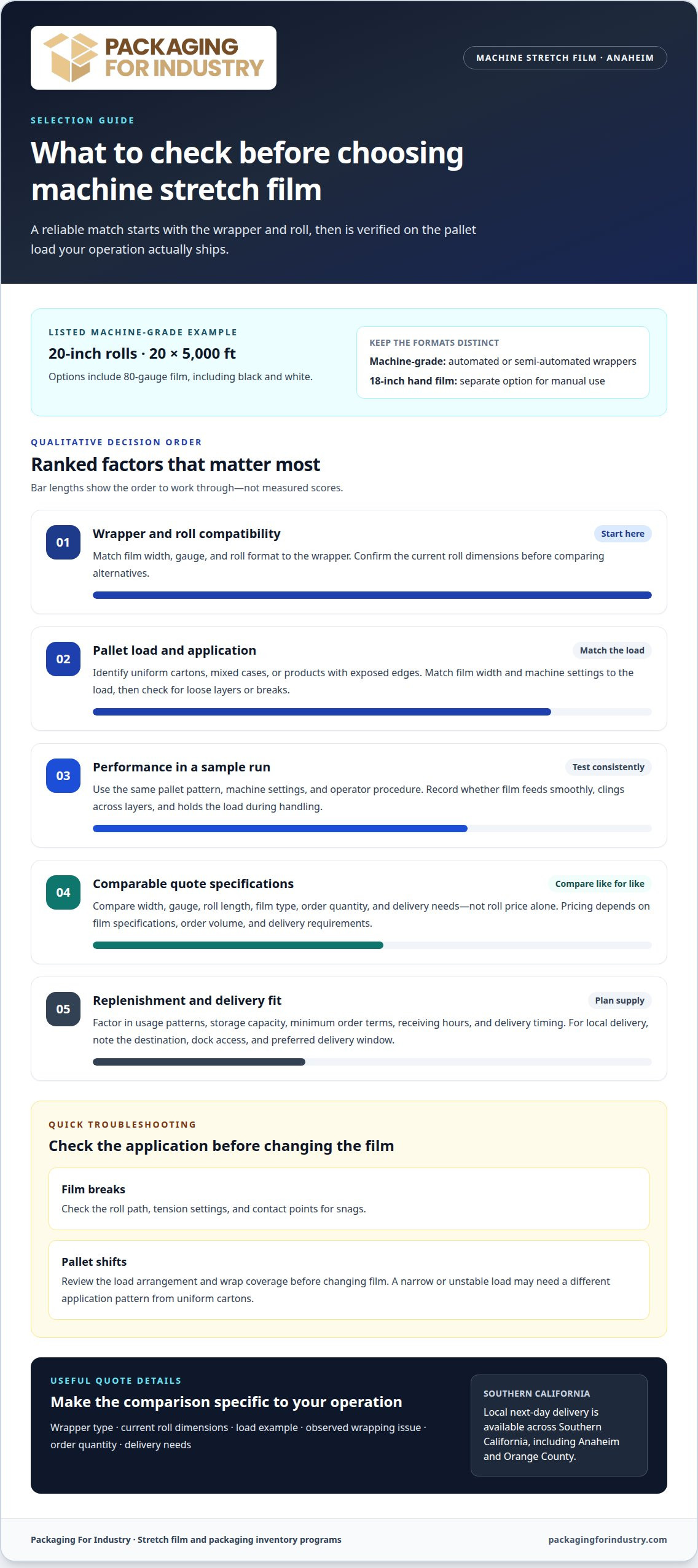
The right machine stretch film is the one your wrapper can run reliably, not simply the roll that looks cheapest. For Anaheim operations comparing a machine stretch film supplier, compatibility starts with the roll’s width, gauge, and format: listed machine-grade options include 20-inch film in 20×5000 sizes, including 80-gauge options, for automated and semi-automated stretch wrappers.
Before changing suppliers, buyers need clear answers about bulk pricing, minimum orders, local delivery, and whether a film works with their equipment. This guide explains what to compare, how machine compatibility affects selection and cost, and what information helps a supplier provide a useful quote. Pricing depends on film specifications and order requirements, so request a quote for your application.
You’ll also find practical advice on testing film and troubleshooting common problems, plus guidance for evaluating wholesale supply for Anaheim and Orange County operations. The aim is a reliable match between film, wrapper, and pallet load that supports warehouse efficiency and packaging cost control.
Key Takeaways
- Match film width, gauge, and roll format to the wrapper and pallet load to support consistent machine performance.
- Compare stretch film quotes by specification, order volume, and delivery requirements, not just by roll price.
- Use sample runs and wrapping results to identify film or application issues before changing a larger supply order.
- Plan bulk purchasing around storage capacity, usage patterns, and the minimum order terms available.
- Packaging For Industry offers stretch film and packaging inventory programs to help Anaheim-area businesses manage supply needs.
Wholesale stretch film and pallet wrap in Anaheim
Choosing pallet wrap starts with the load and wrapping equipment. For shipments from Anaheim, compare film format, width, gauge, and supply needs before selecting a roll.
Custom Widths, Gauges, and Colors
Custom width, gauge, and color requests should be tied to a specific load or handling need. For example, opaque film can help conceal pallet contents, while clear film keeps labels visible. Available machine-grade options include 20-inch rolls in 20×5000 sizes, including 80-gauge black and white film. Machine-grade film is designed for automated and semi-automated wrappers; 18-inch hand stretch film is a separate warehouse option.
Packaging film claims, including recyclability, depend on the material and available local recovery options. Describe stretch wrap as recyclable only when those conditions support the claim.
Local Supply and Application Guidance
A Riverside factory shipping pallets into Anaheim can plan replenishment around film consumption, storage space, and delivery schedules. For a local pallet-wrap supply, a machine stretch film supplier in Anaheim should match roll dimensions and film type to the wrapper and load. The Anaheim packaging service area is relevant to buyers coordinating local sourcing.
For application guidance, identify whether loads consist of uniform cartons, mixed cases, or products with exposed edges. Match film width and machine settings to the load, then check the wrapped pallet for loose layers or film breaks. Consistent application can secure loads without relying on excess wrap.
Machine stretch film for Anaheim operations is designed for automated or semi-automated wrappers. Hand-grade rolls are intended for manual use. When comparing custom widths, gauges, or colors, include the required dimensions, wrapper type, and a load example in your quote request. These details make supplier quotes easier to compare than a general film description alone.
Local delivery across Anaheim and Orange County
Delivery planning affects how much stretch film a warehouse needs on hand. Anaheim buyers can compare local delivery, regional freight, and shipping options by considering order size, receiving hours, and replenishment timing. A pallet-wrap order for a steady production line has different handling needs from a smaller shipment supporting a temporary demand increase.
Will-call may suit buyers arranging their own pickup and transport. Confirm the pickup location, order readiness, loading requirements, and receiving contact before scheduling a vehicle. For local delivery in Anaheim or nearby Orange County communities, include the destination, dock access, and preferred delivery window in your quote request.
Regional freight may suit larger packaging orders moving between facilities or into the Inland Empire. Combining stretch film with other packaging supplies can simplify receiving, provided there is adequate space and safe storage. For a mixed order, identify pallet quantities and unloading access early.
Shipping decisions should account for current inventory use, not just the next order’s size. For example, a distribution center with frequent pallet output can plan replenishment before reserve rolls run low. Share usage patterns and delivery constraints when you request a packaging quote, so options can be evaluated against operational needs.
Local next-day delivery is available across Southern California, including Anaheim and Orange County. Align the order schedule with production demand, storage capacity, and receiving procedures. This gives purchasing teams a clearer basis for comparing local packaging delivery with regional freight or shipments to another facility.
Film samples, pricing, and troubleshooting
Test a sample roll on the wrapper and load that will use it. Keep the pallet pattern, machine settings, and operator procedure consistent throughout the trial. Record whether the film feeds smoothly, clings across layers, and holds the load during handling. A sample run is useful when it reflects actual warehouse conditions, not a different load or wrapping method.
Compare quotes using film width, gauge, roll length, film type, order quantity, and delivery needs. For example, a listed machine-grade option is 20 inches wide and 5,000 feet long; compare its specifications with your current roll before assessing total purchasing value. Pricing depends on film specifications, order volume, and delivery requirements, with the project-specific figure provided after a quote request.
- Record roll dimensions and wrapper type.
- Note film breaks, loose layers, or shifting cartons.
- Compare each trial under the same load conditions.
If film breaks, check the roll path, tension settings, and contact points for snags. If a pallet shifts, review the load arrangement and wrap coverage before changing film. A narrow or unstable load may need a different application pattern from uniform cartons. Record the adjustment and inspect the next wrapped pallet.
For a useful comparison, connect the issue to its operating condition. A film that feeds well on one wrapper may behave differently on another machine or load profile. Share those details when arranging a trial or comparing stretch film options. This keeps specification decisions grounded in actual performance rather than roll descriptions alone.
For a tailored evaluation, request a stretch film quote with the wrapper type, current roll dimensions, load example, and observed wrapping problem. Those details help align sample testing and pricing with the application.
Minimum order quantities and bulk supply
Minimum order quantities affect the balance between unit cost and inventory exposure. Some product listings offer a discount for orders of five or more rolls. Treat that threshold as a purchasing consideration, not an automatic fit for every Anaheim warehouse. The right quantity depends on film consumption, available storage, and replenishment frequency.
Estimate usage from actual wrapping activity. Review purchasing records, pallet volume, and rolls consumed during a normal production cycle. A facility with steady shipments can plan larger orders more confidently than a site with seasonal demand or changing product mixes. Include reserve stock in the calculation, but avoid buying rolls that may sit unused as packaging needs change.
- Compare order quantities against average film use and storage space.
- Group compatible roll specifications to simplify stock control.
- Include delivery timing and receiving capacity in the purchase plan.
Compare bulk pricing only after matching specifications. Check width, gauge, length, and film type across quotes. A lower per-roll price may be misleading if the roll does not match the wrapper requirement. Ask how order thresholds apply to mixed specifications, since combining different rolls may not qualify for the same terms.
For example, an operation using machine film on its main line and hand film for occasional loads should forecast each need separately. This prevents a bulk purchase of one format from masking a shortage of the other. Purchasing teams can also coordinate storage locations and replenishment dates across Anaheim facilities to reduce duplicate orders and last-minute freight needs.
Set a reorder point based on observed use and incoming supply timing, then review it when production schedules change. A simple inventory record that tracks roll type, quantity received, and usage helps buyers refine future orders. This makes bulk purchasing more deliberate and keeps packaging supply aligned with actual demand.
Machine-compatible stretch film and supported wrapper brands
Compatibility depends on the wrapper’s roll requirements and how it applies film. A brand name alone doesn’t establish fit. Match the wrapper’s specifications with film width, gauge, roll dimensions, and load needs before ordering. Available machine-film options include 20-inch rolls in 20×5000 sizes, with 80-gauge black and white film.
Machine-grade film is designed for automated and semi-automated stretch wrappers. To assess compatibility, identify the machine’s manufacturer and model, then compare its roll-mounting and film-feed requirements with the roll format. These details help distinguish a potential match from film designed for manual application.
- Record the wrapper manufacturer and model.
- Note the current roll width, length, and gauge.
- Describe the pallet load and any feed or wrapping issue.
Use those details to narrow your selection, then test a roll under normal operating conditions. Keep the load pattern and machine settings consistent during the trial. Check whether film feeds cleanly, wraps the load evenly, and remains intact during handling. Changes in width or gauge can affect application, so assess the result on the actual machine.
For example, an operation using an automated wrapper should compare its existing roll format with a 20-inch machine-grade option before switching. The 80-gauge specification identifies film thickness, but the right selection also depends on wrapper function and pallet stability. A brand-specific compatibility decision should account for the complete machine setup, not just the wrapper label.
When requesting a stretch film quote, include the wrapper brand and model, roll dimensions, and a load example. If the current film breaks or feeds unevenly, describe when the problem occurs. These practical details help match machine stretch film to the application and narrow down the next trial.
Industries served
Manufacturing plants use machine stretch film to secure palletized components, finished goods, and cartons before storage or dispatch. A production line shipping uniform cases may prioritize consistent wrapping across repeated loads. Operations handling mixed pallet sizes need an application that accommodates changing load shapes without disrupting the packing workflow.
Warehouses use pallet wrap to stabilize inbound stock, replenishment loads, and outbound orders. For example, teams consolidating cartons from different suppliers can wrap each completed pallet before moving it to a rack or loading area. Matching film and application to the warehouse’s handling flow helps keep goods together during routine movement.
Distribution centers often process varied products on tight shipping schedules. Machine wrapping can fit into a packing line where pallets move from order assembly to staging. Loads may include uniform boxes, mixed cartons, or bundled industrial materials. The packaging approach should account for pallet stability and how staff handle loads during staging.
Manufacturers in aerospace, electronics, food, and medical supply chains may ship finished products or replenishment materials on pallets. Each operation has its own load patterns and handling requirements. A pallet of boxed components, for instance, calls for different wrapping considerations than irregularly arranged cartons. Start film selection by understanding the load and its route through the facility.
Construction suppliers and industrial distributors also use stretch wrap to consolidate materials for storage and customer shipments. An Anaheim business sending products to multiple job sites may need orderly, stable pallet loads for dispatch. Packaging decisions should reflect product dimensions, stacking patterns, and shipping workflow rather than relying on one setup for every load.
Manufacturing teams can align packaging choices with production and shipping requirements by reviewing their operations, product mix, and pallet patterns. Considering how goods move between workstations helps purchasing and operations teams connect wrapping requirements with daily shipping activity.
Benefits of choosing the right machine stretch film
Film that suits the wrapper and pallet load can support consistent packaging. For an Anaheim warehouse wrapping uniform cartons, a suitable machine-grade roll can feed through the wrapping cycle without repeated adjustments. A mismatch may cause breaks, rewrapping, or interruptions that use operator time and film.
Packaging cost depends on more than the price per roll. Compare film specifications with the material used per pallet and the frequency of wrapping corrections. If an adjustment reduces excess layers while keeping the load secure, it may help control material use. Track film consumption and rework together to understand the impact.
- Record film use for comparable pallet loads.
- Note breaks, rewraps, and load movement after wrapping.
- Compare results before and after a film or process change.
Stable pallet loads can help reduce shipping damage by limiting movement during normal handling. A mixed-carton pallet, for example, may need an approach that holds the arrangement together during staging and transport. Film selection works alongside careful pallet building; stretch wrap cannot correct an unstable load pattern.
Consistency also supports reliable operations. A distribution center using an automated wrapper benefits when film feeds predictably across routine loads, while purchasing gains clearer usage data for replenishment planning. Matching roll specifications to equipment and load types can reduce avoidable interruptions and make packaging decisions easier to repeat.
Review performance with both operations and purchasing. Operators can report feed issues and rework; buyers can compare usage, order quantities, and replenishment needs. Together, these perspectives can show whether the opportunity lies in film selection, machine setup, or load preparation. A focused stretch film review connects the details to practical cost control.
Packaging For Industry (PFI): Stretch Film
Packaging For Industry (PFI) supplies stretch film for business packaging needs and is a practical option for Anaheim operations seeking film suited to their wrapper, pallet loads, and supply process. Buyers can assess roll requirements alongside warehouse and shipping workflows.
For a machine-wrapping application, share the wrapper type, current roll dimensions, and a representative load. These details help frame a useful stretch film quote and keep the discussion focused on application fit. The stretch film options support buyers evaluating packaging for manufacturers, warehouses, and distribution centers.
Some operations need more than pallet wrap. PFI also supplies foam packaging for products that need cushioning inside a package. Reviewing both needs together can connect product protection with pallet-level handling, particularly for goods moving through multiple warehouse or shipping steps.
Supply coordination matters when film use is steady or replenishment is difficult to manage across operations. PFI’s Vendor Managed Inventory (VMI) for Packaging supports packaging inventory management, while Just-In-Time (JIT) Inventory Management for Packaging helps coordinate supply with operational demand. These services can suit buyers seeking more structured inventory support alongside stretch film purchasing.
To prepare a quote request, outline the wrapper and film format, the loads being secured, expected usage patterns, and any inventory coordination needs. PFI can use this operational context to address your requirements, whether the priority is machine stretch film, foam packaging, VMI, or JIT inventory management.
Contact Packaging For Industry (PFI) to discuss your packaging needs.
Put Your Stretch Film Plan Into Action
Turn your wrapping requirements into a purchasing plan that fits daily operations. Choosing a machine stretch film supplier in Anaheim is an opportunity to align film selection with equipment, product protection, and supply management. Include operations and purchasing in the discussion so decisions reflect both line performance and inventory priorities.
Packaging For Industry (PFI) helps businesses address stretch film and foam packaging needs, with Vendor Managed Inventory (VMI) available for packaging supply management. This broader approach is useful when pallet wrapping is part of a larger effort to coordinate packaging materials and keep warehouse operations supplied.
Bring your priorities to PFI’s quote process, whether you’re evaluating machine film, protecting products with foam, or managing packaging inventory. Share your requirements to identify the right next step for your operation.
With a clear plan, your team can make packaging decisions with greater confidence and keep work moving.
Frequently Asked Questions
Where is the Anaheim stretch film supplier, and which areas does it serve?
Packaging For Industry (PFI) is headquartered in Anaheim and serves businesses in Orange County, Los Angeles, and San Diego. When planning deliveries, distinguish the headquarters location from the delivery destination, especially when packaging is received at another site. Record the facility city and receiving location so teams can coordinate quotes and replenishment consistently across operating locations.
How much does machine stretch film cost per roll or pallet in Anaheim?
Machine stretch film pricing depends on product specifications and order requirements, so request a quote to establish the cost. For an accurate comparison, evaluate equivalent product descriptions and quantities, then compare the quoted order total rather than treating a roll price as the full pallet cost. Keep freight and handling visible in the comparison.
What are the bulk pricing and minimum order quantities for stretch film?
Evaluate minimum quantities and bulk terms for the specific film being purchased rather than assuming they apply uniformly to every order. Before replenishing, estimate demand for each film type and account for warehouse space and budget. If procurement tracks several facilities, record each location’s requirements separately to avoid ordering more than operations need.
How long does stretch film delivery to Anaheim take, and what does shipping cost?
Delivery timing and shipping charges depend on destination and order arrangement. For a workable delivery plan, provide the receiving facility’s hours, dock or unloading constraints, and any appointment requirements. Ask for freight charges to be shown clearly in the quote, then compare the delivered order total. This avoids relying on a product-only figure when receiving procedures also affect execution.
How can I request a stretch film quote, evaluate samples, and place an order?
Start a quote request with your business name, delivery location, required film type, order quantity, and purchasing contact. If evaluating a sample, describe its intended use and agree on what success means, such as smooth feeding or a stable wrapped load. Keep evaluation notes with the purchasing record. Once the specification and quantity are settled, submit them together to reduce back-and-forth.