
The key change when you migrate from Grainger to a dedicated packaging engineer is moving from product purchasing to focused support for your packaging project. According to the United States Environmental Protection Agency, assessing incoming packaging requires an individual or team dedicated to the project. That focus can help connect packaging decisions to product protection, handling, and supply needs.
A familiar supplier and straightforward purchasing process can be valuable. The question is whether your current approach gives packaging challenges enough attention, especially when damage, fit, or supply coordination becomes a concern.
This article explains what dedicated engineering support changes, what to prepare for a transition, and how to assess whether the approach suits your operation. It also covers how packaging design, inventory planning, and implementation can work together to support reliable purchasing and shipping.
Key Takeaways
- Assess whether your current packaging process gives product protection, handling needs, and supply coordination focused attention.
- The United States Environmental Protection Agency identifies a dedicated individual or team as essential when assessing incoming packaging.
- Plan a transition by documenting packaging requirements, recurring issues, and the priorities your operation needs support with.
- Foam packaging may be a practical next step when product protection needs closer attention.
Migrate from Grainger to a dedicated packaging engineer
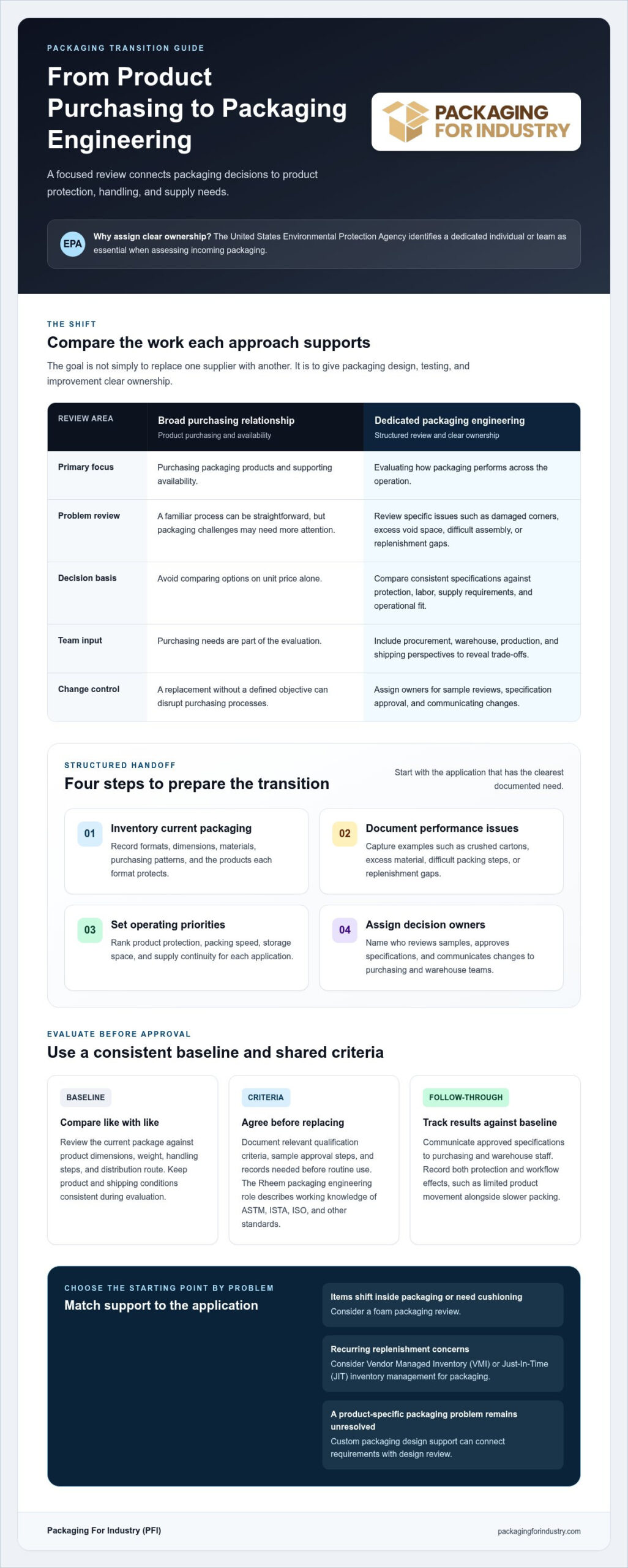
Moving from a broad purchasing relationship to dedicated packaging engineering changes how packaging problems are evaluated. The goal is not simply to replace one supplier with another, but to give packaging design, testing, and improvement clear ownership. Start by defining which products, packaging formats, and operating problems need attention. This scope helps your team compare packaging costs against protection, labor, and supply requirements rather than unit prices alone.
A distributor can support purchasing and product availability. Engineering support adds a structured review of how packaging performs across your operation. Record specific issues such as damaged corners, excess void space, difficult assembly, or recurring replenishment gaps. These observations help identify solutions suited to actual working conditions. Procurement can then compare options against consistent specifications, including bulk pricing when order quantities matter.
The United States Environmental Protection Agency identifies a dedicated individual or team as essential when assessing incoming packaging. Assign responsibility for reviewing packaging formats, evaluating changes, and sharing decisions. Include procurement, warehouse, production, and shipping perspectives. Their input can reveal trade-offs, such as a package that protects a component but takes longer to assemble. Clear ownership also helps teams prioritize changes that may lower packaging costs without overlooking product protection or supply reliability.
Use a structured handoff to transfer useful information and limit disruption:
- Inventory current packaging. Record formats, dimensions, materials, purchasing patterns, and the products each format protects.
- Document performance issues. Capture examples such as crushed cartons, excess material, difficult packing steps, or replenishment gaps.
- Set operating priorities. Rank product protection, packing speed, storage space, and supply continuity for each application.
- Assign decision owners. Name who reviews samples, approves specifications, and communicates changes to purchasing and warehouse teams.
Establish a baseline before changing a design. Compare the current package with the product’s dimensions, weight, handling steps, and distribution route. A part that shifts inside its carton presents a different design problem from one that packs securely but takes up excessive space. Keep product and shipping conditions consistent during evaluation. Then compare packaging costs against the same requirements, weighing performance and operational fit alongside purchase cost.
Agree on evaluation criteria before approving a replacement. The Rheem packaging engineering role calls for working knowledge of ASTM, ISTA, ISO, and other packaging qualification standards. It also describes setting test protocols around product distribution models and total supply-chain plans. For your transition, document relevant criteria, sample approval steps, and records needed before routine use. This gives engineering, procurement, and warehouse teams a shared basis for decisions.
Material review may also form part of an incoming-package assessment. The Agency for Toxic Substances and Disease Registry reports vinyl chloride levels in the packages ranged from none detected (<1 ppb) to about 275 ppb. Treat this as a specific reported finding, not a general conclusion about packaging. Keep material questions distinct from fit, damage, and workflow concerns.
For aerospace, electronics, medical, food, and construction operations, packaging needs vary by product and handling process. PFI’s custom packaging design services can help when a standard purchasing approach leaves a product-specific packaging problem unresolved. The practical advantage is connecting packaging requirements with design support, rather than treating every issue as a routine reorder. Start with the application that has the clearest documented need, then assess whether the proposed design meets your team’s criteria before expanding it to other products.
Implement approved changes in a controlled sequence. Communicate the specification to purchasing and warehouse staff, then track results against the baseline. If a revised package limits product movement but slows packing, record both effects. A clear decision trail helps distinguish design improvements from supply or process problems and provides a sound basis for the next packaging review.
Packaging For Industry (PFI): Foam Packaging
Packaging For Industry (PFI) provides foam packaging to help manufacturers protect products. Consider a review when items shift inside their packaging, need cushioning during handling, or require a more consistent packing approach. Reviewing packing and replenishment routines can connect protection choices with warehouse operations.
PFI also offers stretch film, Vendor Managed Inventory (VMI) for Packaging, and Just-In-Time (JIT) Inventory Management for Packaging. These services can help teams coordinate packaging supply with production and shipping demand. For operations aiming to automate application alongside film supply, pallet wrapping machinery from Phoenix Handling Solutions provides dedicated equipment to keep pallet loads secure during transit. Choose a starting point based on the problem: product movement calls for a foam review, while recurring replenishment concerns may call for inventory management support.
Contact Packaging For Industry to discuss your packaging needs.
Put Your Next Packaging Decision Into Action
A supplier transition works best when the next step is specific and measurable. Choose one packaging application, define the desired result, and assign someone to review the outcome with purchasing and operations. This gives your team a practical way to decide whether to migrate from Grainger to a dedicated packaging engineer and how to manage the change.
Before the review, gather product details, current packaging requirements, and operational priorities. A clear scope keeps the discussion focused on the needs your team wants to address, rather than changing purchasing processes without a defined objective.
Share your packaging requirements and outline the application you want to improve.
A focused first step can help your team make its next packaging decision with greater clarity.