
The lowest unit price doesn’t always mean the lowest total cost. Comparing Uline pricing to local wholesale box suppliers means weighing order minimums, volume discounts, and freight alongside the listed price. Quantity terms affect both the order total and how much packaging your warehouse must store.
For a fair comparison, match box specifications and use realistic order quantities. Supplier type, discount structures, and delivery costs all shape the final packaging expense. These criteria help purchasing teams choose a supplier that fits their operation.
Key Takeaways
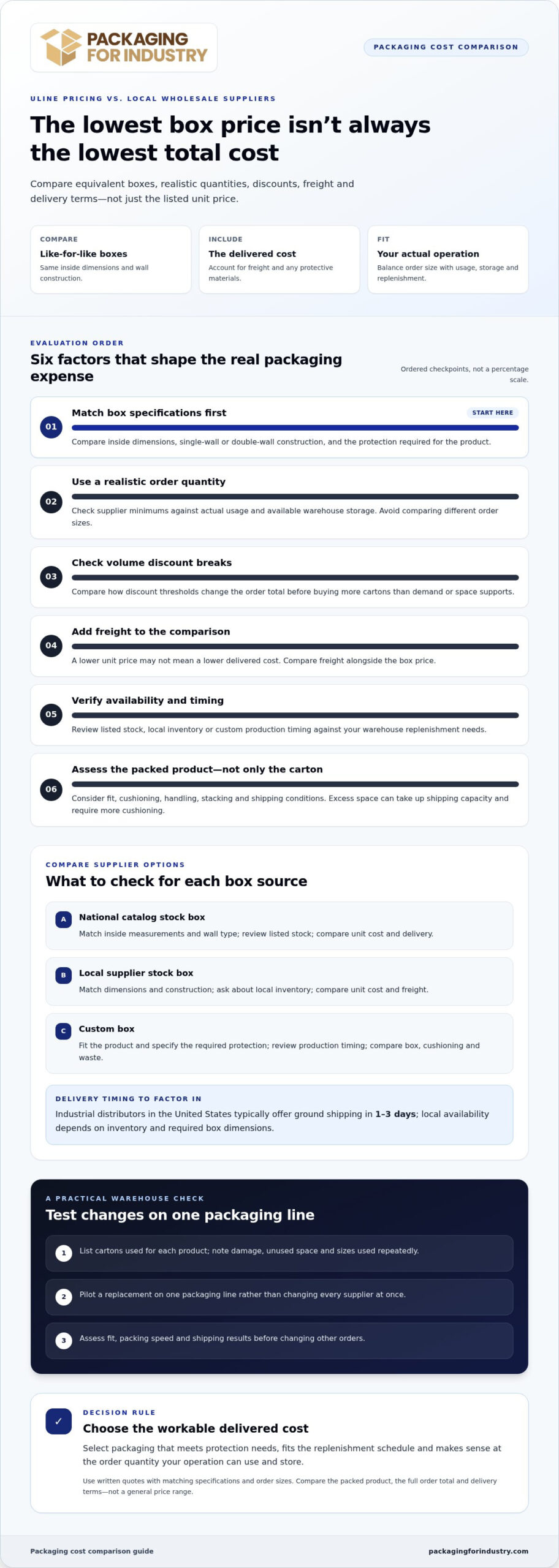
- Compare boxes with matching dimensions, construction, and order quantities so the unit-price comparison is meaningful.
- Wholesale suppliers can differ in minimum order requirements, so match the purchase quantity to your actual usage.
- Check how volume discount breaks affect the order total before committing to a larger quantity.
- Include freight in the landed cost; a lower box price may not mean a lower delivered cost.
- Use the price-by-size-and-quantity comparison to identify which purchasing option best fits your packaging needs.
Comparing unit prices for equivalent packaging
Start by matching box specifications, not supplier names. A compact single-wall carton is not comparable to a larger double-wall box. For a useful Los Angeles comparison, record each box’s inside dimensions, board construction, order quantity, and delivery terms. Then compare equivalent packaging from a national catalog supplier and local wholesale suppliers.
Construction affects both suitability and cost. Single-wall and double-wall boxes serve different shipping needs, so match the protection to the product. Consider weight, handling, stacking, and shipping conditions. A stronger box may suit a fragile item, but add-on protection may be unnecessary for a lightweight product.
Stock dimensions can simplify purchasing when standard sizes fit the product. Custom dimensions may reduce excess space when stock cartons leave large gaps. Compare a stock carton that needs substantial cushioning with a closer-fitting custom box, including both the box price and the protective materials each option requires.
National catalog suppliers and local wholesale box suppliers can differ in stock availability and delivery. Industrial distributors in the United States typically offer ground shipping in 1-3 days and extensive branch networks. Local availability depends on inventory and the required box dimensions, so assess timing against your warehouse’s replenishment needs.
Wholesale prices for single-wall and double-wall corrugated boxes vary by dimensions, construction, quantity, and freight. Compare written quotes with matching specifications and order sizes, rather than relying on a general price range.
| Option | Dimensions | Construction | Availability | Comparison focus |
|---|---|---|---|---|
| National catalog stock box | Match inside measurements | Match wall type | Review listed stock | Unit cost and delivery |
| Local supplier stock box | Match inside measurements | Match wall type | Ask about local inventory | Unit cost and freight |
| Custom box | Fit the product | Specify required protection | Review production timing | Box, cushioning, and waste |
Choose the option that meets protection needs at a workable delivered cost and fits your replenishment schedule.
A warehouse packaging audit can identify which products to switch without replacing every supplier. List the cartons used for each product, note damage or unused space, and flag sizes used repeatedly. Pilot a replacement on one packaging line, then assess fit, packing speed, and shipping results before changing other orders. This gives warehouse staff a manageable way to evaluate a new supplier.
Excess space takes up shipping capacity and may require more cushioning. Compare the packed product, not just the empty carton: a closer-fitting box can improve packaging efficiency while maintaining suitable protection. To find wholesale box suppliers near you in the United States, search by location and product, such as “Los Angeles wholesale box supplier,” then request quotes for matching specifications and quantities.
Wholesale merchants versus industrial distributors
Wholesale merchants and industrial distributors can serve different purchasing patterns. A catalog-based merchant offers a direct route to standard packaging products. An industrial distributor may support recurring purchases across several packaging categories. The right fit depends on materials, order quantity, delivery needs, and packaging performance in your operation. Compare the full purchasing process, not just one listed unit price.
Industrial distributors in the United States typically offer ground shipping in 1-3 days, with extensive branch networks. Some suppliers also offer more flexible minimum order quantities than large catalog merchants. That flexibility can help a warehouse avoid ordering more than its storage space or demand supports. For a recurring box order, compare minimum quantities, reorder steps, delivery terms, and product consistency.
Wholesale ordering can suit standard needs, such as shipping cartons or basic protective materials. An industrial distributor may fit better when purchasing involves varied applications or recurring production requirements. For example, a manufacturer could assess how one supplier handles cartons for finished goods and protective packaging for components. Base the evaluation on actual purchasing needs, rather than assuming one supplier category always costs less.
Different operations use buckets for different purposes. A food producer may use them for ingredients or production materials, while a maintenance team may need them for shop supplies. A construction supplier might use buckets to organize materials at a job site. In each case, consider intended contents, handling, storage, and closure. Compare the full packaging requirement, not just the bucket price.
Industry-specific protection affects what counts as a comparable purchase. An aerospace operation handling precision components has different requirements from a distributor shipping durable building materials. An electronics warehouse may need packaging that protects sensitive items during handling. Before comparing suppliers, document the product, handling steps, shipping route, and damage concerns. This helps purchasing teams define equivalent packaging and avoid comparing products with different functions.
- For standard, occasional orders: compare catalog options, minimum quantities, and delivered terms.
- For repeat purchasing: compare reorder consistency, quantity flexibility, and delivery fit.
- For varied applications: assess whether a distributor can support the material and protection needs together.
Use these criteria for packaging decisions across warehouses, manufacturers, and distribution centers. A focused quote request can turn product, quantity, and protection requirements into a comparable purchasing discussion. Share the intended use and replenishment pattern, then assess each supplier against your operational priorities.
Comparing supplier categories by pricing and volume discounts
Minimum order requirements vary by supplier, and some suppliers offer more flexible quantities than Uline. Compare each supplier’s price breaks, order size, and additional charges to see how the total changes at your purchasing volume.
Supplier Category Pricing
Catalog-based wholesale merchants make it straightforward to compare listed prices for standard packaging. Industrial distributors may offer options suited to recurring or mixed packaging needs, so evaluate the whole order rather than one unit price. Compare the same box specification and quantity across suppliers, then include freight and any order-related charges. A low listed price may not remain the lowest after those costs.
Supplier category alone doesn’t determine value. A business ordering stock cartons repeatedly may prioritize predictable price breaks, while a smaller order may benefit more from flexible quantities. Use equivalent specifications and the same delivery destination for each quote. That gives purchasing teams a consistent basis for assessing bulk packaging pricing.
Minimum Order Quantities
Minimum order quantities affect both the quoted unit price and the cash tied up in inventory. Some suppliers offer more flexible minimums than Uline, which can suit a warehouse with limited storage or changing demand. Compare the required order size with actual usage and available space. A larger purchase only makes sense if the packaging can be stored and used efficiently.
For each quote, record the minimum quantity, price at that quantity, and any applicable charges. Compare those figures with how much your operation can use before packaging dimensions or requirements change. This helps distinguish a useful bulk rate from an order that creates excess stock.
Volume Discounts
Volume-discount breaks may apply at quantities such as 50 units, 100 units, and 500 units. Compare the price at each break for the same box type, rather than assuming a larger order always delivers better value. A discount matters only if the additional quantity fits your purchasing plan and storage capacity.
Uline and local box suppliers may structure price breaks differently. Ask for prices at order sizes your team can realistically use, including a quantity below and above its usual purchase. Compare the unit cost and total charge at each level. This shows whether a discount rewards a practical order size or encourages purchasing beyond current demand.
Use a simple comparison sheet for each alternative: supplier category, minimum quantity, prices at 50, 100, and 500 units, freight, and other charges. Keep box specifications and delivery details consistent. If one supplier quotes a different size or construction, request a matching option before comparing totals. This prevents a discount from obscuring a packaging difference.
Test the order size against your inventory cycle. A distribution center with steady carton use may benefit from a higher price break; a business with variable demand may prefer flexible replenishment. Compare the cost per usable box, not just the advertised break, and choose a supplier whose pricing structure fits actual consumption.
Evaluating freight and total landed cost
A catalog unit price is only one part of a box order’s delivered cost. Include freight and delivery charges, then divide the total by the number of usable boxes. This makes a local delivery quote comparable with a shipped order, especially for bulky cartons.
Uline shipping, delivery, and fuel charges can depend on the order, destination, and delivery method. Compare freight and any listed surcharges against the order total rather than assuming one charge applies to every box purchase. For local and shipped orders alike, use the same quantity and delivery destination.
Freight can add 10-20% to the unit cost of heavy or bulky items. Treat these as examples, not universal rates.
Delivery speed can also affect inventory planning. Industrial distributors typically offer ground shipping in 1-3 days, while office and professional-supply channels typically offer nationwide shipping in 1-2 days. For Los Angeles orders, compare the stated delivery method and timing with the date your warehouse needs stock. A lower landed cost has limited value if the delivery timing disrupts production or fulfillment.
When comparing box suppliers, review each quote and invoice for freight, delivery, handling, fuel surcharges, minimum-order charges, and applicable taxes. Return terms matter too: industrial distributors commonly have defined return windows of around 30 days. Check the return window and any conditions before switching, particularly if you’re testing a new size or order quantity.
- Freight: record the charge for the full order and calculate its per-box effect.
- Taxes: compare the final payable total, including applicable taxes.
- Returns: note the return window and conditions for unused boxes.
- Timing: compare delivery method and expected arrival against warehouse demand.
To compare offers consistently, put box cost, freight, surcharges, taxes, and return terms on one worksheet. For example, compare the same box quantity from a shipped catalog order and a local delivery quote. Account for storage and replenishment needs when switching suppliers: ordering more to offset freight can increase inventory on hand. Judge the result by total delivered cost and whether the supply plan fits your operation.
Uline’s delivery and fuel charges vary with the order, destination, and delivery method. Check the applicable amounts on the specific order total rather than assuming a standard rate.
What are Uline prices for common corrugated shipping boxes by size and quantity?
There isn’t one useful price for a “common box” without matching its size, construction, and order quantity. A stock RSC box and a double-wall carton serve different needs, so compare Uline listings against the same box type and quantity from each supplier. The product prices in the example comparison were checked on October 25, 2026, and catalog prices can change.
Build your comparison around the cartons your operation actually uses. For each size, record the box style, inside dimensions, wall construction, order quantity, and listed unit price. Calculate the box subtotal, then add freight separately. This prevents comparing a smaller carton with a larger one or treating single-wall packaging as a substitute for a double-wall requirement.
Quantity changes the comparison. Use your regular purchase amount, then examine the next available price break in each supplier’s listing or quote. A lower unit price at a higher quantity can still create excess inventory if your warehouse cannot use the cartons promptly. Compare the total for the amount you can consume during your normal purchasing cycle, not only the largest tier offered.
Use a worksheet with one row per box size and one column for each supplier. Include:
- Box match: style, dimensions, and wall construction.
- Order match: quantity and any minimum requirement.
- Cost comparison: unit price, order subtotal, and freight.
- Operating fit: storage needs and the product being shipped.
For a Los Angeles warehouse, this format helps compare an online catalog order with a local supplier quote using identical specifications. If one supplier quotes custom dimensions while another lists stock dimensions, note the difference before drawing a cost conclusion. A closer-fitting box may change cushioning use and packing efficiency, but the comparison should still reflect the protection your product needs.
Recheck the listing or written quote when placing the order. Record the quote date, box description, quantity, freight, and applicable charges. This creates a useful reference for later purchases and helps identify whether a changed total comes from box pricing, order size, or delivery. It also gives purchasing and warehouse teams a consistent basis for reviewing supplier options.
For a corrugated box quote based on your packaging requirements, request a packaging quote.
Packaging For Industry (PFI): Foam Packaging
Packaging For Industry (PFI) offers protective foam packaging for manufacturers shipping products that need cushioning inside a carton. Its foam options can be considered alongside corrugated boxes and stretch film when reviewing protection and packaging needs for warehouse operations.
For aerospace, electronics, and medical device businesses, the right packaging depends on the product and its handling requirements. PFI also offers Vendor Managed Inventory (VMI) and Just-In-Time (JIT) inventory programs to support recurring packaging supply needs. These services help purchasing and operations teams coordinate replenishment.
Turn to PFI to discuss foam protection or recurring packaging requirements with an industrial packaging partner. Contact Packaging For Industry to review your needs.
Put Your Packaging Plan Into Action
Use your comparison as a starting point for improving how packaging supports daily operations. The next opportunity may be refining product protection, aligning inventory with demand, or reducing handling interruptions. A practical purchasing plan considers packaging performance alongside procurement and warehouse workflow.
For businesses assessing these needs, Packaging For Industry (PFI) offers Foam Packaging, Stretch Film, and Vendor Managed Inventory (VMI) programs. These services can help when packaging protection, material use, or replenishment planning needs attention. Reviewing your current requirements can clarify where to prioritize a change while keeping your operation in view.
Use the criteria for comparing Uline pricing to local wholesale box suppliers to guide a conversation about your team’s packaging challenges. Share the products you pack and the operational goals you want to address, then take the next step toward a practical packaging plan.
A well-matched packaging approach helps your team make decisions with greater clarity and control.
Frequently Asked Questions
How does freight cost impact the price comparison between Uline and wholesale?
Freight affects delivered cost, so compare complete orders rather than catalog totals. For a Los Angeles shipment, factors may include carton size, total shipment weight, delivery location, and carrier terms. Local pickup may avoid shipment charges but still require staff time and transportation. Include those operational costs when relevant, then compare the final amount with the packaging budget for that order.
How much can I save by switching to a wholesale packaging supplier?
Savings depend on your current price, packaging specifications, purchase volume, freight, and whether the new option performs the same job. Compare recent invoices with a like-for-like quote, then account for changes in cushioning use, damage, or storage needs. A lower carton price, for example, may not reduce overall spend if the new size requires more protective material or creates handling issues.
Price comparison: which supplier offers the best value?
The best value is packaging that meets your operational requirements at a workable total cost. A Los Angeles fulfillment operation with frequent replenishment may value convenient ordering and consistent supply, while a manufacturer shipping fragile parts may prioritize fit and protection. Set your criteria before reviewing quotes: product performance, ordering effort, delivery fit, and total cost. Then weigh each option against those priorities.
Do local box suppliers offer free pickup or lower-cost local delivery?
Pickup and delivery arrangements differ among Los Angeles box suppliers. A local supplier may offer pickup, delivery, or neither, depending on its terms and the order. Compare the complete arrangement, including travel time, vehicle capacity, receiving hours, and any delivery charge. A warehouse with limited receiving staff may prefer scheduled delivery, while a nearby facility with suitable transport may find pickup practical.
How can I compare box prices fairly by dimensions, board strength, and box style?
Use the same specifications for every quote: inside dimensions, board construction, and box style. Note whether the carton is an RSC or another design, and compare single-wall, double-wall, or triple-wall options only when they meet the same use requirements. Pack a representative product in each candidate and assess fit, closure, and protection during normal handling. This helps avoid choosing a low-priced carton that needs extra materials or repacking.
What are the cost differences between stock boxes and custom-sized boxes from Uline and local suppliers?
Stock boxes may cost less when standard sizes fit, while custom-sized boxes may reduce excess space and cushioning needs. Compare the box price and protective materials for the same product requirements. Prices vary by dimensions, construction, quantity, and freight.