
A single non-compliance code on a government contract can trigger rejected shipments and financial penalties that quickly erase your profit margins. For defense contractors across Southern California, the June 27, 2024, update to MIL-STD-2073 has made staying current more than just a checkbox; it’s a mission-critical necessity. You need mil-spec packaging solutions Southern California manufacturers can rely on to bridge the gap between complex federal regulations and efficient warehouse operations.
It’s frustrating to wait weeks for national catalog suppliers only to receive oversized boxes that drive up freight costs and increase the risk of transit damage to sensitive electronics. Packaging For Industry (PFI) understands that your operational success depends on precision and speed. This guide shows you how to master MIL-STD-2073 compliance while slashing logistics expenses through engineered, right-sized packaging. We’ll examine specific standards for ESD protection, explore the benefits of local next-day delivery to keep your floor running, and explain how custom prototyping ensures your high-value assets arrive in perfect condition every time.
Key Takeaways
- Learn how to navigate the latest MIL-STD-2073 requirements to ensure total contract compliance and avoid costly penalties from government agencies.
- Discover how to select optimal materials, including ESD shielding and specialized cushioning, when sourcing mil-spec packaging solutions Southern California defense contractors require for high-value electronics.
- Understand how CAD/CAM engineering and free prototyping eliminate transit damage by creating a precision fit for complex aerospace and military components.
- Explore procurement strategies like Vendor Managed Inventory (VMI) to lower your overhead and solve storage challenges in expensive Southern California warehouse spaces.
- See how local, next-day delivery and Just-In-Time (JIT) supply chains can remove production bottlenecks caused by excessive lead times from national catalog suppliers.
Navigating Mil-Spec Packaging Compliance in Southern California
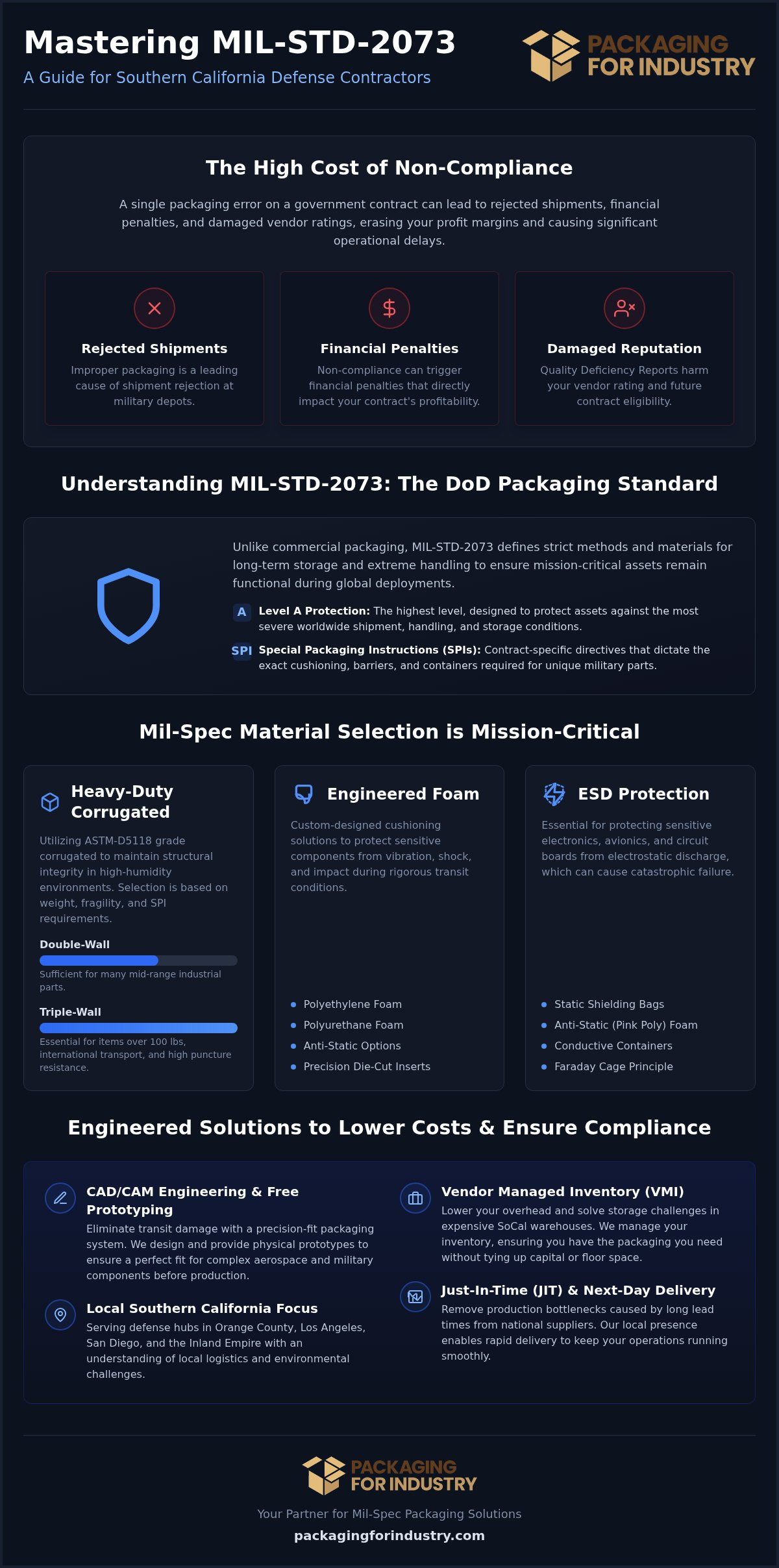
Mil-spec packaging refers to materials and methods that meet strict Department of Defense (DOD) standards for the preservation and shipment of military assets. For contractors operating within the San Diego and Los Angeles defense hubs, compliance is a non-negotiable contractual requirement. These standards ensure that critical components remain functional regardless of environmental exposure or rigorous transit conditions. Relying on standard commercial boxes for high-value government contracts often leads to rejected shipments at the receiving dock, causing significant friction in the supply chain. PFI simplifies this process for local manufacturing teams by providing engineered mil-spec packaging solutions Southern California businesses need to satisfy complex federal audits.
Understanding MIL-STD-2073 and Preservation Levels
MIL-STD-2073 is the standard for military packaging methods and materials. Unlike commercial packaging, which focuses on retail presentation and basic protection, military preservation levels are designed for long-term storage and extreme handling. The history of mil-spec packaging demonstrates that these rigid requirements were born from the need to protect sensitive equipment during global deployments where climate control is nonexistent.
Contractors must distinguish between different levels of protection, such as Level A for maximum military protection or commercial packaging when specified. For new or unique military parts, following Special Packaging Instructions (SPI) is essential. These instructions dictate the exact cushioning, barrier materials, and container types required. PFI assists local firms by interpreting these technical codes and designing compliant systems that prevent corrosion and physical damage during multi-modal transport.
The High Cost of Non-Compliance in Defense Logistics
Improper packaging is a leading cause of rejected shipments and contract delays in the defense sector. If a shipment arrives at a military depot and fails to meet MIL-STD-2073 requirements, the contractor may face financial penalties or “Quality Deficiency Reports” that damage their vendor rating. Using standard corrugated boxes instead of specialized military packaging can lead to catastrophic failures for sensitive electronics, avionics, and munitions.
The financial impact extends beyond mere replacement costs. Transit damage to mission-critical gear can stall entire operations and lead to missed delivery windows. By utilizing mil-spec packaging solutions Southern California contractors can reduce their risk profile. Precision-engineered foam inserts and weather-resistant containers ensure that high-value assets withstand moisture, static, and vibration. This proactive approach to compliance protects your bottom line and reinforces your reputation as a reliable partner to the DOD.
Material Specifications: MIL-SPEC Foam, ESD, and Corrugated
Selecting the right materials for a defense contract requires a deep understanding of the environment the asset will encounter. In Southern California, manufacturers often ship to coastal depots or high-heat desert testing grounds, making weather-resistant materials a priority. We utilize ASTM-D5118 grade corrugated to ensure boxes maintain structural integrity in high-humidity environments. While standard shipping might use single-wall corrugated, mil-spec packaging solutions Southern California contractors use often demand double-wall or triple-wall construction. Triple-wall corrugated provides the puncture resistance and stacking strength required for heavy munitions and engine components, often serving as a cost-effective alternative to heavy wood crates.
The choice between double-wall and triple-wall depends on the weight and fragility of the contents. Double-wall boxes are sufficient for many mid-range industrial parts, but when you’re shipping items that exceed 100 pounds or require international transport, the extra layer of fluting in triple-wall is essential. This material selection isn’t just about protection; it’s about compliance with the specific codes listed in your contract’s Special Packaging Instructions (SPI). Using the wrong grade of fiberboard can lead to rejected shipments at the military terminal, even if the part inside is undamaged.
Engineered Foam for Vibration and Impact Protection
Cushioning isn’t a one-size-fits-all solution. We evaluate the fragility of your part to choose between Polyethylene (PE) and Polyurethane (PU) foam. PE foam is a closed-cell material that offers high load-bearing capacity, making it perfect for heavy machinery. Conversely, PU foam is an open-cell, softer material designed to absorb the energy from drops and vibrations for lighter instruments. Under the MIL-PRF-26514G performance specification, we design custom foam packaging inserts that match the exact geometry of your part. For delicate optics, we provide low-outgassing foam to prevent chemical fogging on lenses, ensuring your equipment is mission-ready upon arrival.
Static Shielding and ESD Compliance
Sensitive electronics require protection from more than just physical impact. Static discharge can cause latent circuit failure, where a component passes initial testing but fails once deployed in the field. We utilize MIL-PRF-81705E, Type III barrier materials to create a Faraday cage around your assets. These moisture barrier bags and static-shielding films prevent electrostatic discharge and corrosion simultaneously. As a trusted manufacturing packaging partner in the Inland Empire and Orange County, we ensure every element of the kit, from the foam to the outer carton, is ESD compliant. If you’re unsure which barrier material your contract requires, you can compare packaging pricing and have our engineers review your specific requirements.
The Engineering Process: From CAD Design to Physical Prototype
Engineering mil-spec packaging solutions Southern California contractors need requires moving beyond guesswork. We utilize CAD/CAM support to translate complex military blueprints into high-precision protective systems. This process ensures that every component, from heavy-duty corrugated walls to specialized foam inserts, aligns perfectly with the physical dimensions and fragility of the asset. By integrating 3D modeling early in the procurement cycle, we identify potential failure points before they reach the assembly line, ensuring that your high-value components remain mission-ready.
Custom Design and CAD/CAM Integration
Our engineers focus on creating integrated custom design packaging that optimizes both protection and volume. For manufacturers in the San Diego and Los Angeles defense corridors, kitting is a major efficiency driver. We design assemblies that organize multiple parts into a single, compliant kit, reducing the logistical burden of tracking individual containers. This approach is particularly beneficial for aerospace packaging, where multi-component assemblies must be secured against the high-frequency vibrations of air transport while maintaining strict weight limitations.
Prototyping for Zero-Damage Shipments
While a digital model provides a strong foundation, a physical sample is critical for verifying Special Packaging Instructions (SPI). A physical prototype allows your operations team to test the pack-out process in real-world conditions. It ensures the foam density provides the correct resistance and that barrier bags fit without bunching or tearing. Because we’re a local partner, we provide rapid revisions that national catalog suppliers simply can’t match. Our facility in Anaheim allows Orange County manufacturers to receive samples and provide feedback in days rather than weeks. To eliminate the risk of non-compliance and transit damage, you can request a quote to start your free prototyping process today.
We validate every design through testing protocols that simulate transit stress. Whether it involves drop testing for impact or vibration tables for long-haul transport, these simulations prove that a custom crate or box will hold up under pressure. This collaborative design process involves your local operations team at every stage. We work closely with Southern California manufacturing teams to refine designs quickly, ensuring the final product meets both DOD standards and your internal warehouse logistics requirements. This methodical approach ensures 100% compliance before the first production run ever leaves your facility.
Procurement Strategies to Lower Military Packaging Costs
Procurement managers in Southern California face a unique challenge: balancing rigid DOD compliance with some of the highest industrial real estate costs in the nation. While meeting MIL-STD-2073 is mandatory, the way you source those materials determines your operational profitability. Implementing strategic mil-spec packaging solutions Southern California manufacturers can leverage, like local inventory management and precision sizing, removes the hidden costs often found in standard catalog orders.
The VMI Advantage for Southern California Manufacturers
Warehouse space in Irvine and Santa Fe Springs is a premium resource that shouldn’t be wasted on bulk packaging storage. We manage your vendor managed inventory to ensure you never face a line-down situation due to a shortage of compliant boxes or foam. By shifting the storage burden to us, you free up floor space for production and simplify the purchasing process for your procurement team. This proactive oversight allows your staff to focus on fulfilling contracts rather than tracking box counts in the warehouse.
The Economics of Custom-Sized Packaging
Many contractors rely on off-the-shelf catalog boxes, but this is often a false economy. Standard sizes rarely match the exact dimensions of complex military components, leading to excessive void fill and higher dimensional weight (DIM) surcharges from carriers. We offer heavy-duty RSC boxes engineered to your specific part geometry, with custom sizes available to meet any SPI requirement. Custom sizing eliminates waste by right-sizing every container to its contents. We also lower labor costs through packaging kitting, providing pre-assembled foam and corrugated sets that arrive ready for immediate use. Consider these factors when evaluating your spend:
- Reduced Freight: Smaller box dimensions lower the DIM weight and overall shipping volume.
- Labor Efficiency: Kitted solutions reduce the time spent assembling multi-part packaging.
- Zero Damage: Precision-fit inserts eliminate the movement that causes transit damage.
- Material Savings: Eliminating excessive bubble wrap or loose fill lowers the cost per unit.
For recurring production lines, we coordinate bulk ordering strategies that capture volume discounts without overwhelming your warehouse. Our local fleet provides next-day delivery across the Inland Empire and Orange County, supporting a Just-In-Time (JIT) workflow. This ensures the mil-spec packaging solutions Southern California production schedules require are always available without tying up significant working capital in excess stock.
Why Partner with PFI for Mil-Spec Solutions in Southern California?
PFI operates as a seasoned industrial consultant and proactive problem-solver for defense contractors across the region. We provide mil-spec packaging solutions Southern California manufacturers trust to maintain operational flow and contractual compliance. Our expertise isn’t limited to providing materials; we act as a “fixer” for your most complex logistical hurdles. By understanding both the engineering requirements of MIL-STD-2073 and the economic realities of the SoCal market, we deliver a system of protection that supports your bottom line. We prioritize long-term reliability and fiscal responsibility, ensuring your assets are protected from the design phase to final delivery without unnecessary overhead.
Local Logistics: Anaheim, Irvine, and San Diego Hubs
Operating in the Southern California defense corridor requires a partner who knows the local terrain. From the aerospace clusters in Irvine to the high-volume manufacturing centers in Anaheim and the Inland Empire, our local presence eliminates freight surprises common with national catalog suppliers. We use our own fleet to provide next-day delivery, keeping your production lines moving without the delays of third-party logistics. This level of responsiveness is essential for the warehouse and distribution sectors where minor supply shortages cause major bottlenecks in contract fulfillment.
Total Product Protection for High-Value Defense Assets
We offer a fully integrated approach that combines heavy-duty corrugated boxes with precision foam inserts and custom crates. Managing multiple vendors for a single kit increases administrative overhead and the risk of fitment issues between components. We provide a one-stop shop for all industrial needs, including corner boards and specialized corner and edge protection for oversized components and sensitive avionics. This ensures every mil-spec packaging solutions Southern California contract is engineered for total accountability. While we are a local partner, our nationwide shipping capabilities support your facilities across the country with consistent precision and compliance.
Our focus remains on the intersection of engineering and economics. We don’t just sell products; we provide an entire system of protection and logistical optimization designed to reduce your shipping damage and lower your total cost of ownership. By partnering with PFI, you’re choosing a steady and dependable guide that values precision and efficiency above all else. We’re ready to help you streamline your supply chain and secure your high-value assets for their next mission.
Secure Your Defense Supply Chain with Engineered Compliance
Mastering the complexities of MIL-STD-2073 requires a partner who understands the intersection of engineering and economics. We’ve discussed how precision material selection, from ESD shielding to triple-wall corrugated, prevents transit damage and ensures 100% compliance with government mandates. By choosing mil-spec packaging solutions Southern California manufacturers can rely on, you eliminate the risks of rejected shipments and high freight costs associated with generic catalog supplies. Our team acts as a proactive fixer for your most difficult logistics challenges.
PFI is committed to your operational success through free CAD/CAM prototyping and local next-day delivery across Orange County and the Inland Empire. Our expertise in current military standards provides the peace of mind you need to focus on fulfilling your defense contracts. We’re ready to help you optimize your warehouse space with VMI programs and protect your high-value assets with custom-engineered protection. You don’t have to navigate these regulations alone when a local expert is ready to support your production line.
Let’s streamline your procurement process and build a more reliable, cost-effective supply chain together.
Frequently Asked Questions
What is MIL-STD-2073 and why does my business need to comply?
MIL-STD-2073 is the Department of Defense standard that outlines specific methods for preservation and packaging to protect items against environmental challenges and handling stress. Your business must comply because these requirements are codified in government contracts. Non-compliance often results in rejected shipments at military depots, financial penalties, and a negative impact on your vendor rating. We help you navigate these codes to ensure every shipment meets the required preservation levels.
How do I request a custom mil-spec foam prototype in Orange County?
You can request a custom prototype by contacting our Anaheim facility for a consultation. We provide free CAD/CAM design support to translate your blueprints into physical samples. This process allows your team to verify the fit and density of the foam before moving into full production. For businesses seeking mil-spec packaging solutions Southern California manufacturers trust, our local prototyping service significantly reduces lead times compared to national catalog suppliers who lack custom engineering capabilities.
Does PFI offer local next-day delivery for defense contractors in San Diego?
Yes, we provide local next-day delivery throughout the San Diego defense hub and the broader Southern California region. By utilizing our own fleet of trucks, we eliminate the unpredictability of third-party carriers. This reliable service helps defense contractors maintain tight production schedules and prevents warehouse bottlenecks. Whether you’re in Mira Mesa or Chula Vista, our logistics team ensures your compliant packaging materials arrive exactly when your operations team needs them.
What is the difference between Level A and Level B military packaging?
Level A packaging provides the maximum level of protection required for items that may experience the most severe worldwide shipment, handling, and storage conditions. Level B is designed for less rigorous circumstances, typically involving shorter storage durations or more favorable transport environments. Choosing the correct level is essential for cost management. Our engineers review your contract’s specific preservation codes to ensure you aren’t over-packaging while still maintaining total compliance with military requirements.
Can you help design packaging that meets both Mil-Spec and ESD standards?
We specialize in integrating electrostatic discharge (ESD) protection with military-grade durability. Our designs utilize MIL-PRF-81705E, Type III barrier materials to protect sensitive electronics from both physical impact and static discharge. By combining specialized cushioning with moisture barrier bags, we create a complete system that prevents latent circuit failure. This integrated approach is a hallmark of the mil-spec packaging solutions Southern California electronics firms use to secure high-value avionics and mission-critical hardware.
How can a VMI program lower my industrial packaging costs?
A Vendor Managed Inventory (VMI) program helps you lower packaging costs by reducing the amount of capital tied up in excess stock. We monitor your inventory levels and replenish supplies automatically, which eliminates the need for expensive on-site storage in high-rent areas like Irvine. This Just-In-Time approach prevents shortages and reduces administrative overhead. You only pay for what you use, allowing you to optimize your cash flow and warehouse floor space.
What are the requirements for mil-spec wooden crates (ISPM-15)?
Mil-spec wooden crates must comply with ISPM-15 standards, which require all wood packaging materials to be heat-treated and marked with a certified IPPC stamp. This process prevents the international spread of timber pests. For military applications, these crates are often built to specific ASTM or MIL-PRF standards depending on the weight and fragility of the asset. We engineer custom wood crates that meet these rigorous international shipping requirements while providing superior structural integrity for heavy industrial components.
How do I get a quote for bulk mil-spec corrugated boxes in Southern California?
You can request a packaging quote directly through our website to compare pricing for bulk orders. Our team will review your specifications, including required board grades like V3C or W5C weather-resistant corrugated. We provide competitive pricing for custom sizes and heavy-duty double or triple-wall boxes tailored to your production volume. Our local experts are available to discuss your specific contract requirements and help you identify the most cost-effective solution for your recurring military orders.