
In 2025, the defense industry contributed $61.3 billion to San Diego’s Gross Regional Product, yet even a multi-million dollar contract can grind to a halt because of a single labeling error or a non-compliant crate. You’re likely already aware that missing a MIL-STD-129R requirement or waiting weeks for custom foam inserts isn’t just a minor inconvenience. It’s a direct threat to your production timeline and payment schedule. Finding a reliable local source for military specification packaging San Diego shouldn’t be the most difficult part of your procurement process, but for many contractors, out-of-state shipping delays and high freight costs for empty boxes remain constant pain points.
This guide will show you how to eliminate lead-time delays and ensure zero-defect compliance by partnering with a local expert who understands the latest MIL-STD-2073 standards. We’ll explore how to reduce your warehouse footprint through vendor-managed inventory and why integrated solutions for crates, foam, and weather-resistant corrugated boxes are essential for Southern California’s defense sector. From navigating ASTM D5118/D5118M-25 requirements to securing just-in-time delivery, you’ll learn how to streamline your supply chain and focus on your core mission.
Key Takeaways
- Understand the critical preservation methods within MIL-STD-2073 to prevent shipment rejections at Naval Base San Diego and MCAS Miramar.
- Discover why choosing a local source for military specification packaging San Diego reduces total procurement costs by eliminating high freight charges and lead-time delays.
- Learn how to leverage Vendor Managed Inventory (VMI) to stabilize your supply chain and ensure custom crates or boxes are always ready for your production line.
- Identify the hidden costs of using off-the-shelf catalog solutions for sensitive defense electronics and aerospace components.
- Explore the benefits of an integrated packaging approach that combines custom-engineered foam, heavy-duty corrugated boxes, and wood crates into a single compliant system.
The San Diego Defense Landscape: Why Local Mil-Spec Compliance Matters
San Diego represents one of the most concentrated defense environments in the world. With the defense sector contributing $61.3 billion to the regional economy in 2025, the pressure on Tier 1 and Tier 2 contractors to perform is immense. Whether you’re manufacturing sensitive electronics for NAVWAR or structural components for aerospace, compliance isn’t optional. It’s the baseline for entry. Relying on a distant catalog supplier often leads to a disconnect between technical requirements and actual delivery. A dedicated local source for military specification packaging San Diego provides the proximity needed to handle the rigorous standards of Naval Base San Diego and MCAS Miramar without the risk of logistical bottlenecks.
Common Failure Points in San Diego Defense Shipments
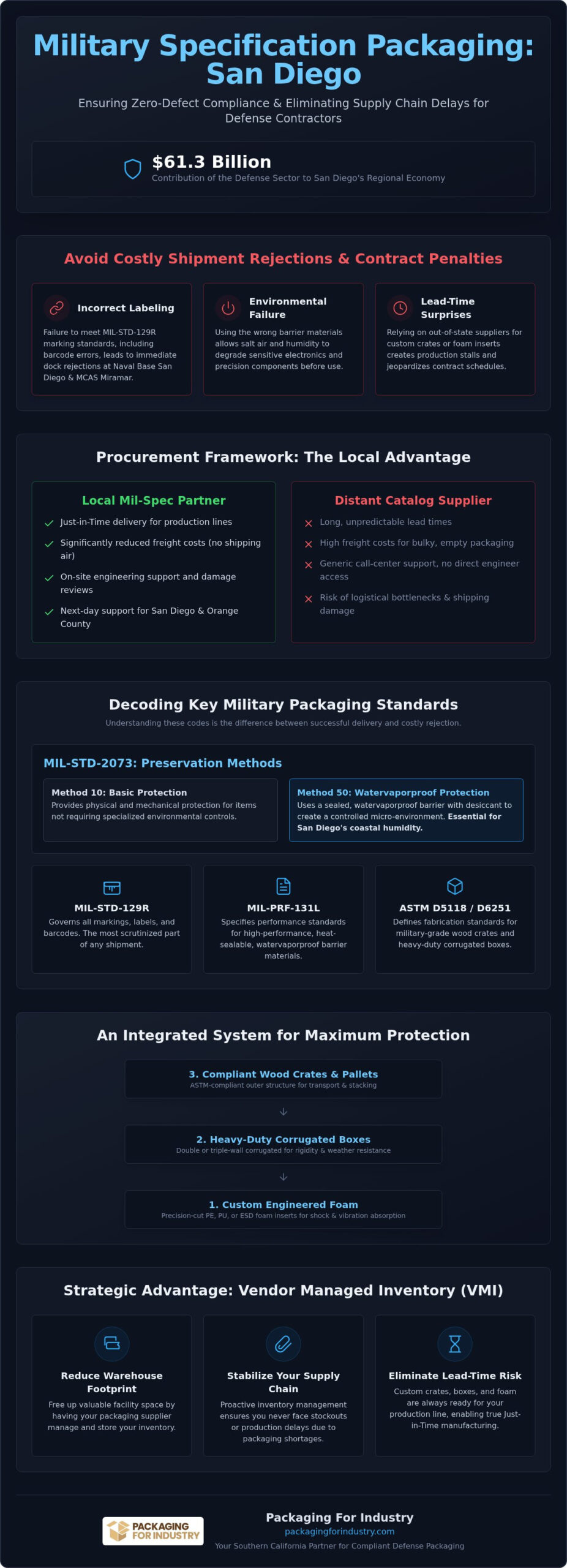
Shipment rejections often stem from small, avoidable errors in military specification packaging. Incorrect MIL-STD-129R marking or subtle barcode errors can cause an immediate dock rejection. These mistakes result in costly return freight and potential contract penalties. We also see failures in environmental protection. If the wrong barrier materials are selected, salt air and humidity can degrade precision components before they even reach the end user. Finally, lead-time surprises are a major risk. When a production line stalls because you’re waiting on custom wood crates from out of state, your 2026 contract schedule is in jeopardy.
The Local Advantage: Next-Day Support for Orange and San Diego Counties
Local logistics offer a level of responsiveness that national suppliers can’t match. PFI provides next-day support across Orange and San Diego Counties, ensuring that your heavy-duty corrugated boxes and custom foam packaging arrive exactly when needed. Sourcing bulky items like pallets and crates locally significantly reduces freight costs; you don’t have to pay to ship air across state lines. Our team conducts on-site packaging reviews to identify damage reduction opportunities before they become problems. You get direct access to engineers who understand your specific mission hardware, rather than a call-center representative reading from a script. If you need to request a packaging quote for an upcoming project, having a local partner ensures that quote reflects real-world San Diego logistics and transit times.
Decoding MIL-STD-2073: Essential Specs for San Diego Contractors
MIL-STD-2073, the Standard Practice for Military Packaging, is the definitive manual for protecting Department of Defense assets. The current version, updated on June 27, 2024, outlines specific methods for preservation that go far beyond standard commercial shipping. For San Diego contractors, understanding these codes is the difference between a successful delivery and a costly shipment rejection. The standard categorizes protection into specific methods, ranging from Method 10, which focuses on basic physical protection, to Method 50, which requires watervaporproof barriers. In our coastal environment, Method 50 is frequently required to shield sensitive hardware from salt air and humidity during transit or long-term storage.
Selecting the right barrier materials and desiccants is critical. High-performance films and moisture-vapor-proof bags must meet MIL-PRF-131L specifications to be compliant. When combined with the correct quantity of desiccant, these materials create a controlled micro-environment for the part. Labeling is the next hurdle. MIL-STD-129R, specifically Revision R, Change 3, governs how these packages are marked. It’s the most scrutinized part of any shipment. Even a perfectly preserved part will be turned away at the receiving dock if the linear barcodes or 2D PDF417 symbols don’t scan perfectly. Partnering with a local source for military specification packaging San Diego ensures your labels and materials are verified against these active standards before they leave the warehouse.
Material Standards: ASTM-D6251 and ASTM-D6880
Military wood crates aren’t standard industrial boxes. They must adhere to rigid engineering standards like ASTM-D6251 for cleated plywood or ASTM-D6880 for heavy-duty nailed wood. These specs ensure the container can withstand the G-forces of military transport. For lighter loads, we often utilize weather-resistant corrugated containers, such as V3C or W5C grades, which meet ASTM D5118/D5118M-25 requirements. Additionally, all wood packaging must carry the ISPM-15 heat-treatment stamp to prevent the spread of invasive species, a non-negotiable requirement for any military asset moving through San Diego logistics hubs.
Custom Foam Engineering for Defense Electronics
Shock and vibration protection requires precise foam selection. Polyethylene (PE) foam offers high durability and is ideal for heavier structural components, while Polyurethane (PU) foam provides a softer cushion for delicate optics. For San Diego’s semiconductor and electronics manufacturers, anti-static or ESD foam inserts are mandatory to prevent electrostatic discharge. We recommend free prototyping for custom inserts to verify the fit and protection levels. This allows you to compare foam densities and designs in a real-world setting before committing to a full-scale mil-spec rollout.
Catalog Suppliers vs. Local Engineering: A Procurement Framework
Procurement managers often default to national catalog suppliers for convenience, but this choice frequently backfires when dealing with rigorous MIL-STD-2073 requirements. Off-the-shelf solutions are designed for broad commercial applications. They don’t account for the specific preservation methods required for defense contracts, such as the vapor-proof barriers or specialized cushioning densities discussed in the previous section. Relying on a local source for military specification packaging San Diego allows for a custom-engineered approach that addresses these technical needs while reducing the total cost of ownership.
Hidden costs are the primary drawback of the catalog model. When you order bulky crates or heavy-duty corrugated boxes from an out-of-state warehouse, you’re essentially paying to ship air. UPS and FedEx surcharges for oversized industrial items can significantly inflate your landed cost. Before finalizing your vendor selection, it’s critical to compare packaging pricing based on the total landed cost rather than just the catalog unit price. Beyond freight, generic packaging often leads to shipping damage because the fit isn’t precise. An integrated solution that combines the box, foam inserts, and wood crate into a single, cohesive design simplifies your purchasing cycle and eliminates the risk of component migration during transit.
Evaluating Supplier Reliability in 2026
Reliability in the 2026 defense landscape is measured by technical capability and proximity. You should verify if your supplier offers custom design packaging backed by CAD/CAM support for precision foam inserts. Your supplier must also provide weather-resistant corrugated materials for overseas military transit. Packaging For Industry (PFI) maintains a local Southern California presence essential for emergency replenishment. If a production line is waiting on a shipment of crates that was delayed by a national carrier, the cost of that downtime far outweighs any perceived savings from a catalog price list.
Cost Reduction through Packaging Reviews
Real savings come from engineering, not just unit price. A professional packaging review analyzes box sizing to eliminate dimensional weight (DIM) surcharges that common carriers apply to inefficiently packed shipments. We help customers lower packaging costs by replacing generic void fill with custom-engineered inserts. This reduces material waste and speeds up the packing process. As your local source for military specification packaging San Diego, we focus on identifying design flaws that lead to product loss. Most importantly, it allows you to reduce shipping damage, which protects your contract profitability and your reputation with the Department of Defense. Precision packaging ensures your mission-critical hardware arrives ready for immediate deployment.
Implementing VMI: Eliminating Lead-Time Risks for Defense Contracts
For San Diego defense contractors, a stockout of custom MIL-STD compliant materials is more than a logistical hiccup. It’s a stop-work event that can jeopardize a portion of the $19.8 billion in defense contracts awarded to local firms in 2025. Vendor Managed Inventory (VMI) is a strategic procurement model where your supplier takes full responsibility for maintaining your packaging stock levels. By choosing a local source for military specification packaging San Diego, you shift the burden of inventory management from your internal team to an expert partner. This ensures that custom crates, heavy-duty corrugated boxes, and foam inserts are ready the moment your mission-critical hardware leaves the assembly line.
The financial impact of VMI is particularly significant in Southern California. San Diego industrial real estate remains among the most expensive in the country. Devoting hundreds of square feet to empty boxes and bulky wooden pallets is an inefficient use of capital that could be better spent on manufacturing capacity. VMI allows you to reclaim that floor space for revenue-generating production activities. When you integrate VMI with Just-in-Time (JIT) production schedules, you create a lean supply chain that responds to the fluctuating demands of 2026 defense contracts without the overhead of excess safety stock. This level of logistical flow is essential for maintaining the high production velocity required by current Naval and Aerospace projects.
The VMI Process for San Diego Manufacturers
Implementation follows a structured methodology to ensure zero-defect availability. First, we conduct a usage assessment and lead-time analysis for your custom mil-spec items. We examine your contract deliverables and historical data to predict high-demand periods. Second, we establish minimum and maximum stocking levels based on your production velocity. Finally, we manage scheduled local replenishment from our Southern California warehouse. This proactive approach eliminates the frantic, last-minute orders that often lead to shipping errors or premium freight charges. It’s a system designed for reliability and fiscal responsibility.
Managing Long Lead-Time Items
Custom wood crates and precision die-cut foam inserts are high-risk components because of their manufacturing complexity. You can’t source these items overnight. A dedicated stocking program ensures these long lead-time products are manufactured in advance and held in reserve at a local facility. This reduces the administrative burden on your procurement teams by automating the replenishment cycle and ensuring you never face a production delay due to a missing crate. Learn more about our Vendor Managed Inventory services to see how this model stabilizes your operations.
Why Partner with PFI for Mil-Spec Packaging in San Diego?
PFI operates as a specialized industrial packaging supplier near me that understands the unique pressures of the Southern California supply chain. Beyond standard stock items, we focus on providing high-performance custom boxes in San Diego for aerospace, medical device, and defense electronics manufacturers. Our facility produces custom corrugated boxes and heavy-duty triple-wall containers that serve as the first line of defense for sensitive mission-critical hardware. As a leading bulk packaging supplier, we provide the scale and precision necessary for Tier 1 defense contractors to maintain 100% compliance while reducing total procurement costs.
Choosing PFI means partnering with a local source for military specification packaging San Diego that prioritizes reliability and fiscal responsibility. We understand that in the defense sector, a single non-compliant label or a failed crate can stall an entire production line. Our team acts as a proactive fixer, identifying potential logistical bottlenecks before they impact your delivery schedule. By maintaining a deep inventory of MIL-STD compliant materials in Southern California, we ensure your operations remain fluid and your contract obligations are met with total peace of mind.
Custom Design and Prototyping Capabilities
Engineering precision is the foundation of our military packaging solutions. Utilizing CAD/CAM support, we design protective systems that fit your complex components exactly, ensuring they meet the rigid preservation methods discussed earlier. Free prototyping allows you to validate protection levels and shock absorption before your contract begins, ensuring no surprises during transit or at the receiving dock. Request a custom packaging quote today to see how our engineering-first approach improves your supply chain reliability.
Integrated Solutions for San Diego Contractors
We provide integrated solutions by acting as a single point of contact for your foam inserts, wooden crates, and ESD materials. This holistic oversight supports local defense hubs like Miramar and North Island with a steady, dependable supply of MIL-STD compliant materials without the overhead of multiple vendors. By consolidating your packaging needs, you simplify your purchasing cycle and improve accountability across the board. PFI reduces lead times for San Diego aerospace firms in 2026 by synchronizing local production with your specific kitting and assembly schedules.
Secure Your Supply Chain with Local Mil-Spec Expertise
Securing your 2026 contract milestones requires a logistical strategy that eliminates shipment rejections and warehouse bottlenecks. By leveraging a local source for military specification packaging San Diego, you gain direct access to MIL-STD-2073 compliance expertise and local next-day delivery. This proximity allows your team to move from design to deployment without the lead-time risks inherent in out-of-state catalog procurement. Transitioning to a local partner ensures that your technical requirements are met with precision rather than generic, off-the-shelf compromises.
Reliability is built through precision engineering and proactive inventory management. PFI supports your operational goals with free prototyping and custom engineering support to ensure a zero-defect fit for every component. Whether you’re managing recurring aerospace contracts or urgent defense electronics shipments, our integrated solutions for crates, foam, and boxes provide the stability your project timeline requires. We’re here to help you reduce professional stress and focus on your core manufacturing mission.
Our team is ready to help you lower packaging costs and improve your delivery reliability today.
Frequently Asked Questions
What is the difference between MIL-STD-2073 and MIL-STD-129R?
MIL-STD-2073 dictates the methods of preservation and packing required to protect items from environmental degradation, while MIL-STD-129R governs the uniform marking and labeling requirements. Think of 2073 as the internal protection strategy and 129R as the external identification system. Both standards are critical for ensuring your shipment isn’t rejected at receiving docks like Naval Base San Diego or North Island.
How do I ensure my custom wood crates are compliant for international military shipping?
Compliance for international military shipping requires adherence to ISPM-15 heat-treatment standards for all wood packaging materials. This process prevents the spread of timber pests and is verified by a specific IPPC certification stamp on the crate. Additionally, your crates should meet ASTM-D6251 or ASTM-D6880 specifications to ensure they can withstand the physical rigors of global military logistics and transport.
Can PFI provide ESD foam inserts for sensitive defense electronics?
PFI provides specialized ESD (Electrostatic Discharge) foam inserts designed specifically for sensitive defense electronics and semiconductor components. These anti-static materials prevent static buildup that can permanently damage mission-critical hardware during transit. We offer both Polyethylene and Polyurethane ESD options to match the specific shock absorption and fragility requirements of your aerospace or defense project.
What are the benefits of a local San Diego packaging supplier over a national catalog?
A local supplier eliminates the high freight costs and lead-time delays associated with shipping empty, bulky boxes from out-of-state warehouses. By choosing a local source for military specification packaging San Diego, you benefit from next-day delivery and on-site engineering support. National catalogs often fail to provide the custom-engineered solutions required for specific MIL-STD-2073 preservation methods, which often leads to higher total procurement costs.
How does a Vendor Managed Inventory (VMI) program work for military packaging?
A Vendor Managed Inventory (VMI) program involves the supplier monitoring your packaging usage and automatically replenishing stock based on established minimum and maximum levels. This system eliminates the risk of production stops caused by a shortage of custom crates or boxes. It also allows you to reclaim expensive San Diego warehouse floor space since you only store what you need for immediate production requirements.
What is the lead time for custom-engineered mil-spec foam in San Diego?
Lead times for custom-engineered mil-spec foam in San Diego are significantly shorter when you partner with a local manufacturer rather than a national distributor. While exact timing depends on the complexity of the CAD/CAM design, our local presence allows for rapid prototyping and production. Once a design is approved and integrated into a VMI program, we can provide next-day delivery for recurring defense contract needs.
Does PFI provide free prototypes for military contract packaging?
PFI offers free prototyping for custom inserts to ensure a perfect fit for your military components before full-scale production begins. This service allows you to validate protection levels and shock absorption designs against your contract’s specific technical requirements. Engineering-led prototyping reduces the risk of shipping damage and ensures your final packaging system is both compliant and cost-effective.
How can I reduce shipping damage for heavy military assets?
Reducing damage for heavy military assets requires high-performance materials like triple-wall corrugated containers or heavy-duty wood crates built to ASTM D6880 standards. Proper blocking and bracing using high-density Polyethylene foam prevent the load from shifting during transit. We also recommend custom-engineered pallets that are specifically designed to handle the weight distribution and G-forces encountered in military logistics.