
Your high-value shipment is held at a foreign port because the wood packaging failed a spot inspection. It’s a scenario that costs Southern California exporters thousands in fines and lost contracts every year. You’ve likely felt the pressure of international shipping regulations, where even a minor compliance oversight can result in the seizure or destruction of your cargo. Finding reliable ISPM 15 certified wood crates Southern California shouldn’t be a source of professional stress or a bottleneck in your operations.
We understand that for manufacturers in Orange County and Los Angeles, a crate is a critical component of your risk management strategy. This guide shows you how to secure compliant, custom-engineered wood crates that pass international customs without delays or unexpected fumigation costs. You’ll learn how to reduce shipping damage through precision-fit foam inserts and why local, just-in-time delivery is the most effective way to lower your total landed costs in 2026. We’ll also cover how current lumber price stability and new California packaging fees under SB 54 impact your procurement strategy.
Key Takeaways
- Understand why verified ISPM 15 certification is essential to prevent international customs delays and avoid the risk of cargo destruction.
- Learn the technical requirements of the Heat Treatment (HT) process and why it has become the global standard for modern industrial compliance.
- Discover how to source ISPM 15 certified wood crates Southern California manufacturers can rely on for heavy-duty machinery and aerospace components.
- Follow a two-step verification process to vet your supplier’s inspection records and ensure your crates are produced in a certified facility.
- Identify the economic advantages of combining custom-engineered wood crates with integrated foam protection to reduce damage and lower total landed costs.
Why ISPM 15 Certification is Non-Negotiable for Southern California Exporters
The International Plant Protection Convention (IPPC) developed the ISPM 15 standard to safeguard global forests and agriculture. Wood packaging materials often harbor invasive pests like the Asian Longhorned Beetle or the Emerald Ash Borer. Without strict treatment protocols, these pests migrate across borders and cause billions in ecological damage. For exporters utilizing ISPM 15 certified wood crates Southern California hubs like the Port of Long Beach and LAX serve as the primary exit points for global trade. Customs authorities at these locations are highly vigilant. They understand that a single infested crate can lead to the quarantine of an entire vessel or warehouse.
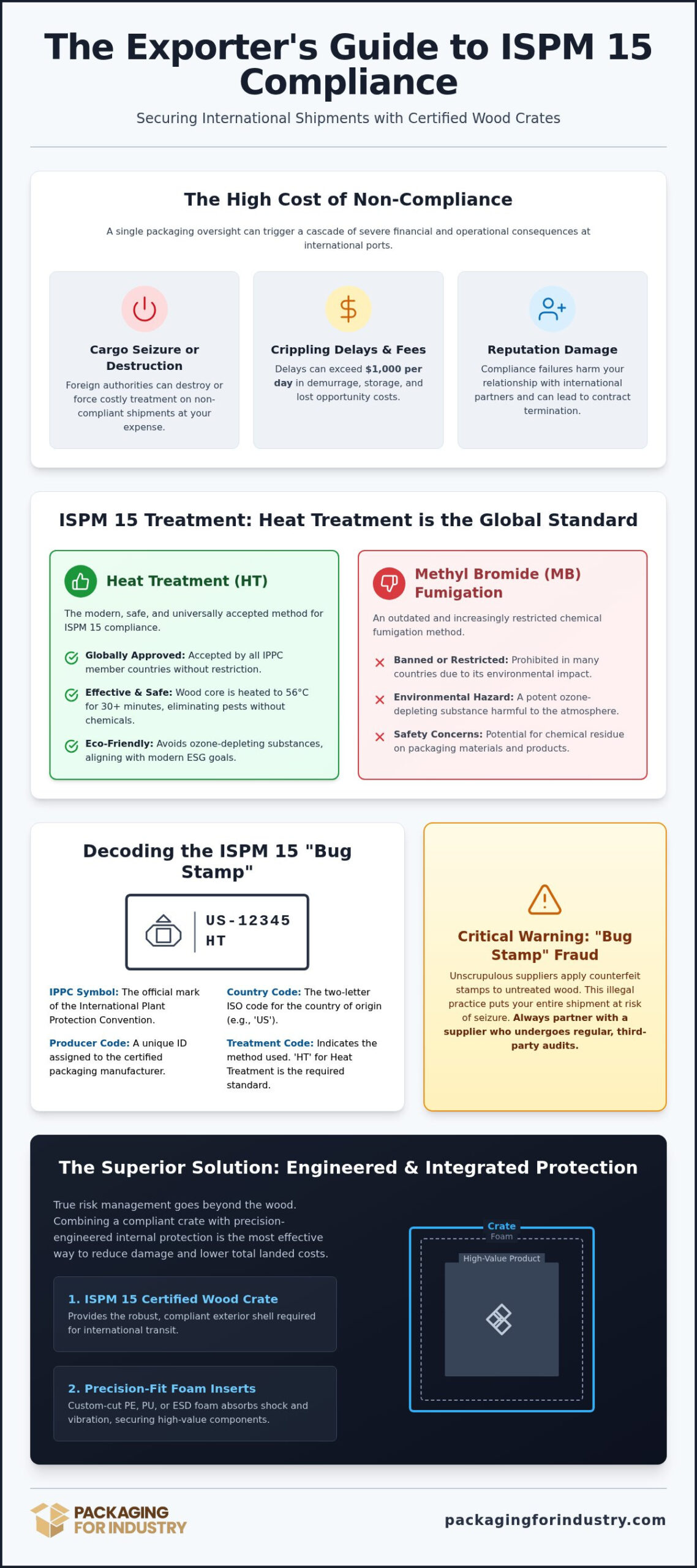
If your shipment lacks the proper IPPC mark, the consequences are immediate and severe. Foreign port authorities typically offer two choices: immediate fumigation at your expense or the total destruction of the cargo. In some jurisdictions, you may even face blacklisting, which complicates every future shipment your company attempts to export. This isn’t just a regulatory hurdle. It’s a massive operational risk that can halt your supply chain and damage your reputation with international distributors.
The Risk of “Bug Stamp” Fraud
Counterfeit marks are a growing concern in the industrial packaging industry. Some unscrupulous suppliers apply a “bug stamp” to untreated lumber to save on kiln costs. Working with a certified local manufacturer in Anaheim ensures total traceability for your equipment. We undergo monthly third-party inspections to verify our heat-treatment logs and compliance standards. This rigorous oversight protects you from the legal and financial fallout of using fraudulent materials. Providing ISPM 15 certified wood crates Southern California businesses can trust requires more than just a stamp; it requires a documented chain of custody and regular audits.
Financial Impact of Customs Delays
The true cost of a compliance failure goes far beyond the price of a crate. When a shipment is flagged, it sits in a bonded warehouse or on the dock, accruing demurrage fees. For high-stakes industries like aerospace or medical manufacturing, a delay doesn’t just eat your margins; it can trigger liquidated damages clauses in multi-million dollar contracts. Logistics experts estimate the average cost-per-day for international shipment delays in 2026 can exceed $1,000 when factoring in storage fees, labor, and lost opportunity costs. Using custom-engineered wood crates ensures your documentation and hardware are beyond reproach before they ever reach the terminal.
Decoding the ISPM 15 Standards: Heat Treatment vs. Fumigation
The International Plant Protection Convention (IPPC) established ISPM 15 as the primary regulatory framework for wood packaging material (WPM) in international trade. To meet this standard, solid wood thicker than 6mm must undergo a specific treatment process to eliminate wood-boring pests. Heat Treatment (HT) is the current industry standard. This process requires heating the wood until its core reaches a minimum temperature of 56°C for at least 30 continuous minutes. This method is highly effective and eliminates the need for hazardous chemicals that can linger on your packaging.
We prioritize Heat Treatment over chemical fumigation with Methyl Bromide (MB). Methyl Bromide is a potent ozone-depleting substance, and many countries have restricted its use or banned it entirely. By choosing HT-processed ISPM 15 certified wood crates Southern California manufacturers align their logistics with modern Environmental, Social, and Governance (ESG) goals. It’s a cleaner, safer, and more universally accepted method for protecting global ecosystems. Furthermore, it’s a common misconception that buying heat-treated lumber from a retail yard is sufficient for export. To be legally compliant, the final assembled product must be stamped by a certified and regularly inspected producer. If you’re unsure about your current export readiness, you can request a packaging quote to have our engineers evaluate your specific requirements.
Understanding the Markings
Every compliant crate must bear a permanent and legible mark. This “bug stamp” includes the IPPC symbol, a two-letter ISO country code (like US), and a unique producer code assigned to the certified facility. You’ll also see the treatment abbreviation: HT for Heat Treated or MB for Methyl Bromide. Some stamps include DB, signifying the wood was debarked before treatment. For maximum efficiency during customs inspections, we place these stamps on at least two opposite sides of the crate to ensure they’re visible to port officials at all times.
Dunnage vs. Finished Product Certification
A common oversight in procurement is neglecting the materials inside the crate. Any wood used for blocking, bracing, or cushioning, known as dunnage, must also meet ISPM 15 standards. Loose wood components require their own specific dunnage stamps. If a customs officer finds even one piece of untreated 2×4 bracing inside a certified crate, the entire shipment can be rejected. We ensure every component of your packaging system is fully compliant, providing ISPM 15 certified wood crates Southern California businesses can use to secure heavy-duty machinery without fear of port rejection.
Custom Engineered Wood Crates vs. Standard Export Pallets
Selecting the right platform for your international shipment involves more than just comparing material costs. While standard export pallets are suitable for uniform loads, ISPM 15 certified wood crates Southern California manufacturers rely on are necessary for high-value industrial machinery. A fully enclosed crate provides a rigid structure that protects against the stacking pressures of sea freight. For equipment with an offset center of gravity, we engineer heavy-duty skids with reinforced bases to prevent tipping. Our design process includes a thorough evaluation of the load weight and the specific handling challenges the shipment will face in transit.
Effective crating goes beyond the exterior walls. We integrate internal supports such as custom-contoured cradles, saddles, and strategic tie-down points to immobilize the product. This precision engineering allows us to minimize the crate’s exterior dimensions. By reducing the total shipping volume, we directly lower your freight costs and improve container utilization. This pragmatic approach ensures you aren’t paying to ship empty space while still maintaining maximum protection for your assets.
Compliance is equally critical for internal components. As outlined by USDA APHIS regarding Wood Packaging Materials, all bracing and blocking must be treated and marked. Failing to certify the internal wood components is a common cause for shipment seizures at international borders. We eliminate this risk by ensuring every piece of lumber within the assembly meets the same rigorous standards as the outer crate.
Integrating Protective Foam Inserts
For fragile or sensitive components, we combine our wood crates with integrated foam packaging. Choosing the right density is vital for shock absorption. We utilize Polyethylene (PE) foam for heavy industrial parts due to its high load-bearing capacity and Polyurethane (PU) foam for lighter, more delicate items. For semiconductor and electronics exporters, we provide ESD (Electrostatic Discharge) foam inserts to protect against static damage during handling. This holistic design protects your equipment from both physical impact and environmental hazards.
Industry-Specific Crate Requirements
Different sectors have unique logistical demands. In the aerospace industry, we provide custom design packaging that accounts for the high value and irregular shapes of turbine components or flight controls. Medical device manufacturers require precision-fit crates that maintain cleanliness standards throughout the supply chain. For military contractors, we engineer solutions that meet strict Mil-Spec standards while ensuring full ISPM 15 certified wood crates Southern California compliance for global deployments. This specialized expertise ensures your specific industry requirements are met without compromise.
Procurement Guide: Buying ISPM 15 Crates in Southern California
Securing ISPM 15 certified wood crates Southern California manufacturers can rely on involves more than just checking a price list. Because these products are custom-engineered for specific industrial loads, your procurement process should prioritize compliance and engineering over the lowest per-unit cost. A failure at the port will quickly erase any minor savings gained from a cut-rate supplier. Follow these four steps to vet your next packaging partner.
- Verify IPPC Certification: Don’t just take a supplier’s word for it. Ask for their unique producer code and proof of their monthly third-party inspection records. This ensures the wood treatment is legitimate and traceable back to a certified facility.
- Request CAD Design and Prototyping: For high-value aerospace or medical equipment, a “close enough” fit isn’t sufficient. Demand a CAD design that accounts for your product’s center of gravity and fragility. A free prototype allows your team to verify the fit before you commit to a bulk order.
- Evaluate Local Logistics: If your operations are in Orange County or Los Angeles, choosing an Anaheim-based manufacturer reduces lead times and freight expenses. Local delivery capabilities are essential for maintaining a lean supply chain.
- Assess Material Integration: A truly efficient supplier provides a total solution. Check if they can integrate custom foam inserts, heavy-duty corrugated boxes, and stretch film into a single kitted delivery. This reduces the administrative burden of managing multiple vendors.
Solving Lead-Time Issues with VMI
Stocking bulky wood crates takes up valuable warehouse space that could be used for production. By utilizing Vendor Managed Inventory (VMI), you can offload this storage burden to your supplier. We monitor your usage patterns and provide just-in-time delivery to your high-volume manufacturing lines. This prevents stockouts and ensures you always have compliant ISPM 15 certified wood crates Southern California ready for your next export shipment.
Local Support for Southern California Manufacturers
Our Anaheim headquarters is strategically located to provide quick-turnaround support for the region’s industrial hubs. Choosing a local partner reduces the carbon footprint of your packaging supply chain and eliminates the long-distance shipping costs associated with out-of-state suppliers. For oversized industrial machinery that is difficult to transport, we offer on-site crating services. Our team comes to your facility to engineer and build the protection around your equipment, ensuring it’s secured and compliant before it ever leaves your dock.
Why PFI is the Preferred Partner for ISPM 15 Certified Wood Crates
Choosing a packaging partner involves evaluating their ability to protect your bottom line as much as your product. At PFI, we don’t just sell components; we engineer integrated logistical systems. As a comprehensive industrial supplier, we offer a one-stop shop for corrugated boxes, custom foam inserts, and ISPM 15 certified wood crates Southern California manufacturers depend on for global trade. This consolidated approach eliminates the logistical friction of managing multiple vendors. It ensures every layer of your packaging works in unison to prevent shipping damage and customs rejection.
Our team has a proven track record supporting Southern California’s aerospace and defense sectors. We understand the high stakes of shipping sensitive flight hardware and precision instruments. By focusing on the intersection of engineering and economics, we achieve measurable packaging cost savings through optimized design. We don’t over-engineer with unnecessary lumber. Instead, we use CAD/CAM technology to identify the exact structural requirements for your load, reducing both material waste and total shipping weight.
Reliability is the foundation of our partnership. When you source ISPM 15 certified wood crates Southern California from our Anaheim facility, you’re gaining a steady consultant who understands the nuances of international compliance. We manage the technical details of heat treatment and IPPC certification so your operations team can focus on production. Our goal is to provide peace of mind through a predictable and efficient supply chain.
Free Prototyping and Design Reviews
We believe in verifying performance before a full production rollout. Our engineering team provides free prototyping and design reviews to ensure a perfect fit for your most complex industrial geometries. We utilize advanced CAD/CAM support to create internal cradles and supports that immobilize your product during sea freight transit. You can learn more about our technical approach in our article on Engineering Custom Crates for International Transit. This proactive design phase prevents costly field failures and ensures your hardware arrives in pristine condition.
Ready to Secure Your International Shipments?
Professional procurement managers need a supplier that moves with the speed of their manufacturing line. We offer direct, pragmatic support for B2B teams looking to streamline their export packaging. Experience the reliability of a local Anaheim industrial supplier that prioritizes your deadlines and compliance needs. Don’t let your cargo sit at the port due to a paperwork error or a missing stamp. Contact us to request a custom packaging quote today and let our engineers secure your next international shipment.
Secure Your Global Supply Chain with Engineering-Grade Compliance
Managing international logistics requires a partner that understands the high stakes of compliance. We’ve explored how heat-treated wood prevents costly customs seizures and why specialized engineering is the only way to protect high-value machinery. Securing ISPM 15 certified wood crates Southern California businesses can trust means looking beyond the unit price and focusing on the total landed cost of your shipment. It’s about eliminating professional stress through reliable, compliant protection.
Our Anaheim-based manufacturing facility provides the local agility you need to meet tight export deadlines. We specialize in Aerospace and Defense compliance, ensuring your most sensitive hardware meets every rigorous standard before it reaches the port. With free CAD prototyping and local next-day delivery, we eliminate the friction in your custom packaging procurement process. It’s time to move your cargo with confidence.
We’re ready to help you optimize your shipping operations and secure your cargo for the global market.
Frequently Asked Questions
What exactly is an ISPM 15 certified wood crate?
An ISPM 15 certified wood crate is a shipping container constructed from solid wood that has been treated to eliminate invasive pests. To meet this global standard, the wood must reach a core temperature of 56°C for at least 30 minutes. This process ensures your packaging doesn’t transport wood-boring insects into foreign ecosystems. Every compliant crate must bear a permanent IPPC mark, often called a “bug stamp,” to be cleared by customs officials.
Does ISPM 15 apply to all international shipments from Southern California?
This regulation applies to all international shipments using solid wood packaging thicker than 6mm destined for any of the over 160 participating countries. If you’re exporting machinery or aerospace components from hubs like LAX or the Port of Long Beach, your wood packaging must be compliant. It doesn’t apply to domestic shipments within the United States or to materials made entirely from processed wood like plywood or plastic.
How can I tell if a wood crate is truly ISPM 15 compliant?
A truly compliant crate features a legible, permanent IPPC mark on at least two opposite sides. This stamp includes the IPPC logo, the ISO country code (US), a unique producer number, and the treatment abbreviation (HT for Heat Treated). You should also verify that your supplier undergoes monthly third-party inspections. Obtaining ISPM 15 certified wood crates Southern California manufacturers can trust requires working with a facility that maintains rigorous treatment logs and audit records.
Can I reuse ISPM 15 certified crates for multiple international shipments?
You can reuse these crates as long as they remain structurally sound and haven’t been modified with untreated wood. If you replace a broken board or add new bracing, the entire crate loses its certification. Any repaired crate must be re-treated and re-stamped by a certified facility to remain compliant. For high-volume exporters, we recommend a regular inspection of your reusable crate pool to prevent unexpected port delays or fines.
What is the difference between heat-treated and kiln-dried wood?
Kiln-dried (KD) wood is processed to reduce moisture for structural stability, while heat-treated (HT) wood is heated specifically to kill pathogens. While many kilns reach the required temperatures for ISPM 15 compliance, the wood isn’t certified unless it’s documented and stamped by a licensed producer. Don’t assume that lumber marked “KD” is legal for international export; always look for the specific HT designation within the IPPC stamp to ensure compliance.
Do plywood crates require ISPM 15 certification and the bug stamp?
Processed wood materials like plywood, OSB, and particle board are exempt from ISPM 15 requirements because the manufacturing process uses high heat and pressure that eliminates pests. If your crate is 100% plywood, it doesn’t need a stamp. However, most industrial crates use solid wood for skids, framing, or internal bracing. If any solid wood component is present, the entire unit must be treated and stamped by a certified producer to pass customs.
How much extra does ISPM 15 certification cost for a custom crate?
The cost of certification is a small fraction of the total crate price and is far less expensive than the risk of shipment seizure. Pricing depends on current lumber market rates and the volume of the order. Most of the cost is associated with the energy used for heat treatment and the administrative overhead of maintaining certified status. We focus on engineering-driven designs to minimize wood usage, which often offsets the treatment costs.
How long does it take to get a custom ISPM 15 crate in Orange County?
Lead times for custom designs typically range from a few days to a week depending on the complexity of your hardware. For local manufacturers in Anaheim, we can often provide CAD designs and prototypes within 24 to 48 hours. Established customers using our Vendor Managed Inventory services can even receive next-day delivery on pre-approved designs. This proximity allows ISPM 15 certified wood crates Southern California buyers to maintain lean operations without risking stockouts.