
A single non-compliant label or an incorrect barrier material can get an entire defense shipment rejected at the receiving dock, putting your contract at risk before the product ever reaches its destination. If you’re sourcing military specification packaging in Orange County, you already know that the DOD doesn’t offer second chances on packaging errors, and waiting weeks for a national catalog supplier to ship generic solutions isn’t a viable strategy when production schedules are tight.
You’re right to take this seriously. Interpreting MIL-STD-2073 requirements, selecting the correct cushioning materials, and ensuring every label meets contract specifications is genuinely complex work. One misstep doesn’t just damage a component; it can trigger a contract review.
This guide cuts through that complexity. You’ll learn exactly what DOD compliance requires at the packaging level, which materials and configurations apply to aerospace and defense components, and how a local Orange County supplier can deliver certified, custom-engineered Mil-Spec solutions faster than any national distributor. From heavy-duty corrugated and custom foam to wood crates and compliant labeling, here’s what you need to keep your contracts protected and your production line moving.
Key Takeaways
- MIL-STD-2073 and ASTM D3951 are the two primary compliance frameworks governing defense packaging, and understanding which standard applies to your contract is the first step to avoiding costly rejections.
- Sourcing military specification packaging in Orange County from a local supplier significantly reduces lead times compared to national catalog distributors, keeping your production schedule on track.
- Custom-engineered foam, ESD-compliant materials, and wood crates must be matched precisely to the component being shipped — generic solutions introduce compliance risk that can trigger a contract review.
- Vendor Managed Inventory (VMI) programs eliminate packaging shortfalls on recurring defense orders, ensuring compliant materials are available when your production line needs them.
- A qualified local Mil-Spec partner offers free prototyping and direct engineering support, allowing you to validate packaging designs against DOD specifications before a single unit ships.
What is Mil-Spec Packaging and Why is it Critical?
Military specification packaging refers to materials, methods, and configurations that meet Department of Defense standards for protecting equipment through storage, handling, and transport. It’s not a marketing category. It’s a contractual requirement, defined by specific standards that dictate everything from barrier material selection to cushioning density to label placement. If your packaging doesn’t meet those requirements precisely, the shipment fails inspection, regardless of whether the component inside is undamaged.
The DOD’s packaging standards exist for a direct operational reason: equipment that arrives damaged or degraded doesn’t support mission readiness. A corroded circuit board, a cracked optical housing, or a contaminated hydraulic component doesn’t just represent a wasted shipment; it represents a gap in operational capability that has real consequences downstream. The packaging is the last line of defense before a component enters a supply chain that may span multiple continents and months of storage.
For manufacturers sourcing military specification packaging in Orange County, the local defense and aerospace cluster creates a specific set of demands. Orange County is home to a dense concentration of prime contractors and subcontractors producing components for programs across all branches of the military. These firms operate on tight production schedules with little tolerance for packaging delays or compliance failures. A national catalog supplier shipping from a remote distribution center introduces lead time risk that a local supplier can eliminate.
Common Mil-Spec Terminology for Purchasing Managers
Understanding the language of Mil-Spec packaging prevents costly misinterpretations at the contract level. Three terms are foundational:
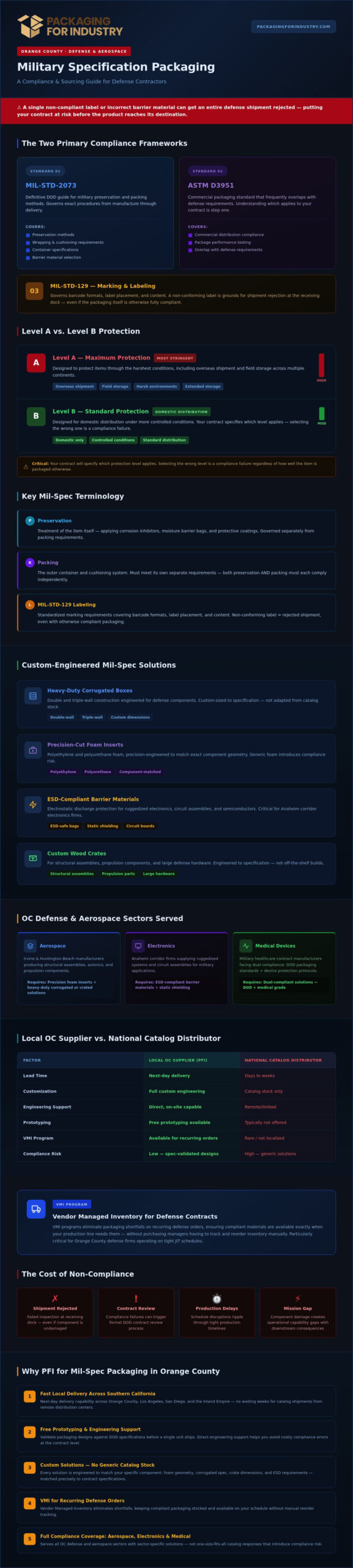
- Level A vs. Level B Protection: Level A packaging is the most stringent, designed to protect items through the harshest conditions, including overseas shipment and field storage. Level B provides protection for domestic distribution under more controlled conditions. Your contract will specify which level applies, and selecting the wrong one is a compliance failure.
- Preservation vs. Packing: Preservation refers to the treatment of the item itself, such as applying corrosion inhibitors or moisture barrier bags. Packing refers to the outer container and cushioning system. Both are governed separately and must meet their respective requirements.
- MIL-STD-129 Labeling: Standardized marking and labeling requirements govern everything from barcode formats to label placement and content. A label that doesn’t conform to MIL-STD-129 is grounds for rejection at the receiving dock, even if the packaging itself is otherwise compliant.
Industries in Orange County Requiring Military Standards
The demand for compliant aerospace and defense packaging runs across multiple sectors in the region. Aerospace component manufacturers in Irvine and Huntington Beach produce structural assemblies, avionics, and propulsion components that require precision-engineered foam inserts and heavy-duty corrugated or crated solutions. Electronics and semiconductor firms operating in the Anaheim corridor supply ruggedized systems and circuit assemblies that require ESD-compliant barrier materials. Medical device manufacturers serving military healthcare contracts face dual compliance requirements, balancing DOD packaging standards with device protection protocols. Each sector has distinct packaging requirements; a generic solution serves none of them effectively.
Navigating Mil-Spec Standards: MIL-STD-2073 and ASTM D3951
MIL-STD-2073 is the definitive guide for military preservation and packing methods, establishing the exact procedures contractors must follow to protect defense materiel from manufacture through delivery. Understanding how it applies to your specific contract isn’t optional. It’s the foundation of every packaging decision you’ll make.
The standard operates through a structured methodology: it assigns a preservation method, a wrapping and cushioning requirement, and a container specification to each item based on its physical characteristics and the operational conditions it will encounter. Your contract communicates all of this through a 17-digit packaging code embedded in the contract data requirements. Each segment of that code corresponds to a specific requirement, from the unit container type to the intermediate packaging and the method of preservation. Reading that code correctly before you source a single material is how you prevent a rejection before it happens.
ASTM D3951 enters the picture when a contract permits commercial packaging practices. It’s a commercial standard that the DOD accepts as an alternative to full MIL-STD-2073 compliance in specific, lower-risk applications, typically domestic distribution of non-sensitive components under controlled conditions. The key word is “permits.” If your contract doesn’t explicitly reference ASTM D3951 as an acceptable standard, defaulting to it is a compliance error. When sourcing military specification packaging in Orange County, confirm which standard governs your contract before selecting any material or configuration. For contractors navigating DOD defense procurement packaging compliance requirements, the DFARS Part 246 quality assurance provisions provide the regulatory framework that governs how these standards are enforced at the contract level.
Breaking Down MIL-STD-2073 Requirements
Three technical requirements drive the majority of packaging decisions under MIL-STD-2073:
- Method of Preservation: This governs protection against corrosion, moisture, and environmental degradation. Common methods include wrapping in volatile corrosion inhibitor (VCI) materials, heat-sealing in moisture vapor barrier bags, and applying desiccant packs calibrated to the container volume. Long-term storage applications require moisture vapor transmission rate (MVTR) values that only certified barrier materials can meet. A standard poly bag doesn’t qualify.
- Cleaning and Drying: Components must be free of contaminants, oils, and residual moisture before preservation begins. Packaging over an uncleaned surface traps corrosion catalysts inside the barrier, negating the entire preservation effort.
- Cushioning and Bracing: The standard specifies cushioning methods based on item fragility and weight. Density, thickness, and placement are all defined requirements, not engineering judgment calls. Custom-engineered foam packaging matched to the component’s geometry is the reliable solution here; generic cut foam introduces dimensional gaps that fail under shock loading.
Compliance Documentation and Quality Control
The DD Form 250 is the Material Inspection and Receiving Report that accompanies every government shipment. It documents that the item was inspected, that packaging meets contract requirements, and that the shipment is accepted for delivery. An error on the DD Form 250 can hold a shipment at the receiving dock just as effectively as a physical packaging defect. PFI’s engineering process ties directly to this documentation requirement: every custom packaging solution is validated against the contract’s technical data package before production begins, so the materials and configurations you receive are traceable to the specification your DD Form 250 will reference.
If your production schedule doesn’t allow time to work through these specifications independently, request a packaging quote from PFI and bring your contract’s packaging code to the conversation. That’s the fastest path from specification to compliant, production-ready materials.
Custom Engineered Solutions: Foam, Crates, and ESD Protection
Compliance with MIL-STD-2073 doesn’t stop at selecting the right barrier material. The cushioning system, the outer container, and the electrostatic protection layer must all be engineered to the specific component being shipped. Generic solutions fail here, not because they’re poorly made, but because defense packaging requirements are component-specific. A foam insert dimensioned for a similar part doesn’t protect your part. A standard wood crate without ISPM-15 certification stops at international customs. These aren’t edge cases; they’re predictable failures that custom engineering eliminates before a single unit ships.
Protective Foam for High-Value Defense Goods
The choice between polyethylene and polyurethane foam isn’t a preference decision; it’s an engineering one. Polyethylene foam offers higher density and closed-cell construction, making it the standard choice for heavy, rigid components that require firm, consistent support through repeated shock loads. Polyurethane foam, with its open-cell structure and softer compression characteristics, is better suited for lighter, more fragile assemblies where surface contact pressure is the primary concern. Using the wrong density for a given component weight and fragility rating introduces movement inside the package under transit loads, which is a compliance failure even when the outer container passes visual inspection.
For circuit boards, avionics assemblies, and semiconductor components, anti-static foam is a non-negotiable requirement. Standard foam generates triboelectric charge during handling. That charge discharges through the component. Anti-static and conductive foam variants dissipate that charge safely, protecting sensitive electronics from damage that often doesn’t manifest until the unit is installed and tested in the field.
Free prototyping is the practical safeguard that connects engineering intent to production reality. For firms sourcing military specification packaging in Orange County, PFI’s prototyping process validates foam insert geometry, density, and fit against the actual component before any production quantity is committed. A prototype that fails the fit test costs nothing. A production run of non-compliant inserts costs a contract. Explore PFI’s full range of foam packaging solutions to understand what custom-engineered options are available for your specific application.
Heavy-Duty Crates and Pallets for Global Deployment
Oversized aerospace components, ground support equipment, and heavy mechanical assemblies require wood crating systems that address two distinct requirements simultaneously: structural integrity under load and international phytosanitary compliance. ISPM-15 heat treatment certification is mandatory for any wood packaging material crossing international borders under DOD logistics. Untreated wood is turned away at port. That’s a hard stop with no field remedy.
Custom skids and crate bases for oversized parts require load-bearing calculations matched to the component’s weight distribution, not a standard pallet footprint. For aerospace and defense packaging applications involving irregular geometries or off-center mass, custom-engineered bases prevent shifting under fork truck handling and air freight loading, both of which introduce dynamic loads that standard pallets aren’t designed to absorb.
The most effective configurations for defense shipments combine custom foam inserts with heavy-duty corrugated boxes as the intermediate layer inside a wood crate. This integrated approach addresses shock, vibration, and compression simultaneously, with each material layer performing a defined protective function. That’s the engineering logic behind every compliant solution: not a single material doing everything, but the right materials doing exactly what they’re specified to do.
When your contract requires military specification packaging in Orange County for components moving through international logistics chains, the crating system needs to be engineered from the load out, not selected from a catalog. PFI’s custom design capabilities are built specifically for these requirements, from ISPM-15 certified wood to precision foam interiors, delivered locally without the lead time risk of a national distributor. Learn more about PFI’s custom packaging design services to start the engineering conversation before your next contract requirement becomes a production constraint.
Streamlining Defense Procurement in Orange County
Procuring military specification packaging in Orange County requires more than just finding a vendor that stocks boxes. It requires a partner that understands the cadence of local defense manufacturing. When your production line in Irvine or Huntington Beach is running high-volume aerospace components, a three-day delay from a national catalog supplier is a liability you can’t afford. Sourcing from Southern California packaging suppliers eliminates the transit risks and lead time uncertainties that plague national logistics chains.
Long-term defense contracts often involve recurring production schedules that demand a consistent supply of specialized materials. This is where Vendor Managed Inventory (VMI) provides a significant operational advantage. Instead of dedicating valuable warehouse space to bulky Mil-Spec boxes and foam inserts, you can utilize a stocking program where your supplier maintains the inventory and delivers only what you need for the current production run. This shift from reactive purchasing to a managed supply chain stabilizes your costs and ensures you never miss a shipping window due to a packaging shortage.
Many procurement managers treat big-box catalogs as a default, but these suppliers rarely offer the technical expertise required for DOD compliance. When a contract specifies a particular barrier material or a custom foam density, a generic “close enough” option from a national catalog will lead to a rejection. PFI serves as the pragmatic alternative, providing the engineering-minded support that big-box retailers lack. We focus on the intersection of engineering and economics, ensuring your packaging is as cost-effective as it is compliant.
Local Logistics: Next-Day Delivery in OC and LA
The proximity of a local supplier is a critical component of a “Just-In-Time” manufacturing strategy. For manufacturers in Anaheim or Irvine, having access to next-day delivery across Orange County and Los Angeles means you can respond to emergency Mil-Spec needs without halting operations. By leveraging PFI’s local stocking programs, you effectively extend your warehouse capacity without increasing your overhead, allowing you to focus floor space on production rather than packaging storage. This local support is especially vital when a contract revision suddenly changes your packaging requirements mid-run.
Cost Reduction Strategies for Military Packaging
Efficiency in defense packaging isn’t just about the unit price of a box. It’s about reducing the total cost of ownership through precision. You can lower your packaging costs by focusing on three areas:
- Right-sizing: Custom-engineered containers eliminate excess dimensional weight, lowering your freight costs across every shipment.
- Vendor Consolidation: Sourcing your heavy-duty corrugated, custom foam, and stretch film from a single partner simplifies your accounts payable and streamlines receiving.
- Compliance Reliability: The most significant cost reduction comes from 100% compliance. Avoiding a single rejected shipment or contract penalty pays for the packaging system many times over.
Why PFI is Your Preferred Orange County Mil-Spec Partner
Decades of work inside the aerospace and defense supply chain builds a particular kind of institutional knowledge that a national catalog distributor simply can’t replicate. PFI has spent that time learning how Orange County defense manufacturers operate: the production rhythms, the contract pressures, the zero-tolerance environment for packaging errors. That operational context shapes every recommendation our team makes, from material selection through final assembly and kitting.
Our engineering team stays current with evolving DOD packaging standards, including the compliance requirements taking effect in 2026, so your contracts are validated against the specifications that will govern your next inspection, not the ones from a previous revision. Quality control isn’t a final checkpoint at PFI; it’s embedded at every stage of the design and production process, from the initial CAD design review through prototype validation and production release. When your DD Form 250 references a packaging specification, the materials in that shipment are traceable to that exact requirement.
What separates PFI from a transactional supplier is direct access to industrial packaging engineers, not order entry clerks. When a contract revision changes your barrier material requirement mid-production run, you need someone who can interpret the technical data package and source a compliant solution the same day. That’s the conversation PFI is built to have.
Beyond immediate packaging needs, many defense contractors find that long-term success requires a focus on organizational resilience. To optimize your broader business strategy, you can visit Formatour Incorporated for expert advisory on strategic transformation and operational performance.
The PFI Difference: Engineering Meets Economics
PFI operates as a fixer, not a fulfillment center. When a logistical challenge surfaces, whether it’s an unexpected contract specification, a component geometry that doesn’t fit a standard insert, or a last-minute change to international shipping requirements, PFI’s engineering team works the problem from the specification back to the solution. Free prototyping and design reviews are part of that process. A prototype that catches a dimensional error before production costs nothing. A non-compliant production run costs a contract.
For firms sourcing military specification packaging in Orange County, that proactive approach translates directly to cost protection. Compliance reliability eliminates rejection costs. Right-sized custom designs reduce dimensional weight charges. Consolidated sourcing across corrugated, foam, and specialty materials simplifies procurement without sacrificing specification accuracy. Request a packaging quote for your next DOD contract and bring your packaging code to the conversation.
Contact Our Orange County Team Today
PFI serves defense and aerospace manufacturers across Anaheim, Irvine, Santa Ana, and the Inland Empire, with fast nationwide shipping available for contractors operating across multiple states. PFI provides next-day local delivery across Southern California to ensure defense production lines never stop due to a packaging shortage. Whether your requirement is a single custom crate or a recurring VMI program for a long-term contract, contact PFI’s Orange County team to start the conversation with engineers who understand exactly what military specification packaging in Orange County demands.
Protect Your Contracts with the Right Mil-Spec Partner
DOD packaging compliance isn’t a detail you can resolve after a rejection notice arrives. The decisions you make before a single unit ships, selecting the correct preservation method, engineering the right cushioning system, and sourcing ISPM-15 certified crating, determine whether your shipment clears inspection or triggers a contract review.
Three points from this guide are worth carrying forward. First, your contract’s packaging code governs every material decision; reading it correctly before you source anything is non-negotiable. Second, custom-engineered solutions protect compliance in ways generic catalog options simply can’t. Third, a local supplier with DOD expertise eliminates the lead time risk that national distributors consistently introduce.
For military specification packaging in Orange County, PFI brings together DOD compliance expertise, free CAD/CAM prototyping, and local next-day delivery across Southern California. Bring your contract’s packaging code to the conversation and our engineering team will take it from there.
Your next DOD shipment deserves packaging that clears inspection the first time. Let’s build that solution together.
Frequently Asked Questions About Military Specification Packaging in Orange County
What is the most common military packaging standard used in Orange County?
MIL-STD-2073 is the primary standard governing defense packaging in Orange County and across the broader DOD supply chain. It defines preservation methods, cushioning requirements, and container specifications for military materiel. Given the concentration of aerospace and defense contractors in the region, the majority of contracts PFI supports reference MIL-STD-2073 as the governing framework, though MIL-STD-129 labeling requirements are almost always layered on top of it.
How do I know if my contract requires MIL-STD-2073 or ASTM D3951?
Your contract’s technical data package will specify which standard applies. ASTM D3951 is only acceptable when the contract explicitly permits commercial packaging practices, typically for domestic shipments of lower-sensitivity components under controlled distribution conditions. If your contract doesn’t reference ASTM D3951 by name, assume MIL-STD-2073 governs every packaging decision. Defaulting to the commercial standard without that explicit authorization is a compliance error, not a judgment call.
Can PFI help with MIL-STD-129 labeling and marking requirements?
Yes. MIL-STD-129 compliance covers barcode formats, label content, and placement requirements that vary by contract and item type. A label that doesn’t conform to these specifications is grounds for rejection at the receiving dock, regardless of how well the physical packaging performs. PFI’s team reviews your contract’s marking requirements as part of the packaging design process, ensuring labels are validated against the specification before your shipment moves.
Does PFI offer ESD-safe packaging for military electronics?
PFI supplies anti-static and conductive foam variants engineered specifically for circuit boards, avionics assemblies, and ruggedized electronics. Standard foam generates triboelectric charge during handling, which can discharge through sensitive components and cause damage that doesn’t surface until the unit is installed and tested. ESD-safe foam dissipates that charge safely, meeting the protection requirements that defense electronics contracts demand. Custom-cut inserts are available to match your component geometry precisely.
What is the typical lead time for custom Mil-Spec foam inserts?
Lead times vary based on design complexity and production volume, but PFI’s local Southern California operations provide a meaningful advantage over national catalog suppliers. For firms sourcing military specification packaging in Orange County, proximity eliminates the multi-day transit times that national distributors build into their fulfillment cycles. Bring your component dimensions and contract packaging code to the initial conversation; that information allows PFI’s engineering team to scope the project accurately and give you a realistic production timeline upfront.
Is your wood packaging ISPM-15 certified for international military shipping?
Yes. All wood crating and pallet materials supplied by PFI for international shipments meet ISPM-15 heat treatment certification requirements. Untreated wood packaging is turned away at international ports of entry, creating a hard stop with no field remedy. For defense components moving through overseas logistics chains, ISPM-15 certification isn’t optional. PFI builds this requirement into the crating specification from the start, so your shipment doesn’t encounter a customs barrier after it’s already loaded.
Do you provide free prototypes for custom military crates and foam inserts?
PFI offers free prototyping as part of the custom design process for qualifying projects. A prototype validates foam insert geometry, crate dimensions, and material fit against your actual component before any production quantity is committed. Catching a dimensional error at the prototype stage costs nothing. A non-compliant production run costs a contract review. For defense manufacturers in Orange County operating on tight production schedules, that upfront validation step is one of the most cost-effective risk controls available.
How does a VMI program work for recurring defense contracts?
A Vendor Managed Inventory program shifts inventory responsibility from your facility to PFI. Based on your production schedule and contract requirements, PFI maintains a dedicated stock of your specified Mil-Spec materials and delivers against your production cadence rather than waiting for a purchase order. You avoid tying up warehouse space with bulky corrugated, foam, and barrier materials, and you eliminate the risk of a packaging shortage halting a production run. For long-term defense contracts with predictable volume, VMI converts packaging procurement from a recurring operational task into a managed, stable supply arrangement.