
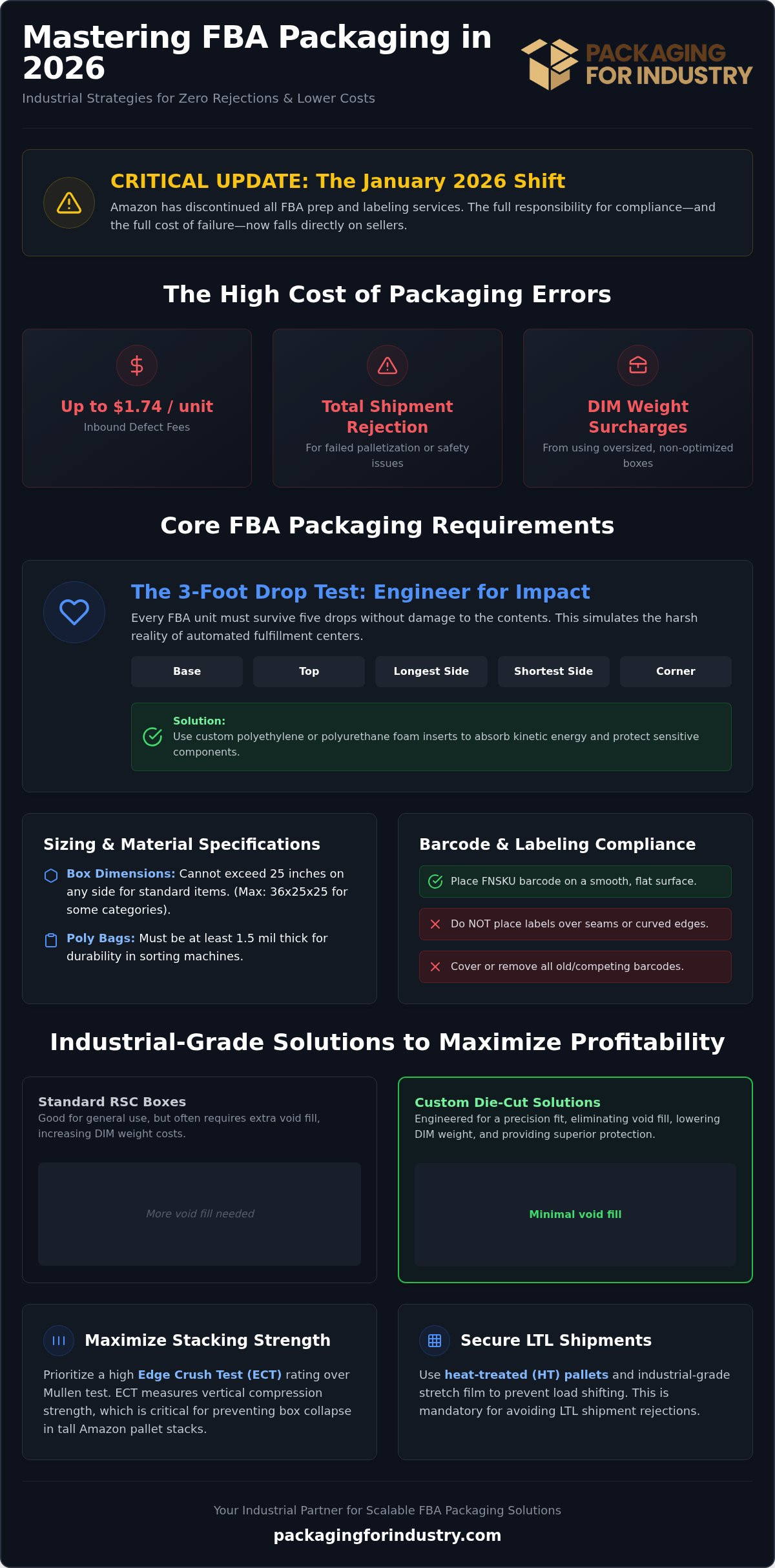
As of January 2026, Amazon has officially discontinued all FBA prep and labeling services, shifting the entire burden of compliance directly onto your warehouse floor. With inbound defect fees for standard items now reaching as high as $1.74 per unit, a single packaging oversight can instantly erode your product margins. You’ve likely dealt with the frustration of rejected shipments or unexpected dimensional weight surcharges due to improper box selection. It’s clear that the “good enough” approach to shipping no longer works in a fulfillment environment that is now entirely focused on automated efficiency.
We understand that mastering how to package products for Amazon FBA is no longer just a logistical task; it’s a critical financial strategy for manufacturers and distributors. This guide provides industrial-grade strategies to help you navigate the latest 2026 requirements, from 1.5 mil poly bag standards to the strict 36x25x25 inch box limits. You’ll learn how to optimize your heavy-duty corrugated boxes and custom foam inserts to achieve zero FBA rejections while lowering your total freight costs. We will preview the specific materials and palletization techniques that ensure your inventory survives the journey and arrives ready for the shelf without penalty.
Key Takeaways
- Learn how to package products for Amazon FBA using high ECT-rated corrugated boxes and custom foam to ensure your inventory survives automated sorting and the mandatory 3-foot drop test.
- Discover how to “right-size” your packaging through custom engineering to eliminate costly dimensional weight (DIM) surcharges and reduce monthly FBA storage fees.
- Master Amazon’s strict LTL inbound requirements by utilizing heat-treated pallets and industrial-grade stretch film to prevent load shifting and shipment rejections.
- Identify the structural differences between standard RSC boxes and custom die-cut solutions to maximize vertical stacking strength in high-volume fulfillment centers.
- Understand how local Southern California manufacturers leverage Vendor Managed Inventory (VMI) to maintain consistent lead times and avoid costly FBA stockouts.
Understanding Amazon FBA Packaging Standards for Industrial Sellers
Amazon’s fulfillment centers operate with high-speed conveyors and robotic sorters that treat every parcel with the same mechanical force. For industrial manufacturers, learning how to package products for Amazon FBA effectively means engineering for survival. The core objective isn’t just getting a box through the door; it’s ensuring the contents remain pristine after multiple high-velocity impacts. Since Amazon discontinued in-house prep services in early 2026, the responsibility for compliance rests entirely on your shoulders.
Standard prep often involves simple bagging or labeling. However, “ready-to-ship” packaging is the industrial gold standard. This approach uses robust materials like heavy-duty corrugated boxes to eliminate the need for over-boxing. While Frustration-Free Packaging (FFP) offers lower surcharges, it requires rigorous certification and high-performance materials. If your packaging fails to meet these standards, you face inbound defect fees that can reach $1.74 per unit for standard items. Common rejections often stem from structural collapses or barcodes that become unreadable due to poor material choice.
The 3-Foot Drop Test: Engineering for Impact
Amazon requires that any item sent through Fulfillment by Amazon (FBA) must pass a rigorous 3-foot drop test. This test involves dropping the unit five times: on its base, top, longest side, shortest side, and a corner. Standard single-wall boxes often fail this test when carrying heavy industrial components or precision instruments. At PFI, we recommend using custom foam packaging like polyethylene or polyurethane. These materials absorb the kinetic energy that would otherwise shatter sensitive electronics or aerospace parts during the sorting process.
Labeling and Barcode Compliance for Industrial Goods
Accurate labeling is the backbone of the FBA system. Every unit must have a scannable FNSKU barcode placed on a flat surface. Don’t place labels over seams or curved edges where they might distort. For industrial master cartons, you must ensure that only the correct shipping label is visible; old barcodes from previous shipments will trigger a rejection. We use high-durability thermal ribbons and labels that resist the humidity and abrasion typical of large-scale warehouses. This prevents the “unscannable” defects that lead to costly manual processing fees and inventory delays. If you’re looking to lower packaging costs, getting the label right the first time is the easiest way to avoid Amazon’s penalty fees.
Selecting the Right Materials: Corrugated Boxes and Protective Foam
Choosing the correct materials is the most effective way to protect your profit margins from Amazon’s automated fulfillment environment. Standard retail boxes often lack the structural integrity required for high-density storage. Understanding how to package products for Amazon FBA requires a shift from consumer-level aesthetics to industrial-grade durability. Most high-volume sellers rely on Regular Slotted Cartons (RSC) for general inventory; however, custom die-cut boxes offer a precision fit that eliminates the need for excessive void fill. By exploring industrial corrugated boxes with the correct specifications, you ensure your products withstand the compression of vertical stacking in massive fulfillment centers.
Edge Crush Test (ECT) ratings are more critical than ever in 2026. While the Mullen test measures puncture resistance, the ECT rating specifically measures the stacking strength of the box. This is vital because Amazon maximizes warehouse space by stacking pallets high. If your boxes lack sufficient vertical strength, the bottom layers will collapse, leading to damaged inventory and safety violations. Adhering to OSHA pallet racking standards and Amazon’s internal safety protocols helps you avoid the “inbound defect” penalties that now cost sellers up to $5.72 per bulky unit.
Box Strength: When to Use Double-Wall or Triple-Wall
Amazon enforces a strict 50-pound weight limit for standard boxes. Any parcel exceeding this must be labeled for “Team Lift” or “Mechanical Lift.” For items approaching this weight limit, standard single-wall corrugated is rarely sufficient. Double-wall boxes provide the necessary burst strength to prevent heavy parts from breaking through the bottom. If you ship high-density industrial components, triple-wall corrugated is the best choice to prevent “box bulge.” Bulging boxes often exceed the 36-inch maximum length or 25-inch width limits, triggering dimensional weight surcharges. You can compare packaging pricing for these heavy-duty options to find the right balance between protection and freight costs.
Protective Foam: Polyethylene vs. Polyurethane
Internal protection is where most FBA shipments fail the mandatory 3-foot drop test. While bubble wrap is a common choice, it often deflates under the weight of industrial goods. Polyethylene foam is superior because it provides a closed-cell structure that doesn’t bottom out during impact. For lighter, more delicate items, polyurethane foam offers soft cushioning that absorbs vibration. If you sell high-value electronics, you must use anti-static (ESD) foam to prevent electrostatic discharge during high-velocity sorting. Utilizing custom foam packaging solutions allows you to create specialized inserts that lock your products in place, ensuring they arrive at the fulfillment center in sellable condition.
Custom Engineering vs. Stock Supplies: Balancing Cost and Protection
Relying on stock catalog boxes might seem like a time-saver during the purchasing phase, but it often creates a long-term drain on your fulfillment budget. When you evaluate how to package products for Amazon FBA, you have to look beyond the unit price of the corrugated box. You’re actually paying for the volume that box occupies in the Amazon warehouse and on the delivery truck. Stock sizes rarely align perfectly with industrial components, leaving you with excess space that requires expensive void fill or, worse, triggers a higher fee tier. Custom engineering solves this by right-sizing the container to the product, ensuring you aren’t paying to ship and store empty air.
Amazon’s fee structure heavily penalizes inefficiency through dimensional weight (DIM) calculations and monthly storage surcharges. If your box is just one inch too large in any dimension, it can push your shipment into a “bulky” category, where fees jump significantly. For bulky items not certified in the Ships in Product Packaging (SIPP) program, Amazon adds a surcharge ranging from $1.51 to $4.04 per unit. Transitioning to Custom Packaging Design and Engineering allows you to bypass these penalties by creating a footprint that meets Amazon’s exact size tiers while maintaining maximum protection.
Reducing Dimensional Weight with Custom Sizing
Dimensional weight is a pricing technique that uses an estimated weight calculated from the length, width, and height of a package. If your package is light but large, you’ll be billed at the higher DIM weight rather than the actual weight. By eliminating even a few inches of excess corrugated material, manufacturers can significantly lower their fulfillment costs. Our clients have seen FBA fee reductions of up to 15% simply by optimizing their master cartons. This right-sizing approach also reduces the amount of stretch film and corner protection needed for inbound pallets, further streamlining your operational spend.
The Value of CAD/CAM Prototyping
For aerospace and automotive suppliers in Southern California, precision is a requirement, not an option. We use CAD/CAM prototyping to create exact physical samples of your packaging before you commit to a bulk production run. This process is essential for evaluating foam cushioning materials and ensuring they provide the necessary G-force protection during Amazon’s high-velocity sorting. Prototyping ensures your high-value parts comply with Amazon’s “no loose items” policy, preventing the internal shifting that leads to damage claims. As a local Los Angeles packaging supplier, we provide these engineering services with rapid turnaround times, helping you move from design to FBA inbound status without the delays of overseas sourcing.
Palletization and Load Stabilization for FBA Inbound Shipments
Amazon’s receiving docks are among the most unforgiving environments in modern logistics. While individual box compliance is vital, the structural integrity of your bulk shipment determines whether your inventory is accepted or turned away at the gate. Understanding how to package products for Amazon FBA for Less-Than-Truckload (LTL) shipments requires strict adherence to palletization standards that prevent shifting during transit. Amazon requires standard 40 x 48 inch pallets that meet GMA Grade B or higher specifications. Using broken, undersized, or non-standard pallets is a guaranteed way to trigger inbound defect fees or a total shipment rejection.
Load stabilization depends heavily on the quality of your consumables. As of early 2026, Amazon requires all pallets to be stretch-wrapped in clear plastic; using opaque or colored film can lead to processing delays or rejections. The wrap pattern must secure the load to the pallet base itself to prevent “sliding” during heavy braking or forklift maneuvers. High-performance Industrial Stretch Film and Pallet Wrap with the correct gauge is essential for maintaining tension without snapping. For manufacturers shipping from high-humidity areas like Orange County or San Diego, selecting a film that maintains its cling properties is critical for long-haul stability.
Advanced Load Stabilization Techniques
Heavy industrial loads often suffer from “strap crush” or “corner collapse” when high-tension banding is applied. We recommend using heavy-duty cardboard edge protectors to distribute pressure evenly across the stack. As specialized Corner and Edge Protection Manufacturers, we’ve seen how these simple additions prevent the box deformation that causes pallets to lean. Utilizing pre-stretched film also helps lower material costs while providing higher containment force. This ensures your high-value aerospace or automotive components remain perfectly vertical throughout the entire journey to the fulfillment center.
Preventing Pallet Rejections at the Amazon Dock
Amazon enforces a maximum pallet height of 72 inches, including the height of the pallet itself. Exceeding this limit makes the load incompatible with standard racking and will result in a refusal. Additionally, the total weight must not exceed 1,500 pounds. Each pallet requires four labels, one centered on each side, to ensure visibility for forklift operators and automated scanning systems. Ensure your pallets are accessible for standard forklifts with a minimum 4-way entry. If your load is double-stacked, it must be done safely and labeled as such, though most industrial sellers find that single-stacking provides the best protection against damage claims.
PFI: Your Industrial Partner for Scalable FBA Packaging Solutions
Success on Amazon isn’t just about the quality of your product; it’s about the reliability of your supply chain and the durability of your outbound parcels. When you’re figuring out how to package products for Amazon FBA, relying on a generic catalog supplier often leads to long lead times and high shipping costs for the supplies themselves. PFI serves as a professional, cost-saving alternative for bulk FBA supplies, offering the engineering expertise that national distributors lack. We don’t just sell boxes; we provide a complete system of protection that integrates directly with your production cycle.
Mastering how to package products for Amazon FBA requires more than just meeting a checklist; it requires a partner who understands the economics of your warehouse. We focus on the intersection of engineering and fiscal responsibility, ensuring your packaging protects your margins as much as it protects your goods. By choosing a local partner, you gain the agility needed to respond to Amazon’s frequent policy changes and seasonal demand spikes without the logistical headaches of overseas or out-of-state sourcing.
Optimizing Supply Chains with VMI
Running out of packaging during a peak sales window like Q4 can halt your FBA restocks and damage your seller ranking. Our Vendor Managed Inventory Services eliminate this risk by placing the responsibility of stock levels on us. We monitor your usage rates and ensure you always have the corrugated boxes, stretch film, and foam inserts you need on hand. This approach improves your cash flow by preventing you from sitting on months of excess inventory while ensuring you never miss a critical shipment window. It’s a pragmatic solution for manufacturers who need to focus on production rather than box counts.
Local Support for Southern California Manufacturers
We provide local next-day delivery across Anaheim, Orange County, and Los Angeles, which significantly lowers your inbound freight costs on packaging materials. Our proximity allows your operations team to have direct access to our engineering experts for rapid prototyping and troubleshooting. If you’re moving beyond small parcel FBA and into larger logistics, we also specialize in Engineering Custom Crates for International Transit. This local oversight ensures that every piece of packaging is built to survive the specific stressors of the Amazon fulfillment network. Don’t let poor packaging compliance or stockouts hurt your bottom line. You can request a custom packaging quote to compare our pricing against your current supplier and see the benefit of a local industrial partnership.
Secure Your FBA Profit Margins with Industrial Engineering
Mastering how to package products for Amazon FBA is a continuous process of balancing structural integrity with shipping economics. You’ve seen that relying on stock catalog boxes often leads to unnecessary fees and high damage rates. By implementing custom CAD/CAM prototyping and selecting high-performance materials like polyethylene foam, you ensure your high-value aerospace or industrial components survive Amazon’s automated sorting systems.
Compliance isn’t just about labels; it’s about the entire load stabilization strategy. Using the right gauge of stretch film and corner protection prevents the pallet shifting that causes dock rejections. As your local Southern California partner, we provide the expertise in industrial standards and the operational agility of next-day delivery to keep your supply chain moving. Our Vendor Managed Inventory programs mean you’ll never face a stockout during peak sales seasons.
Protecting your inventory shouldn’t be a source of professional stress. We’re here to help you optimize every inch of your packaging for maximum fiscal responsibility and long-term reliability.
Frequently Asked Questions
What is the maximum box weight for Amazon FBA?
The standard weight limit for any individual box is 50 pounds. If a single oversized item exceeds this weight, you must clearly apply “Team Lift” labels on the top and sides; items over 100 pounds require “Mechanical Lift” labels. Boxes containing jewelry or watches have a stricter limit of 40 pounds. We recommend using double-wall corrugated for any industrial shipments nearing these limits to prevent the bottom from bursting during transit.
Does Amazon FBA require specific box types for industrial products?
Amazon requires rigid, six-sided boxes with intact flaps. While they don’t mandate a specific brand, industrial sellers should prioritize Regular Slotted Cartons (RSC) with high Edge Crush Test (ECT) ratings. For heavy metal parts or machinery components, double-wall or triple-wall corrugated is necessary to survive the vertical stacking pressure found in high-volume fulfillment centers.
How do I pass the Amazon FBA 3-foot drop test?
Learning how to package products for Amazon FBA specifically for the 3-foot drop test requires locking the product in place with high-density cushioning. The unit must survive five drops on its base, top, longest side, shortest side, and a corner without the contents breaking. Custom polyethylene foam inserts are the most reliable way to ensure heavy or sensitive parts pass this requirement on the first attempt.
Can I use custom printed boxes for Amazon FBA?
Yes, custom printed boxes are permitted as long as the branding doesn’t interfere with barcode scannability. You must ensure the FNSKU label is placed on a flat, unprinted surface to avoid scanning errors at the warehouse. Many manufacturers use custom boxes to maintain brand identity while utilizing our engineering support to ensure the box meets all structural compliance standards.
What are the pallet requirements for shipping to Amazon FBA warehouses?
You must use 40 x 48 inch wooden pallets, specifically GMA Grade B or higher. Pallets cannot exceed 72 inches in height, including the pallet base, and the total weight must stay under 1,500 pounds. Every load must be secured with clear stretch film and feature labels on all four sides to ensure rapid processing at the Amazon receiving dock.
How can I reduce my Amazon FBA shipping and storage fees?
Right-sizing your containers is the most effective way to lower packaging costs. By engineering a custom box that eliminates excess void space, you reduce both the dimensional weight and the monthly storage fees charged by Amazon. This strategy also removes the need for expensive fillers like bubble wrap, which are often inefficient for securing heavy industrial goods.
Does PFI offer FBA-compliant packaging for aerospace and electronics?
We provide specialized solutions for high-spec sectors, including anti-static (ESD) foam inserts and heavy-duty boxes that meet aerospace standards. Our team uses CAD/CAM prototyping to verify that your specialized components are fully protected and compliant before they enter the FBA network. This precision engineering helps you avoid the inbound defect fees that Amazon now applies to non-compliant shipments.
Why should I choose a local Southern California packaging supplier for FBA?
Working with a local packaging supplier in Orange County or Los Angeles provides significant lead-time advantages and lower freight costs. We offer next-day delivery across Anaheim and San Diego, ensuring you never miss an FBA restock window. Local support also means you can work directly with our engineering team to solve complex compliance issues that national catalog distributors aren’t equipped to handle.