
High humidity can reduce corrugated boxes’ stacking strength by as much as 50%. For Los Angeles warehouses, moisture-resistant corrugated boxes for long-term warehouse storage can help protect loads, but box performance also depends on how cartons are stored and stacked.
Humidity can soften paper fibers and weaken the bonds between corrugated layers. Poor pallet placement and overstacking add strain. Choosing a more moisture-tolerant box is only part of the solution: storage conditions and handling practices matter too.
This article explains how moisture affects stacking strength, what influences lead times for custom moisture-resistant boxes, and which warehouse practices can help limit weather-related damage. You’ll also learn how to weigh box design against storage conditions to protect inventory and manage costs.
Key Takeaways
- Keep corrugated inventory off the ground, protected from temperature and humidity swings, and rotate stock to limit storage-related deterioration.
- Choose moisture barriers and box construction around the exposure and load; coatings can help, but they don’t eliminate every moisture risk.
- Custom box lead time depends on design details such as coating and die-cut requirements, so include them when planning packaging supply.
- Weather damage can create costs beyond replacing packaging, including product loss, shipment delays, and weakened customer confidence.
- PFI’s custom packaging design, VMI, and just-in-time packaging services can help align packaging supply with warehouse and production needs.
How does humidity affect the stacking strength of standard shipping boxes?
Humidity weakens corrugated fibers and can reduce a box’s ability to support stacked loads. In Los Angeles warehouses, moisture control and sound pallet practices both affect packaging performance.
Humidity and Corrugated Performance
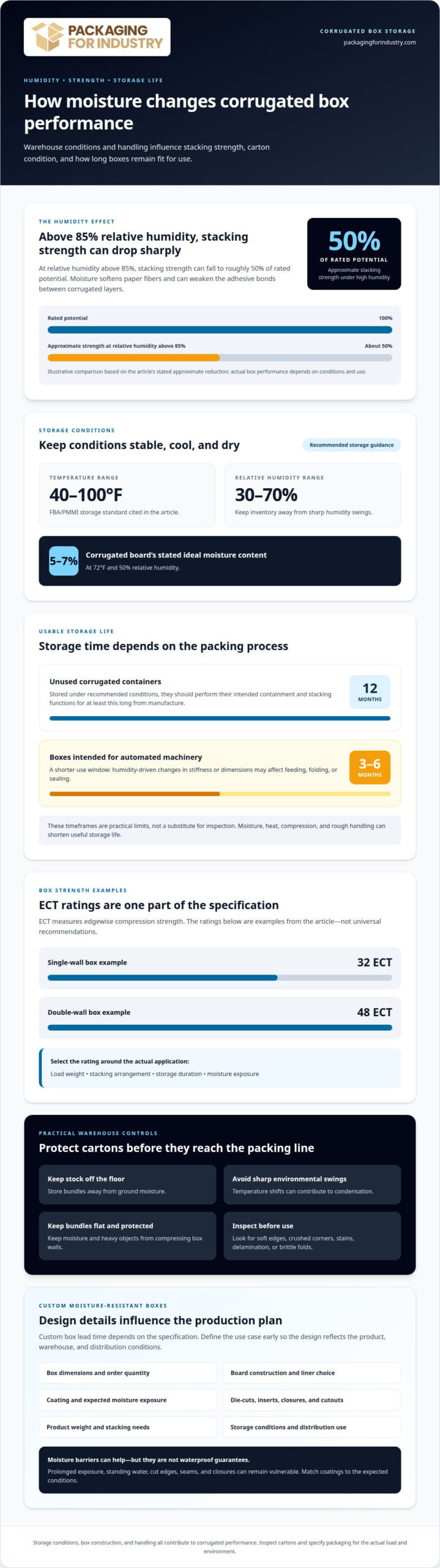
Humidity and direct water exposure soften corrugated fibers, reducing board stiffness and compression strength. At relative humidity above 85%, stacking strength can fall to roughly 50% of rated potential. Excess moisture can also weaken the adhesive bonds between layers, increasing the risk of crushed cartons during storage or shipment. This matters because a box’s dry-condition rating may not reflect its performance after prolonged exposure.
Storage Conditions for Long-Term Protection
Corrugated boxes perform best under stable, cool, dry storage conditions. The FBA/PMMI storage standard recommends 40-100°F and 30-70% relative humidity. Corrugated board’s stated ideal moisture content is 5% to 7% at 72°F and 50% relative humidity. Keep inventory away from sharp temperature and humidity swings, and store it off the floor. These practices help preserve strength and packaging availability. Corrugated box options can be selected around warehouse and shipment needs.
Risks in Humid Warehouses
Prolonged damp conditions can soften cartons and weaken seams, increasing the risk of failure under stacked loads. Temperature shifts can also cause condensation on nearby surfaces or packaging. Damp, damaged cartons may encourage mold or attract pests, particularly when stored goods or debris provide food sources. After a leak or environmental change, inspect stored packaging for visible moisture, soft edges, stains, or other damage before use.
Strength Ratings and Storage Rules
ECT measures edgewise compression strength; single-wall boxes rated at 32 ECT and double-wall boxes rated at 48 ECT are examples, not universal recommendations. Select a rating based on load weight, stacking arrangement, storage duration, and moisture exposure. California SB 54 mandates a 25% reduction in single-use plastic packaging by 2032, according to the California State Legislature; this requirement concerns plastic reduction, not corrugated storage conditions. In Los Angeles, account for warehouse conditions and the actual load when choosing box strength.
What is the typical lead time for custom water-resistant boxes in SoCal?
For custom moisture-resistant corrugated boxes for long-term warehouse storage in Los Angeles, lead time depends on box dimensions, order quantity, board construction, coatings, and die-cut requirements. A standard container involves fewer design decisions than a box with a custom insert, unusual closure, or multiple cutouts. Define the product weight, storage conditions, and distribution use early so the design and production plan reflect the actual application.
Wax and wax-alternative coatings can help corrugated boxes resist moisture absorption for a period, but they do not guarantee protection against prolonged exposure, standing water, or extreme conditions. Cut edges, seams, and closures may remain vulnerable. Match the coating to the expected exposure, such as occasional damp handling versus repeated condensation. This helps specify moisture-resistant corrugated boxes for long-term warehouse storage in Los Angeles without mistaking a coating for a waterproof barrier.
Kraftliner is one paper liner option to consider alongside flute structure, load, and coating. Moisture barriers and specialty coatings add design choices, but the complete construction must still meet stacking and handling requirements. Aqueous coatings use water-based formulations, but that alone does not establish recyclability. The coating formulation and full package construction affect how materials can be managed after use.
Die-cut customization can add design and tooling steps, particularly for complex openings, folds, or locking tabs. Sharing a product sample, internal dimensions, stacking needs, and storage environment helps optimize the design before production. These details also clarify durability requirements without adding unnecessary protective weight. For a project-specific schedule and box specification, request a custom box quote with the intended use and design details.
Corrugated box storage life
Unused corrugated containers stored under recommended conditions should perform their intended containment and stacking functions for at least 12 months from manufacture. General handling guidance is to use corrugated products within several months and no later than 12 months after manufacture. These timeframes are practical limits, not a substitute for inspecting materials before use. When requesting a corrugated box quote, consider expected storage time and conditions alongside box specifications. Moisture exposure, heat, compression, and rough handling can shorten useful storage life.
Boxes intended for automated machinery have a shorter use window: 3-6 months. Changes in humidity can affect board stiffness and cause dimensional variation, which may interfere with feeding, folding, or sealing. For hand-packed freight, inspect aged cartons for soft edges, crushed corners, delamination, or brittle folds. Visible damage can signal reduced structural integrity, even when a box has remained within its storage period. Share your packing process and expected inventory turnover when comparing packaging options.
Storage conditions affect whether a carton retains its designed performance. Keep bundles flat, protected from moisture, and away from heavy objects that could compress the walls before use. Store boxes off the ground and rotate inventory using first in, first out, so older stock does not remain forgotten behind newer materials. Proper storage helps prevent damage that could compromise stacking strength or closure and informs decisions about stock quantities and replenishment timing.
Match your inspection to the job. A carton holding dense parts in stacked freight needs sound corners and intact seams. A box with internal cushioning also needs enough room for both the product and cushioning, without bulging panels. Before packing, reject cartons with damp patches, crushed edges, or damaged folds. For long-term storage, track manufacture dates by lot and issue stock in age order. This keeps inventory moving and helps teams identify packages that need closer review when planning a packaging purchase.
Cost and reputation impacts of weather damage
Weather-damaged packaging can cost more than the price of a replacement carton. A wet pallet at a Los Angeles loading dock may require repacking, extra handling, and delayed dispatch. If weakened boxes collapse in transit, contents may need inspection or replacement, while staff spend time documenting damage and coordinating corrective work. These expenses affect the shipment even when the product remains usable.
Moisture can weaken corrugated layers and their adhesive bonds, reducing the support available to the load. A carton exposed to a leak, for example, may lose rigidity before reaching a distribution area. Coatings can help limit moisture absorption for a period, but they cannot remove every exposure risk. The right choice depends on the application and contact conditions, including whether the package faces brief dampness or continuing moisture.
Customers judge a delivery by the condition of both the product and its container. Softened corners, staining, or a collapsed panel can trigger extra receiving work and questions about handling. For businesses shipping sensitive components, damaged packaging can make the delivery appear poorly controlled. Clear inspection records and prompt communication help teams explain what happened and focus the response on the affected shipment.
Reduce avoidable disruption by identifying where moisture enters the process. Check storage areas, dock transfers, and freight staging for leaks or condensation, then separate affected cartons before packing. Review whether the box construction and coating suit the application instead of relying on coating alone. This assessment helps target protection where it matters, limit rework, and preserve customer confidence without adding unnecessary packaging to every order.
Storage practices for warehouse boxes
Choose storage conditions that help preserve corrugated box strength before packing. AICC recommends processing and storing corrugated materials in areas above 55°F. Keep stock away from moisture sources and abrupt temperature or humidity changes. Use a thermometer and humidity monitor to track conditions, and move vulnerable cartons away from damp walls or loading areas. When requesting a corrugated box quote, discuss storage conditions and box requirements with your packaging supplier.
Select box strength and pallet configuration for the load. Single-wall boxes rated at 32 ECT and double-wall boxes rated at 48 ECT provide examples of different structural capacities, not universal choices. Keep cartons flat and aligned with pallet edges. Pallet overhang can reduce compression strength by 23-49%, depending on its magnitude and direction, so avoid projecting boxes beyond the pallet footprint.
Stack cartons to protect their compression strength during storage and shipping. Interlocked stacking patterns can reduce top-to-bottom compression strength by 45-55%; column stacking keeps vertical box corners aligned. Don’t place heavy objects on folded cartons, and protect pallet edges during forklift handling. Store boxes off the ground on a clean, new, or nearly new pallet. These measures help maintain carton performance and reduce damage before use.
Protect packaging supplies through careful handling and rotation. Dropping, dragging, or tossing bundles can crush corners before use. Apply first in, first out so older inventory moves to packing first, and inspect cartons for damp patches, soft edges, or crushed panels. Keep packaging flat, stabilize unit loads, and avoid overstacking. When comparing packaging pricing, consider box strength and storage needs to help lower packaging costs and reduce shipping damage.
Packaging Products and Why Choose Packaging For Industry (PFI)
Packaging For Industry (PFI) helps manufacturers connect warehouse protection needs with practical packaging supply and inventory planning. Foam Packaging can cushion products, while Stretch Film can help secure palletized loads. The right combination depends on the product, load, and how packaging moves through your operation.
Foam Packaging can cushion products inside a package and help limit movement during handling. Stretch Film can secure unitized loads for warehouse movement and shipment. Neither replaces dry storage or makes corrugated boxes waterproof. These materials address different parts of the packaging system, helping buyers consider product protection and load stability alongside warehouse conditions.
Supply planning matters too. Vendor Managed Inventory (VMI) for Packaging can coordinate packaging stock with operational demand. Just-In-Time (JIT) Inventory Management for Packaging aligns supply timing with planned use. These approaches are useful when packaging availability, storage space, and replenishment need to work together, rather than relying on excess warehouse stock.
Consider contacting PFI if weather exposure has damaged loads, packaging inventory is difficult to manage, or protective materials need to suit a specific handling process. Useful details include the product being packed, how it is stored, and how the finished load moves through distribution. This context helps focus the discussion on practical packaging needs, since one solution does not fit every application. Contact Packaging For Industry (PFI) to discuss your packaging requirements.
Industries Served
Packaging For Industry (PFI) supports businesses in manufacturing, aerospace, electronics, medical devices, food and beverage, automotive, machinery, construction, and logistics. Each industry handles different products and workflows. A manufacturer may package components for another production step, while a distributor prepares finished goods for varied customers. Packaging choices should reflect the item’s shape, handling, and route through the business.
Aerospace and electronics operations often handle components that need carefully planned fit and cushioning during movement. Medical device manufacturers and food producers have distinct product and handling requirements, so packaging decisions must suit each application. Custom packaging design can account for product dimensions and packing methods. Foam packaging can cushion items inside an outer container, depending on the shipment’s needs.
Warehouses, logistics providers, and fulfillment operations handle receiving, storage, order picking, and outbound preparation. Packaging needs can vary with order profiles and the products moving through the facility. A packaging plan should account for how staff handle items, group products for dispatch, and fit packaging into the workflow. Packaging support for manufacturers can align with production requirements and the products being shipped.
Construction suppliers, automotive businesses, and industrial equipment companies also need packaging suited to their products and shipping processes. Start by identifying the item being packed, how it moves through the operation, and the protection it needs at each stage. This industry-specific context helps shape packaging decisions around actual handling demands instead of assuming one standard approach works for every business.
Benefits of Working with a Packaging Supplier
A packaging supplier can help purchasing and operations teams evaluate packaging as part of the full shipping process. Rather than treating each carton as an isolated purchase, review product dimensions, packing steps, and freight handling together. This can reveal where excess material, awkward packout, or inconsistent specifications add avoidable work. The goal is a packaging plan that fits actual operations, not a one-size-fits-all selection.
Right-sizing packaging can support cost control and reduce damage. A box with too much unused space may need extra cushioning, while a tight fit can leave a product vulnerable during handling. Review the item and packing method to find a suitable balance. For fragile components, protective foam can limit movement inside the package; for other products, a simpler configuration may be adequate.
Consistent specifications also make repeat orders easier to manage. Once teams settle on suitable packaging, warehouse staff can recognize materials, prepare familiar packouts, and communicate requirements across shifts. Review specifications when products or shipping methods change to prevent outdated packaging from becoming the default. A focused packaging review can also identify ways to manage costs without relying on unsupported savings estimates.
Working with a supplier can reduce the coordination burden on internal teams. Buyers can bring product, handling, and shipping requirements into one packaging discussion instead of resolving each issue separately. Clear specifications help purchasing compare relevant options, while operations can assess how materials work on the packing floor. This shared view supports practical decisions, protects product condition, and helps teams plan future packaging needs.
Build a Packaging Plan Around Your Warehouse
Make storage protection part of your purchasing plan, rather than a decision made after weather damage occurs. A clear packaging standard can connect warehouse conditions, product handling, and replenishment needs. For moisture-resistant corrugated boxes for long-term warehouse storage in Los Angeles, consider how packaging choices fit the full operation, from receiving materials to preparing outbound shipments.
Packaging For Industry (PFI) offers Foam Packaging and Stretch Film for distinct protection and load-handling needs, along with Vendor Managed Inventory (VMI) for Packaging to support supply planning. These options can complement a broader packaging strategy, but the right mix depends on your products, facility, and workflow. Share those details when planning your next packaging purchase so the discussion reflects your actual operating requirements.
A thoughtful packaging plan helps your team make clearer purchasing decisions and align supply with day-to-day operations.
Frequently Asked Questions
What tape should I specify when requesting a quote for water-resistant boxes?
Choose tape that bonds reliably to the box’s outer surface and suits the closure method. Coatings or treatments can affect adhesion, so test tape on a sample carton before applying it across a production run. Apply firm, even pressure along the seam and check that the tape remains attached after normal handling. When requesting a packaging quote, share the box surface and closure requirements so your supplier can help identify suitable packaging supplies.
What should I consider when ordering corrugated boxes for storage?
Corrugated cardboard has no single lifespan that applies to every carton and use. Storage conditions, board construction, handling, and load all affect how long it remains suitable. When comparing packaging pricing, share how the boxes will be stored, moved, and loaded. Retain lot or manufacture-date information and inspect cartons before assigning them to a critical shipment.
What should I specify when requesting a quote for water-resistant corrugated boxes?
Water resistance means a package can slow or limit moisture penetration under certain exposure conditions. Waterproof describes protection against a defined water exposure. The distinction depends on the complete, assembled package, including seams, closures, and openings, not just the board surface. For a meaningful quote, describe the expected exposure and assess the finished package under those same conditions instead of relying on a material label alone.
What moisture-resistant corrugated box coatings and liners are available for bulk orders?
Options include treated board, barrier layers, and coated surfaces, with construction selected for the application. For purchasing, specify which faces need protection and whether folds, cut edges, or seams will face direct exposure. Share how the boxes will be stored and handled, along with your custom size and bulk order requirements. These details help your packaging supplier compare suitable constructions for the intended use.
How should I compare wax-coated, polyethylene-lined, and treated corrugated boxes when requesting a quote?
These constructions offer different ways to limit moisture contact. Wax applies a coating, polyethylene adds a liner layer, and treated board modifies the paper material. Compare them by exposure location, package design, and handling process, not just material name. When requesting a quote, describe how the finished box will be converted, sealed, and managed after use, since these factors affect practical performance and end-of-use handling.
What warehouse conditions should I share with a supplier when ordering corrugated boxes?
Use recommended warehouse conditions as operating guidance, not as a guaranteed failure threshold. Conditions near a loading door may differ from those in a central storage aisle, so consider where cartons actually sit. Temperature and humidity records can help identify recurring changes and problem areas. Share those conditions, along with the box’s intended load, when asking a supplier to help select packaging for your application.
How should I evaluate stored moisture-resistant corrugated boxes before placing a bulk order?
Storage life depends on box construction and exposure, so moisture resistance alone does not establish a fixed usable period. Keep packaging identification with its storage lot, and evaluate cartons intended for critical shipments separately from routine stock. A sample packout can show whether folds, closures, and dimensions still work with the product and packing process before using the same carton at scale.
What packing and sealing requirements should I include in a moisture-resistant box quote?
Pack products only when they and the packing area are dry, and protect moisture-sensitive items inside the carton. Choose a closure suited to the box surface, then verify adhesion along the full seam. Avoid overfilling, since bulging panels can interfere with secure closure and consistent handling. Include your packing, sealing, and stacking requirements when requesting a quote so the box construction suits your process.