
How much of your quarterly profit is being sanded away in the refinishing department because of a packaging material that was supposed to protect your parts? It’s a frustrating reality for many industrial manufacturers. You invest in a high-quality powder coat or Class A finish, only to have it arrive at the customer with ghosting, scuffs, or micro-abrasions. Often, the culprit is the very material meant to keep it safe. Selecting the correct non-abrasive foam for painted surfaces is not just about choosing something soft; it’s about understanding cellular structure and chemical neutrality to prevent friction-based marring.
We understand that high rejection rates and the expense of reworking damaged components create unnecessary operational stress. This guide will teach you how to select the right protective foam to eliminate surface marring, scratching, and ghosting on high-value painted industrial components. We’ll examine the technical differences between various foam densities, compare polyethylene and polyurethane options, and show you how to optimize packaging costs through better material selection. By the end of this article, you’ll know exactly how to secure your supply chain and find a reliable Southern California packaging supplier for your bulk orders.
Key Takeaways
- Identify the specific cellular structures of Polyethylene and Polyurethane to ensure your packaging material provides the necessary protection without compromising the paint finish.
- Discover how selecting the right non-abrasive foam for painted surfaces can significantly lower rejection rates by preventing transit-related marring and ghosting.
- Compare the long-term cost-effectiveness of custom foam inserts against stock sheets to streamline your packaging process and reduce shipping damage.
- Follow industry best practices for surface preparation and curing to ensure your high-value industrial components remain pristine from the factory floor to the end user.
- Partner with a local Southern California packaging supplier to access custom-engineered solutions and next-day delivery that optimizes your logistical flow.
What is Non-Abrasive Foam and Why Does It Matter for Painted Parts?
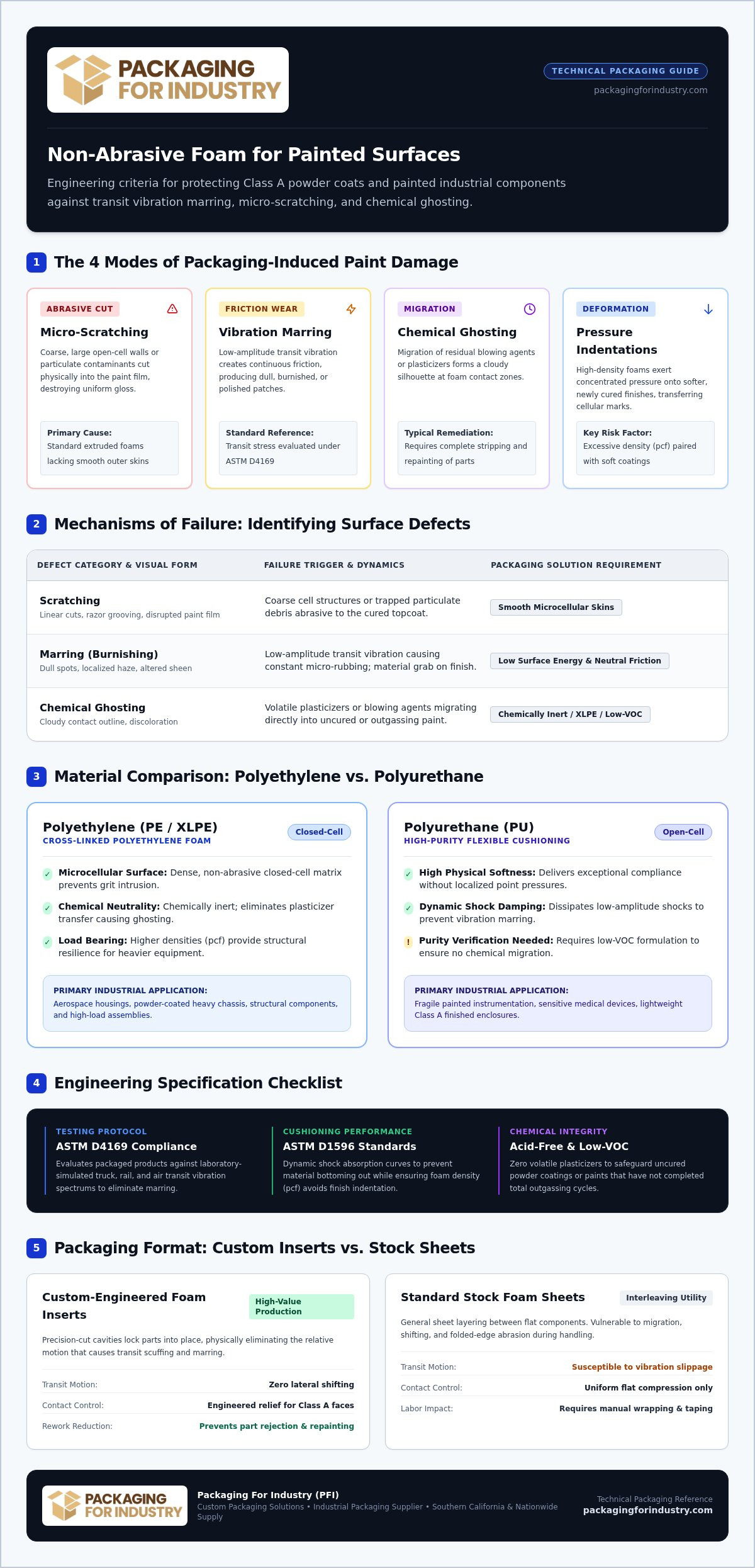
Non-abrasive foam for painted surfaces is a specialized class of foam packaging engineered with a smooth, microcellular structure. While many industrial suppliers focus on abrasive foams designed for sanding and surface finishing, protective packaging foam serves the opposite purpose. Its primary function is to maintain the integrity of “Class A” finishes throughout the rigors of the logistics cycle. High-value sectors like aerospace and medical device manufacturing require these materials because even microscopic surface defects can lead to immediate part rejection. Effective protection relies on the fundamental principles of package cushioning, where the material must provide shock absorption while remaining physically and chemically neutral toward the finished substrate.
Scratching vs. Marring: Identifying the Enemy
Distinguishing between scratching and marring is essential for selecting the correct protective material. Scratching occurs when a coarse cell structure or trapped particulates physically cut into the paint layer. This is often a failure of low-quality, large-cell foams that lack a smooth skin. Marring, or burnishing, is a more subtle failure. It happens during transit when low-amplitude vibrations, often tested under ASTM D4169 standards, cause the part to rub against the foam. This constant friction creates a dull or “polished” spot on an otherwise uniform finish. If the surface energy of the paint interacts poorly with the foam’s texture, the material may “grab” the finish, leading to visible scuffing even if the foam feels soft to the touch.
The Hidden Danger of Chemical Ghosting
Chemical ghosting is a complex failure where permanent marks are left by the migration of chemicals from the foam to the paint. This often manifests as a cloudy silhouette of the foam’s contact points. It’s a significant risk for manufacturers using “fresh” paint or powder coatings that haven’t fully outgassed. The culprit is typically the presence of residual blowing agents or plasticizers within the foam. Using chemically stable cushioning materials like cross-linked polyethylene (XLPE) or high-purity polyurethane helps mitigate this risk. We recommend verifying that your foam supplier uses materials that won’t react with specific coating chemistries, as ghosting usually requires a full strip and repaint to fix, which creates a massive spike in your production costs.
Common Surface Damage Risks:
- Micro-scratching: Caused by coarse cell walls in standard extruded foams.
- Vibration Marring: Resulting from high-frequency road or air transit energy.
- Chemical Migration: Leading to permanent ghosting on uncured or sensitive finishes.
- Pressure Sensitivities: Where high-density foams leave “imprints” on softer coatings.
Material Comparison: Polyethylene vs. Polyurethane for Painted Surfaces
Selecting the right foam packaging starts with understanding the chemical and physical properties of the two primary polymer families. Both polyethylene and polyurethane offer protection, but they perform differently under the ASTM D1596 dynamic cushioning standards. Choosing the wrong density or cell type can lead to surface marring or bottoming out during transit. Density is typically expressed in pounds per cubic foot (pcf). Higher density foams provide the structural integrity needed for heavy loads, while lower densities offer the “give” required for lightweight, fragile items.
For high-value finishes, chemical neutrality is just as critical as physical softness. Acid-free and low-VOC foams prevent the migration of blowing agents or plasticizers that cause the permanent ghosting marks discussed earlier. Using a non-abrasive foam for painted surfaces requires a balance between the material’s ability to absorb shock and its surface energy. If the foam is too abrasive or chemically active, it will compromise the finish regardless of its thickness.
Polyethylene Foam: The Shield for Heavy Painted Parts
Polyethylene (PE) is a closed-cell material known for its durability and moisture resistance. It’s an excellent non-abrasive foam for painted surfaces when shipping heavy industrial equipment, automotive body panels, or large machinery. Because it’s closed-cell, it doesn’t absorb oils or moisture that could trap abrasive particulates against the paint. Cross-linked polyethylene (XLPE) is the gold standard for Class-A surfaces. Its microcellular structure is significantly smoother than standard extruded PE, providing a velvet-like contact point that eliminates the risk of hairline scratches during long-haul vibration.
Polyurethane Foam: The Soft Touch for Fragile Finishes
Polyurethane (PU) is an open-cell foam favored for its extreme softness and flexibility. It excels at protecting delicate medical enclosures, aerospace avionics, and complex electronics with intricate geometries. While PU offers superior shock absorption for light parts, its open-cell nature means it can compress more easily under heavy weight. It’s essential to verify that your PU foam is low-outgassing to prevent chemical reactions with sensitive coatings. If you’re currently experiencing high rejection rates due to finish damage, you can request a packaging quote to compare material options and find a more reliable solution for your production line.
Technical Selection Criteria:
- Density: Matches the weight of the part to prevent bottoming out.
- Cell Structure: XLPE for the smoothest contact; PU for maximum shock absorption.
- Chemical Stability: Acid-free and low-VOC to prevent ghosting.
- Moisture Resistance: Closed-cell PE for parts stored in humid environments.
Custom Foam Inserts vs. Stock Foam Sheets: Which is Best?
Choosing between manual wrapping and precision-cut solutions is a critical decision for any operations manager. While stock rolls may seem like a low-cost entry point, the hidden expenses of labor and product damage often outweigh the initial savings. Implementing non-abrasive foam for painted surfaces requires more than just the right material; it requires a delivery system that prevents movement. If a part shifts even slightly during transit, the resulting friction can compromise the finish regardless of the foam’s softness.
The ROI of Custom Foam Engineering
Custom-engineered custom foam inserts offer a level of standardization that manual wrapping cannot match. When a part is physically immobilized within a CAD/CAM designed cavity, the vibration friction that causes marring is virtually eliminated. This level of precision is validated through ISTA transit simulation test procedures, which simulate the exact stresses of the modern supply chain. By testing your packaging against real-world vibration profiles, you can identify potential failure points before they reach the customer.
PFI provides free prototyping to ensure a perfect fit before you commit to a bulk order. This service is particularly valuable for aerospace and medical device manufacturers in Southern California who cannot afford the high cost of part rejections. If the cost of refinishing a single damaged component exceeds the price of a custom packaging set, the economic argument for engineering is clear. Standardized inserts also reduce labor costs in the fulfillment center, as packers no longer need to guess how much wrap is sufficient for each part. This speeds up the pack-out process while ensuring every item receives the same level of protection.
When to Use Stock Foam and Cushioning
Stock foam and other cushioning materials still serve a purpose in industrial environments, particularly as interleaving for flat panels or as a secondary wrap for oversized items. However, relying on stock sheets requires strict adherence to packing protocols. If a foam sheet is not properly secured, it can slide against the painted surface during transit. This movement creates micro-abrasions that dull the finish, making the part appear used or poorly handled upon arrival.
For manufacturers with diverse product lines, stock foam provides necessary flexibility. We often recommend a hybrid approach: using custom inserts for the most sensitive components and high-quality stock sheets for less critical parts. Regardless of the format, ensuring you use a certified non-abrasive foam for painted surfaces is the only way to protect your brand’s reputation and your bottom line. Proper material selection, combined with a secure fit, remains the most effective strategy for eliminating shipping damage.
Best Practices for Packaging Painted Industrial Components
Protecting high-value finishes requires a methodical approach that starts before the part even touches the packaging. Even the highest quality non-abrasive foam for painted surfaces cannot compensate for poor handling protocols. To ensure zero-defect delivery, follow these five essential steps:
- Verify Full Cure: Never pack a component until the paint or powder coating has reached its full chemical cure. Uncured finishes are soft and highly susceptible to imprinting and chemical migration.
- Surface Decontamination: Wipe down every part to remove shop dust, metal shavings, or grit. These particulates act as sandpaper when trapped between the foam and the surface under pressure.
- Match Density to Weight: Ensure the foam won’t bottom out. A part that crushes its foam barrier will inevitably contact the abrasive corrugated wall.
- Immobilize the Load: Use custom-cut cavities or interleaving to eliminate lateral shifting.
- Validate with Prototypes: Conduct drop and vibration tests before full-scale production. Research from ASTM D4169 indicates that 90% of truck transit vibration occurs at or below 0.40 Grms, which is the threshold where most surface marring begins.
Eliminating Movement to Prevent Friction Marring
Friction is the primary driver of transit damage. The “Tight Fit” rule dictates that any gap between the part and the foam allows for micro-movements that lead to burnishing. For oddly shaped components, using stretch film to secure foam blocks directly to the part prevents the material from sliding. For long painted tubes or extrusions, custom-engineered foam end-caps provide 360-degree clearance from the outer container, ensuring the finish never touches a hard surface. This method is far more reliable than loose-fill or generic wrapping.
Environmental Factors in Surface Protection
Atmospheric conditions inside a shipping container can reach extreme temperatures, often exceeding 120 degrees Fahrenheit during summer months. This heat accelerates chemical migration, making the selection of a chemically neutral non-abrasive foam for painted surfaces even more critical. Humidity also impacts material performance; open-cell foams can absorb moisture, potentially trapping dampness against the paint. For defense contractors, adhering to military packaging standards like MIL-STD-2073 ensures the foam meets rigorous non-abrasive and anti-corrosive requirements. We recommend testing your packaging in environmental chambers if you ship through varied climates.
Why PFI is the Preferred Southern California Supplier for Custom Foam
Industrial manufacturers in Southern California face unique logistical pressures that require more than just a catalog-based vendor. Packaging For Industry (PFI) operates as a proactive partner and a seasoned industrial consultant, focusing on the intersection of engineering and economics. We specialize in aerospace packaging and high-value industrial finishes, where the requirement for a certified non-abrasive foam for painted surfaces is a standard operating procedure. Our engineering-first approach ensures that your components arrive in pristine condition, directly impacting your bottom line by slashing rejection rates and eliminating the need for costly refinishing.
We understand that the true cost of packaging isn’t found in the unit price of the foam, but in the reliability of the entire supply chain. By utilizing CAD/CAM support for custom foam design, we provide precision-engineered solutions that outperform generic alternatives. Our VMI programs and just-in-time inventory management prevent packaging shortages, ensuring your production lines never grind to a halt due to a lack of protective materials. This comprehensive oversight allows us to offer a total system of logistical optimization rather than just a collection of products.
Local Service and Next-Day Delivery
Our strategically located hub in Anaheim allows us to provide local next-day delivery across Orange County, Los Angeles, San Diego, and the Inland Empire. This proximity is a major advantage for packaging for manufacturers who require rapid prototyping and immediate response times. While we maintain nationwide shipping capabilities for multi-location industrial operations, our local presence ensures that we can be on-site to troubleshoot shipping damage or refine a custom design at a moment’s notice. This localized service model reduces lead times and allows for a more agile manufacturing process.
Request a Custom Foam Quote Today
Identifying cost-saving opportunities starts with a comprehensive packaging review. We invite you to request a packaging quote to begin the process of optimizing your protective materials. Our team will evaluate your current damage rates and labor costs to demonstrate how a custom-engineered non-abrasive foam for painted surfaces can provide a significant return on investment. We offer free prototyping to ensure a perfect product fit before you move to a bulk order, giving you total peace of mind that your high-value finishes are protected. Contact us today to compare packaging pricing and secure a more reliable supply for your industrial operations.
PFI’s Core Capabilities for Industrial Clients:
- Precision Prototyping: Free custom foam samples designed for your specific part geometry.
- Local Logistics: Next-day delivery across Southern California to minimize warehouse footprint.
- Supply Reliability: VMI and just-in-time programs tailored to recurring production needs.
- Technical Expertise: Specialized foam grades for aerospace, medical, and electronics sectors.
Secure Your High-Value Finishes and Optimize Logistics
Eliminating surface damage on high-value industrial components requires a shift from generic materials to engineered solutions. Protecting “Class A” finishes is a matter of both physical cellular structure and chemical neutrality. Selecting the correct non-abrasive foam for painted surfaces prevents the micro-abrasion, marring, and chemical ghosting that lead to high rejection rates. By moving away from manual wrapping and adopting custom-cut inserts, your operation can reduce labor costs and ensure every part arrives in factory-fresh condition.
PFI provides the expertise needed to secure your supply chain through CAD/CAM design and free prototyping. Our Anaheim hub serves Southern California with next-day delivery, ensuring you have the protective materials you need without the burden of excessive inventory. We specialize in aerospace and medical-grade protection, bringing precision to every industrial packaging challenge. Let us help you lower your packaging costs and improve your delivery reliability.
Protecting your brand’s reputation starts with the security of your products in transit. We look forward to partnering with you to solve your most complex packaging challenges.
Frequently Asked Questions
What is the best foam to use for high-gloss painted surfaces?
Cross-linked polyethylene (XLPE) is the superior choice for high-gloss painted surfaces due to its microcellular structure. Unlike standard extruded foams, XLPE has a velvet-like finish that prevents hairline scratches. It’s chemically inert, meaning it won’t react with sensitive clear coats or powder coatings. For manufacturers in Southern California, PFI provides custom XLPE inserts that provide both physical protection and surface safety for Class A finishes.
Will standard polyethylene foam scratch my car or aerospace parts?
Standard polyethylene foam can cause micro-scratching on sensitive car or aerospace parts if they aren’t properly secured. The cell walls in standard PE are relatively coarse compared to specialized non-abrasive foam for painted surfaces. During transit, engine and road vibrations cause parts to rub against these coarse edges. This friction leads to burnishing or dull spots. We recommend using smooth-skinned PE or XLPE for these high-value applications.
What causes foam to leave marks or ‘ghosting’ on painted finishes?
Ghosting is primarily caused by chemical migration from the foam packaging into the paint layer. This happens when residual blowing agents or plasticizers in the foam react with the finish. The risk increases if the paint hasn’t reached a full chemical cure or if the shipping container is exposed to high heat. Using chemically stable, low-outgassing foams is essential to prevent these permanent silhouettes from forming on your finished components.
Is polyurethane foam safer than polyethylene for delicate coatings?
Polyurethane (PU) foam is softer and provides excellent shock absorption for lightweight, delicate parts. However, its open-cell structure can trap moisture or abrasive particulates, which might damage sensitive coatings over time. Polyethylene (PE) is often safer for heavier industrial components because its closed-cell nature prevents moisture absorption. The safest choice depends on the part’s weight and the specific chemistry of the coating being protected during the shipping cycle.
How do I know if my paint is cured enough for foam packaging?
You should verify the full cure time provided by your coating manufacturer rather than relying on the dry to touch state. Most industrial paints and powder coats require several days to reach maximum hardness and chemical stability. Packaging a part before it reaches this stage makes it highly susceptible to foam imprinting and ghosting. We advise conducting a small-scale test with a foam prototype before moving to full-scale production.
Can I get custom-cut non-abrasive foam for low-volume production?
PFI provides custom-cut non-abrasive foam for painted surfaces even for low-volume production runs. We understand that specialized manufacturers in industries like aerospace often have smaller batches that still require precision protection. Our CAD/CAM design capabilities allow us to create bespoke inserts without the need for expensive die-tooling in many cases. This flexibility helps smaller operations reduce shipping damage without committing to massive inventory levels that tie up warehouse space.
Does PFI provide free samples of non-abrasive foam materials?
PFI offers free prototyping and material samples to help you ensure a perfect fit for your high-value components. Our engineering team uses CAD/CAM support to design custom foam inserts that address your specific shipping challenges. This service allows you to test the foam’s interaction with your painted surfaces before placing a bulk order. Local manufacturers in Anaheim and the surrounding Southern California area can benefit from our rapid prototyping to speed up production.
How much does custom foam packaging cost compared to standard bubble wrap?
While custom foam packaging has a higher initial unit cost than standard bubble wrap, the total cost of ownership is often lower. Custom inserts significantly reduce labor time in the fulfillment center by eliminating the need for manual wrapping. Most importantly, they slash the high costs associated with product damage, returns, and refinishing. Investing in engineered protection is a fiscal strategy that improves cash flow by reducing emergency orders and production stops.